Managing Christmas With Depression

In day to day life, I think there is a certain pressure to be happy.
People are always singing about looking on the “bright side of life”, and whenever it is time to celebrate the anniversary of someone’s birth we tunelessly make our way through the all too familiar song that usually comes prior to the blowing out of some candles on a cake, a song that urges the person to feel joy that they are no longer entrapped by the walls of a womb. Even at Easter or New Year the pressure to have a “Happy” time is plastered into the holiday by cards and pictures willing joy at that time of year (this is why I like Lent. There is no pressure to be happy at Lent. Good for you Lent.)
Obviously, this is all makes a lot of sense as people want other people to be happy during celebratory times or indeed all year round. It would be a pretty miserable world if every birthday we received cards that said things like “I hope you have a horrendous day and that everyone forgets to buy you a cake” or “I hope you spend the day wishing you were back in the womb as I have since the day you were born”, and it certainly would make party hats and balloons look a little out of place.
Nevertheless, of all the times we are told to be happy, there is no holiday with a greater pressure for merriment than the month long December festival of Christmas. If you can be happy then that is great, but when you have depression this pressure for jovial smiles and antler hats can be incredibly difficult and is one of the reasons I think people with mental illnesses often find Christmas to be one of the most difficult times of the year.

Seriously, the pressure is everywhere, both from fellow humans and even foods that pop up in the bakery aisle at the supermarket, grinning at you from their cellophane packets like it is the easiest thing in the world (yes gingerbread men. I am talking about you. Smug bastards…On another note can someone please tell me why gingerbread men have buttons…as far as I can see they are naked little creatures and without clothes I cannot see the necessity for holding those non existent garments together with bright Smartie buttons…are their clothes invisible? In which case why can I see their buttons…or is the gingerbread man actually a biscuit version of a normal man in a gingerbread suit of which the buttons are a part…Oh my goodness I bet that is it…the outside of a gingerbread man is actually a costume to disguise the nature of the fact we are all eating standard biscuit men instead of these fictional gingerbread creatures…we have all been lied to…TRUST NOBODY THIS FESTIVE SEASON).

There is even pressure to laugh at meal times what with the compulsory paper hats and jokes fluttering from the folds of exploding crackers, although I do have to admit, I rather like the prizes you get in crackers. I swear every box contains at least one cracker with a bag of marbles in, which is odd considering nobody plays marbles these days…suffice it to say I have not won a stash myself yet (I do however have a life time supply of tiny playing cards and mini screwdrivers.)
Nevertheless, all this forced joy makes it seem as if people see December as a time we can all put aside our difficulties for the month just so we don’t ruin carol singing around the tree, or setting fire to a Christmas pudding with our miserable faces in the background of every photograph.

Indeed the difficulty of Christmas with mental health problems is evidenced by the fact that suicide rates go up around this time of year. I don’t know why exactly this is, but if I had to hazard a guess I would say that it is this pressure to be happy that is the cause.
Having depression and admitting to having spent three days crying into a pillow is hard all year round, but at least all year round it is more acceptable. At Christmas any sign of negativity is immediately rebuked with the instruction “cheer up! It is Christmas”, as if a bit of tinsel and a few fairy lights should be enough to cure any depression. You can’t even cancel plans at Christmas if you are too unwell or anxious to leave the house, without being charged with the accusation that you are a “party pooper” (when really it is your mental illness that has been doing all the pooping on the party rather than something you have decided to do for laughs).

At Christmas then, the pressure to be happy means that people feel more unable to talk about the negative things going on for fear of bringing everyone down. Every time you are greeted by a family member you haven’t seen in a while for one of the annual gatherings they will ask things like “how have you been?”, a difficult topic to discuss when “Pretty suicidal and this is the first time I have got out of my duvet fort all week” is not deemed an acceptable answer. For this reason, many people feel the need to lie about how they truly feel and have to grit their teeth, lying about how they are “not too bad” whilst simultaneously having to swallow the lonely truth that they wish they could reach out to someone with for comfort rather than suffer in silence, and If there is one thing guaranteed to make a mental health problem worse, it is suffering in silence. Maybe suicide rates go up then not just because of the stress and debt as postulated in the papers, but because this pressure to be happy leaves people more ashamed than usual and unable to ask for help.

Perhaps another reason as to the rise in number of those who feel there is no escape from their pain other than to end their existence, is that everyone else in the world always looks especially happy. Of course there is a good chance that they aren’t happy and we are all hiding the truth behind toothy grins together, but seeing everyone around you feeling something and being caught up in a merriment your brain will not allow, can make you feel just as lonely and isolated as the inability to speak out honestly.

Obviously I am not criticising the general population for being happy at Christmas, nor am I blaming the rise in suicide rates on the smiley faces of ginger spiced baked goods (those would be some pretty powerful biscuits), but I guess I just want people to know that if it were possible for the mentally ill to set aside our aching emptiness of depression for the festive period, every sufferer would do just that. When we are miserable at Christmas it is not because we haven’t got into the Christmas spirit or because we want to ruin cutting the Christmas cake. I personally wish I could buck up and ensure my family have a “happy Christmas” but I can’t, and it is hard to feel guilty about it every year.

Similarly, if you yourself are a sufferer and struggling with the need to be merry and bright this winter, I wanted to write this post to let you know that not being happy and able to throw caution and anxiety into the wind so you can enjoy yourself, doesn’t mean you are a bad person nor does it mean that you are alone. As you sit there grinning at the dinner table holding back tears you know rationally have no right to be there, as lonely as it feels, you are not alone. If you are struggling please do not feel such a pressure to be silent that things end up getting worse. More people need to speak about living with depression as Christmas if the problem is ever going to be solved, so admitting that you need help is not a sign of weakness or shame. Instead it is admitting that things are not as simple as checking the date on the calendar to see how happy you should be for the day, and that depression is not easily solved by a bit of festive ribbon.

If you are reading this with or without mental health problems I of course wish you a fabulous Christmas, but then again do not feel any pressure. Maybe this year is just about having an “alright” Christmas or simply getting through Christmas at all, and it is a bucket full of “have an OK Christmas” wishes that I am sending to you now. However you feel, it is ok, you have every right to feel it, and you are certainly not alone. Take care everyone. x

depressedchristmas

Born Without Marbles Is Now On YouTube!

What is this? A born without marbles post on a Friday? What is going on? I thought they only came on Mondays? Someone contact the BBC and get Fiona Bruce to report this (actually don’t bother. I already contacted them. They weren’t interested). No, this is not actually the usual Monday blog post, it is in fact an announcement to let you all know that Born Without Marbles is now not just on my website…IT IS NOW ON YOUTUBE AS WELL! Are you thrilled? Now you can hear me waffle as well as read about it every Monday! Bless this happy happy day! Anyway, this is just to let everyone know that the channel is there so feel free to take a gander and subscribe if you fancy (and by if you fancy I mean please subscribe even if you don’t fancy. Trust me, All the cool kids are doing it so it must be a good idea). I won’t post on here every time I upload a video (unless that wouldn’t be annoying/you wouldn’t mind), so be sure to check on the Youtubes for my face whenever you can.

Hope you are all having a marvellous day, take care everyone x

How To Fight Fear With Fear In Recovery From Mental Health Problems

When you are in treatment for a mental health problem, one of the questions that comes up a lot is the query of “What do you want?”. Many people find this helpful, and in thinking about what they want from life, they find motivation and strength to recover. For example, I know a lot of people with eating disorders who want to have children, are helped to eat by the thought that they need to be healthy to have a nice comfy womb (that is the scientific term for “be fertile” I believe).
When you know what you want from life, it doesn’t make recovery easy, but it gives you a purpose, something to fight that nagging voice in your head with, an argument as to why you are forcing yourself to do things like challenging pieces of therapy that make you feel uncomfortable. With an end goal, the stress and pain of recovery make sense, like running a race and focusing on the finish line with a giant gold trophy at the end of it, whether that trophy represents kids, a passion to travel the world or a desire to pursue a difficult career that wouldn’t be possible with insanity by your side.

To be fair I think “What do you want?” is a really important question for anyone to ask themselves in life, or indeed an important question for waiters to ask customers prior to bringing them food. Imagine if every time you went to a restaurant the chef just always assumed you wanted oranges and served everyone who ever sat at a table a bowl crammed with citrus wedges without finding out if the person liked such a thing first. WHAT A MAD WORLD THAT WOULD BE!
Clearly then, the aforementioned question is vital for sanity in the mental health world and the restaurant trade, but the problem with it is how you answer such an inquisition when you are unsure of exactly what you want, what your goal in life is, and it is an issue that can leave you feeling a bit stuck. That is how I feel, like I am running in a race where I can’t see a finish line or big shiny trophy to aim for, and considering that a loss of interest in things is a symptom of depression, I imagine it is a feeling that many are familiar with.

The only thing that I can hand on heart say that I actually have a desire to do, or a want to achieve, is to be a published author one day. That idea is the thing that gets me out of bed in the morning, but I am tentative to make that my overall focus for recovery. Becoming a professional author is a notoriously difficult thing to achieve and I am fearful of basing my entire recovery on such a risky goal that is really quite out of my control. Of course I realise no career or dream is straight forward and nothing anyone would ever really want is easy to reach. After all, if dreams weren’t a little fantastical and difficult, where would the appeal be? The point of dreams is that they have that element of the unattainable surrounding them to make them special. That said, wanting to be a writer is probably up there in the top ten dreams that are seldom realised.
When you want to be a writer, there are no directions, no post code to put into google maps and no yellow brick road giving you a little route to follow to your desired destination. You want to be published and can write all you want, but getting anywhere with it is a little out of your control and a lot of it is based on luck. It really is a case of writing and then keeping your fingers crossed, a particularly difficult combination of actions to do together as when one’s fingers are crossed, it makes it infinitely more difficult to hold a pen to write anything with.

In terms of concrete and definitely attainable things I want then, my pocket of ideas is empty. I suppose I should count myself lucky that I have the want to be a writer at all, as like I said, when you are depressed or caught up in a mental illness, you are so wrapped up in your mind that you can’t want anything other than for the pain to stop.
Coincidentally, when psychology professionals and therapists ask me what I want, that is pretty much my answer. I don’t know what I want, so personally I find focusing on what I don’t want is easier, as I know I don’t want to feel the way I do. I don’t want to feel the weight of sadness on my shoulders when there is nothing rational to be sad about, I don’t want to be anxious about touching doorhandles, I don’t want to shower for ages and I don’t want to care about what food I will be eating in the next few weeks. At the same time though, it has been such a long time since I lived in any other way that I don’t know what the alternatives to those things are. When you have been out of the real world for so long, how can you remember what it is like there, let alone what things you would want to get out of it?

It sounds pretty negative to focus on things you don’t want rather than the things you do, but recently I have to say that actually thinking that way has been a bigger help and more of a motivation than any potential desires on the horizon.
When in hospital and indeed now I am back home, at every meal time I am scared and I do not want to eat. It isn’t a case of not wanting whatever food has been place in front of me (please let it be known that my mother is a fabulous cook and all of her concoctions are a delicious treat for all the senses…if you don’t have an eating disorder screaming at every mouthful). No, rather than a case of unappetising culinary creations, when I do not want to eat, it is a case of feeling so sick with terror that I fear consuming the food as I know it will only make that anxiety worse which, clearly, I do not want. If anyone was placed in front of a plate of something that scares them, who on earth would dive in with joyous anticipation of the spine tingling sensations they knew would ensue?
Say someone was scared of spiders and they were presented with a plate of little arachnids performing a traditional waltz around a dinner plate (fun fact, 8 legged insects are fantastic at and passionate about ballroom dancing. You won’t find any evidence of it online or any book so you will have to trust me on that. Seriously though, they LOVE it.)
When presented with these graceful creatures using crockery as their own professional dance floor, who with a fear of spiders would offer a hand to one of the many limbs scurrying before them in the interests of dancing a jive or having a cheeky go at a tango? More importantly, who would want to? Probably no-one. The only way I can think of getting someone to want to do such a thing would be to make an alternative which they wanted less. For example, if it was a a case of dance with a spider for ten minutes or marry a spider for life, I imagine a lot of arachnophobes would want to give the insect tango a try.

That is in essence how I manage to eat at home and how I motivate myself to do a lot of challenging things treatment requires of me in terms of anorexia, OCD or indeed depression. I do not want to eat, I know that I will feel anxious and an agonising guilt just from picking up the fork, but I know that if I don’t there will be consequences I want even less and fear even more, such as my CTO having me hauled back into hospital before I can say “why are there nurses banging at the door?”.
I guess what I am trying to do is play fear at its own game. I know that I am going to be scared every day and I don’t have a positive idea of what I want in life to override that. Therefore instead of being cornered by the fear, I come back at it and use fear to make me do the things I am scared of by creating a far more horrifying alternative, by making whatever action scares me in recovery the “lesser of two evils” as it were. I am scared to eat dinner this evening, but I am more scared of being taken back into hospital and made to gain more weight, so I know I will get on and chow down no matter what.

I would love to write a Disneyfied post instead of this, one that reassures any readers out there that dreams can come true, can conquer any mental torment and that focusing on the positives like answering the question as to “what you want” in life is the key to recovery. I want to tell people who are struggling that all you have to do is find your passion as the way to overpower your demons once and for all, but answering that question as to what you want is a challenge in itself. Of course it would be infinitely better if I were able to eat a steaming bowl of spaghetti without any anxiety because I had goals and passions in life stronger than the fear flowing through my veins, but it is I suppose better to use fear to manage the scary things than to not do the scary things at all.

If you have a mental illness that is taking over your life and you don’t feel a burning desire to dance like Billy Elliot or paint like Van Gogh pushing you forward, don’t let that lack of knowing what you want hold you back and don’t let the fear of making changes bind you in chains. Play fear and lack of interest at their own game, take advantage of them. Rather than being dominated by an OCD or anorexic fear of touching a door handle/eating pasta, think of the alternative to challenging that behaviour and find a fear of living your whole life being controlled by your neuroses that inspires a greater terror than any door handle/Italian carbohydrate ever could. I can’t promise it will work and I can’t even be sure whether or not this will make sense to anyone out there, however this post is at least an attempt to explain how I am dealing with the fear and apathy involved in the struggle for sanity.
Nobody ever wants to feel fear, but often when it comes to mental illness, fear is all you have, so I for one am going to use what I have got until I can find something better.

spider1

Six Tips For Going Home After A Hospital Admission For Mental Health Problems

You know that feeling when you go to the cinema, watch a film, then leave the pitch black room of the movie theatre and step out into the light? Usually, if you have been seeing a film in the day time, the sunlight outside will be such a contrast to the dimmer environment you inhabited previously, that you end up blindly staggering around in a daze wondering where you are, how to deal with the situation, and why on earth that small bucket of popcorn you purchased cost £50.
That overwhelming sudden change in environment and resulting confusion is pretty much what it is like when you leave inpatient treatment in a mental health hospital for the real world after several months (though I admit, in that situation, you are a little less concerned about the price of popcorn in cinemas than the analogical version suggests), and this is one of the reasons so many people relapse the moment they leave 24 hour care.
In hospital, you are helped to manage your mental health problem in a very specific environment which, once changed, can make someone feel like they are mentally back at square one, home in the house with the same ghosts that haunted them prior to admission. Everyone knows that going into hospital is hard, but at the same time, there are moments when leaving and going back home doesn’t feel any easier. There is a lot of support out there for people who are due to be admitted, but not a lot of help for those on the brink of freedom, and when on the brink of anything (e.g a cliff or freedom), it is vital to have a parachute, a safety net, a plan, and that is what I hope to help you lovely people with in this post. So as someone who left hospital a mere six days ago themselves (it is a very long story that I won’t bore you with here, but in summary I kicked up a right fuss about being in hospital and have been allowed home on a Community Treatment Order, a full explanation of which can be found via this link to my post about the Mental Health Act…https://bornwithoutmarbles.com/2016/07/11/demystifying-the-mental-health-act-with-penguins/) here are a few nuggets of advice for how to deal with leaving inpatient treatment after a lengthly admission:

1. Make a plan and stick to it: When you are in hospital, there are usually a lot of rules and staff who enforce them. Your days are structured, and going from this very regulated, controlled environment to total freedom where you can do as you please, can be a frightening shift in responsibility. Therefore it is vital to make a plan and rules to stick to at home so that the change is less dramatic and you still have boundaries, rather than the secure bars of safety falling down around you and allowing your mental illness to run wild. Create a basic timetable to follow (not religiously, just to give you a sense of how to structure the days you are suddenly free to spend as you choose), and implement any non-negotiable rules from the ward at home. Follow the plan of recovery that you have been working on in hospital and don’t let your days be filled up by the to-do lists scribbled on the walls of your mind by your anxieties.

2. Take it one day at a time: Before going home it is important to acknowledge that making the transition is never going to be perfect. There are new challenges to face, and with that it is likely there will be little slip ups along the way (If you watched hurdles at the Olympics this year you will know exactly what I mean. Seriously those people were professional hurdlers and they still kept falling over and sending hurdles flying all over the place). The key however is to not see every set back as permission to revert to relapse or give up the race. If you mess up one day, start afresh the next morning and don’t let a bad hour spiral into another bad year. Treat mistakes like sand castles, make them, acknowledge them, whack a shell on top, and then watch the tides of time wash them away.

3. Keep Moving forward: Whenever I leave hospital I often find myself feeling that the geographical move signals a mental move in terms of recovery. When inpatient you are constantly being pushed to move forward, but when you go home it is easy to halt all progress and remain static because your head tells you that you are “not in treatment anymore”. The truth is, wherever you are, you are in treatment and progress in recovery is possible, so to avoid getting stuck, make a list of goals or challenges for each month to keep progress going.

4. Ask for help: Bottling up thoughts and keeping how you feel a secret is a lot harder in hospital than at home because in hospital there are people constantly following you around and shining a torch in your face at night to check if you are sleeping, which, funnily enough you were until someone rudely shone a torch in your face (if you have someone doing that at home then you should probably bring it up with your landlord). Asking for help when inpatient then is not really necessary, because help is often following you around even when you don’t want it. At home however, it is easy to isolate yourself, pretend you are ok to please others, and fall down a slippery slope greased with eels and vaseline because you fear letting others know that you need a little assistance in scrambling back up aforementioned eel ridden slope. Admitting you are struggling is tough, but it is tougher to fight your battles alone. If you can call the hospital to speak to staff from the unit you were in, do that. If not, call a friend. Either way, reach out, be honest and don’t be ashamed of needing people to hold onto.

5. Use your imagination: Whenever I have been in hospital, then go home and struggle, I often find it helpful to imagine I am back in hospital. It doesn’t sound like particularly great advice to help someone in their journey to mental stability by telling them to imagine they are in a psychiatric unit (in terms of signs of insanity that one sounds pretty high up the list), but I like to remind myself of the fact that though things feel so different and so much harder at home, really the only difference is location. If you have managed to eat your meal plan/not self harm/resist compulsive behaviours within hospital walls then going home and doing the same is, in practical terms, no different. The hurdles as it were have not got higher, they are on a different track, so if you can leap them in one place you can leap them in another. Don’t let your head spiral out of control and make you believe that doing what you have been doing for months is as drastic as it feels.

6. Acknowledge that you are still unwell: One of the biggest mistakes when leaving inpatient treatment is to see yourself as “better” and able to thrust yourself back into hard core “normal life”. Just being at home will take a lot of energy and mental effort, so don’t force or pressure yourself to going straight back to a stressful job full time when you have been out of action for a while. Allow yourself to still see the journey to recovery as your full time occupation and ease yourself back into things gradually. If you have a job, maybe go back part time at first so that you still have time to look after yourself, and find your feet back home. Then when you have found your feet (and we all know how much easier life is when one is aware as to the location of all body parts), you can try full time again, but take it steady and prioritise mental health.

So there you have it! Six delightful tips to help keep you on track when making the difficult transition from hospital to home. Maybe calling them delightful is a bit of a stretch, but they are at least what I am trying to use to help me as I find myself suddenly back in reality after several months of being locked away behind a very high and unscalable green fence.
On a more personal and honest note, I know that discharging myself from inpatient treatment six days ago was probably not the best idea, and I know I did it for the wrong reasons, but hopefully it will work out OK in the end. Whether or not these tips are any good of course will be determined by how things go over the next few months of me carrying them out myself back at home.

I guess that is something we will find out together…

Leaving inpatient tips

Preparing For University With A Mental Health Problem

In a few short days it will be September, aka the month in which all of the leaves turn orange and everyone takes this as a sign that everyone should probably go back to school, or, potentially, to university. What with leaving home, meeting new people and learning to use a frying pan, going to university for the first time is stressful for anyone. With mental health problems however, the experience can be a whole new level of terrifying, and although your chosen institution may provide a handy welcome pack with maps and phone numbers of who to call when the oven explodes, they never seem to offer any advice on how to deal with the whole thing when you are a new student without marbles, a situation I found myself in several years ago.

I think part of the problem is that before people have even stepped onto campus, they have built up an image of what their first year at university is “supposed to be like” and anticipate having to be involved in various situations they may not be comfortable with.
People expect that they will have to drink copious amounts of alcohol, attend wild house parties where somehow everyone ends up naked, make best friends with everyone living in their accommodation, share a kitchen with people who never wash any dishes so that by month three the sink is covered in plates that have rapidly been growing some kind of blue fungus, carry out crazy pranks with their hilarious roommate Colin, get entangled in a passionate one night stand with a mysterious moustachioed stranger, live off kebabs/Pot Noodles/Pizza, experiment with drugs, and capture all hilarious moments on a polaroid camera to place carefully in a scrapbook which will then provide unforgettable memories of the university experience that will forever be heralded as the best three years of your life.
That university image, so often portrayed on social media, is understandably a nightmare concept for various mental health conditions. People with depression and social anxiety may fear attending all these wild parties when they are often unable to get out of bed, let alone party and interact with strangers. People with OCD may struggle with the wild unstructured “anything goes” attitude and questionable hygiene or lack of ritualistic order associated with student living, or people with eating disorders may fear having to drink alcohol and eat pizza to fit in at any social gathering.

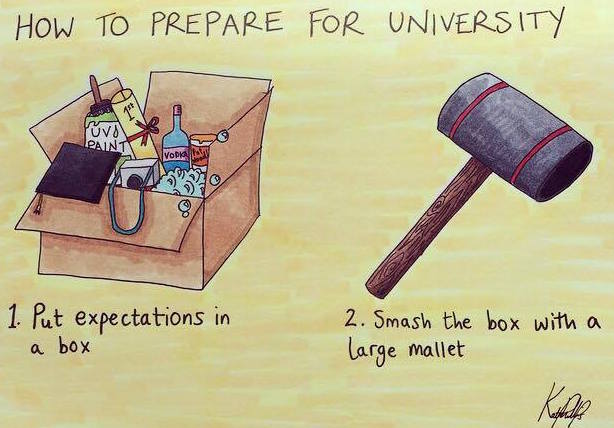
Well, if that wild carefree party life described above matches your expectations as to what you think university will be/require you to live up to, I would like to invite you to place those expectations or ideas of things that are “supposed to happen” in a box, and then smash that box with a fairly large mallet. Nay, lets go wild. With a flipping colossal mallet.

Admittedly, my description of what people envisage before they go to university, really is the experience had by some students (bar the bit about hilarious pranks with roommates called Colin…people called Colin don’t tend to like pranks), but it isn’t the experience that you have to have or feel pressure and stress to be involved with. I would love to say that going to university with a mental health problem is easy, and it is true that some people find the new environment beneficial to recovery, but that doesn’t happen for everyone and it is important to acknowledge that so we can deal with it.

Indeed, when you embark on your university journey whilst dealing with a mental health issues, it is likely that it is not going to be straight forward and you may not have the same experience as everyone else. It isn’t pessimistic to think this way, it is realistic, and being aware of potential difficulties from the outset is a far better way to go about things than charging forth unprepared with deluded optimism, pretending you don’t have mental health issues in hopes that they will just go away. Denying them will not make university any easier and not dealing with them could make difficulties you thought wouldn’t be an issue come as quite a shock. The key is to accept early on that you are going to university in perhaps a different situation to most people (after all it isn’t every student that goes to get a degree whilst fighting an unrelenting mental health gremlin), and that is ok, not something to feel ashamed or guilty about.
You don’t have to pressure yourself to live the “expected” university life of gay abandon if that is something you cannot manage right now…

…That said, I am not trying to tell you all to go to university and allow your mental health issues to take over entirely, as whilst you must acknowledge the issues are there, it is good to challenge yourself and try new things. TO AN EXTENT.
University can provide opportunities for millions of new experiences, and though you may not be able to join in with all the things that are on offer, if there is something you would like to try that challenges your mental health problem in a manageable way, (whether that be going to a society, or saying hello to someone in your accommodation), go for it. I know I avoided all challenges in the early weeks by totally isolating myself (aka I lived under my desk for a month covered in a blanket in fear another student might see me through the peephole in my door and want to say hello), and it made things a hell of a lot worse for me in the long run.
Eventually however, I came out from under my desk, and over the three years I managed to go clubbing/ to a party a few times and live with some lovely girls in a shared house. I didn’t want to do any of these things and was terrified for various OCD, anxiety, ED reasons, but on days where I felt a little stronger, I pushed myself to try and join in with others. Of course it was difficult and I can’t say it always went to plan, but by dipping my toe into the waters just outside of my comfort zone occasionally, I managed to have some fun that I would have missed out on had I kept myself locked away in my rituals and bubble of safety.
What I mean then by saying you should challenge yourself to an extent, is to be aware of your difficulties and know when a challenge is manageable and when one is not. It is great to give scary things a go, but do not blindly leap so far out into the waters of your comfort zone that you end up drowning if you are not ready, just because you feel you should/feel pressured to. It is not weak or boring to say no to things everyone else is doing, so don’t be too hard on yourself. Nobody “fails at life” just because they didn’t manage to go to that foam party with UV paint being splattered into the crowd and needed to spend the night curled up under a blanket for a good cry instead.

It really is key that people remember the fact that when going to university with a mental health issue, you are ill, and have to put as much time into prioritising care for your mental health as you do for prioritising attempts at socialising or writing essays.
For example, if you have an eating disorder, it is important to make time to eat, follow any prescribed meal plan you have and not let things slip just because you are away from people at home who “know”, so if you miss bits nobody will notice. If you have depression and can’t get out of bed for a few days, take care of yourself and keep yourself safe rather than beating yourself up or feeling guilty about it. Prioritise taking your medication, make time to go to the Doctor, seek out mental health services available to you and take up offers of appointments. Equally, inform lecturers of your issues so that they can support you if you miss a lecture or require essay extensions, as although scary, being honest with staff and the support I received in return was vital for my experience.

Most importantly and the most difficult thing to accept though, is to know when enough is enough. It would be great to go to university with mental health problems and for it all to go swimmingly, but if that doesn’t happen and if you going to university has such a dramatic impact on your mental health that you find yourself becoming increasingly unwell, accept that this might not be the right time for you to be there. Allow yourself to drop out or defer until another year. Maybe in a few years time when you are in a better place you can try again, or maybe university just isn’t right for you, but either way it is fine, not a sign of failure, and no degree is worth sacrificing your health for.

There are a million other things I could probably go into when it comes to university and mental health or more specifics in terms of how to deal with it with specific illnesses, but I have waffled on too long and as a basic overview, I guess this is my advice:
It will be hard, it will be scary (much like an old toffee wearing devil horns), but the most important thing is to just try your best, take care of yourself first and never give yourself a hard time for being unable to live the “typical student” lifestyle.

That said if anyone would like more specific information or tips on managing university with certain illnesses or situations, feel free to comment or message me privately and I will do my best to help. To all those going to university in a few short weeks, good luck, I will be thinking of and supporting all of you. Take care.
University

Why Friendship Is Important When Battling A Mental Health Problem

A few months ago I read a quote stating that when “I” became “we”, mental illness became mental wellness. Now at the time I will admit I thought that statement was a nice thing to write on the wall of a psychiatric unit (as in properly artistically written as a message, purposely placed there by the authorities rather than some crazed crayon scrawl of a patient with too much time and too many crayons), but other than that I didn’t believe the statement very much. It felt like one of those things that is all well and good to say like “the sun will come out tomorrow” and other similarly cheesy phrases sung by red headed orphans who have no experience, knowledge or authority in weather forecasting to make any such predictions, but I have to say that over the past few weeks, I have realised that this quote is actually pretty accurate. Okay, it is not flawless, but there is a lot more truth in it than the words of a deluded 10 year old who thinks no outfit is complete without a smile, a very inappropriate thing to wear to a relative’s funeral.

I think I can say on behalf of many, that having a mental health problem is very lonely.
For one thing there is the actual physical distance created by mental illness. Maybe your difficulties restrict your ability to take part in life so you lose touch with friends leading “normal” lives and end up pretty isolated. Maybe you have to take time off work to go into hospital or to have treatment which separates you from the community in which you may have played a part. Maybe you fall out with acquaintances who cannot understand why you can’t “just be normal” when “it’s all in your head” and there is “nothing physically wrong with you”, but the biggest distance is the unseen emotional distance that nobody really talks about. When you are so trapped in thoughts spiralling around in your head, you feel as if you are a million miles away from people who may be sat right beside you, simply because you can’t relate to them in anyway. You watch them laugh, eat or open a door without washing their hands afterwards, you wonder how they do it, and you feel like a lesser underdeveloped species. Furthermore there are the thoughts that come with mental health problems, the low self esteem, feelings that everyone must hate you, the shame and inability to be honest with people incase they think you are crazy, and general emotional detachment from reality.

Both these physical and emotional distances can make you feel like you are the only person in the world who thinks the way you do, and this in turn contributes to the overwhelming sensation of being alone. Don’t get me wrong, being alone is nice sometimes, but when you are feeling alone and trying to battle a mental illness that is hitting you on the head with a mallet every five minutes, it can make your individual feeble attempts to fight against it weak and futile in comparison to its all controlling power. What you need is an army to help you, people on your side to support you in battle, in short, you need to call in the troops to face your demons with you, troops who will preferably bring a large number of rather large mallets with them. For this reason, friendship, community and kindness should never be ignored as ways of treating any disorder, for they are pretty much as important as all the therapy and psychiatric drugs in the world.

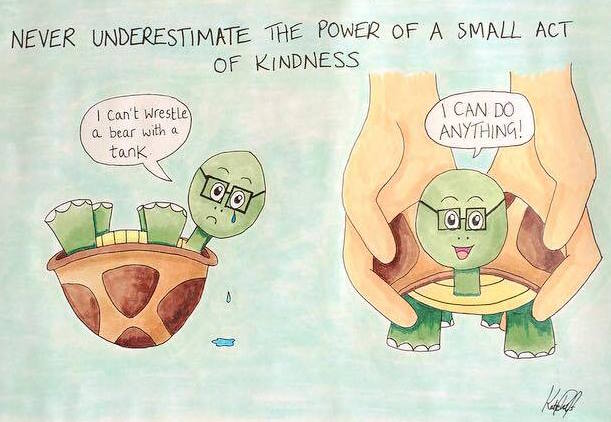
I guess my attitude to all this has changed fairly recently and has been during my time in hospital. When you are stuck in unfamiliar surroundings with unfamiliar people, anyone is going to feel alone, and that in turn made me feel pretty alone with my problems. Fighting them felt futile and every second pointless. It was like I was a tortoise lying upside down on my back waving my legs around, unable to roll back over, yet being asked to wrestle with a lion, a crocodile, three tigers, and a bear who had somehow developed the use of opposable thumbs and managed to get his hands on an armoured tank complete with canon. As I lay there flailing pathetically, I couldn’t help but think “why bother trying to fight this? I can’t stand on my feet let alone battle a pack of vicious animals with the use of military style transport and machinery”. However, I then received a sudden onslaught of kindness both from friends, family and strangers, and it made me wonder whether or not there might actually be a point in giving it my best shot.
When people feel emotions caused by kindness shown by other people, they tend to say things like that they were “touched” and “moved”, but to say that is to vastly underestimate what I felt. Indeed I was so touched I was practically black and blue all over with the force of it, and so moved that one morning I actually found myself several thousand miles away in the sahara desert, where it took staff on the ward a very long time to find me again (they say they the reason for the delay in locating me was a dodgy sat nav but I am suspicious that they got distracted by the abundance of sand and started building castles…nurses love sand castles). I felt like a gigantic boob with the worlds strongest wonderbra supporting me, and though I never imagined anything positive ever coming from feeling like a boob, here I was proved wrong.

Knowing I had all these people supporting me made me feel empowered and suddenly trying to wrestle all those animals seemed a lot less daunting. I had back-up, and if I joined forces with them then my beasts could be overcome. Furthermore, actually engaging in the battle suddenly seemed worthwhile. When flailing on my back (remember the analogy, I am a tortoise here), not only did I see the fight as impossible, but I saw it as something that didn’t matter because I didn’t care what happened to me. I didn’t care if the lion ripped off my head or the bear flattened me to a pancake in his armoured vehicle. To be honest, when I was admitted, I just wanted for it all to be over. With the support I received though, I realised that it wasn’t just my vote that counted in all of this, it wasn’t just a case of me not wanting to fight and that being the end of it. For some bizarre reason, a lot of other people did think it mattered. They did care, and they did want me to win the fight. There were people who didn’t want to see me torn to pieces, there were people rooting for me, people who wanted me around, so when it came to facing a challenge, lunch for example, I couldn’t help but think “Even if I don’t care and don’t want to do this right now, there are a lot of people who do care, and I am not going to let them down, so for now I will do it for them”.

The confirmation in the quote that when “I” becomes “we”, illness becomes wellness and the important message I want to get across here then, is that when it comes to fighting mental health issues, knowing you are not alone in your recovery can be as important as any other aspect of treatment. If you don’t have mental health problems yourself but know someone who does and you want to help but don’t know what to do, helping them doesn’t have to be as hard as you may think. You don’t need to study all the psychology books in the library to try and understand what they are going through. You don’t have to move in with them, rally them each morning with an inspirational speech and skip encouragingly beside them throughout the day. Trust me, just letting a friend know that you are there for them if they need, that you care about their battle and other simple acts of kindness will do more for them than you will ever know.
Alternatively, if you yourself are sitting there reading this and you have mental health problems, feel that nobody understands, are unable to talk to friends and family in real life about your struggles and feel completely alone, know that this is not the case. I may not know you personally, but I can assure you that I care about your battle and I am more than happy to support you in it. When you know you are not alone you gain power, and that is what I want to give to you. I want you all to know that I am one your side, and that I have three tanks with canons so big that those bears and lions don’t stand a chance. If simply knowing that is enough then great, but if you still feel alone and ever want someone who understands, email or message me. I may not give the best advice and hearing from a stranger may not be what you want right now, but if you need a hand to hold in this darkness, I am more than happy to lend you all mine.

Take care everyone.

Tortoise

Demystifying The Mental Health Act…With Penguins

If there is ever a widely reported act of violence on the news orchestrated by a single individual, the majority of the time it will be equally widely reported that said person was mentally ill and most likely “detained under the Mental Health Act”. Understandably then, when people hear of people being detained under the Mental Health Act, they associate the Act with danger. To be fair I can understand why people may jump to this conclusion.
If every time I heard about some violent crime I simultaneously heard that the perpetrator was addicted to coco pops, I may naturally make a connection between violent knife attacks in the street and coco pops. When the coco pops are simply mentioned as a “thing” and there is no explanation to tell me that coco pops are actually little puffs of cocoa sugar covered wheat based cereal with the key ability to turn the milk chocolatey, how am I to know any different?
Therefore, seeing as I am currently “detained” and have recently been given a load of forms explaining the official legal terms of it all, I thought I would do a post to clear up any confusion and to give a purely factual explanation of what the Mental Health Act is, what it does and what it means.
I don’t however want this to turn into some boring school lesson, so to liven it up I am going to provide my explanation via little examples involving “Patricia the penguin”. You know what they say: “When life gives you lemons you make lemonade”, so when life sections you under the Mental Health Act, you use the lump of paperwork dumped on you to make a post explaining what it means, with pictures of penguins to help clear up confusion and reduce mental health stigma. I think that’s the saying anyway…so here goes…

What is the Mental Health Act?: It is a law that enables professionals to admit and detain patients for a compulsory admission to hospital. It doesn’t have to have involved any incidents of violence, much like the consumption of coco pops does not have to be involved with criminal activity. Alas, unlike coco pops, the Mental Health Act does not turn the milk chocolatey, for there is rarely any milk involved.

How does one come to be sectioned under the Mental Health Act?: This is a question that will vary between the sections of the Act and individual circumstances, but as a basic principle a Mental Health Act Assessment will be called by professional people (I am not sure what they are professionally qualified in exactly, but they are usually people holding clipboards, stroking their chins, squinting/looking thoughtful), and they will interview you and ask questions in order to assess your health.

Are there different sections of the Mental Health Act?: What a marvellous question dear reader and one I can respond to with the knowledge that indeed there are several, the differences between which I will explain below with the help of Patricia…

Section Two: Recently, Patricia the penguin has been acting unsafely (skating on thin ice as it were), and is suspected to have a mental illness without the capacity to see that she is putting herself in danger. She is not however diagnosed with one, nor has she been in hospital before, so a group of professional penguin Doctors with specific training may place her under a section two, aka a legal detention to hospital for an assessment of her mental health, in order to establish whether or not she needs treatment. It can last up to 28 days and in that time they aim to discover if she has a mental disorder. Under this law she can be treated against her will if it is deemed in her best interests, and discharge or transfer to another section can happen during, or at the end of the 28 days.

Section Three: A section three is a detention in hospital for treatment, so if Patricia were to be put under this section it would mean that she were well known to hospital services, would have a diagnosis and not require assessment. In the section two admission, the focus would have been more about finding out why Patricia was found skating on thin ice in the middle of nowhere and deciding whether or not her reasons were rational, but for the section three they already know why she was skating in such a reckless way, for she has a diagnosis of “Skating on thin ice syndrome”, a common mental health problem in penguins that requires treatment when severe. On this section Patricia can be held for up to 6 months, but may be discharged sooner, or later if the section is renewed for further treatment. Again under this section it is possible for Patricia to be treated against her will (e.g. in her case, forced to skate on thicker blocks of ice even if she doesn’t want to).

Section Four: Section four is pretty much like a section two in that again it is a detention for a short period of time (72 hours) for an assessment of one’s mental health. This is more commonly used in emergency situations as you only need one special doctor to enact it, unlike a section two which requires two. For example, if Patricia is skating on thin ice at 5am in the middle of the arctic and two doctors with the ability to enact the Mental Health Act have been sent for, but one got lost by turning left at the second igloo (use your imagination kids), the doctor with superior navigation skills could potentially hold Patricia under a section four for 72 hours until the other Doctor hurries up to give his second opinion, which then may result in her being placed on a section two.

Section Five: In this circumstance Patricia has realised she may have skating on thin ice syndrome and has voluntarily admitted herself to hospital. However, twenty minutes into her admission she is overwhelmed with the desire to skate on thin ice and asks to discharge herself. The Doctor does not think this would be a good idea in terms of Patricia’s safety though, so he can put her on a Section 5(2), aka use his “Doctor’s holding power” for up to 72 hours. If there are no doctors available at the time Patricia is asking to leave however, a nurse can enact a section 5(4) which lasts for 6 hours or until a doctor arrives. This section will be used if there aren’t specially qualified doctor/doctors around to enact a section two/four available and can take place in general as well as mental hospitals.

CTO: This isn’t technically another section it is tied up in it all, as a CTO is a community treatment order that it’s possible for someone who has been detained under a section 3 to be discharged on to. Basically, it’s a legally binding order of conditions someone has to meet in order to be allowed to remain in the community (e.g. Patricia must attend weekly appointments/hand in her ice skates, cancel her membership to the local ice rink and take her antifreeze medication.)

And there we have it! Now of course this is a very brief explanation as to what the Mental Health Act is and there are far more details and legal jargon/complexities that go into each section, but hopefully I have demystified The Mental Health Act somewhat, albeit with a very basic, penguin centred outline. Hopefully if you are reading this you will never have to have anything to do with the Mental Health Act personally, but at least you will know what it actually is that is being referred to when an article brings it up in relation to something unpleasant that doesn’t put any effort into explaining the Act itself.

Finally, I just want to let everyone know that if anyone is concerned, I can confirm that Patricia the penguin is merely a fictional character created for the purpose of educating and reducing stigma, so please do not go away and worry about how she is doing after having been through all these sections. As a product of my imagination, I can assure you that Patricia is just fine, and I hope you all are too. Cheerio.

Patricia
(I hope the above picture serves as enough evidence that Patricia is safe and sound/not in any danger. As you can see she is merely enjoying a bowl of coco pops in her safe ice igloo and has not been ice skating, nor will she be doing so in the near future.)

Life Lesson: Running Away From Your Problems Is Not A Good Idea

Last Wednesday (the 22nd of June if you want to put it in your diaries for next year), was my 24th birthday. I anticipated a day of being at home with my family and playing on my new games console, but things did not go exactly to plan, much like the rest of this week. So, for today I wanted to use this post to provide a brief personal update on my current situation, as I feel it will be necessary for you all to know for the next few weeks of blogging delights, and the whole thing has taught me a little lesson I wish to share with you, the lesson being that you cannot run away from your problems. Actually that is a lie, you can run away from your problems very easily, but they will chase after you, and those little buggers can run fairly fast (so fast that I am convinced that they are on steroids and am hereby requesting that “Problems” are not allowed to race at this years olympics).

But I am getting ahead of myself, spouting lessons before I have explained how I learnt them, so let us go back to the beginning, by which I mean my 24th birthday rather than the dawn of time and the dinosaurs.

So, on the 24th of June at 10:30am my dad picked me up from my house to attend my appointment at the hospital and there I sat in the waiting room until my Psychologist arrived. I was taken to be weighed as per usual (a fairly disappointing experience, as the scales were just as they always were, no balloons/ribbons on the scales to celebrate my birthday or anything), and then we went through to talk. Had barely been chatting for five minutes however, before my psychologist presented me with an unexpected birthday present, this year, the very unwelcome surprise of an inpatient bed in hospital due to recent deterioration in my mental health, the bed being for Friday, less than 48 hours away. Now I know that people say that it is the thought that counts, and if anyone offers you a gift for your birthday you should be grateful and say thank you, but suffice it to say that I was not at all impressed with this suggestion, and couldn’t help thinking that my therapist should do any future present shopping for friends and family on amazon. I would rather she had given me a moustache maintenance kit for a gift, and I don’t even have a moustache…yet.

It was all pretty unwanted and sudden in my eyes, not the birthday party I wanted at all, so I left feeling rather deflated, much like the non existent balloon my therapist had failed to put on the scales to add a bit of merriment to weigh day proceedings. Luckily my mum later cheered me up by taking me to the park I used to frequent as a child to play on the swings, a far jollier birthday activity. I then played my new games console all evening, so I managed to have a nice birthday in the end by generally ignoring all worries about hospitals and anything other than which character I wanted to be in Mario Kart. (Incase you are interested I picked Toad because he looks like a mushroom and if you don’t find pleasure in watching a man who looks like a piece of spotted fungi zoom around a racing track throwing bananas, then quite frankly there is no hope for you). Basically, I ran away from my problems and pursued my dreams of winning the grand prix instead.

The next day however I was rudely awaken by my problems (quite literally, my therapist phoned me whilst I was still in bed dreaming of penguins), and she told me once again that I should go into hospital the next day. Again, I refused and got on with my day, but a little later I got another phone call that suggested the problems I was avoiding were rapidly gaining on me, this time the notification of a Mental Health Act assessment later that afternoon. My parents have since told me many a time, that it would have been the best idea to just remain calm and attend, but as a natural born problem avoider without marbles, I decided to do the next best thing, aka run away on bus and then a train to Exeter. Do I have family or friends in Exeter you ask? No. Did I have a place to stay or plan in Exeter at all you cry? No. I quite simply had no idea what I was doing other than getting away from the situation and possible hospitalisation to be re-fed back in Bristol. Unfortunately things got a little messy around this point, and though I caught the train and found myself hurtling across the English countryside at 65mph, the mess I had got myself in was hurtling right alongside (not even on a train, the mess was literally running alongside the track that fast. Steroids I tell you. STEROIDS). I won’t bore you all with the details, but in summary, my problems burst on the train to seize me no matter how hard I tried to deny any of it was happening, and a few hours later they had rudely dragged me back to Bristol where I was sectioned under section three of the Mental Health Act and admitted to an eating disorders hospital right away with none of the things I would have needed to pack. All I had in my bag was my wallet and my train tickets to Exeter, which I had well and truly learnt were of no use in my current predicament.

So, that pretty much brings me to my present situation, legally detained in hospital, unsure of how long I will be here and frightened in relation to every aspect of my life. Worst of all, the hospital in which I am detained doesn’t even have wifi (I am officially back in the stone age), and I will admit that one of my worries when I woke up the next day was you, my dear little internet blog readers. Though a small crowd I admit, you are in all honesty a key motivation for me to keep kicking ass as much as I can. I have no control of my personal life at the moment, but I still have my blog and writing to escape to so that is what I am focusing on for now to get me through. That said, without wifi posting this is going to be an almighty challenge, so if it is Monday and you are reading this then another lesson we will have learnt from this week is that I am a technological genius who is more educated in the ways of computer than Bill Gates.
Thankfully, as one positive to brighten up this rather bleak post, I do at least have some of my things in my hospital room now, as my mother was kind enough to bring the basics in, and it is always nice to have your own toothbrush and teddies when trapped under stressful circumstances. I guess that is yet another lesson right there: never underestimate the power and importance of clean teeth and something to cuddle.

I really hope you can all forgive me for this slightly indulgent post that is all about my personal mental health and situation, rather than stigma reducing information or any advice I can offer, but to be fair this is my birthday week, and if you can’t be a bit indulgent and have a ramble about yourself on your birthday then when can you? I promise normal/more interesting blogging will resume next week when I have settled in and know what is going on in my life, but for now I hope you can all at least take away the main lesson I have learnt and point of this post that in some ways we can all benefit from it, that being that when it comes to mental health issues and things generally in life, you cannot run away from your problems as they will always catch up with you eventually, (even if you are on a train to Exeter).

Orange.jpg

(For the purpose of this picture I have envisaged my problems as a giant orange with a satsuma for a nose. This is not because of any symbolic significance related to oranges or their complex segmented form, it is simply because I really do not like oranges and never miss an opportunity to draw them in a bad light).


Why Being Suicidal Is Not About Wanting To Die

Before reading this post please note that it involves trying to explain what being suicidal feels like, so if there is ANY risk of that triggering you in any way please click away now.

Suicide is a difficult topic to talk about because there are so many feelings that go alongside it. For some it can be immoral, too upsetting, something “selfish” people do, too sensitive, too dark, maybe even something that people avoid talking about because it is too difficult to understand why someone would commit such an act. For all of these valid and understandable reasons, suicide is not often talked about, it is a bit of a taboo, especially for people who find themselves plagued by suicidal thoughts on a daily basis.
To say you feel suicidal sounds melodramatic and “actually mad”, so I feel that a lot of people who feel that way keep quiet because they either don’t want the judgement/stigma that comes with honesty, or because they don’t want to be thought of as “crazy” and locked up in some imagined padded cell with a straitjacket and men in white coats. However I think that if more people were honest and able to openly talk about suicidal thoughts without any stigma, maybe more people would come forward to discuss how they feel, which could then save lives. Before this can happen though, I think more people need to understand what people mean when they say they are suicidal, rather than jumping to the conclusion that the person is insane and simply wants to die.

As it happens, or at least in my case, when I have suicidal thoughts/ideations/damn annoying brain intrusions that I wish would kindly leave immediately (that is the official medical term), it is nothing about wanting to die. Obviously I cannot speak for everyone who has ever thought about suicide, but from people I have spoken to, I have found a common ground in that a fair amount don’t exactly want anything. For many, suicide is actually more about not wanting something.

Imagine being on one of those step machines in the gym. I don’t know what they are called, but I am talking about the thing that is kind of like a treadmill but with steps instead of flat space, so you can effectively walk up a constant stream of stairs without actually going anywhere (what a productive way to spend your time!).
Imagine you have been on that same step machine for hours, constantly walking up stairs that take you nowhere. Understandably, after several hours you will be exhausted, fed up, in physical pain and unsure as to whether you can continue. There is however no off button on this machine (a severe design flaw), and you cannot get off it without falling into a giant tank of hungry sharks, poisonous jellyfish and squid with tentacles poised to strangle you the moment you hit the water (please note this is not often the case when it comes to machines in your local gym, but for the sake of example just humour me).
You don’t want to keep walking, but you certainly don’t want to fall into the lagoon of doom, so you force yourself to persevere in the hopes that if you keep pushing, eventually the machine will stop and you will be free. A week passes. The machine is still going, you are in agony, yet you persist. 9 months pass. You have been walking up these seemingly pointless stairs for as long as it take for a human to be created and born and you are in pain that cannot be described. You are worn out, spent of all your best efforts, and are the walking definition of “at the end of one’s tether”. You then look down and find yourself contemplating the only way you can see out of the situation, the lagoon of dooSuicide Squidm which is no less terrifying than the first day you found yourself on this godforsaken machine. Obviously you do not want to jump into the water, (you can’t swim and have a severe phobia of marine life), but after 9 months on this damn machine, the sharks and jellyfish look like the only/best option. When thinking about whether or not to jump, you are not thinking about what you want to do, you are thinking about getting away from the pain coursing through your body
, opting for the lesser of two evils, even if the evil hovering below you is a giant furious squid with a monocle (the squid isn’t actually wearing a monocle but this post is getting a bit heavy and I am trying to lighten the mood. I want this post to inform not drag readers into a bottomless depression).

To me, that is what feeling suicidal feels like, it isn’t a case of wanting to die, it is a case of
not feeling able to carry on. That said, the analogy is not perfect and I AM NOT SAYING THAT SOMETIMES SUICIDE IS THE ONLY OPTION. My explanation is HOW IT FEELS to be suicidal as opposed to the reality.

If the person reading this is well aware of the pain of suicidal thoughts, I want you to know that the reality of the situation is very different. Little do you know that whilst you are on that machine, helicopters and cranes are on the way to rescue you, the machine is going to run out of electricity, you are not going to be walking in that pain forever and there is always a way out or an escape even if you can’t see it. Things don’t stay the same forever, even the Spice Girls broke up eventually and we all thought that was a bond that would never be broken. Machines and depression or suicidal thoughts cannot survive into infinity and whilst you fight your way through I can guarantee there are a million people out there who want nothing more than to help you off that machine. It may not be today or tomorrow but some day a giant bird is going to appear with a rescue team on its back and you are going to have a way out that doesn’t involve the lagoon of doom or actual suicide. The important thing, is that you are alive to see that day, and hopefully ride off on that giant bird/life without these thoughts, that when on the stepper you never thought was possible.
If you can relate to this post in any way, please know that I am marching up those seemingly endless stairs alongside you, not knowing what to do but just hoping that one day that bird is going to come and all of this pain will be a distant memory.
This post is to explain how it FEELS to be suicidal to people who may not understand, but if you do understand please know that the feelings are not reality. They can’t be. Squid don’t even wear monocles.

Seriously though, If you are struggling with suicidal thoughts please tell someone right away, whether that be a friend, stranger on a helpline (you can call Samaritans on 116 123) or even go to A&E. Just don’t be afraid of talking about it, because staying silent is ultimately a hell of a lot more dangerous.

Take care peeps x

Suicide bird