Personally, this Halloween I am dressing up as a penguin shaped pumpkin and would advise anyone out there to do the same. However, if there is anyone out there determined to dress as someone with mental health problems, I thought I would help you out a bit with this handy video…
Awareness
An Explanation Of Invisible OCD Rituals
When most people imagine someone with OCD carrying out a ritual, they probably picture them visually carrying the ritual out in the “real world”. Maybe some will picture a person repeatedly tapping a light switch, arranging books or washing their hands, but it is unlikely that the person pictured will simply be standing there with no obvious signs of ritualistic activity.
However, many people with OCD actually have rituals that can be carried out invisibly, and this is a side to OCD that I feel needs more discussion/awareness raised, partly to help others understand the condition better, but partly to help sufferers who do not realise that what they are experiencing is actually a form of OCD that can be treated.
Now I have started to write this blog post I have realised just how hard trying to explain a mental ritual is to people who may not have had them themselves (damn it past Katie why did you have this as an idea for a blog).
If trying to give a rough idea in terms of my OCD though, my personal thought rituals generally involve things like compulsively picturing certain events or people, thinking the same words a certain number of times, having to remember something in exact detail or ritualistic blinking (which I suppose isn’t really a thought ritual as if you know what I am doing you can physically see it, but in most circumstances people don’t notice and thus I count it as one of the lesser known invisible sides to the illness. Even when people do notice I am fairly good at covering it up anyway. You would not believe the number of times people have asked if I am ok because I am flapping my eyelids like the wings of a hummingbird and I have had to pretend I had an eyelash. I used to feel very bad saying this as I don’t like lying, but recently the guilt has gone as I realised that it isn’t actually a lie. It is indeed a true fact that I have eyelashes…just not in the specific eye location implied by my blinking…God this is a long set of brackets…sorry about that…I will close them now…actually wait…no it is ok that was all I had to say about blinking…today at least).
Some of these thought rituals mentioned above are fairly straightforward, as in the “repeating a certain thought over and over”. Okay it can take a long time but it is easy to understand and explain to professionals as a symptom. This is not however the case with all thought rituals, and in order to give some impression of just how complex they can become, I thought I would explain a specifically long and complicated one of mine (if you are able to follow this next bit and gain any sense from it then congratulations, you are a genius, please apply to Mensa immediately).
So, probably the most complex of my rituals is one that I carry out every night before I go to sleep in order to “keep my friends and family safe” (though I am of course aware that rationally there is no way that my thoughts prior to the land of nod are capable of such safeguarding. Nevertheless I still carry them out every evening without fail…GAH!)
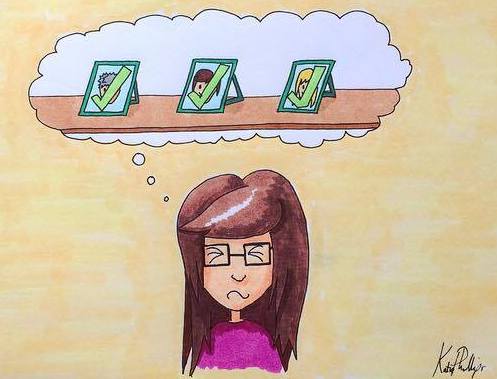
The start of the ritual involves picturing a long mantlepiece (it is made of high quality mahogany in case you are interested), and it is lined with photo frames, each one containing the face of a loved one that I wish to protect. Over the years the photos of the people in these frames have changed as people have come and gone from my life, but it is rare that a picture is removed and more common for an extra one to randomly appear when someone becomes particularly special to me (bear in mind this is a very long mantlepiece that can hold an infinite number of frames. It is a nightmare to dust.)
Once all the pictures are imagined in their neat little line, the next step is to imagine a paintbrush with green paint on the end drawing a tick over the face of each person to confirm them as safe, much like an attendance sheet register thing that you have in school. What must not happen is that I picture a red cross being painted over each face. It sounds easy enough, after all they are my thoughts so surely I can think what I want (ha!), but it is very much like that trick when people ask you to imagine a scenario and not to imagine a white elephant, a statement after which you can think of little other than a trunked creature looming in the forefront of your mind. Once the green tick is imagined on the person’s face I then have to move on to the next picture and so on until all of the faces are adorned with a flourish of bright jade acrylic. However, if during this process one of the pictures goes wrong (aka they get a red cross), then I have to start the entire thing again from photo one. Even if I finally manage a line of perfect ticks though, the ritual is not over, as then I have to imagine staring at all these approved photographs for 100 counts without imagining a gust of wind blowing any of the pictures over which is incredibly stressful as if such a wind occurs I have to whip out the paint brush and start all over again. That little explanation from the painting of the green ticks is step ONE of this thought ritual.
There are ten steps overall. TEN.
Rest assured, I will not elaborate on the next nine steps as I fear I would be here all day. No matter what step I get to however, if there are any mistakes I am sent back to step one and hopefully this explains somewhat the difficulty, complexity and time consuming nature of rituals that may not be visible like those in which I wash my hands multiple times. I realise it probably sounds a bit weird to say that I get stressed and upset over imaginary breezes blowing imaginary photo frames off an imaginary mantlepiece, but if those breezes come and if those pictures fall then I fear I will put everyone I have ever loved in danger due to my negligence, an understandably scary thought for anyone.
You are probably wondering how on earth I concocted such ridiculously long mental routines, yet if you were to ask me how they appeared I honestly couldn’t tell you. They didn’t exactly appear overnight, rather they developed over time in a gradual process I cannot remember the beginning of. That said, if I had to pin the origin of my mental rituals it would probably be my first hospital admission to a psychiatric unit over ten years ago. With most people, OCD tends to evolve and morph over time as the person’s life and situation changes and it is often a dramatic change in environment or situation (like suddenly being inpatient in hospital), that can cause rituals to flick on stealth mode and turn invisible. Before my first hospital admission, all of my rituals were visible and involved things like showering for hours on end or repeatedly washing my hands. In hospital however, none of these rituals were possible as I was physically locked out of my bathroom and had to ask for permission each time I needed to use it, at which point I would be supervised and stopped from engaging in any behaviours. Now, on the surface, you would think this cured the problem. True, I was no longer showering for hours every day, but that wasn’t because I didn’t have OCD anymore, it was because I was physically incapable of getting to the shower despite best efforts (turns out I am rubbish at picking locks/kicking down doors of psychiatric unit shower rooms. I would make a poor criminal.)
By being physically locked away from the equipment needed to do my usual rituals then, my rituals changed and adapted. The OCD was too strong to just disappear at the first hurdle in the road and instead my compulsive behaviours became located in areas nobody could lock me out of, areas nobody could bar my access too, those areas being found in my own head (just left of imagination next to the frontal lobe to be specific).
The reason this invisible kind of thought ritual OCD is less talked about than its more apparent variants is probably because of how difficult it is to explain (let alone understand…seriously if you are following this get on that Mensa thing). Nevertheless, difficult or not I think it is a really important topic to raise awareness of as like I said near the start, some people may be suffering from OCD in this way and not really aware of it. I have been in treatment for years so when aspects of my OCD became internal I knew immediately what it was, yet I am sure there will be people out there struggling who never knew that this was a thing. Perhaps there are people out there silently suffering, in distress as they find themselves having to paint ticks and avoid imaginary gales without having any idea of why or how to stop it. Had I no knowledge of OCD and were I experiencing such things there is a good chance I wouldn’t tell anyone because even I can admit that thought rituals sound a bit “crazy” and are not something you would want to bring up voluntarily or admit to, especially if you didn’t know anyone else felt the same. Maybe people with thought rituals don’t even realise it is OCD because they think OCD is washing, and it is for those people (as well as any other lovely people reading this of course) that I have written this post.
If you are struggling with compulsively carrying out intricate thought patterns that cause distress if not performed correctly, you certainly are not alone and it doesn’t mean you are crazy. Obviously I cannot diagnose anyone online, but if you relate to this post there is a good chance that what you are struggling with is an invisible form of OCD. That probably sounds scary if you haven’t ever considered yourself as a person with mental illness in need of therapy, but hopefully it will provide some comfort knowing that your struggles are part of an illness that can be treated. It is not something to be suffered in silence even if your routines are performed in such a manner and I would urge anyone out there relating to this to go to the GP and ask for help. If they have any awareness of mental health issues they will NOT think you are “weird”, they will understand that this is a common issue for OCD sufferers and hopefully by speaking out you will be able to get the help you need. Also if there are any GPs out there or students training in medicine, maybe this post could help you identify these symptoms and help someone in the future. Either way I really think invisible thought OCD rituals need more discussion. The more we are aware of OCD, the more we can understand and most importantly of all, defeat it.
Take care everyone x
“Sometimes I Am Pleased I’ve Got An Eating Disorder” – My Response to Liz Jones
Ok after this I promise I won’t bother you all with another post again…until Monday…Ahem…
Nevertheless I just had to post a little video again today because it is time relative to an article I felt the need to respond to that was published last weekend…HAVE A GREAT DAY x
Why Gyms Need To Be More Aware Of People With Eating Disorders
Recently, I have noticed that gyms have been popping up all over the place, and it is getting to the point where I would not be surprised if I went down to the bottom of my garden one day to find that a new branch had set one up in my shed between the empty plant pots and the lawn mower. Obviously I understand the benefits of the gym, getting a bit of exercise is important to keep healthy, and it is nice to have a place that allows you to look sweaty and tired whilst exercising without the potential judgement one would receive were you to start doing press ups in the cereal aisle at your local supermarket. The problem is that while gyms advocate health and fitness, there is often far too much emphasis on the idea that both are achieved by losing weight, which of course, it isn’t. For some people maybe, but the generalisation that weight loss will improve your health is a dangerous one, especially for people with eating disorders, and in my opinion it needs to be addressed by gyms immediately.
When I first joined my local gym I was 16 years old and in my preliminary session with a member of staff I stated that my goal was to lose weight. This member of staff then took my height, weight, and calculated my BMI to discover a number that I will not post specifically, but let’s just say it was towards the lower end of healthy. Despite this information, the personal trainer happily agreed to set me up with a meal plan and exercise regime to achieve my weight loss goals, without any debate or suggestion that my intention to “shed the pounds” was unnecessary and actually detrimental in terms of fitness.
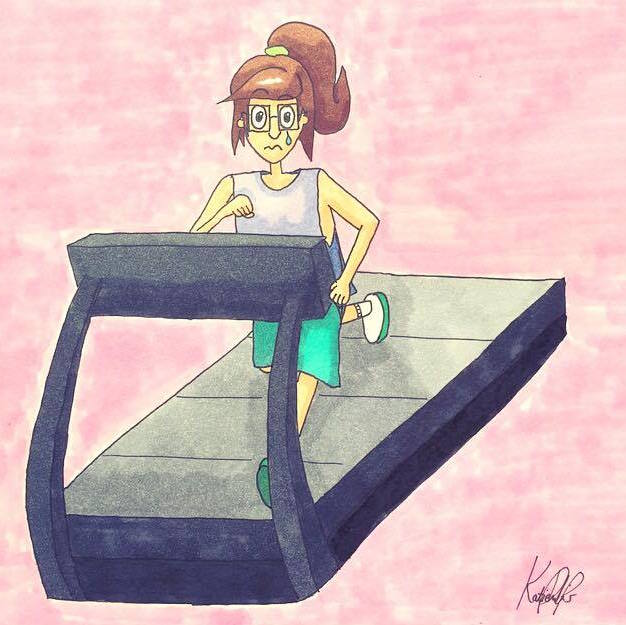
A few months after that preliminary session, I was admitted to hospital on an eating disorders program where I stayed for ten months, gaining back all the weight I had lost on the treadmill.
The day I was healthy and had been discharged, I went back to the gym, not with the intention of losing this time, merely “toning” my new healthy body, but soon enough it became an obsession again and I was there all the time exercising until I was about to pass out. One morning I went to the gym at 6am, the moment they opened. By 9am I had been admitted to hospital again due to my eating disorder and exercise addiction, which combined had made me rather underweight and not “fit” in any sense of the word (unless your sense of the word fit is that it means “to be a weak, dizzy mess on the brink of collapse”, in which case I was REALLY fit). A mere three days before that day, I had been approached by a personal trainer who offered to work with me and help me to lose weight.
Annoyingly, this being a blog post constructed of words rather than expressions displayed on my spectacular visage, you can’t physically see me right now, but as you read that last sentence, please just picture me throwing my hands up in despair and shaking my head at the ridiculousness of that situation.
Now, I understand that personal responsibility for one’s self and one’s actions is important. After all, gyms cannot be asked to dictate the lives of their members, weigh them upon entry, demand they get off the treadmill if they didn’t finish their bran flakes that morning, and cook them a hearty balanced stew for dinner each night (although I would not be adverse to any of these ideas), but when an eating disorder really takes over someone’s mind, that person can have no control, be unable to take responsibility for their own safety, and need people to step in. In part, this is because they may not realise that they are even ill, denial and distorted perceptions being a massive issue in people with eating disorders. The other and in my opinion bigger issue that can result in a lack of control over one’s behaviour however, is the feeling of a lack of permission to look after oneself.
Every time I went to the gym I was terrified and certainly didn’t want to be there at all. I had been told multiple times by doctors, my eating disorder service, nurses in A&E, that I could have a heart attack at any moment, but not going simply wasn’t an option. My head told me I wasn’t allowed to make that decision.
If I pleaded with the eating disorder that I was scared and couldn’t go to the gym, it would scream so relentlessly that I felt I had no choice but to give in, and I would end up on that treadmill whether I wanted to be or not.
Furthermore, the fact that I was continually let into the gym despite being so underweight almost supported the voice of the eating disorder. I had doctors telling me I was physically unwell and looked awful, but when I went to the gym and started rowing on one of those damn machines that is nothing like a real boat experience whatsoever (6 years at that gym and I didn’t see a single duckling), nobody batted an eyelid, so I assumed the doctors were lying and that I must look fine. If I was clearly “so underweight”, then why on earth would a gym let me in and offer me a personal trainer to lose more flab than I had already? Surely this meant they thought I was overweight too? Not saying anything to people who are clearly unwell is one thing, but asking if they want help in making themselves even more unwell in the interest of “fitness” just to make money is a whole new kettle of fish, a very dangerous hot kettle with sharks in it who are able to withstand shockingly high temperatures.
What’s worse is that my experience is by no means unusual or a sign that I clearly had a bad gym, as it is something that happens to loads of people in loads of gyms all across the country.
Now again, I am not asking gyms to approach skinny people in the gym, catch them with a giant net and fling them violently out of the window. Such a code of practice would be futile due to the important fact I have stated in previous posts, that not everyone who is skinny has an eating disorder and not everyone with an eating disorder is skinny. Indeed, someone could be severely unwell, on the brink of death or a heart attack and look a healthy weight or overweight. What I am asking for, is personal trainers and other staff to be made more aware of people with eating disorders, and how to support or help them when they are in a destructive relationship with the gym. They need to be able to spot various symptoms or unusual behaviours, be trained to have a grasp of eating disorders and exercise addictions, or be aware of someone’s motivations in losing weight if there are signs of any underhand eating disorder suspiciousness going on.
At the very least, if they measure someone and know someone is already a healthy weight or underweight, they shouldn’t give them a weight loss meal plan or ask if they want to pay you to help them shed the non existent rolls of fat they are complaining about just to make some cash in the name of “fitness”. When someone has an eating disorder, such suggestions are more like offers to assist in suicide for the price of £20 an hour. BARGAIN.
I know that it is a massive pain to say gyms have to spend extra money on funding training, especially when it may be that such training may be irrelevant for the majority of the time when it comes to healthy members.
Nevertheless, I would still say that it is less of a pain to be aware of sufferers and deal with them whilst having slightly lower profits, than to have to deal with a law suit and a hell of a lot of guilt when someone who clearly shouldn’t be exercising dies on one of the treadmills. I may not be a personal trainer, but that certainly doesn’t sound like fitness to me.
Unveiling The Secrets Of Life As A Mental Health Nurse
As you are probably all aware, this blog is a blog about mental health.
If you weren’t aware and thought this was actually a blog offering gardening tips, then I am sorry to disappoint you, but I really have no advice to offer in that department so you may want to look elsewhere for tips. All I know is that you should water your plants…but not too much…and plants need sunlight…but then some like to be in cool dark cupboards…yeah like I said I really am not qualified or experienced as a gardener…ANYWAY, browsing the titles of my current collection of posts I have noticed that most of them are aimed at people with mental health problems, but what about a post centred around the people who spend their lives trying to treat those without marbles? How do they feel about working with the mentally ill? What do they like about the job and which parts make them wish they had steered clear of the anxious and the depressed inhabitants of this godforsaken planet, to pursue a career in fish mongering instead? What makes them dream of swapping therapy for cod and medication side effects for a nice piece of haddock? What advice do they have for people thinking about becoming a mental health professional and how does one go about following that dream? If the mentally ill are plants, who are the gardeners providing enough warmth for seed germination and growth? (Please note I just used the word germination…that is a gardening term…maybe I am more qualified in that department than I realised). Well, if you have wanted to know the answers to any of these questions and even if you haven’t, I am here today to give them to you anyway in a hard hitting interview with a real, qualified mental health nurse working on the ward in which I currently reside. Prepare yourself for the secrets of the mental health professionals, the story behind the shift work and a very confused nurse wondering what on earth I am talking about…
LIGHTS GO UP.
[The nurse and I are seated in blue chairs in a place known as “the quiet room”. The conversation begins whilst the sound of the cleaner mopping slops rhythmically in the background]
Me: Hello Nurse Gertrude Potatobucket, thank you so much for joining me today for this interview.
Gertrude Potatobucket: What interview? Who is Gertrude Potatobucket?
Me: This interview. I want to know about the life of a mental health nurse for an article on my blog. Also you are Gertrude Potatobucket for the duration of this interaction because I am hiding your real name in the interest of confidentiality, so you can be brutally honest as nobody will know your true identity.
GP: I will agree to the interview but can’t I pick another name? Why does it have to be Gertrude Potatobucket? That sounds ridiculous.
Me: I will have you know it is not at all ridiculous but is an underused name that deserves more recognition, so no, you cannot pick an alternative. Anyway, I’m supposed to be the one asking questions here so please just accept your new identity and lets get to the good stuff.
GP: Katie I really think…
Me: [In a loud and interrupting manner] QUESTION ONE. WHAT DOES BEING A MENTAL HEALTH NURSE ENTAIL?
GP: [Sighs…there is a long pause during which the sound of mopping appears to increase in volume until Nurse Potatobucket realises that she is going to take part in an interview whether she likes it or not and gets on with answering the question at hand]. The role of a mental health nurse is different depending on what kind of service you are working for but in terms of my responsibilities on this Eating Disorder Unit, I am in charge of co-ordinating health care assistants on shift, running support groups, working with patients in 1:1 sessions, supporting them at meal times and I am in charge of handing out any medication prescribed by Doctors or psychiatrists.
Me: What a busy bee you are! I can almost hear you buzzing, your face is practically aglow with black and yellow stripes. So tell me Gertrude, how did you earn such responsibility? How does one go about becoming a mental health nurse? What training is required?
GP: To be a mental health nurse you need to have at least 5 GCSE’s including maths, English and Science and then go to university for three years to study mental health nursing. You don’t have to go to university to work in mental health though. If someone wanted to be a Health Care Assistant they would need to have something called a care certificate, but it is possible to get a job as an HCA without any official training. If someone has experience in mental health and does a good interview for a job, they may be offered a position and then have the opportunity to do the care certificate whilst working.
Me: Well to qualify alone sounds like a lot of fun but how about the job itself? What would you say is the best thing about being a mental health nurse?
GP: Supporting people and helping them to make positive changes in their lives.
Me: How nice. I don’t want to paint a misleadingly fluffy picture about the job though so tell me, what is the worst thing about being a mental health nurse?
GP: You see some really sad and upsetting stuff. Also shift work can be difficult as you never have a fixed schedule or routine and can be working at day or night depending on your rota. That said I know that “Bertha Potatonose” likes shift work as it enables her to be flexible when looking after her children, so it is different for everyone. Oh God I have just used her real name, can you cut that bit out?
Me: No need, I will simply hide her identity by replacing her real name with Bertha Potatonose.
GP: What is it with you using the word potato in fake surnames?…
Me: [Even louder and more interrupting than the first time the interviewee started to question the interviewer] QUESTION FIVE: HOW DOES BEING A MENTAL HEALTH NURSE AFFECT YOUR DAILY LIFE AND WHAT ADVICE WOULD YOU GIVE TO SOMEONE WHO WANTED TO BE A MENTAL HEALTH NURSE?
GP: [Sighs. Despair at the situation is visible. The cleaner is still mopping in background]. First off I would advise someone to get some life experience or experience as an HCA. Secondly I would say that in terms of daily life you really need to learn to leave work at work and look out for your own wellbeing at home. You can’t look after someone else unless you have first looked after yourself.
Me: Does this mean there any people then that you would advise to avoid looking into being a mental health nurse? Are there any people you feel would be particularly unsuited to the role?
GP: No. It can be a difficult job but anyone can be a mental health nurse. Different people bring different life experiences, skills and character to the job and I think that is important. Mental illnesses don’t all fit into a neat box and neither do the people who are able to be great Mental Health Nurses.
Me: Inspiring. Truly inspiring.
Now Ms Potatobucket, I know that the people at home often worry when speaking to a mental health professional in candid honesty about their condition that they will be thought of as “crazy” or “weird”. Answer me honestly, do mental health nurses ever judge patients regarding what they say in a session?
GP: No, there is never any judgement. All I feel towards people talking about their difficulties is empathy and I want to show compassion towards the difficult time they are having in life.
Me: Well that is a relief. I am sure we will all rest easier in our beds tonight knowing that we can spill our inner most thoughts without fear of being thought to be “weird”. In addition to worries like that, a lot of people in treatment out there may also be struggling at the moment and feeling like things will never get better. Do you think recovery from a mental illness is ever really possible?
GP: Definitely. All mental health nurses hold the hope and belief that the people they are treating can get to a better place. I think everyone is capable of building the strength and determination not to let their mental health problem rule them forever, and in learning skills they can gain confidence they may not have had initially in fighting their issues.
Me: Fascinating stuff Gertrude. Truly fascinating. Now finally. The question everyone at home has been waiting for and the most important piece of information in all of this. Tell me, has being a mental health nurse in any way altered the opinion you hold with regard to penguins?
GP: What does that have to do with working in mental health?
Me: [Incandescent with rage at being asked a third question during the interview] MS POTATOBUCKET
GP: Oh for goodness sake ok, yes, being a mental health nurse has given me a new found appreciation for penguins.
Me: Aha! Just as I expected! Gosh! Looking at my watch it appears we are all out of time! Thank you so much for answering these questions Nurse Potatobucket. Your honesty and words will touch millions. On behalf of all my readers please know that we are eternally grateful.
GP: Can I go now?
Me: Absolutely
[Interview ends. The sound of mopping in the background has stopped. Upon leaving the room the cleaner is nowhere to be found and only a mop lies in the corridor. The cleaner has not been seen since…]
FADE TO BLACK
Well there you have it! The hard nitty gritty truth about what it is like to work as a Mental Health nurse, how to become one, and how such a career can affect one’s opinion on monochrome birds who refuse to comply with society’s expectations and use their wings to fly. I really hope that this helped people out there either if they are thinking about becoming a Mental Health Professional or those in treatment worrying about what carers in an inpatient setting may be thinking. It appears there is no judgement when it comes to working with the marble-less hoards and no matter how it feels at the time, it seems there is always hope and the potential to recover.
Now if you don’t mind me I am going to abandon my job as journalist for the day and turn to a little detective work. I really am getting worried about the case of the mysteriously disappearing cleaner that took place during this interview…any witness statements would be appreciated in the comments.
I will speak to you all next Monday, take care x

Delayed Maturity In People With Mental Health Problems
In a few weeks time, my parents are flying to Malaysia for a fortnight’s holiday whilst I stay in my slightly less exotic summer holiday home of the English psychiatric unit (note I say only say slightly less exotic. Malaysia may have rainforests and tropical climates but I will have you know we have pineapple juice in the fridge here as a breakfast beverage option). The prospect of two weeks without my Mum and Dad here is terrifying. As a 24 year old I feel I should be past such anxiety when separated from my parents, but I can’t help it. In terms of maturity, I am ridiculously behind other people my age, in terms of development into an adult (whatever the hell that is).
Rationally, I suppose most people would miss their parents whilst they go galavanting off around the world and I know nobody feels prepared for becoming an adult. A lot of my friends for example are a rather taken aback with things like moving out or paying electricity bills, and like me often very much feel like retreating into a blanket fort to watch a Disney film. That said, because of all this mental health nonsense, I feel I am so extremely behind that it is as if I am in a giant swimming pool with all the other people my age, and that I am the only one who still has arm bands on. Heck I am not even in the pool with them, I am sitting in a paddling pool on the outside, splashing about and wondering how on earth these people are performing the front crawl with such ease.
This feeling of being behind my peers in terms of growing up used to worry me a lot, but “delayed mental ageing” or “stunted development” is very common in people with mental health problems. I have no idea why exactly this is, but if I were to guess I would say it was because when you are riddled with an illness of the mind, you kind of step out of the world and get lost/trapped inside of your head. Your neuroses and anxieties become your universe, they consume your entire being in terms of thoughts and behaviour, and it is very easy to forget that there is any other planet out there at all.
With things like OCD, your world is your rituals, every action requiring such concentration and focus that you have no senses spare to be receptive to anything else. When you are depressed you are too busy trying to motivate yourself to keep breathing to have time for real life stuff, and then there are eating disorders where your entire universe is food. No wonder then that people often describe people with severe mental health problems as “totally out of it”. Sometimes, they really are holidaying on the outward planet of insanity with whatever anxieties that involves, and in being this way they miss a lot of what is really happening in the real world, not because they are self obsessed, but because they are not there.
This wouldn’t be as big an issue as it is, and it wouldn’t potentially “stunt” or delay development and maturity at all if the world would just stop spinning whilst us marble-less creatures were otherwise engaged. If the world waited, people could just get better and pick up their lives and development from where they left off before the insanity creatures whisked them away, but that is the problem. The world doesn’t stop turning (sometimes Earth can be so inconsiderate). Even if you are living on a different planet, time in the real world still passes, so when you try to recover and return to normality it can be quite a shock to the system.
This shock is a really difficult thing to explain to people who haven’t experienced it, so in classic Born without Marbles style I am going to try to make some sense of it via some kind of analogy. The analogy? That coming back into the real world after being trapped in a mental illness is sort of like the feeling you get when you watch a TV program for several months, miss a few years, then try to pick it up again only to be baffled and confused as to what on earth is going on.
In this analogy, sane people have been watching a daily television show, lets call it “The Life and Times of Percy The Penguin”, a soap opera style show about a community of penguins living in the Arctic (think Coronation Street with more waddling). The sane people have never missed an episode, so they have seen the story grow over the years, and learnt things about the world that have changed and enhanced their lives. Each episode actually helps people develop in life.
Now, the person with mental health problems starts off watching this program too, but then, just in the middle of an episode in which Percy is getting married to his childhood sweetheart Patricia, the mental illness kicks in and whisks them to a world where there are no televisions. Whilst they have the illness they are trapped in this other world, anxious, alone, repeating rituals, hearing voices and experiencing a whole other load of things that most people never do. Despite their absence however, in the real world, the television show continues on without them.
Say they are then stuck in this mental world for a decade but then finally break free, back to reality. One may assume that they can join back in watching the program, understanding life in exactly the same way as everyone else, fitting in just like before, but unfortunately that is not the case.
They turn on the TV and are immediately confused by the image that confronts them on the screen. Where the hell is Patricia they wonder? Why does Percy have a wooden flipper? Who is this Polly he is married too? Why are Percy and Polly crouching in a bunker looking terrified and why have all the other penguins in the village been replaced by seals? It makes no sense.
To everyone else the answers are obvious. By staying in the real world they never missed an episode and have grown up over the years alongside the program, their understanding and knowledge continuing to grow as the program progressed. They are all well aware of the fact that in “The Life and Times of Percy the Penguin”, Patricia actually turned out to be an evil seal in disguise who ripped Percy’s fin off in the middle of their wedding, resulting in the rather splinter ridden replacement. They all saw every other penguin in the village reveal themselves to be evil seals working for Patricia, with the only real penguin other than Percy in the area being a hidden gem named Polly, who Percy then fell in love with, married, and is now hiding in an ice cave with planning how on earth the pair will overcome the wrath of Patricia the dictator and her fin flapping minions. The mentally ill person can try and catch up, scrabble around for any video tapes or use Google to find out all the things they have missed, but it isn’t the same. The lessons learnt over the missed years and development in everyone that the program inspired, happened in a time that cannot be retrieved, leaving the mentally ill person understandably behind and immature in comparison.
That is how I feel right now, and considering I first got ill when I was 11, I feel that mentally I am still that age, not even a teenager, yet in recovery everyone is trying to force me into this world of the 24 year old. It is terrifying. “Getting better” from any mental illness is quite a challenge as it is, but getting better AND trying to cram 13 years worth of growing up into a couple of months is a bit much to ask. I am just not ready to be 24 yet, I haven’t had all the years leading up to it to prepare myself and I haven’t learnt the lessons you are supposed to learn alongside friends who are going through the same thing, friends who are now rather far ahead of me.
Whilst all the other people at school were leaving the beanie babies behind, hitting puberty, getting hormones and falling into relationships, I was too busy calculating the calories in an apple to join in with all the developing. When they were learning to drive, I was off counting the number of times I had washed my hands, and when they began to move out of their family homes I didn’t notice because I was too upset or anxious to come out from under a blanket.
I feel silly and embarrassed by these things, but at the same time I want to talk about them openly so that more people can understand and fewer people have to feel ashamed. It is easy to judge someone for living in their parents’ house past the age most people have moved out, but I think it is important for people to be aware of the fact that this whole stunted development thing is a real issue and yet another complex reason to add to the list of what makes recovery from any form of insanity such a scary, and difficult process. Maybe one day if I “get better”, spend long enough in the real world, then I won’t feel so alienated and distant from friends my age living adult lives. Maybe one day I will understand the friends I have who are considering getting a mortgage (what the hell is that?), whilst I consider which starter Pokemon to pick (Squirtle every time), and maybe one day I will have the answers as to how to sort your life out when your mental age feels so disconnected and underdeveloped compared to everyone else. I certainly hope so, and as soon as I find those answers, I will be sure to let any of you others out there who are struggling with this issue know exactly what they are. Until then, I guess I will just have to keep my arm bands on as it were. Force myself out of the paddling pool, keep jumping in the deep end where the other 24 year olds are, splash around a bit and hope to God there are some good life guards or at least a rubber ring floating around.

Demystifying The Mental Health Act…With Penguins
If there is ever a widely reported act of violence on the news orchestrated by a single individual, the majority of the time it will be equally widely reported that said person was mentally ill and most likely “detained under the Mental Health Act”. Understandably then, when people hear of people being detained under the Mental Health Act, they associate the Act with danger. To be fair I can understand why people may jump to this conclusion.
If every time I heard about some violent crime I simultaneously heard that the perpetrator was addicted to coco pops, I may naturally make a connection between violent knife attacks in the street and coco pops. When the coco pops are simply mentioned as a “thing” and there is no explanation to tell me that coco pops are actually little puffs of cocoa sugar covered wheat based cereal with the key ability to turn the milk chocolatey, how am I to know any different?
Therefore, seeing as I am currently “detained” and have recently been given a load of forms explaining the official legal terms of it all, I thought I would do a post to clear up any confusion and to give a purely factual explanation of what the Mental Health Act is, what it does and what it means.
I don’t however want this to turn into some boring school lesson, so to liven it up I am going to provide my explanation via little examples involving “Patricia the penguin”. You know what they say: “When life gives you lemons you make lemonade”, so when life sections you under the Mental Health Act, you use the lump of paperwork dumped on you to make a post explaining what it means, with pictures of penguins to help clear up confusion and reduce mental health stigma. I think that’s the saying anyway…so here goes…
What is the Mental Health Act?: It is a law that enables professionals to admit and detain patients for a compulsory admission to hospital. It doesn’t have to have involved any incidents of violence, much like the consumption of coco pops does not have to be involved with criminal activity. Alas, unlike coco pops, the Mental Health Act does not turn the milk chocolatey, for there is rarely any milk involved.
How does one come to be sectioned under the Mental Health Act?: This is a question that will vary between the sections of the Act and individual circumstances, but as a basic principle a Mental Health Act Assessment will be called by professional people (I am not sure what they are professionally qualified in exactly, but they are usually people holding clipboards, stroking their chins, squinting/looking thoughtful), and they will interview you and ask questions in order to assess your health.
Are there different sections of the Mental Health Act?: What a marvellous question dear reader and one I can respond to with the knowledge that indeed there are several, the differences between which I will explain below with the help of Patricia…
Section Two: Recently, Patricia the penguin has been acting unsafely (skating on thin ice as it were), and is suspected to have a mental illness without the capacity to see that she is putting herself in danger. She is not however diagnosed with one, nor has she been in hospital before, so a group of professional penguin Doctors with specific training may place her under a section two, aka a legal detention to hospital for an assessment of her mental health, in order to establish whether or not she needs treatment. It can last up to 28 days and in that time they aim to discover if she has a mental disorder. Under this law she can be treated against her will if it is deemed in her best interests, and discharge or transfer to another section can happen during, or at the end of the 28 days.
Section Three: A section three is a detention in hospital for treatment, so if Patricia were to be put under this section it would mean that she were well known to hospital services, would have a diagnosis and not require assessment. In the section two admission, the focus would have been more about finding out why Patricia was found skating on thin ice in the middle of nowhere and deciding whether or not her reasons were rational, but for the section three they already know why she was skating in such a reckless way, for she has a diagnosis of “Skating on thin ice syndrome”, a common mental health problem in penguins that requires treatment when severe. On this section Patricia can be held for up to 6 months, but may be discharged sooner, or later if the section is renewed for further treatment. Again under this section it is possible for Patricia to be treated against her will (e.g. in her case, forced to skate on thicker blocks of ice even if she doesn’t want to).
Section Four: Section four is pretty much like a section two in that again it is a detention for a short period of time (72 hours) for an assessment of one’s mental health. This is more commonly used in emergency situations as you only need one special doctor to enact it, unlike a section two which requires two. For example, if Patricia is skating on thin ice at 5am in the middle of the arctic and two doctors with the ability to enact the Mental Health Act have been sent for, but one got lost by turning left at the second igloo (use your imagination kids), the doctor with superior navigation skills could potentially hold Patricia under a section four for 72 hours until the other Doctor hurries up to give his second opinion, which then may result in her being placed on a section two.
Section Five: In this circumstance Patricia has realised she may have skating on thin ice syndrome and has voluntarily admitted herself to hospital. However, twenty minutes into her admission she is overwhelmed with the desire to skate on thin ice and asks to discharge herself. The Doctor does not think this would be a good idea in terms of Patricia’s safety though, so he can put her on a Section 5(2), aka use his “Doctor’s holding power” for up to 72 hours. If there are no doctors available at the time Patricia is asking to leave however, a nurse can enact a section 5(4) which lasts for 6 hours or until a doctor arrives. This section will be used if there aren’t specially qualified doctor/doctors around to enact a section two/four available and can take place in general as well as mental hospitals.
CTO: This isn’t technically another section it is tied up in it all, as a CTO is a community treatment order that it’s possible for someone who has been detained under a section 3 to be discharged on to. Basically, it’s a legally binding order of conditions someone has to meet in order to be allowed to remain in the community (e.g. Patricia must attend weekly appointments/hand in her ice skates, cancel her membership to the local ice rink and take her antifreeze medication.)
And there we have it! Now of course this is a very brief explanation as to what the Mental Health Act is and there are far more details and legal jargon/complexities that go into each section, but hopefully I have demystified The Mental Health Act somewhat, albeit with a very basic, penguin centred outline. Hopefully if you are reading this you will never have to have anything to do with the Mental Health Act personally, but at least you will know what it actually is that is being referred to when an article brings it up in relation to something unpleasant that doesn’t put any effort into explaining the Act itself.
Finally, I just want to let everyone know that if anyone is concerned, I can confirm that Patricia the penguin is merely a fictional character created for the purpose of educating and reducing stigma, so please do not go away and worry about how she is doing after having been through all these sections. As a product of my imagination, I can assure you that Patricia is just fine, and I hope you all are too. Cheerio.

(I hope the above picture serves as enough evidence that Patricia is safe and sound/not in any danger. As you can see she is merely enjoying a bowl of coco pops in her safe ice igloo and has not been ice skating, nor will she be doing so in the near future.)
Why Being Suicidal Is Not About Wanting To Die
Before reading this post please note that it involves trying to explain what being suicidal feels like, so if there is ANY risk of that triggering you in any way please click away now.
Suicide is a difficult topic to talk about because there are so many feelings that go alongside it. For some it can be immoral, too upsetting, something “selfish” people do, too sensitive, too dark, maybe even something that people avoid talking about because it is too difficult to understand why someone would commit such an act. For all of these valid and understandable reasons, suicide is not often talked about, it is a bit of a taboo, especially for people who find themselves plagued by suicidal thoughts on a daily basis.
To say you feel suicidal sounds melodramatic and “actually mad”, so I feel that a lot of people who feel that way keep quiet because they either don’t want the judgement/stigma that comes with honesty, or because they don’t want to be thought of as “crazy” and locked up in some imagined padded cell with a straitjacket and men in white coats. However I think that if more people were honest and able to openly talk about suicidal thoughts without any stigma, maybe more people would come forward to discuss how they feel, which could then save lives. Before this can happen though, I think more people need to understand what people mean when they say they are suicidal, rather than jumping to the conclusion that the person is insane and simply wants to die.
As it happens, or at least in my case, when I have suicidal thoughts/ideations/damn annoying brain intrusions that I wish would kindly leave immediately (that is the official medical term), it is nothing about wanting to die. Obviously I cannot speak for everyone who has ever thought about suicide, but from people I have spoken to, I have found a common ground in that a fair amount don’t exactly want anything. For many, suicide is actually more about not wanting something.
Imagine being on one of those step machines in the gym. I don’t know what they are called, but I am talking about the thing that is kind of like a treadmill but with steps instead of flat space, so you can effectively walk up a constant stream of stairs without actually going anywhere (what a productive way to spend your time!).
Imagine you have been on that same step machine for hours, constantly walking up stairs that take you nowhere. Understandably, after several hours you will be exhausted, fed up, in physical pain and unsure as to whether you can continue. There is however no off button on this machine (a severe design flaw), and you cannot get off it without falling into a giant tank of hungry sharks, poisonous jellyfish and squid with tentacles poised to strangle you the moment you hit the water (please note this is not often the case when it comes to machines in your local gym, but for the sake of example just humour me).
You don’t want to keep walking, but you certainly don’t want to fall into the lagoon of doom, so you force yourself to persevere in the hopes that if you keep pushing, eventually the machine will stop and you will be free. A week passes. The machine is still going, you are in agony, yet you persist. 9 months pass. You have been walking up these seemingly pointless stairs for as long as it take for a human to be created and born and you are in pain that cannot be described. You are worn out, spent of all your best efforts, and are the walking definition of “at the end of one’s tether”. You then look down and find yourself contemplating the only way you can see out of the situation, the lagoon of doo m which is no less terrifying than the first day you found yourself on this godforsaken machine. Obviously you do not want to jump into the water, (you can’t swim and have a severe phobia of marine life), but after 9 months on this damn machine, the sharks and jellyfish look like the only/best option. When thinking about whether or not to jump, you are not thinking about what you want to do, you are thinking about getting away from the pain coursing through your body
, opting for the lesser of two evils, even if the evil hovering below you is a giant furious squid with a monocle (the squid isn’t actually wearing a monocle but this post is getting a bit heavy and I am trying to lighten the mood. I want this post to inform not drag readers into a bottomless depression).
To me, that is what feeling suicidal feels like, it isn’t a case of wanting to die, it is a case of
not feeling able to carry on. That said, the analogy is not perfect and I AM NOT SAYING THAT SOMETIMES SUICIDE IS THE ONLY OPTION. My explanation is HOW IT FEELS to be suicidal as opposed to the reality.
If the person reading this is well aware of the pain of suicidal thoughts, I want you to know that the reality of the situation is very different. Little do you know that whilst you are on that machine, helicopters and cranes are on the way to rescue you, the machine is going to run out of electricity, you are not going to be walking in that pain forever and there is always a way out or an escape even if you can’t see it. Things don’t stay the same forever, even the Spice Girls broke up eventually and we all thought that was a bond that would never be broken. Machines and depression or suicidal thoughts cannot survive into infinity and whilst you fight your way through I can guarantee there are a million people out there who want nothing more than to help you off that machine. It may not be today or tomorrow but some day a giant bird is going to appear with a rescue team on its back and you are going to have a way out that doesn’t involve the lagoon of doom or actual suicide. The important thing, is that you are alive to see that day, and hopefully ride off on that giant bird/life without these thoughts, that when on the stepper you never thought was possible.
If you can relate to this post in any way, please know that I am marching up those seemingly endless stairs alongside you, not knowing what to do but just hoping that one day that bird is going to come and all of this pain will be a distant memory.
This post is to explain how it FEELS to be suicidal to people who may not understand, but if you do understand please know that the feelings are not reality. They can’t be. Squid don’t even wear monocles.
Seriously though, If you are struggling with suicidal thoughts please tell someone right away, whether that be a friend, stranger on a helpline (you can call Samaritans on 116 123) or even go to A&E. Just don’t be afraid of talking about it, because staying silent is ultimately a hell of a lot more dangerous.
Take care peeps x

Why We Need To Rename The “Loony bin”
In terms of mental health, there are many slang terms used to refer to a psychiatric hospital, (“nuthouse/funny farm etc), but while these terms are still offensive, there is a particular slang term that I think is particularly dangerous. I understand that slang is useful in society and I am not demanding the removal of all slang from now on, but issues can arise with slang when the term becomes more notorious than the correct phrase and actually alters the perception people have of whatever is being referred to. That is the unfortunately the case with the term “loony bin”.
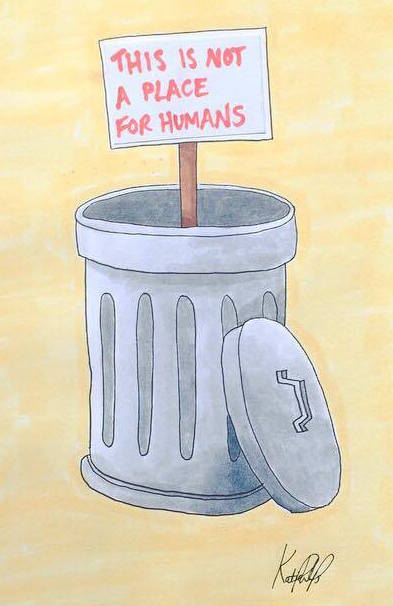
I realise calling a psychiatric unit a “nut house” isn’t accurate either, for example I have never encountered a “nut” when in hospital (other than the odd almond or macadamia in my fruit and fibre…I once heard someone claim they found a pecan in their bowl but I think that was just a myth so don’t take my word on it), but the “loony bin” slang term is particularly damaging as it conjures up ideas of a place into which the rubbish is tipped, a place that people don’t come back from and if anything is utter trash, it is that image.
I myself have had several admissions to various different “loony bins” and I can state with the utmost conviction that none of them bore any similarities to a bin, neither appearance wise or in terms of function. Firstly, on the whole they were all very clean (one had the bathrooms cleaned after practically every use so sometimes I was unable to shower BECAUSE they were being made extra clean), but more importantly none of the patients were anything like waste needing to be dumped.
The problem with the phrase isn’t even just damaging to the self worth of current or ex-patients. Potential inpatients may be scared of, and thus refuse admissions for treatment that they desperately need, because this whole “loony bin” perception has made people fear they will go in and never come out, that they are a lost cause who needs to be locked away from society for good. Admissions to a psychiatric hospital however, are not final destination. Instead they are more of a holiday. Ok, I will admit they are not exactly like a holiday, I know I would prefer a beach in the Caribbean over a stark white bathroom with a staff member watching me pee, but what I mean by this comparison is that they are a place that people come back from (albeit without the much revered tan or photo album). Going into hospital doesn’t have to be a terrifying endgame, define people or morph them into the branded mental patient to be impersonated at Halloween parties.
There is of course also the issue of this “bin” (a name of a place usually reserved for objects not people), being used as a place for “loons”. “Loons” sound like magical creatures, inhuman half breeds who are fundamentally different to “normal people”. The whole idea just emphasises the false distinction between “mental people” and “sane” ones when really they are both exactly the same. People in mental hospitals are not a different species, they are human just like you (unless dear reader, you are in fact a penguin in which case may I congratulate you on finding my blog without opposable thumbs).
I think it is comforting to label people with mental health problems as loons to be kept in a separate lidded inhuman/object bin world of restraints and locked doors, because by separating the sane and the insane, making a “them” and “us” situation, it perpetuates the idea that those crazy people are different and therefore you are not at risk of being contaminated. To think that a person screaming and being held down to be injected with anti anxiety medication is just like you is frightening and prompts all kinds of questions like “what if that happens to me”? It is nicer to think of all of that stuff as things that happen to “other” people, that the person cradling a wooden spoon and singing nursery rhymes is different, no possible image of you in the future. It is nice to put the lid on the idea and leave it outside the house for the rubbish collectors to remove so you don’t have to deal with it in your home.
The derogatory slang of “loony bin” and resulting “loon/human”, “them/us” dumping ground view of psychiatric units really is a use of language that has the ability make patients feel hopeless and forgotten, doomed waste discarded for good, and it creates judgement in people without mental health issues that just continue the stigma and fear that surrounds it all. I urge people to know that none of this is true.
For patients who have been admitted I want to say that life is not over, and being in hospital doesn’t mean that you are rubbish or damaged beyond repair and the landfill is not your future and final destination.
If anything I would say the slang for a psychiatric hospital should be “the temporarily out of order and in need of repair tray”, just like “normal” hospitals that treat only physical illnesses. It is not a place to be thrown in when you don’t have a place in the real world anymore, it is just a place in which you remain as human and as worthy of life as anyone else on the planet, you just have a few cracks in your porcelain skin that needs a little glue to help them stick back together.
We need to stop seeing psychiatric hospitals as bins or end games for the weird wastes of failed humanity, but as places for ordinary people who are just struggling in life and need a little support to get back into full working order, simply time and space to patch things up and get them well enough to leave that repair tray so they can go back home.
Veganism Vs Eating Disorders
I first became vegan in 2012, and at that time I didn’t know anyone else who was a vegan. From my viewpoint, they were pretty rare and sparse, much like some herbivorous creature David Attenborough would have to spend weeks stalking before he could actually get one on film. Recently however, I seem to be seeing a lot of vegans springing up all over the place. As a vegan myself, obviously I think this is great, as it strengthens a movement and cause that I agree with and am passionate about, but the concerning thing is that a lot of people I have seen suddenly start milking almonds are people in the eating disorder community (both online and in real life).
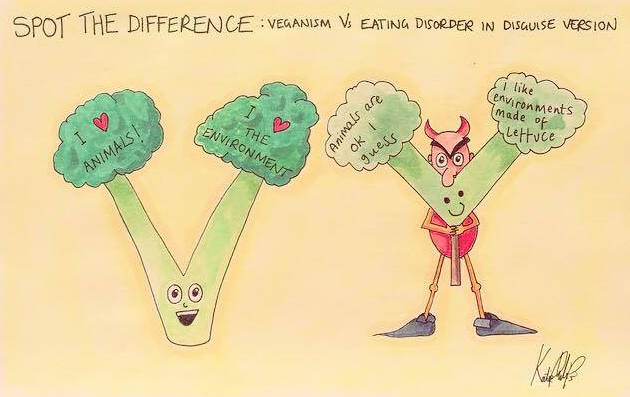
Obviously “veganism” and “anorexia” are two very different things, one is an ethical movement, the other a mental illness, so naturally being vegan does not mean that someone has an eating disorder, just as someone having an eating disorder doesn’t mean they are vegan. Nevertheless there can unfortunately be times when they cross over, and the lines between the two normally very separate labels become a bit blurred, much like the colours of a carrot and a stalk of broccoli do when you put them in a blender and switch it on high speed. It is here that the problems start, problems people need to be more aware of and open to discussing, as it is here people can start using veganism as a mask to cover what is really an eating disorder, a dangerous trick that can leave many people unaware that they have a problem or mean that others do not pick up on what is a potentially fatal illness.
In other words it is hard to work out which bit is broccoli and which bit is carrot, so I feel it is important for people with eating disorders who are vegan to question their lifestyle decision, not because it is wrong, but to make sure it is for the right reasons. Therefore in order to try and help people who are unsure about either themselves or a friends dietary choices, below I am going to list several things to look out for as signs that your veganism is actually something a lot more dangerous…
1. Why are you vegan? What was the initial cause or reason and how did you come to the decision? – When you or your friend became vegan, what was the drive behind it? Was it to benefit the environment? To fight animal cruelty? Or was it to use as an excuse to mask why you are taking things out of your diet? With eating disorders, veganism can sometimes unfortunately be used as a get out of jail free card. If you start refusing all standard cakes or ice cream, family may be concerned or question whether or not there is a problem. Wave the vegan flag however, and you have given yourself a more socially acceptable disguise for your refusal, as I think we can all agree that “I am not eating that because I am vegan” tends to go down a lot better than “I am not eating that because I have an eating disorder that is slowly killing me”.
2. Restriction or alternatives? – An important thing to bare in mind when considering someone’s veganism is how they go about it. For example, veganism is NOT about cutting things out, it is about swapping them. Used to get protein from meat and eggs? You can swap that for chickpeas and beans. Had your fat requirements from full fat dairy? Introduce yourself to Mr avocado and his civil partner Señor peanut butter. Veganism is about still getting all of your daily needs but from plant based sources, it is not about emptying all the cupboards and then living off a bag of lettuce.
3. The “Imagine you accidentally” game – Imagine you (as a vegan), ate something that was not vegan by complete accident and without having any way of knowing about the non-veganness before hand. What do you think? Is it all “oh my God I just ate something with cream in it I am going to get fat! My thighs will be wider than the widest wide thing in the Museum of very wide things”, or is it more along the lines of “Oh Damn! That is annoying, I feel guilty about the animals but I guess it was human error, not my fault and I will just have to check ingredients more thoroughly from now on”?
4. How has veganism impacted your lifestyle overall? – Obviously being vegan involves dietary changes, but changes are not limited to food alone. By deciding not to contribute to the exploitation of animals, you are deciding not to use animals for your own gain, not just deciding to avoid eating them and their produce. For example when I became vegan, my entire make up collection, shampoos, shower gels and toothpaste all changed to animal friendly versions. If the only aspect of veganism you care about is the food side of it then maybe examine why this is, to make sure it isn’t because the food changes are actually about something other than animal ethics. After all it makes little sense to avoid eating a cow whilst wearing a leather jacket, so finding out and questioning your stance and opinions on the non food related parts of veganism can be handy in giving you a clue as to where your head is at.
5. The Vegan bakery test – Imagine a friend wants to support your decision to be vegan and takes you to a vegan bakery. There are vegan brownies, cakes, muffins, the lot. When you look at the display what do you think? Is it a case of “Oh no my excuse to get out of cake is gone! What do I do? I must reach behind the counter, grab a wooden spoon and whack my friend on the head to distract them whilst I run away”, or is it more similar to “Oh my goodness I want that chocolate peanut butter muffin in my face immediately”. This test is a fairly good guide in my opinion as to how much your veganism is impacted by possible animal or disordered eating factors. It is also a good test as a guide to find out how much you like your friends, because if you are that eager to hit them in the face with a wooden spoon you may want to consider socialising with other people.
In an ideal world obviously I would love for everyone to be vegan, so I don’t want this post to be seen as telling people with eating disorders to run off and bite the nearest sheep immediately.
What I am saying is that if you are vegan or have a friend who has recently turned vegan, be sure to question it (especially if they have a history of eating disorders), and be fully aware of why that choice has been made. In my opinion a vegan diet is one of the healthiest diets around, so if you have an eating disorder and your veganism is a separate entity to it, then go ahead and carry on loving your lentils. Hell, have a shower in chickpeas and build a house out of a giant cabbage, just be sure to distinguish whether or not you are dealing with real veganism or a potentially fatal eating disorder wearing a vegan mask. After all, no cow is going to be particularly grateful that you stopped drinking its milk because of a voice in your head that is trying to kill you.
Stay safe all vegans and non vegans and people reading this in general. Cheerio for now.
 Born without marbles