The Importance Of Seeing Food As Fuel When You Are In Recovery From An Eating Disorder

When I first thought about writing this post, as you can see from the title, I was intending to talk about why people with eating disorders need to see food as something to fuel them and keep them alive, yet now I have changed my mind (not that I am indecisive or anything…or am I…I’ll have to get back to you on that…). Ok this post is still going to be about the importance of seeing food as fuel, but actually I feel I should address why EVERYONE needs to start doing this, as it seems that in our society, whether you are mentally ill or not, food is primarily thought of in terms of what it will do to your weight.

For example, a few years ago during an inpatient admission, I was on bed rest which meant that, as you have probably guessed, I “rested” in a garage (only joking, it was in a bed. Just keeping you on your toes). Anyway, I was lying there and I was confused as to why I had to eat my meal plan when I wasn’t “doing anything” to burn it off. In my eyes, if I ate even a pea whilst lying down all day, I would gain weight because I wouldn’t have exercised enough to burn it off. I talked to one of the therapists about this and I remember her telling me that even if I wasn’t “doing anything”, I still needed to eat and still needed to have energy just for my body to work. Ok I may not be running around anywhere, but my body still needed the food so that all the bits inside could do their jobs and she drew out this chart as to how much food is actually needed just to sustain life without all the wandering in-between. I, by jumping from “eat X” to “gain weight from X”, had skipped a massive step and had imagined that whatever I ate would make me gain weight. Nevertheless, every time I was given a meal plan increase, my first thought was “that is going to make me gain weight”, without thinking of all the reasons and uses for food that come before the body even gets around to considering weight gain. Hearing that from someone with an eating disorder probably isn’t surprising, but at the same time the idea of food as a dictator of weight and nothing more is something that I see throughout society.

These days what you eat seems to be less about giving you energy to actually help keep your liver livering so that you can live your life and more about making choices based on what size jeans you want to fit into.
It is like those articles online or segments on daytime television, where they tell you what exercises you would have to do to burn off a certain food. I am pretty sure that a few years ago they were even considering adding that information to the wealth of nutritional guidelines scrawled across any packet of Hobnobs just so that people would know that if they ate one of the biscuits, they could easily burn it off with fourteen and a half press ups and a quick run through of the Macarena.
It just makes me wonder what on earth we think food is for if all we are doing is thinking about how it needs to be “burnt off”, skipping the state where we allow the body to actually use it, like I did all those years ago. Why do we need to be so obsessed with burning our food off? Know what happens if you “burn off” and “use up” every calorie by running on a treadmill? You win a prize? No. YOU DIE.

Think about the times when there is a cake in an office or people order desserts at a meal. Usually if someone turns down a piece, you can bet a good chunk of cheddar that their refusal will be something along the lines of “Oh no I can’t join in with that because it will go straight to my love handles”. It is rarely, if ever, someone will turn down food because they “don’t want it”, and is unfortunately usually down to this idea that whatever they eat will affect their weight which of course it won’t and that immediate connection is incredibly disordered.
The truth is, the primary purpose of food and indeed the necessity of food is to keep you alive and any other consequence is only a secondary consideration, yet it is the secondary consideration that people focus on all too much. Like I said when I began this post I intended to encourage people in recovery from their eating disorders to see meal plans as things that are there to keep them alive rather than seeing them as things that are going to cause them to gain weight. Ok weight gain may result if enough calories are consumed to allow that (weight gain that if you are on a re-feeding diet I highly expect is necessary), but that is not the first thing to happen. Indeed people with eating disorders, myself included, seem to focus so much on the effect of food on weight that they forget that it has any other purpose.
Years ago during another admission, I remember following my meal plan for months and eventually I did manage to gain enough weight to get me back in the healthy range and my first thought was “oh well I clearly don’t need to eat anymore because I don’t need to gain any more weight”. When the doctor told me to keep my meal plan the same I was confused as I had imagined he would say that I could stop eating now I had gained to the point where my body was healthy, what use did I have for food? What use did you have for food past Katie? Hmm let me think…TO KEEP YOU ALIVE BECAUSE THAT IS PRIMARILY WHAT FOOD IS FOR.

Food did not originate with the sole purpose of changing our bodies like those “eat me” cakes in Alice in Wonderland or that mushroom where if she eats from one side she gets tall and from the other side she gets small (I actually have a theory that all mushrooms have that power but because we tend to eat mushrooms whole aka we eat both sides, the magic of each side cancels the other out, thus we remain the same size…maybe don’t shout about that in public though…in my experience whenever I talk about magic mushrooms someone tends to call the police and I end up with a lot of explaining to do.)
No, unlike Alice’s wonderful mushrooms (or, if I am right, normal mushrooms), food is primarily there to keep the heart beating and that is it, yet like past Katie this seems to be something we have all forgotten.

Take the hellish old saying of “a moment on the lips, forever on the hips”. This makes it sound like the second you take a bite of a tasty salted french fry (after it has been dipped in ketchup of course), that french fry immediately sets off through your digestive system until it reaches the hip, at which point it will decide to set up camp and stay there as an extra piece of flesh. No. In reality, the first thing that french fry will do is go down your digestive system and start looking for things to do. Looks like the heart could use a little energy? Awesome, then the fry will head over there and give a few beats to keep the old ticker going. Kidney need a bit of help (or kidneys if you are one of those lucky devils who still has two), fine, that fry will head off to those kidneys and do a bit of filtering or whatever kidneys do. Without food those things don’t just keep happening! What do people think is keeping us alive if food is only there to dictate the width of our thighs? Do we think livers and kidneys run on fairy dust and pixie magic? HAS THE WORLD GONE MAD?

I just think that we all need to back up out of this disordered attitude of “things you would have to do to burn off a carrot stick” thing and be reminded that food is actually fuel that keeps you alive. If you are in recovery from an eating disorder, don’t get me wrong, I understand, and with every bite my head is focusing not on what that piece of food is going to do for my kidneys but what it is going to do to the number on the scales, but when those thoughts crop up remember that the whole weight gain aspect is a secondary thing and not the primary purpose of food as is made out in society. You do not need to be underweight to earn the right to eat cake on your birthday and you don’t suddenly stop requiring food the moment you are weight restored. No matter who you are or what your weight, you NEED fuel to survive like a car needs petrol. It doesn’t matter what colour the car is or what size the wheels, no matter what the physical composition of that car, it needs petrol to move just as you need food to breathe. YOU ARE THAT CAR. It doesn’t matter if you have small tyres, a huge engine, dodgy limp wing mirrors or a sizeable windscreen wiper, you need fuel to go, end of discussion.

Whether people have eating disorders or not though, collectively if I could do anything in this post it would be to urge people to see food less in the disordered “a moment on the lips forever on the hips” sense and in a way more akin to “a moment on the lips and then down to the aortic pump for a good few beats to keep me alive so that I can actually get on with my day and have a life”. Admittedly it isn’t as catchy, but trust me, it is far more scientifically accurate.

FoodIsFuel

The Effect Of Mental Health Problems On Carers

A few days ago I was out for a wander with my mother and I asked to borrow her phone because my OCD fear of contamination often means that I leave my own phone at home, meaning my “mobile” is ironically rather stationary. I did not ask to borrow her phone to play a few rounds of snake as I often did as a child (God I miss the 90’s), I borrowed it because I wanted to check my emails. You see, I am a very important person and for this reason I am often swamped with a lot of very important emails and thus it is vital for me to check my emails at all times to see what exciting opportunities I am receiving/check if my online shopping order of a new penguin onesie has been dispatched yet, because one cannot wait around all day for these things. What do they expect me to do, wear normal clothes? What a hideous idea!

Anyway, as I tapped on the little email icon on my mother’s telephonic device, I was immediately confronted with a word document in which I could clearly see my name. Had I not read my name I would have perhaps realised that this document was not for me and was actually an email sent to my mother, seeing as I was using her phone which was naturally signed into her account. Having realised this I would have, of course, closed the document and signed out in order to respect my mother’s privacy, but alas I did not realise this right away as, like I said, I had read my name. Thinking my emails had somehow popped up automatically I read on, but soon enough I realised that this message was perhaps one that had not been written for the eyes I had tucked neatly behind the rims of my spectacles (top tip: when wearing glasses always make sure your eyes are tidily kept behind the lens part of the glasses rather than allowing the eyes to wander aimlessly across one’s face).
When I realised that this document was not for me I probably should have closed it right away and swiped off to check on that penguin onesie, but alas I was all too curious and without saying a word, I read all of what was on the screen…

The document it turned out, was a draft of a letter from my parents, a letter about me. I won’t go into the full details of the letter’s contents, but as a brief summary it said “Dear High up person in Mental Health services, We are the parents of Katie who is really mentally ill and we are terrified for her life right now because things are so bad, so please can you help locate some kind of treatment that is more intense than the outpatient services she is currently receiving because she is truly insane and we do not know what to do with ourselves”. Suffice it to say, upon reading that, I was a little shocked. Obviously I know that I am mentally ill and I know that this has a large impact on the family and friends around me, but I guess that when you are the one suffering with the mental health problem, it is quite easy to forget the effect it has on other people because you are so wrapped up in your own world. Seeing this was a massive reminder and realisation as to how much people with mental health problems affect the people who love them. On this blog I am always talking about how my illness affects me and when we think about a household in which someone is a little bit on the bonkers side, it is often the person who is unwell, as opposed to the carer, who is in the forefront of our minds. This really made me think how if I, as someone who has a lot of experience in mental health problems, can forget or not realise the impact of insanity on others, a lot of people out there with no experience probably have no idea at all and therefore it needs to be talked about.

Indeed it reminds me of an incident a few weeks ago when the window cleaner rang on the doorbell to collect money for his bubbly services. Months prior, had he rang the bell, nobody would have answered because my mum would have been at work and I would have been hiding under a blanket somewhere worrying about who was ringing on the doorbell. However, recently my mum has given up work for “many reasons” she says, but if we are honest it is to care for me because, to borrow a phrase of every 5 year old trying to get out of a P.E lesson across the country, I am “not very well” (Thanks for letting me borrow that phrase kids. You may have it back now. Really appreciate it.)
Naturally though, the window cleaner is not aware of my mental health problems, so he was surprised at my mum opening the door in the day time. When she explained that she had actually given up work, he jovially commented “ahh, a lady of leisure”, and to be fair to him, how was he to think otherwise. Still it was a comment that made me a bit uncomfortable because I realised that there are probably some people out there who would hear that my mum has given up a “proper job” to look after me and would think that she is indeed a lady of leisure, swanning around the house in a floaty gown without a care in the world. She doesn’t have a mental health problem and since mine are all invisible creatures in my head, it would be easy to assume that they don’t affect her life very dramatically. This could not be further from the truth, and in my eyes my mum’s unofficial job of “looking after a maniac everyday” is not at all leisurely and, if anything, it is the most physically and emotionally exhausting job on the planet.

For me, it can take hours to eat a meal, hours to perform a washing routine “correctly”, hours to put my hair into a pony tail that is “just right” according to OCD and not likely to kick off world war three any time soon. Rituals take so long that I am frequently getting to bed around 6am, just as my dad is getting up for work, and though my mum isn’t there for all of that time, for the majority of it, she is there. She is the one calming me down after I have had a panic attack, she is the one helping me to prepare food and weigh courgettes if I am too scared to go in the kitchen myself, she is the one having to answer my constant reassurance seeking questions of “did I do that right/is something bad going to happen”. Aside from those more physically demanding things however, I would say that the biggest impact is the emotional stuff that goes alongside it.

I remember a time when I was having a particularly bad day and had found it hard to follow my meal plan so I ended up accidentally fainting (I am pretty sure it is hard to faint on purpose but I want to make it clear that the fainting had not been my intention). When I came round on the sofa I did not feel well at all and I remember mum being very anxious about it, a fact which, at the time, I felt really angry about. Looking back it sounds awfully selfish but I just couldn’t see why she was making a fuss. She wasn’t the one whose heart was skipping beats like a child with a jump rope of death, she wasn’t the one who was so weak she could barely move and whose vision was fading in and out of total darkness. If she was at all dizzy or weak, she could solve the problem easily by going into the kitchen and having a few chocolate digestives to perk her sugar levels up. I on the other hand, no matter how I felt, was still too scared to eat something. Little did I think about what it must be like to watch someone you love struggling to stay alive, without being able to do anything about it. Okay my mum “has it easy” in that she can grab a biscuit whenever she wants one, but she also has to worry about the fact that I cannot do that, that I cannot take care of myself at all right now, and that is incredibly difficult.

It isn’t even as if she can get a break very often from her role as “carer” because naturally if she isn’t caring for me she is worrying about who is doing it for her or worse, me caring for myself. She can go to bed at 2am and sleep through the rituals I carry out until 6am but I highly doubt she has a restful sleep knowing that I am awake charging around like a lunatic, worrying about whether i have eaten enough or whether I am going to have one of my panic sessions which usually leads to me doing something rash and dangerous before I have time to realise what is going on.
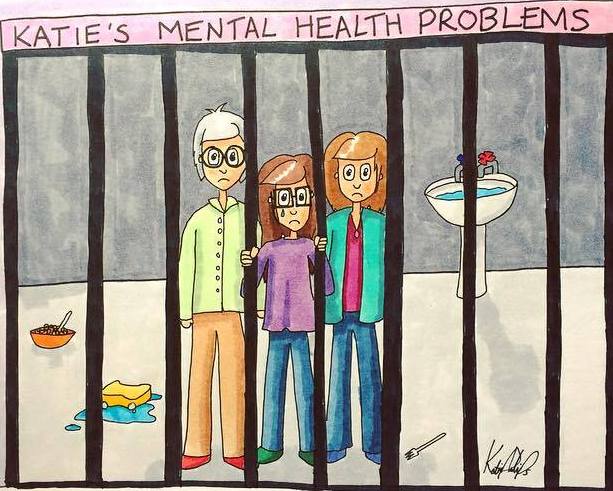
Living with someone with a mental health problem also restricts someone’s movement and freedom drastically, much like it might if you had a Yorkshire terrier or a golden Labrador. I have never had a dog but from what I gather, you need to constantly be aware of what they are doing and where they are going. You cannot just jet off to Paris for the weekend without worrying about where the dog is going to go, and in my mother’s situation, I am very much like that dog (only a really freaking crazy dog that you can’t just send to the local kennel.) In the letter from my parents to the fancy mental health person that I had read accidentally/kind of on purpose having discovered accidentally, they spoke about how they have a holiday booked in August and are panicking because if things remain as they are, I will not be able to be left. People know that as someone who is unwell, I often feel trapped behind the bars of the mental health cage, but it is important to realise that often, those around them are caught up in that cage behind those bars too.

Reading that letter has had a big effect on me, not in the sense that I am now “trying harder” to get better as if I wasn’t trying before, but because it has made me especially aware of how mental health problems suck both the lives out of those they inhabit and any other lives that happen to be within range. A mental health problem is not a vacuum with a specifically designed nozzle that only pulls on the sufferer, it is a vacuum with a flipping massive gaping hole that hovers over a household and jumbles up all that there is inside, so that even those who aren’t “technically ill” can feel like their world is spinning.
In a way I guess this blog is kind of like a shoutout or a thank you to my parents as well as an apology at how much I am affecting their lives negatively right now. More than that though, I want it to highlight the fact that in general, life as a carer is incredibly taxing and debilitating in its own right, and that it is a serious job, the stress of which should never be underestimated or brushed aside. Raise awareness for people who struggle of course, but it is important to also raise awareness and support for the people who are standing alongside them.

If you yourself are a carer of someone with a mental health problem, please know that on behalf of all mentally ill people, I see you, and I thank you.

Take care everyone x

CarerPrison

Why We Need To Keep Talking About Mental Health

Tomorrow is a very special day for this blog that you are oh so kindly reading in this moment (cheers for that), for tomorrow will mark the one year anniversary of Born Without Marbles being “a thing” on the internet as opposed to an idea in my head that I was too scared to carry out.
That means that I have been harping on about mental health, whether you have liked it or not, for an entire year, and I wouldn’t be surprised if there were people out there wondering why on earth I am still waffling on about illnesses that the majority of the population are well aware of by now.
Ok the general public may have misconceived ideas and perceptions as to what an illness may really be like, but everyone has a rough idea these days as to what things like OCD and Anorexia actually are, so why am I still talking about these things and why do I plan on continuing to talk about these things for the foreseeable future? Newton isn’t still harping on about the time that apple fell on his head (partly because Gravity is old news that doesn’t own the headlines these days and partly because he died in 1726 which somewhat limits his abilities to “harp on”), so why do I keep talking about what it is like to be mentally ill when the existence of mental illnesses is no longer breaking news. Well friends, whether you have been here from the beginning or whether this is your first experience of Born Without Marbles (Welcome. Please excuse the penguins I have left lying around in each post. They are kind of important), today I am going to answer that question and tell you why, even after a year of weekly waffling, I still feel that we all need to keep talking about mental health.

Of course there are all the obvious things like the fact that the more we talk about mental illness, the more research there will be and in turn the more likely we are to find a cure. To explain why I personally have such a passion for the subject however, I need to take you back to 2003, and, more specifically, eleven year old Katie (to set the scene I looked exactly the same as I do now only shorter).
As the name of this blog suggests, I can see that I have shown signs of mental illness from the moment I was born, but it was in 2003 that things really began to become a problem, that I became afraid and ashamed for the first time of the thoughts going on in my head. It was the first time that I didn’t feel normal, and feared that I was different from everyone else.

Every day at school I would watch other pupils in awe. I would see them eating school dinners, opening doors and shaking hands with each other as if it was the easiest thing in the world, and I would wonder how on earth they did it all. For some reason when I tried to open a door, I would find myself frozen in fear, unable to touch the handle as if someone was holding my arms behind my back. When I was in the queue for school dinners, my head was screaming at me to run away because I wasn’t allowed to eat, and no matter how hard I tried to concentrate in lessons about ox bow lakes, all I could see in my mind were images of terrible things happening to all the people I loved, and hear threats that the only way to stop those things happening was to repeat some kind of ritual. This would have been rubbish enough, but the worst bit was that I had no idea what this meant or why this was happening. I thought long and hard, trying to come up with an explanation but the whole thing made very little sense to me. What was so scary about the germs on a door handle when I had evidence all around me showing that nothing bad was happening to people “contaminated” with them? Why couldn’t I go to lunch, even on pasta days? Logically I knew that I loved pasta (pasta is flipping awesome), so why did the idea of eating a steaming bowlful topped with as much cheese as I could get away with before a disapproving dinner lady grasped my cheddar filled palm, scare me so much?
These things went on for months, and I said nothing to anyone because I was too afraid. Maybe mental health wasn’t as widely discussed in 2003 or maybe I was just unaware of what mental illnesses were, but I had never heard of anyone experiencing these things so I kept silent and hoped they would go away. Spoiler alert: they didn’t. Of all the awkward situations I found myself in however, there is one in particular that sticks in my mind and one that continues to motivate me and my dedication to this blog today.

“It” happened at the end of a music lesson. Now, in my school, music was taught in a separate building to all others, ditto art, drama, and DT who all had their own individual buildings (something tells me the staff members of the more creative subjects did not get on well…this explanation of the separate buildings certainly correlates with the time I saw the head of drama pelting the art teacher’s studio with water balloons anyway…)

On the day in which our story occurred, our class had been taken to a room on the top floor of the music building where there were a lot of computers and keyboards set up for us to spend a few hours learning how to play the theme tune from Titanic (a vital part to any eleven year old’s education). Then, the lesson ended and we were dismissed, a fact that meant we were going to have to leave the room and therefore, someone was going to have to open the door. Usually I was very good at avoiding such a responsibility, and at the end of every lesson I would fumble around with my bag until someone else had done the job so that I could scoot on after them without touching anything. This technique worked perfectly for every lesson, but today, for some reason, the teacher wanted us to lead out in single file from the nearest computer to the door. I think maybe someone had been messing about with a keyboard, playing Celine Dion’s soundtrack with a little too much gusto, so in the exit of the classroom, the teacher wanted to establish some serious authority. I felt sick. I was at the computer nearest the door. I was to be the first to leave, I was to lead my fellow students to freedom. I was to open the door. When I saw that it was a push door then, I was thrilled. Happily I nudged the door with my foot and led my classmates out, but the relief was short lived as I realised we were headed for another door, a pull one with a handle…AND AN EXIT CODE KEYPAD.
I thought about pausing in the corridor to let someone overtake but the corridor was too narrow, it was single file, there was no escape, and as I walked down the stair case to the door I genuinely felt like I was walking to the gallows. This was it. I was going to have to touch a door handle, and it was going to be the end of the world. When I reached the door I stopped. The time had come to raise my hand, but I couldn’t move. Instead, I just found myself stuck, panic building as the queue of students eager to go home started forming behind me. Luckily everyone was talking about the day too much to notice my embarrassing situation at first, but after a few minutes of standing in a line waiting, understandably, people started wondering what the hell was going on, and from the back of the line I heard a voice ask perfectly reasonably “is there something wrong with the door?” From then it went silent and all I could hear was the response in my head of “no actually, there is nothing wrong with the door, there is something wrong with me and I have no idea what it is”.

Eventually, after what felt like 34 years, the person behind me became impatient, reached around and opened the door, and from there I ran sobbing to the medical centre with shame, fear and embarrassment. I didn’t want to see anyone ever again, I had to hide, so I decided to take refuge in the sanitarium. When the nurse asked me what was wrong, I lied and told her that I had a tummy ache. I spent the rest of the day curled up on the sofa with a hot wheat bag watching episodes of the Simpsons, feeling more alone than I knew it was possible to feel. There were hundreds of other pupils in the school, but for some reason I was different, I couldn’t open doors or eat meals like they appeared to, and there was nobody, least of all me, who understood why.

It is for that Katie sitting on that sofa with that smelly hot wheat bag that I started this blog, and it is for all the smelly hot wheat bag holding people out there pretending to be fine, pretending to have tummy aches to cover up the fact they are terrified of their own minds and too scared to speak out for fear that other people won’t believe them, that I write this blog. Had I heard about mental health problems sooner, maybe I would have asked for support sooner, but what I would have found more helpful than any of the symptoms listed in the millions of health care packs, would have been the knowledge that there was at least someone out there who struggled with the same things, who let me know I wasn’t crazy, that I wasn’t alone. It is for that reason that, no matter how much awareness there is about the existence of mental illnesses, I will keep talking about my experiences with mental health problems in public spaces. This isn’t a blog to just give information, in my eyes, this blog is a friend, both to me, to the readers and to anyone out there who comments to say that they can relate to my problems and thus remind me once again that none of us are alone.

So happy birthday Born Without Marbles, and thank you from the bottom of my heart for all the support anyone reading this has ever provided. Here’s to another year, another 52 weeks of my ramblings, another 365 days of friendship.

Take care everyone x

MarblesBirthday

My New Diagnosis

For well over a decade, and since my very first therapy session many moons ago, (aka JUST after the dinosaurs died out and at the time when there were Tyrannosaurus Rex bones still lying about EVERYWHERE after that rather inconvenient meteor), therapists and psychologists across the country have always said that there is “something” wrong with me. Obviously they have always known about my OCD, Eating Disorder and Depression, yet still many have insisted that there is “something else” lurking within me and playing general havoc with my brain.

I have always found this “something wrong” that nobody can put their finger on, (or any body part for that matter), to be rather confusing.
When I was 15 the it was banded about that this “thing” might be bipolar disorder, but after trial and error with a few medications, that suggestion was tidied away as well as all the others and I have tried my best to forget about it. I was doing pretty well with this forgetting thing in my opinion (I had placed the “there is something wrong with you that we do not understand” memory alongside Pythagorus’ theorem in the box of “things I no longer need to know after the age of 16”), but then my forgetting box was rudely ripped open again very recently.
If you have been following this blog for a while you may remember that I had an assessment with a new OCD service in October of last year, a three hour interrogation examining all of my mental health problems and experiences of the world throughout my life. I mentioned nothing of any extra “bonus” diagnosis that nobody was sure of, so for this reason I was surprised when the psychologist I was speaking to randomly asked if I had any other diagnoses, as yet again I was showing signs of this “something else”, that something possibly being a “personality disorder”. I didn’t mention this when I had the assessment all those months ago because I imagined it would go away like all those other conversations of mysterious mental health problems in the past.
When I was told that the OCD service may not be able to facilitate my care if I had a personality disorder and I may need to see another service first however, I was unable to forget it again and became increasingly frustrated. Here I was potentially having issues with receiving treatment because of a mysterious something that I wasn’t even diagnosed with, and it was at that point that I knew I needed answers.

Like I said in my “why I like being diagnosed with mental health problems” blog post a few weeks ago, I like having the labels and diagnoses of my conditions in black and white because it helps me to deal with them and means I know what enemy I should be fighting. If you want a full understanding of why I like being diagnosed with (NOT HAVING) mental health problems, then I fully recommend checking that post out before this one (Why I Like Being Diagnosed With Mental Health Problems – it really is a great read. Trust me it involves a picture of a monkey banging a gong and singing Bohemian Rhapsody), but as a brief summary for all those with an aversion to classic song performing primates, my argument was that I like being diagnosed with mental health problems because it is only when you name a problem and pin it down that you can figure out how to overcome it. It is useless for a person working in a garage to simply say “there is something wrong with your car” because then they can’t fix it. They need to specifically identify the issue that there is a gaping hole in the front tyre, as only when they know that, do they know where they start tinkering and what equipment they will need.

Consequently, after my OCD assessment, I went to each of the three therapists I see in turn and asked them to tell me if there was something wrong and if so, what the hell it was. I can’t remember who first brought it up, but rather quickly a condition (we will call it Penguin condition for the time being), was suggested as the answer to all the questions I have had over the years. From that suggestion I had many appointments discussing the condition and as instructed, I researched it, learnt about it, and I watched a DVD given to me by a therapist, of various people being interviewed about their experience of Penguin condition.

Of course I didn’t relate to every single person on the DVD nor did I agree with some of the explanations of Penguin condition online, but on the whole, when learning about it, something clicked. As I heard people talking about what it was like I was astonished to hear them basically describing things I do/have experienced in life, and although scared and not eager to add a new diagnosis to my list, I was at least a little relieved. Finally I wasn’t just “weird”, I had Penguin condition and maybe if I started dealing with it, things would improve across the board. Perhaps the underlying issue of Penguin condition was the reason for the OCD and eating disorder, perhaps none of the treatment has cured me yet because we were actually treating the wrong parts first, like trying to eat the chunks of brownie at the bottom of a sundae glass before you have tackled the ice cream piled on top of it (ALWAYS SAVE THE BROWNIE BITS FOR LAST. ALWAYS. THAT IS THE RULE. ICE CREAM FIRST, BROWNIES LATER).

For this reason I became eager for the diagnosis to be put in place so that I could finally know where I stood. As well as answering my need for answers I also wanted it made official so that future therapists or medical professionals would know the full story if ever reading my notes, without me having to always add into new introductions the explanatory “I know you have read my notes but just so you know Penguin disorder is also on there but it is not written down”. I wanted it in black and white to be neat, to be clear, and partly because when things are in black and white, they look a little more like a penguin without the beak.

Then, a few weeks ago, I had a session with my psychiatrist and it was decided that we would make it official and the diagnosis would go on my records. At first I was relieved, but then he started to warn me about the consequences of it being made official. Suddenly I wanted to forget all about it and fall back into blissful ignorance again.
Apparently this condition is one with a lot of stigma to it, stigma that can lead to some therapists refusing to see you if you have the diagnosis. This wasn’t really a problem for me. If a therapist isn’t going to see me because I have a certain mental health problem then clearly they aren’t a good therapist or a person that I want to associate with anyway, but the constant reinforcement of judgement that could potentially befall me freaked me out a bit. I am not ashamed of having mental health problems, I talk about them openly on the internet for this reason and to hopefully help others be less ashamed about their disorders, yet with Penguin condition I really was rather scared and embarressed. My psychiatrist said he could treat me for the condition and just not put it on my notes if I would prefer, yet as easy as that would be, I still felt uncomfortable. Yes I wouldn’t have the “shame” of being diagnosed with a condition that faces a lot of stigma, but on some level I would also be admitting that there was shame in the condition and that I should keep it on the down low which is not how I feel about any other mental health problem I have. I am a firm believer that if you have a problem, keeping it on the down low is only going to make it worse and will not raise any of the positive awareness that could potentially be spread with honesty. Nevertheless I am a little afraid, and so for now it is on my notes as “under revision” incase I change my mind by the next appointment and want it removed (apparently without the under revision bit this is something that once on your records, will not come off no matter how much scrubbing or Cilit Bang you apply. Bang and the dirt is gone? Yeah, but the disorder will still be there!).

I have a few days until my next appointment now, and by that next session I have to decide whether or not I want to specify that mysterious something wrong or just sweep it under the carpet again. As well as debating whether to let it on my medical notes I have been debating whether or not to bring it up or “come out” with it in my blog. Again, my initial reaction was no. Even my mum agreed that it might not be the best idea. If you google the condition or do any surface level research on it, people with this disorder are painted as crazed monsters who are unbearable to be around. Reading the articles even I admit that I started to think that I would never want anything to do with someone suffering from the condition, and that was when I made my decision to get over my fear, come clean and talk about it on my blog like I talk about everything else, regardless of whether anyone else is interested. If everyone thinks people with Penguin condition are dangerously insane, then I want to talk about it and I want to raise awareness of the fact that that is not the case and what the people with it are really like. As you can see I am still scared of saying it on here (hence the code name Penguin condition), as I do fear the judgement, but they say feel the fear and do it anyway, so here it goes.

My most recent mental heath update then? After all that waffle what has happened? Well dear friend, I have been diagnosed with Borderline Personality disorder. I am still exactly the same blogger you have been following for however long you have been, with exactly the same issues. It’s just that one of the hidden ones now has a name (sort of like when some women on TV seem to name one of their boobs…it is something that has always been there only now it can be addressed formally in a letter or serious conversation). As you can see this post is long enough as it is so I won’t go into what that means and what myths need debunking here, but for now I feel like telling you is a big enough step. (That said I know many people do not know what this disorder is or have many misconceptions so, before I can provide an explanation of my personal experience I have linked a PDF below from the charity “Mind” which I feel is the best and least stigmatised description around, so if you want to learn more, dear god please go there rather than to a general google search).
Maybe I will delete this post before I upload it but I hope I don’t, and if you are reading it then I guess I have been brave. Nobody should be ashamed of their mental health problems, and I for one am going to live by that, even if doing so is something that scares me right now.

Take care everyone x

diagnosispicture


http://www.mind.org.uk/information-support/types-of-mental-health-problems/borderline-personality-disorder-bpd/#.WLRDi7GcbVo

The Difficulty Of Losing A Therapist

Over the past few weeks, I feel that I have been going through what is commonly referred to as “a break up”, one of those horrible experiences that, in popular culture, is often portrayed as a situation that can only be remedied by much crying into tissues and several tubs of ice cream. Now I know what you are thinking, “but Katie, how can you be going through a break up when you yourself admitted the day before Valentine’s Day that you haven’t been in any kind of romantic relationship for over two years” (alright don’t rub it in guys…Jeez).
Well if you thought that, you would be right, no, I haven’t been in a romantic relationship for a very long time (aside from the one I am in wth Helena Bonham Carter that she isn’t aware of…yet), but in the world of mental health there is a common experience that is very like a break up, that being the loss of a therapist.

Now, before I go on I would like to preface this by saying that I do not mean for this to imply that I am caught up in any romantic entanglements with the therapist I am referring to and who is currently in the process of “leaving me” for a new job.
Indeed our relationship is very much the standard “patient/psychologist” affair (perhaps affair wasn’t the best choice of word there…). However, what I don’t think a lot of people understand is just how attached one can get to a person who only hangs out with you every week because they are paid to do so.
It a very odd situation, and whenever a therapist leaves I feel I should deal with it easily, without being particularly bothered. This is after all not a new experience for me, as I have literally lost count of the number of therapists that have left me over the years, (seriously if you rounded them all up you would have more than enough of a cast to put on a performance of Les Miserables and trust me, from someone with a theatre background, you need a lot of people to perform that show). That said I know a lot of people find this a very difficult thing to go through, and rather than it mean we are clingy or weird, I think it makes a lot of sense.

Yes, a relationship with a therapist is strictly professional and should, on paper, be the equivalent relationship to someone you have hired to be your private chef (who is paid for by the NHS because you are mentally unable to sustain yourself alone….I need to work on my analogies…)
The chef turns up at your house because it is their job just like my therapist turns up for our appointments, but when you are talking about your deepest darkest secrets and fears rather than how you like your eggs cooked, it can’t help but become more personal whether you intend it to or not.
In every other professional relationship you have with someone who is being paid to spend time with you, like a chef or a plasterer in your house, the reason for their being there is in reference to something separate, aka food or dodgy walls. With a therapist though, unsurprisingly, a lot of it is about talking about your life. How can that not be personal?
Ok other professional relationships have personal aspects to them as well, a private chef for example may eventually grow to know how much milk you like in your cup of tea without asking every time, yet with a therapist there grows a level of intuition that is less about knowing how you like your tea and more about being able to simply look at your face and know automatically that it is time to put the kettle on (although I would like to clarify that my therapist has never actually made me a cup of tea at all…if you are reading this dear therapist, maybe work on that in your new job). It is that deep connection of being understood as a person, and for that reason of course it can be like a relationship break up when a therapist retires or leaves to get a new job.

Again, of course I am not saying that it is in any way romantic and unlike romantic relationship endings we are not going to be left wondering who gets custody of the kids (we already decided in our first session that I get them Monday to Friday and then she has them over the weekend). Nevertheless I am left wondering what I will do without this person who is currently a big part of my life.
When you see a therapist for a long period of time, discussing your mental health problems/building a therapeutic relationship is sort of like building a house. In the beginning you have an empty plot of land and the patient has a hell of a lot of bricks (bricks that in terms of this analogy represent secrets/thoughts/things that make you as a person). The patient is standing in the middle of this messy pile of bricks without any idea of how to deal with it, so the therapist is there as a sort of builder/tidier to help sort it all out. Every week you both turn up at this plot of land and gradually, the patient hands the bricks individually to the builder. Together you try to construct something that is a little less of a mess, and a little more something you can work in. The more you talk, the more bricks that come out, and eventually the house is finished at which point you can go inside and start trying to make the place liveable. You try things out, experiment with fuchsia walls, checkered wall paper or new therapies and you see what works for you.
Then finally you get to the point where you can both walk into the house (aka brain), and know the insides and outs of it so well that one of you can reference something within the house and the other will know exactly what they are talking about. Refer to the “plant thing in the bathroom” and they know what that plant thing is as well as when in your life you bought it and why it is in the house, just as a therapist will eventually grow to know all about the way your mind works as well as any life events you simply reference to as “that time with the giant squid”. If anyone else comes in the house and you reference the plant thing, they don’t understand exactly what you are talking about. Even if you take them to the room to point it out they cannot have the same level of understanding as the person who helped you build the bathroom in that particular way and find that particular plant at the gardening centre. You can tell a new therapist about what happened during “that time with the giant squid”, but to them it will just be a story rather than an experience you have lived through together.
Getting a new therapist then is not as simple as the professional transition involved when you get a new plasterer for example (I have just realised there are a hell of a lot of interior design analogies in here which I think is in reference to my love of 90’s TV show Changing Rooms. I miss Carol Smiley. Where did she go. She was so Smiley). No, instead of a new therapist coming in to help you in the house you had made earlier, it is like having to smash all of that “brain internal understanding relationship” stuff to the ground and having to start again. Once again you need to start passing them all the individual bricks they have never seen before, so you actually have a long time of simply building up enough of a rapport/understanding before you can get on with any of the serious stuff.

Like the end of any romantic relationship you find yourself wondering if you will ever find someone you will get on as well with or who will understand the way you work in the same way, and the first sessions with a new therapist are very much like all the first dates you have to go on to try and find a new partner. Conversations go from deep personal investigations into the meaning of life to the cookie cutter “so what is your job”, “where do you live” standard statements that you have to go through before you can get to anything of real interest or value.
Unlike a first date of course, a new therapist will probably have all of your notes from the previous one and thus a rough knowledge of your history, but nevertheless, with or without these notes they will always say that they want to hear about your history “from you”. Admittedly this is a good idea. Obviously I can explain something that happened to me when I was eleven better than a therapist was able to jot down in a word document, but having to go through all that stuff is exhausting. Maybe if you don’t have a huge mental health history this “tell me about you” question can be answered relatively quickly, yet for me it is a question that is incredibly daunting. Tell me about your experiences with mental health services?! How can I do that? We have nearly 14 years of appointments to catch up on! I can’t get through all that in one hour!? DO YOU HAVE ANY IDEA HOW EXPENSIVE HOSPITAL PARKING IS?

This entire blog is probably just one long incoherent ramble so half of you reading will be probably wondering what the hell I am talking about and who the hell Carol Smiley is. I guess I just wanted to raise some awareness of how difficult it is when a member of your therapy team has to change and why it feels so much more impactful than a change in any other strictly professional relationship. If I was ruler of the world I think I would probably make it law that therapists are unable to ever get new jobs, retire, change jobs or go on maternity leave (sounds ridiculous I know but in terms of fair/rational leadership I would still be doing a better job than Donald Trump.)
Luckily as you will know if you have been around my blog for a while, I do have a whole team of therapists so it isn’t a total break down of my psychological support and only one person is changing. I also know and like the replacement very much so it is as “good” and manageable a “break up” as it can be. Nevertheless I can’t help but feel as though in a few weeks when it is time for our last session (on the 21st of March, put that in your diary folks), I will be losing someone very important, someone who I can trust and rely on, so naturally, this isn’t going to be easy.

Take care everyone x

therapistchange

Born Without Marbles Is Now On YouTube!

What is this? A born without marbles post on a Friday? What is going on? I thought they only came on Mondays? Someone contact the BBC and get Fiona Bruce to report this (actually don’t bother. I already contacted them. They weren’t interested). No, this is not actually the usual Monday blog post, it is in fact an announcement to let you all know that Born Without Marbles is now not just on my website…IT IS NOW ON YOUTUBE AS WELL! Are you thrilled? Now you can hear me waffle as well as read about it every Monday! Bless this happy happy day! Anyway, this is just to let everyone know that the channel is there so feel free to take a gander and subscribe if you fancy (and by if you fancy I mean please subscribe even if you don’t fancy. Trust me, All the cool kids are doing it so it must be a good idea). I won’t post on here every time I upload a video (unless that wouldn’t be annoying/you wouldn’t mind), so be sure to check on the Youtubes for my face whenever you can.

Hope you are all having a marvellous day, take care everyone x

Six Tips For Going Home After A Hospital Admission For Mental Health Problems

You know that feeling when you go to the cinema, watch a film, then leave the pitch black room of the movie theatre and step out into the light? Usually, if you have been seeing a film in the day time, the sunlight outside will be such a contrast to the dimmer environment you inhabited previously, that you end up blindly staggering around in a daze wondering where you are, how to deal with the situation, and why on earth that small bucket of popcorn you purchased cost £50.
That overwhelming sudden change in environment and resulting confusion is pretty much what it is like when you leave inpatient treatment in a mental health hospital for the real world after several months (though I admit, in that situation, you are a little less concerned about the price of popcorn in cinemas than the analogical version suggests), and this is one of the reasons so many people relapse the moment they leave 24 hour care.
In hospital, you are helped to manage your mental health problem in a very specific environment which, once changed, can make someone feel like they are mentally back at square one, home in the house with the same ghosts that haunted them prior to admission. Everyone knows that going into hospital is hard, but at the same time, there are moments when leaving and going back home doesn’t feel any easier. There is a lot of support out there for people who are due to be admitted, but not a lot of help for those on the brink of freedom, and when on the brink of anything (e.g a cliff or freedom), it is vital to have a parachute, a safety net, a plan, and that is what I hope to help you lovely people with in this post. So as someone who left hospital a mere six days ago themselves (it is a very long story that I won’t bore you with here, but in summary I kicked up a right fuss about being in hospital and have been allowed home on a Community Treatment Order, a full explanation of which can be found via this link to my post about the Mental Health Act…https://bornwithoutmarbles.com/2016/07/11/demystifying-the-mental-health-act-with-penguins/) here are a few nuggets of advice for how to deal with leaving inpatient treatment after a lengthly admission:

1. Make a plan and stick to it: When you are in hospital, there are usually a lot of rules and staff who enforce them. Your days are structured, and going from this very regulated, controlled environment to total freedom where you can do as you please, can be a frightening shift in responsibility. Therefore it is vital to make a plan and rules to stick to at home so that the change is less dramatic and you still have boundaries, rather than the secure bars of safety falling down around you and allowing your mental illness to run wild. Create a basic timetable to follow (not religiously, just to give you a sense of how to structure the days you are suddenly free to spend as you choose), and implement any non-negotiable rules from the ward at home. Follow the plan of recovery that you have been working on in hospital and don’t let your days be filled up by the to-do lists scribbled on the walls of your mind by your anxieties.

2. Take it one day at a time: Before going home it is important to acknowledge that making the transition is never going to be perfect. There are new challenges to face, and with that it is likely there will be little slip ups along the way (If you watched hurdles at the Olympics this year you will know exactly what I mean. Seriously those people were professional hurdlers and they still kept falling over and sending hurdles flying all over the place). The key however is to not see every set back as permission to revert to relapse or give up the race. If you mess up one day, start afresh the next morning and don’t let a bad hour spiral into another bad year. Treat mistakes like sand castles, make them, acknowledge them, whack a shell on top, and then watch the tides of time wash them away.

3. Keep Moving forward: Whenever I leave hospital I often find myself feeling that the geographical move signals a mental move in terms of recovery. When inpatient you are constantly being pushed to move forward, but when you go home it is easy to halt all progress and remain static because your head tells you that you are “not in treatment anymore”. The truth is, wherever you are, you are in treatment and progress in recovery is possible, so to avoid getting stuck, make a list of goals or challenges for each month to keep progress going.

4. Ask for help: Bottling up thoughts and keeping how you feel a secret is a lot harder in hospital than at home because in hospital there are people constantly following you around and shining a torch in your face at night to check if you are sleeping, which, funnily enough you were until someone rudely shone a torch in your face (if you have someone doing that at home then you should probably bring it up with your landlord). Asking for help when inpatient then is not really necessary, because help is often following you around even when you don’t want it. At home however, it is easy to isolate yourself, pretend you are ok to please others, and fall down a slippery slope greased with eels and vaseline because you fear letting others know that you need a little assistance in scrambling back up aforementioned eel ridden slope. Admitting you are struggling is tough, but it is tougher to fight your battles alone. If you can call the hospital to speak to staff from the unit you were in, do that. If not, call a friend. Either way, reach out, be honest and don’t be ashamed of needing people to hold onto.

5. Use your imagination: Whenever I have been in hospital, then go home and struggle, I often find it helpful to imagine I am back in hospital. It doesn’t sound like particularly great advice to help someone in their journey to mental stability by telling them to imagine they are in a psychiatric unit (in terms of signs of insanity that one sounds pretty high up the list), but I like to remind myself of the fact that though things feel so different and so much harder at home, really the only difference is location. If you have managed to eat your meal plan/not self harm/resist compulsive behaviours within hospital walls then going home and doing the same is, in practical terms, no different. The hurdles as it were have not got higher, they are on a different track, so if you can leap them in one place you can leap them in another. Don’t let your head spiral out of control and make you believe that doing what you have been doing for months is as drastic as it feels.

6. Acknowledge that you are still unwell: One of the biggest mistakes when leaving inpatient treatment is to see yourself as “better” and able to thrust yourself back into hard core “normal life”. Just being at home will take a lot of energy and mental effort, so don’t force or pressure yourself to going straight back to a stressful job full time when you have been out of action for a while. Allow yourself to still see the journey to recovery as your full time occupation and ease yourself back into things gradually. If you have a job, maybe go back part time at first so that you still have time to look after yourself, and find your feet back home. Then when you have found your feet (and we all know how much easier life is when one is aware as to the location of all body parts), you can try full time again, but take it steady and prioritise mental health.

So there you have it! Six delightful tips to help keep you on track when making the difficult transition from hospital to home. Maybe calling them delightful is a bit of a stretch, but they are at least what I am trying to use to help me as I find myself suddenly back in reality after several months of being locked away behind a very high and unscalable green fence.
On a more personal and honest note, I know that discharging myself from inpatient treatment six days ago was probably not the best idea, and I know I did it for the wrong reasons, but hopefully it will work out OK in the end. Whether or not these tips are any good of course will be determined by how things go over the next few months of me carrying them out myself back at home.

I guess that is something we will find out together…

Leaving inpatient tips

Unveiling The Secrets Of Life As A Mental Health Nurse

As you are probably all aware, this blog is a blog about mental health.
If you weren’t aware and thought this was actually a blog offering gardening tips, then I am sorry to disappoint you, but I really have no advice to offer in that department so you may want to look elsewhere for tips. All I know is that you should water your plants…but not too much…and plants need sunlight…but then some like to be in cool dark cupboards…yeah like I said I really am not qualified or experienced as a gardener…ANYWAY, browsing the titles of my current collection of posts I have noticed that most of them are aimed at people with mental health problems, but what about a post centred around the people who spend their lives trying to treat those without marbles? How do they feel about working with the mentally ill? What do they like about the job and which parts make them wish they had steered clear of the anxious and the depressed inhabitants of this godforsaken planet, to pursue a career in fish mongering instead? What makes them dream of swapping therapy for cod and medication side effects for a nice piece of haddock? What advice do they have for people thinking about becoming a mental health professional and how does one go about following that dream? If the mentally ill are plants, who are the gardeners providing enough warmth for seed germination and growth? (Please note I just used the word germination…that is a gardening term…maybe I am more qualified in that department than I realised). Well, if you have wanted to know the answers to any of these questions and even if you haven’t, I am here today to give them to you anyway in a hard hitting interview with a real, qualified mental health nurse working on the ward in which I currently reside. Prepare yourself for the secrets of the mental health professionals, the story behind the shift work and a very confused nurse wondering what on earth I am talking about…

LIGHTS GO UP.

[The nurse and I are seated in blue chairs in a place known as “the quiet room”. The conversation begins whilst the sound of the cleaner mopping slops rhythmically in the background]

Me: Hello Nurse Gertrude Potatobucket, thank you so much for joining me today for this interview.

Gertrude Potatobucket: What interview? Who is Gertrude Potatobucket?

Me: This interview. I want to know about the life of a mental health nurse for an article on my blog. Also you are Gertrude Potatobucket for the duration of this interaction because I am hiding your real name in the interest of confidentiality, so you can be brutally honest as nobody will know your true identity.

GP: I will agree to the interview but can’t I pick another name? Why does it have to be Gertrude Potatobucket? That sounds ridiculous.

Me: I will have you know it is not at all ridiculous but is an underused name that deserves more recognition, so no, you cannot pick an alternative. Anyway, I’m supposed to be the one asking questions here so please just accept your new identity and lets get to the good stuff.

GP: Katie I really think…

Me: [In a loud and interrupting manner] QUESTION ONE. WHAT DOES BEING A MENTAL HEALTH NURSE ENTAIL?

GP: [Sighs…there is a long pause during which the sound of mopping appears to increase in volume until Nurse Potatobucket realises that she is going to take part in an interview whether she likes it or not and gets on with answering the question at hand]. The role of a mental health nurse is different depending on what kind of service you are working for but in terms of my responsibilities on this Eating Disorder Unit, I am in charge of co-ordinating health care assistants on shift, running support groups, working with patients in 1:1 sessions, supporting them at meal times and I am in charge of handing out any medication prescribed by Doctors or psychiatrists.

Me: What a busy bee you are! I can almost hear you buzzing, your face is practically aglow with black and yellow stripes. So tell me Gertrude, how did you earn such responsibility? How does one go about becoming a mental health nurse? What training is required?

GP: To be a mental health nurse you need to have at least 5 GCSE’s including maths, English and Science and then go to university for three years to study mental health nursing. You don’t have to go to university to work in mental health though. If someone wanted to be a Health Care Assistant they would need to have something called a care certificate, but it is possible to get a job as an HCA without any official training. If someone has experience in mental health and does a good interview for a job, they may be offered a position and then have the opportunity to do the care certificate whilst working.

Me: Well to qualify alone sounds like a lot of fun but how about the job itself? What would you say is the best thing about being a mental health nurse?

GP: Supporting people and helping them to make positive changes in their lives.

Me: How nice. I don’t want to paint a misleadingly fluffy picture about the job though so tell me, what is the worst thing about being a mental health nurse?

GP: You see some really sad and upsetting stuff. Also shift work can be difficult as you never have a fixed schedule or routine and can be working at day or night depending on your rota. That said I know that “Bertha Potatonose” likes shift work as it enables her to be flexible when looking after her children, so it is different for everyone. Oh God I have just used her real name, can you cut that bit out?

Me: No need, I will simply hide her identity by replacing her real name with Bertha Potatonose.

GP: What is it with you using the word potato in fake surnames?…

Me: [Even louder and more interrupting than the first time the interviewee started to question the interviewer] QUESTION FIVE: HOW DOES BEING A MENTAL HEALTH NURSE AFFECT YOUR DAILY LIFE AND WHAT ADVICE WOULD YOU GIVE TO SOMEONE WHO WANTED TO BE A MENTAL HEALTH NURSE?

GP: [Sighs. Despair at the situation is visible. The cleaner is still mopping in background]. First off I would advise someone to get some life experience or experience as an HCA. Secondly I would say that in terms of daily life you really need to learn to leave work at work and look out for your own wellbeing at home. You can’t look after someone else unless you have first looked after yourself.

Me: Does this mean there any people then that you would advise to avoid looking into being a mental health nurse? Are there any people you feel would be particularly unsuited to the role?

GP: No. It can be a difficult job but anyone can be a mental health nurse. Different people bring different life experiences, skills and character to the job and I think that is important. Mental illnesses don’t all fit into a neat box and neither do the people who are able to be great Mental Health Nurses.

Me: Inspiring. Truly inspiring.
Now Ms Potatobucket, I know that the people at home often worry when speaking to a mental health professional in candid honesty about their condition that they will be thought of as “crazy” or “weird”. Answer me honestly, do mental health nurses ever judge patients regarding what they say in a session?

GP: No, there is never any judgement. All I feel towards people talking about their difficulties is empathy and I want to show compassion towards the difficult time they are having in life.

Me: Well that is a relief. I am sure we will all rest easier in our beds tonight knowing that we can spill our inner most thoughts without fear of being thought to be “weird”. In addition to worries like that, a lot of people in treatment out there may also be struggling at the moment and feeling like things will never get better. Do you think recovery from a mental illness is ever really possible?

GP: Definitely. All mental health nurses hold the hope and belief that the people they are treating can get to a better place. I think everyone is capable of building the strength and determination not to let their mental health problem rule them forever, and in learning skills they can gain confidence they may not have had initially in fighting their issues.

Me: Fascinating stuff Gertrude. Truly fascinating. Now finally. The question everyone at home has been waiting for and the most important piece of information in all of this. Tell me, has being a mental health nurse in any way altered the opinion you hold with regard to penguins?

GP: What does that have to do with working in mental health?

Me: [Incandescent with rage at being asked a third question during the interview] MS POTATOBUCKET

GP: Oh for goodness sake ok, yes, being a mental health nurse has given me a new found appreciation for penguins.

Me: Aha! Just as I expected! Gosh! Looking at my watch it appears we are all out of time! Thank you so much for answering these questions Nurse Potatobucket. Your honesty and words will touch millions. On behalf of all my readers please know that we are eternally grateful.

GP: Can I go now?

Me: Absolutely

[Interview ends. The sound of mopping in the background has stopped. Upon leaving the room the cleaner is nowhere to be found and only a mop lies in the corridor. The cleaner has not been seen since…]

FADE TO BLACK

Well there you have it! The hard nitty gritty truth about what it is like to work as a Mental Health nurse, how to become one, and how such a career can affect one’s opinion on monochrome birds who refuse to comply with society’s expectations and use their wings to fly. I really hope that this helped people out there either if they are thinking about becoming a Mental Health Professional or those in treatment worrying about what carers in an inpatient setting may be thinking. It appears there is no judgement when it comes to working with the marble-less hoards and no matter how it feels at the time, it seems there is always hope and the potential to recover.
Now if you don’t mind me I am going to abandon my job as journalist for the day and turn to a little detective work. I really am getting worried about the case of the mysteriously disappearing cleaner that took place during this interview…any witness statements would be appreciated in the comments.

I will speak to you all next Monday, take care x


Gertrude Edited