Mental Health Problems In The LGBTQ+ Community

This is just a little note to say that this post mentions incidents involving self harm so if that would trigger you, I thank you very much for joining us today but maybe go and treat yourself to a good cup of tea and biscuits instead. Safety first pals!

I once had a psychologist who, during a talk about my mental health and how broken my brain is, asked me if I thought any of my issues “were because of being gay”. I was appalled.

“How dare you!” I replied. “What homophobic nonsense is this? I am deeply offended! You think people who are gay must also be mad because nobody with common sense would be queer? For-shame! A plague unto you and your ancestors! Watch me flounce out of this room waving my rainbow flag in a fury! Watch me flounce I say!” (please note that this was what I replied in my head…in reality I think I just squinted my eyes a bit and formed a quizzical expression).

At the time I didn’t see what being a member of the LGBTQ+ club, had to do with my mental health at all, but after a little bit of discussion, research, and no actual flouncing, I realised that this psychologist was on to something.
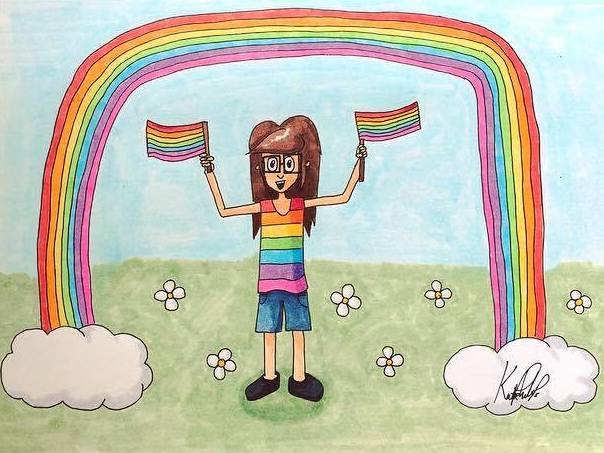
Turns out, rainbow folk in general show higher levels of anxiety, depression and suicidal thoughts than heterosexuals, so seeing as it is Pride month in the UK this month, I thought I would use this post to think about why that might be. It’s like that old saying, “if you are gay and you have mental health problems, it is your duty to mush those experiences together and write a blog about it.”

In my experience,I wouldn’t say that for me personally, being a member of the LGBTQ+ community has been THE trigger that led to all of my personal mental health problems, although I know that for some people, it can be.
Often I think it can be things like homophobic bullying and external discrimination that are the reason people who are LGBTQ+ might go on to suffer problems, and in that respect, I have been very lucky.
I have never been bullied for my sexuality, my family have always been very accepting (my mum to the point where she is basically a walking gay pride parade all year round and always gets very excited/becomes a fan every time any celebrity comes out as a homosexual), and I live in a country/time period where it is safe for me to be “out” without fearing arrest.
The only discrimination I have ever had has been the odd homophobic slur shouted out of a car window at me as I was walking down the street, but this has never really bothered me as I don’t have that much respect for the opinions of people who shout abuse out of car windows… I might admire their ability to project with their vocal chords out of a moving vehicle, but when it comes to their judgements on who I fall in love with, frankly, I don’t give a damn.

However being LGBTQ+ has certainly affected me because of discrimination, it is just that all of that discrimination came from my own head and in the early days of my queerness, led me to feeling very ashamed.
Nobody in my external surroundings was telling me I was weird or shouldn’t be gay, but my head was, and consequently I was scared to tell anyone about it incase they felt the same. Indeed I decided that rather than tell anyone, I would start a grand “make Katie straight” mission so that nobody would ever have to find out. You may wonder how on earth one goes about “de-gaying themselves” as surely to do so is impossible, and in that assumption, you would be right. Little old me however, was convinced otherwise.

The idea came to me whilst watching a television program which funnily enough, was about a straight woman seeing if she could undergo treatment to turn her gay…Good lord they show some weird things on TV these days…
Anyway, in the program, this woman was told by some mad scientist to use this machine that would give her electric shocks every time she thought something heterosexual in an attempt to recondition the brain to stop thinking those things. The theory was that if your brain experiences an electric shock every time you think about something, it will stop thinking about that thing (either that or your hair will stick out all over the place forevermore and you will run up one hell of an electricity bill).
Unfortunately, I did not have an electric shock machine. I did however, have access to a lot of sharp things around my household, and I think you can guess how things went from there without me providing any more detail. As part of my “make Katie straight” plan, I set about trying to literally cut the gay part away from me, a futile pursuit considering “gayness” is not an extra body part or a long fingernail you can clip away at until it is gone. Unsurprisingly, that plan didn’t work, but it did get me into a cycle of self harm that I couldn’t get away from and still struggle with to this day.

Admittedly, my struggle with self harm is not about being gay anymore, but the whole situation introduced the idea of self harm as a punishment, a coping mechanism to try and remove guilt or shame I was feeling about anything in life.
Rather than being a punishment for being gay, it has become a punishment for things like bad marks on a test at school, or saying something mean in an argument, and I actually used to keep a little notebook in my pocket throughout the day to keep track of my “crimes” so I knew how many “punishments” I deserved later.
At first I was only doing a few things “wrong” a day, but because I was scared to talk to any of my psychologists about it as that would involve telling them how self harm started, and though I was ok with being gay, I didn’t expect everyone else to be. Consequently the notebook of punishments escalated and got so out of hand that after a few months, every action was considered a crime deserving of punishment, from using a “large blob of toothpaste” (which would use up the family tube sooner and lead to money needing to be spent on a new one), to “not smiling well enough at my friend in the corridor at school”.

It wasn’t until my mum found some blood soaked clothing in my bag which I had been trying to smuggle into school to wash in the school sink before she could see it in the laundry, that the whole self harm as punishment thing came out, and even then I wouldn’t tell people how it had started.
By the time I did tell people that I was gay, I had already been in therapy for 8 years or so and had been through two admissions to psychiatric hospitals, always keeping that part of my identity hidden. Like I said, being gay has never been a cornerstone in the almighty Jenga tower of my insanity so I don’t think that keeping that part of me a secret severely hindered my treatment. I was still able to talk openly and honestly about the depression, OCD, BPD related problems and anorexia in therapy, yet although it isn’t the source of my mental health problems, when I finally came out to professionals it did serve as some kind of relief. Whether it had been important to OCD or not, I always had to watch what I said in sessions incase I accidentally let a possible clue slip like “I LOVE HELENA BONHAM CARTER AND I WANT TO MARRY HER IN A BIG GAY WEDDING WITH A BIG RAINBOW CAKE BECAUSE I AM A BIG GAY MYSELF”. Being able to talk openly without worrying about that certainly made a difference and made me feel more connected to my therapists, because I think if you are ever keeping a secret from anyone, you are automatically reserved around people even when that secret isn’t being discussed.

As you can see then, compared to some members of the LGBTQ+ community with mental health problems, being queer hasn’t had anywhere near the impact on me that it has on other people. In essence, being gay is the vanilla extract in my giant cake of insanity rather than the flour of which the majority of the cake comprises.
That said there are a lot of LGBTQ+ folk out there who struggle so much with their identity either due to judgement from outside sources or internal judgement on themselves, that being LGBTQ+ can be a direct cause of certain conditions like depression or anxiety and it is for these people that we need to talk more about this kind of thing in the hopes that they will be able to seek help themselves. If shame about your identity leads you to having mental health problems, it is likely that shame will prevent you from seeking help for them, and as we all know that is just going to make things worse.

In this post I do not want to do a shoutout to all the LGBTQ+ people out there who are hiding in the bushes and tell them to run about telling everyone about their identity, because I understand that for some people in certain families or countries, that might not be safe for them.
All I want to say is that if you are struggling and feeling like there is nobody to turn to, you are not alone and I can promise you that there are people out there who understand (I am one of them. Hello, it is nice to meet you. My name is Katie and if you bring me penguins we can be best friends). If being LGBTQ+ is causing mental health problems and it is not safe for you to speak to people around you, there are hundreds of LGBTQ+ mental health charities out there for every country (I will link a page recommending some existing in the UK below), and if you can, I would encourage you to reach out to them for support.
I am not going to demand you just get a rainbow flag and feel proud because it is pride month, as I understand it is not as easy as that, but I do hope to offer some sense of reassurance that being LGBTQ+ is NOT something anyone needs to to be ashamed of or punished for, no matter what that voice in your head tells you.

Take care everyone x
RainbowBlog

https://www.mind.org.uk/information-support/guides-to-support-and-services/lgbtq-mental-health/useful-contacts/#.WV0XKlKZPVo


Birthdays And Mental Health Problems

When I was younger and heard adults saying things like “I just want to forget about my birthday this year”, I thought that adults were crazy and needed to seriously reconsider the way in which they were living their lives. Why on earth would anyone ever want to forget about their birthday?

For me, birthdays were something to look forward to and something I couldn’t forget about if I tried. Birthdays were about choosing which soft play area you were going to take all of your friends to for the party, buying rainbow coloured bouncy balls to fill party bags with and deciding whether you wanted a Thomas the tank engine or Spice Girls birthday cake ready to decorate with a flaming beacon of candles. Birthdays were about unwrapping incredibly exciting and complicated plastic contraptions that you would then spend the rest of your day watching your mum struggle to assemble amidst an encyclopedia of instructions in every language but English, before finally making it look like the thing on the box, only to realise that batteries were not included, causing your mother to curse the creators of Toys R Us and howl at the moon until the early hours of the morning, Barbie’s camper van standing motionless and taunting you from the corner. Birthdays were about wearing a badge with your age on it to school so that everyone would know how very mature you were and how much respect they should bestow upon you, and no birthday was complete without a trip to TGI Fridays where you would stand on your chair like a king whilst a chorus of red and white striped waiters belted out “Happy Birthday”, the performance concluding with rapturous applause from all around and, if you were lucky, an extra gummy worm in your Mississippi mud pie. With all that to look forward to, how could anyone dread a birthday?

I was sure that I would always look forward to my birthday and would never be one of these fools who looked upon the occasion with anything other than spine tingling excitement. I was wrong.
For the past few years, despite little Katie’s best intentions, I have become one of those people who wants to forget about their birthday, and I think it is because as you get older, birthdays don’t mean the same things as they used to. They become less about gummy worms and birthday cakes and more about time passing you by, life passing you by, which isn’t something you really care about when you are younger and your main focus is getting the bit of icing on the cake that has your favourite cartoon character on it. On top of that however, when you are mentally ill, I think they are especially hard because for me at least, a birthday can feel like a reminder that you have wasted another year drowning in anxiety and the older you get, the longer you have been stuck with this mental illness bothering you all the time.

That said, I guess you can sort of see birthdays and that marker of time passing as a positive thing. This year for example, I turned 25 (I did it last Thursday as a matter of fact and luckily, despite all the dreading and worrying about it talked about in this post, I really did have a lovely birthday, so if you sent me a birthday message or said hello to me at all on the 22nd June then thank you for being someone who made it special. I really appreciate you all so much). Alas! I must get back to the point!
So, turning 25 means I will have been unwell for 14 years. On the plus side, whilst a depressingly long time, it is an improvement in the sense that I can say the number 14 because it is a safe number, unlike the number I used to have to say, (the one that comes between 12 and 14), which is a somewhat difficult number for me to handle in terms of OCD (YAY SILVER LININGS).
Also there is something rather motivating about birthdays in that they often inspire you to make goals of things you are unhappy about and want to change before the next one.
Indeed, I think that as the number of years I have been ill has gone up, the more motivated I have become to fight my illnesses and push as hard as I can for recovery even when it involves doing something scary.

During the first years of my illness when I had to go back a year in school and take time out of education to go into hospital, I was motivated to fight purely because my illnesses were making me unhappy, but not so much because I realised what I was missing out on whilst stuck in my head. Ok I often couldn’t leave the house and I missed out on a few sleepovers with friends, a couple of school trips and several opportunities to share a pizza and watch a movie on a Saturday night, but to begin with, missing the odd pizza isn’t that big a deal. Obviously I would have liked to have done all the things like going bowling with friends and eating popcorn at the cinema, but for me being safe at home not having to touch or eat anything, felt a lot more comfortable. I would have rather stayed in my little bubble avoiding as much anxiety as I could, even if that meant being a little bit lonely, than go out of my bubble and cause myself a lot of distress trying to wear a pair of bowling shoes or eating a mouthful of popcorn. Staying safe was my priority, and if that meant missing out on a few sleepovers/meant less terror, that was a necessary sacrifice I would take. Why terrify yourself for weeks and weeks just trying to get the courage to see a friend for an hour? Better just to avoid it.

However the longer you live with mental illness, the more those little things add up over the years, and suddenly you find you have not just missed the odd sleepover, you have missed hundreds of sleepovers, hundreds of moments in which people took photos and made memories that they reminisce about and fondly recall with sentences beginning “Oh my goodness do you remember when…”. After several years, you haven’t missed one bucket of popcorn, you have missed an entire swimming pool worth of popcorn (not that I advise you put popcorn into a swimming pool…just trying to get the image of how much popcorn we are talking about across), and that amount of popcorn can’t be caught up on as easily as the one bucket you missed in the first place. As the days become months and the months become years, you realise just how much of your life you have missed out on because you were too scared to take part in it, and suddenly the motivation to work even harder to stop the years passing by without you noticing increases, because you finally understand how rubbish it feels to be left so far behind everyone else.

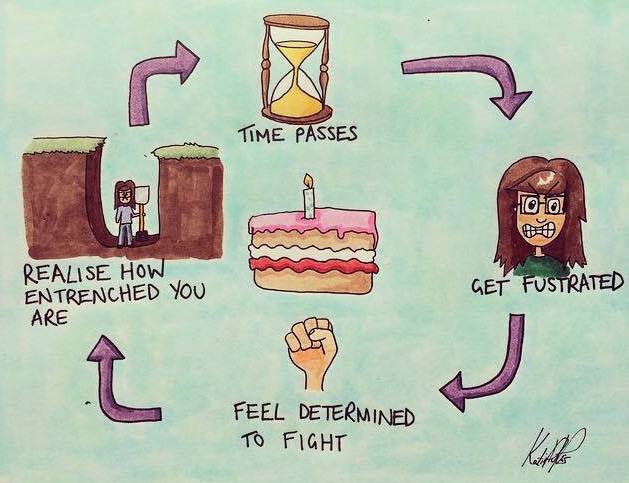
However at the same time, whilst the longer you live with a mental illness the more anger and frustration you have at it to motivate your recovery, the further entrenched you are in that illness and thus the harder it feels to get better. It is a catch 22 situation, the most vicious of all the vicious circles.

Time passes, you get angrier at all the time wasted, you become more motivated to fight but then find it is harder to fight than the first day you tried to challenge yourself because the illness has used the time wasted to dig its claws into you even further. Odd things that started out as little quirks to keep yourself safe become engrained habits and habits are a lot harder to break than things you only did a few times. I have smoked only one cigarette in my life and I will be honest, I hated it. It was like swallowing a smelly smokey fire. Therefore deciding to “give up” on the idea of smoking after that cigarette was not a challenge at all. I had spent longer as someone who didn’t smoke than I had spent as someone who did, it wasn’t a habit and I was not addicted or used to the comfort or feeling of a cigarette in my hand. Now however, I have officially been mentally ill for longer than I have ever been not mentally ill and I have dug myself into a hole so deep that it is far harder to get out of. Years ago I didn’t go to a meal out with friends because it made me uncomfortable, but that uncomfortable feeling has built over the years, and now I don’t go because I am terrified. Eating out doesn’t make me anxious, it makes me feel like I am dying on the inside. The longer you are ill, the more set in your ways you are and the harder it is to get better.

This year then, as always, though I dreaded my birthday as it scares me to think how long I have been trapped in my own mind, I am trying to see it as a positive motivation for change, an opportunity to say “this past 14 years has been hell and I am determined to fight as hard as I can to make sure that number doesn’t go up by one every time my age does”. I am fed up, truly angry every year as I see the growing list of all the opportunities I have missed out on and I really do want things to be different. It is just difficult, ageing with mental illness. As the years pass you may feel more motivated, but at the same time, you just feel more trapped.

Take care everyone x

BirthdayBlog

The Numbness Of Depression

Trigger warning: This blog post does include a reference to self harm (a very casual one with no details), but if that would trigger you please go and read something more relaxing like a manual telling you how to grow vegetables. I hear it is the perfect time to plant courgettes…

Depression is, technically, one illness named after one emotion. For me however, what depression feels like is different every day. Sometimes having depression is the experience I imagine most people picture depression to feel like, aka some days I am depressed/agonisingly sad. Over the course of any average week though, it is likely that depression will throw up some different negative emotions picked out of its sinister collection. One day the main emotion might be guilt, the next hopelessness, anxiety, anger or even intense pain to the point that I go a bit delirious and start laughing for no reason because I don’t know what else to do. For me, depression is not simply about being depressed, it is about being and feeling many different things and sometimes, in my experience, living with depression is about feeling nothing at all. Today is one of those days.

I think trying to explain what it feels like to be numb is one of the harder aspects of depression to express because…well…it doesn’t FEEL like anything…that is the point…
If I had to try to describe it I would say it’s like you turn into a robot or someone who is sleepwalking. I can walk, talk and carry out mechanical actions when instructed, but I am not really there, sort of the classic the lights are on but no-one’s home because the occupants have decided to go on a Mediterranean cruise for a few weeks (they went waterskiing and had ice-cream on the beach. It really was a wonderful holiday).

When I feel numb I am technically alive in that I am breathing, but there is no real life there, it is just a body on autopilot, a tin man who hasn’t yet been given a heart.
There is no passion, no want or desires. There aren’t even preferences, because when you don’t feel anything, everything in this world is the same so there isn’t anything to choose from.
For example, if you have taste buds, buying a tub of ice cream involves making a choice because all the flavours taste different and will therefore be experienced differently. The tub of vanilla will taste of vanilla, the chocolate of chocolate and the strawberry ice cream will taste of pistachios (there was a mix up at the factory).
If however, all the ice creams were to taste the same, there would be no choice to make, you cannot choose one thing over another when everything tastes of cardboard.
On these numb days, days like today, you could honestly walk up to me and give me the options of either a hug or a punch in the face and I would be indifferent to both of them. Logically I can see that it is nicer to have a hug than a punch in the face, so rationally I can understand that the hug should be my choice, but that choice has no feeling. I don’t want the hug nor do I dread the punch in the face, I just know the one to go for through the same logical process you might use to tick a box in an exam paper of non-verbal comprehension.

On the one hand you would think it might be nice to not feel anything, and you could say that it is better to feel nothing than to feel heart aching sadness. I do not agree.
When you are angry or sad, you get through that emotion by feeling it and living out the experience.
When you are angry you can ride that wave by shouting into a pillow to get the frustration out (be sure to apologise to the pillow later), and when you are sad you can cry until you run out of tears. I actually think that the feeling you get after a really good cry is almost worth all the crying it takes to get there.
When you are numb however, you can’t scream or cry it out because there is nothing there to get out. You can’t whip out some techniques you have used in therapy to calm down, there is no proactive action you can take, you just have to stand there staring into space (you can stare at a TV screen or a tree instead but it won’t make any difference because everything looks the same, like all of the ice cream tasted of cardboard). You just have to sit with it.

If I am feeling numb I often try to motivate some kind of feeling or life back into myself by looking at one of my lists of reasons to stay alive. Sounds a bit dramatic but these days suicidal thoughts are so frequent and loud that I have to have at least one list on me at all times to provide an answer to the question of “Why not just end it now?”.
I have lists on my phone, lists in my diary, on my wardrobe, lists of the people that I love and any possible goals or aspirations for the future.
For example I know that one day I want to be a writer, I want to go to Disneyland, I want to have a cat and a dog, I want to read all of the books I can get my hands on and I want to have a house with one of those bookshelves that has a ladder attached so that I can swing between F.Scott Fitzgerald, Harry Potter and the Bronte sisters like Belle from Beauty and the Beast.

When I am numb however, the lack of desires, want or interest in anything makes these reasons that I hold as fundamental to my survival, redundant. They don’t mean anything. They are just empty words. It makes me sound like a terrible person and there are probably people out there who think I am a terrible person for what I am about to say but the truth is that on days like today, I even look at reasons like “You need to keep fighting for your Mum and Dad” and I feel nothing towards it or my parents.
I know logically that I love them more than anything and I know they are the most wonderful, caring and supportive parents in the world, but I don’t feel that love, I don’t feel that “I love you”, it is merely a factual statement. I can read the words “You need to keep fighting for your mum and dad who you love very much” but that’s all they are. Letters. Words. A variety of marks and symbols made out of ink on a page, words with no more weight, depth, significance or profound importance than a casual offhand comment someone might make about how much milk they like in their tea. “I love my family” should have far more passion in it than “just a splash of milk please” but again, I am numb, the feelings are on mute, everything is the same. Everything is cardboard.

Similarly, there are many reasons as to why I struggle with self harm. Sometimes I do it because I feel that I need to be punished, need to release some built up anxiety rushing through my veins, need to make an invisible pain visible so that I can understand it, and sometimes on numb days, I do it to try and get myself to feel something. ANYTHING, even if that feeling is unpleasant.
Today I self harmed to try and inspire the life back into me, shock the system from robot mode to human just as you might pinch someone to wake them from a dream. I thought that if I caused the body pain, my mind would come back to feel it and then maybe I could cry and feel better, but even though I could see the damage on my body I couldn’t feel a thing. It was like harming a very lifelike mannequin.

Today then, that is what depression feels like for me. It feels like nothing. I feel numb. Everything is cardboard. Today, I have no passion. All I have are these words, so that is what I am giving to you. I hope you find some meaning in them.

Take care everyone x

RobotKatie

Embarrassing Incidents Caused By Mental Health Problems

I talk a lot on this blog about what it is like to live with various mental health problems, often waffling on about how exhausting, traumatic, frustrating and upsetting it is to have a brain that doesn’t want to co-operate with your goals in life. What I rarely talk about though, is that sometimes, as well as being all those serious things, living with mental health problems can just simply be damn embarrassing and leave you in awkward situations that you later look back on and feel like a fool.
Indeed, every time I have played one of those truth or dare games and the question has been “what has been your most embarrassing moment?” the first answer that has sprung to mind has been something related to mental health. It is also a question that often comes up when playing getting to know you games in any team building exercise you have found yourself roped into, yet every time I am asked such a question I never feel able to be honest because admitting to some of the nonsense you can get into when battling a mental illness, to a bunch of people who don’t understand such things, can sometimes be more embarrassing than the situation you are meaning to describe.

When it comes to picking an embarrassing mental health situation I have a bag full of examples to chose from (the one with the fireman or the “box of soggy kale in the cinema” incident are particular gems), but for today I think I am going to go with one of my more recent exploits that occurred during what I thought would be an innocent little trip to the supermarket.
As always mum and I were doing the food shop together and I was, as always, sticking right by her side, the childhood lesson that you should never run off on your own in a supermarket still burned into my brain as well as the fear of such a thing happening (when I was younger I lived in terror of the idea that one day I would have to have my name read out by some lady on a tannoy as the idiot who got lost and was found sobbing in an aisle of loo rolls. The shame of it!)
There is, however, one aisle in the supermarket that I am not a fan of, that being the meat aisle, so when my mum wheels her trolley down there I often hang out in the adjacent aisle and wait very patiently without panicking about my name being read to the entire shop over any tannoys. As I was waiting in the next aisle during this particular expedition, I noticed a woman enter from the other end, her arms extended out wide to carry a large pile of groceries.
To be honest, this woman (lets call her Bertha), really should have had a basket, but I think she was doing one of those whip rounds where you only plan on popping in to get a pint of milk and end up leaving with some Bombay mix, three jars of pickled onions, and a birthday cake in the shape of a caterpillar. I ignored dear Bertha in the beginning, and each of us continued along our merry ways without taking much notice of each other…

Then it happened.

Disaster struck.

Bertha, dropped her yoghurt. *Clashes cymbals for dramatic effect*

It was like watching a car crash in slow motion only with fewer screeching tyres and more rapidly descending low fat dairy products. Now, Bertha, aka dropper of the yoghurt, would have probably liked to have reached down to retrieve her shopping herself, but as I mentioned, Bertha was carrying a lot of groceries and in her defence was rather incapacitated (again, this woman really needed a basket). Had she bent down to retrieve the yoghurt herself, she would have risked an overflow of all of the other food items she had clasped to her chest, smashed jars, broken Bombay mix, wonky caterpillars, aka, total disaster.
As I looked at her carrying those groceries and saw the yoghurt fall to the floor, I instantly knew what was going to happen next. I was the only other person in the aisle. Bertha was going to ask me to pick up the yoghurt. *Clashes cymbals again as a blood curdling scream is heard over some hidden speaker system*

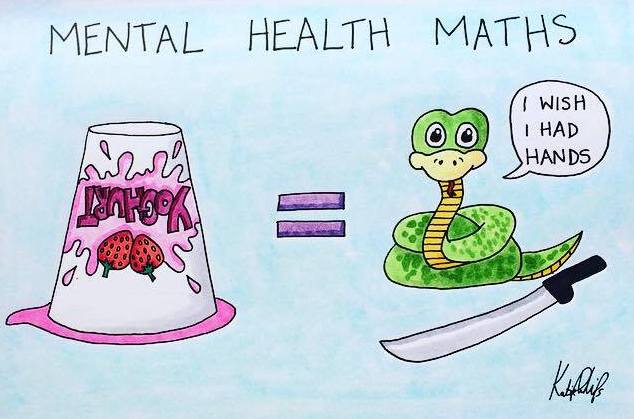
To most “normal” people/sane people, the idea of being asked to pick up a yoghurt is probably not that terrifying, but to someone with OCD who fears touching anything that has been on or near the floor, it was a nightmare. If I had to explain it, someone asking me to pick something off the floor gives me the anxiety someone would feel were they asked to pick up a rattlesnake carrying a machete…in its non existent hand…(note to self, next time when trying to think up an analogy, think of an animal with hands…)

The second that yoghurt hit the floor, I immediately set about looking like the busiest person ever to exist, in the hopes that Bertha would not ask me for assistance out of awareness that I was on a very important mission of my own. I snapped my head away from the yoghurt to the shelves and feigned a deep interest in a bottle of olive oil (rookie error, nobody is ever interested in olive oil. I should have gone for pasta but alas, retrospect is a wonderful thing). I stared at this bottle of olive oil and peered at it so closely you would have thought the meaning of life was inscribed in tiny letters along the side of the label, as if this olive oil was the most fascinating and wonderful thing I had ever seen. My acting was impeccable, several people from the frozen section even applauded despite their distance from my performance, and sent fan mail which I received a few days later. Bertha however, did not take the hint. Despite my acting performance, Bertha saw me and my bottle of olive oil and said in a voice that sent shivers down my very spine “excuse me can you please pick up my yoghurt?” *clashes cymbals so violently that they break into a million pieces and the very centre of the earth explodes*

Looking back, you may ask me why I didn’t just say that I had OCD and couldn’t help, before venturing off to find someone better suited to the needs of someone who needs their yoghurt risen from the ground like some 21st century Lazarus. If I had had a leg disease or something, I would have had no problem in saying “sorry I am currently disabled because of my leg disease” yet for some reason it seemed unacceptable to say “I am currently disabled because my brain is broken”. It doesn’t make any sense, both are a disability and both physical and mental illnesses impact and interfere with your life, but still I couldn’t be honest because saying I had OCD felt a million times more embarrassing than saying I had a leg disease. This sounds especially weird for someone who is able to speak openly about their mental health problems online without shame, but then again I think that is because I don’t really believe that anyone is reading my blog and if they are (hello you), I know they can’t see me hiding behind a cushion in the corner as they do so. For some reason I found that I couldn’t tell Bertha the truth, provide her with an explanation as to why I was scared to pick up her yoghurt, so instead I did the next best thing. I ran away. As I sprinted off into the distance I didn’t look back, but in my mind I can still see the imagined image of Bertha standing there over her yoghurt, Bombay mix tucked under her chin, staring after me and wondering what on earth was going on.

I grabbed my mum and dashed us out of the shop before we could buy anything (we were all very hungry that week), and by the time we got home I felt terrible. Ok I was embarrassed but I also felt incredibly guilty. Here was this poor woman asking me for yoghurt help, and I ran away.
It just makes me wish that there was less shame and less embarrassment over disabilities caused by mental illness, so that people could be honest in that kind of situation. I truly dream to live in a world where one day it will be possible to say “I am scared to pick up your yoghurt because I have OCD” without looking like a lunatic and whilst being taken as seriously as anyone with a physical and more visible impairment. Maybe I am underestimating Bertha and maybe she would have been understanding, but still you have to admit it is more likely she would have raised an eyebrow at the mental illness excuse as oppose to the leg disease thing.

If any of you out there have found yourselves in similar embarrassing situations in which your mental health problem made you feel like a fool, I hope you see this post as a comfort. Remember you are not alone in feeling like a bit of an idiot because there is someone out there who left a woman with her yoghurt on the floor, but more importantly, remember that when in the supermarket, one should always remember to pick up a basket before heading for the yoghurt.

Take care everyone x

Yoghurt

How To Tackle Suicidal Thoughts And The Fear That Things Will Never Get Better

So, I will be honest, I am currently in a very dark place (my parents haven’t paid the electricity bill and I ate our entire supply of candles because they smelled like Jaffa cakes…Alas they did not taste like Jaffa cakes and I am still picking wax out of my teeth. Life lesson: do not eat scented candles).
Seriously though, mentally, things with me are pretty terrible and I am on the brink of giving up entirely. I am losing hope in the idea that one day things will be better, and recently I have noticed a lot of friends or people online with mental health problems feeling the same.

I think that there have been times in my life where I have just assumed that I am going to get better, just as you grow up assuming you will naturally fall into the stereotypical life of getting married and having a few kids. When I was younger I was always watching Disney films, and when it comes to Cinderella or Snow White, there is never any doubt as to how things are going to end. When you watch Cinderella you don’t sit around worrying that she will be stuck sweeping floorboards for the rest of her life, you know straight away that the girl is going to go to the ball in a big ole pumpkin and that her poor choice of ill fitting footwear is going to result in her marrying the man of her dreams. Naturally then, I assumed that one day I would lose a shoe and automatically fall in love with and marry some Prince Charming, without realising that my mother would never allow me to buy footwear I hadn’t tried on to ensure a perfect fit, or that I was a queer little thing who wasn’t interested in princes no matter how “charming” they may be.
Similarly with mental health problems, I guess I have always assumed that somehow, no matter what happens, one day there will be a fairy godmother with a magic wand and things will get better. I do not know how or when, but I simply couldn’t get my head round the idea that this could be it, that recovery isn’t as automatic and as assumed as I imagined princes to be, that sometimes, people spend their lives as tortured mentally ill souls with no happy ending.

Thinking like this, if I am going be in this state forever, it is easy to ask myself why not just end it now? Why draw it out? Why not rip the plaster off quickly as it were. It sounds incredibly bleak, but mental health problems are incredibly bleak and I am not going to sugar coat them to insinuate otherwise. Recently I have been having suicidal thoughts every minute of everyday, and when you don’t think you are ever going to get better, it is hard to come up with a good argument to fight them.

Like I said, I am not alone in feeling this, and I have had many conversations with fellow mental health warriors who have lost hope, who don’t think there is any chance of them getting better so why carry on? Maybe you yourself reading this have resigned yourself to the fact that you are a terminal case, perhaps because a professional has given you the label of “chronic” or simply because the weight of your struggles is so heavy that trying to imagine life without them is akin to trying to imagine a penguin without the adorablessness which, as we all know, is impossible (if anyone wants to debate this issue feel free to contact my solicitor and I will happily see you in court).
There is however one thing that I do find comforting, even when I fully believe that I will be like this forever, one argument against the suicidal screaming in my head telling me to jump into oblivion and end the debates/suffering once and for all, an argument that funnily enough, comes in the form of basic mathematics (don’t panic, I hate maths too but this is cool maths I promise and you don’t even need a protractor or a calculator to join in).

If you hark back to your maths lessons at school, you may remember the point where you started learning about things like probability. The lessons get more complex as each year passes, but in the early days of primary school education, the grand complexities of probability and chance are usually explained via some kind of analogy involving a bag filled with balls, for as we all know, in later life it is an incredibly common experience to be confronted with a bag of balls and the need to calculate your chances of picking out a specific kind of ball.
In the lesson, it is likely that the teacher produced a bag to explain things, and would say something like “there are ten balls in the bag, five green, five purple” before waffling on a bit about how if you put your hand in the bag there is an equal chance that the ball you pull out will be purple as there is for it to be green. Then the teacher usually complicated matters (don’t they always), and added say ten more purple balls to the bag. This would then make the chances of picking out a green ball less than they had been previously, and you will spend the next twenty minutes of that lesson calculating chance and ratios surrounding various combinations of coloured balls in a bag.

Now for the purpose of this discussion lets scrap the balls and replace it with a bag of Smarties because let’s be honest, we are not in some official school right now, we can do what we want in this maths lesson and if we want Smarties instead of balls we will damn well have them (I told you this maths would be fun…THERE ARE SMARTIES INVOLVED).

So, picture life as a bag filled with millions upon millions of Smarties (it is a really really big bag and these are really small Smarties).
All the Smarties in this bag are pink. Except for one. One of the Smarties hidden somewhere in that bag is blue. That blue Smartie is the chance of you getting better in a world of pink Smarties telling you that that isn’t going to happen. If you put your hand in the bag you may very well be right, you may get a pink Smartie and be mentally ill and miserable forever. In your mind the chances of you getting better are as rare as that blue Smartie, but the key thing is, as long as you are alive, that blue Smartie is still there, and the only way to guarantee 100% your belief or the professionals’ belief that you will never recover and are going to be miserable forever, is for you to end it all now.

When I have days that are plagued by suicidal thoughts so loud I can barely breathe because I don’t think things will ever be better, I always remind myself that the only way to make sure they don’t get better, is to listen to those thoughts. Killing yourself is basically like pouring all of your Smarties into the ocean so that the colour washes off and they all become white Smarties with that blue Smartie existing only in the realms of myths and legend. If you hang in there, aka you keep plunging your hand into that massive bag, there are no guarantees of you getting better, but by keeping yourself alive, at least you are keeping that chance alive too, however small and insignificant that chance may be.

Now like I said, I am going to be honest in this blog, because if you are someone who reads this blog, then I consider you as a friend and friends tell the truth so I refuse to sugar coat any of this (the only sugar coated contents of this blog are the Smarties).
If you are in a dark place like me right now, and have spent the day contemplating your demise, I am not here to tell you that if you keep fighting through this rubbish it will all work out in the end. I am not a fortune teller, I do not have a crystal ball, and the only conclusion I have ever gleaned from reading tea leaves is that I seem to have run out of tea. If you keep yourself alive and keep fighting maybe you are right, maybe things will stay rubbish and maybe you will keep plunging your hand into that bag and pulling out the pink Smarties. However, no matter how hopeless you feel, if you keep yourself alive, the chance that the blue Smartie will crop up is there. I cannot tell you the probability/ratio of how likely you are to get better, but you must always remember that if you are trying, there is at least a chance. Don’t allow the fear of being mentally ill forever, convince you to do the one thing that ironically does nothing but solidify that conclusion.
Fight back, keep trying, keep safe, and even in the darkest days, no matter what, you have to believe in that blue Smartie.

Take care everyone x

SuicideSmartie

Why We Need To Keep Talking About Mental Health

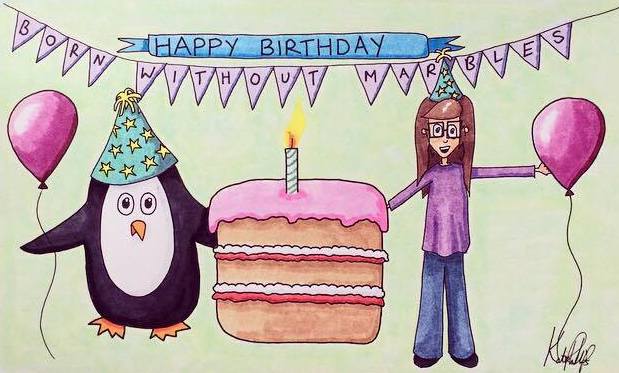
Tomorrow is a very special day for this blog that you are oh so kindly reading in this moment (cheers for that), for tomorrow will mark the one year anniversary of Born Without Marbles being “a thing” on the internet as opposed to an idea in my head that I was too scared to carry out.
That means that I have been harping on about mental health, whether you have liked it or not, for an entire year, and I wouldn’t be surprised if there were people out there wondering why on earth I am still waffling on about illnesses that the majority of the population are well aware of by now.
Ok the general public may have misconceived ideas and perceptions as to what an illness may really be like, but everyone has a rough idea these days as to what things like OCD and Anorexia actually are, so why am I still talking about these things and why do I plan on continuing to talk about these things for the foreseeable future? Newton isn’t still harping on about the time that apple fell on his head (partly because Gravity is old news that doesn’t own the headlines these days and partly because he died in 1726 which somewhat limits his abilities to “harp on”), so why do I keep talking about what it is like to be mentally ill when the existence of mental illnesses is no longer breaking news. Well friends, whether you have been here from the beginning or whether this is your first experience of Born Without Marbles (Welcome. Please excuse the penguins I have left lying around in each post. They are kind of important), today I am going to answer that question and tell you why, even after a year of weekly waffling, I still feel that we all need to keep talking about mental health.

Of course there are all the obvious things like the fact that the more we talk about mental illness, the more research there will be and in turn the more likely we are to find a cure. To explain why I personally have such a passion for the subject however, I need to take you back to 2003, and, more specifically, eleven year old Katie (to set the scene I looked exactly the same as I do now only shorter).
As the name of this blog suggests, I can see that I have shown signs of mental illness from the moment I was born, but it was in 2003 that things really began to become a problem, that I became afraid and ashamed for the first time of the thoughts going on in my head. It was the first time that I didn’t feel normal, and feared that I was different from everyone else.

Every day at school I would watch other pupils in awe. I would see them eating school dinners, opening doors and shaking hands with each other as if it was the easiest thing in the world, and I would wonder how on earth they did it all. For some reason when I tried to open a door, I would find myself frozen in fear, unable to touch the handle as if someone was holding my arms behind my back. When I was in the queue for school dinners, my head was screaming at me to run away because I wasn’t allowed to eat, and no matter how hard I tried to concentrate in lessons about ox bow lakes, all I could see in my mind were images of terrible things happening to all the people I loved, and hear threats that the only way to stop those things happening was to repeat some kind of ritual. This would have been rubbish enough, but the worst bit was that I had no idea what this meant or why this was happening. I thought long and hard, trying to come up with an explanation but the whole thing made very little sense to me. What was so scary about the germs on a door handle when I had evidence all around me showing that nothing bad was happening to people “contaminated” with them? Why couldn’t I go to lunch, even on pasta days? Logically I knew that I loved pasta (pasta is flipping awesome), so why did the idea of eating a steaming bowlful topped with as much cheese as I could get away with before a disapproving dinner lady grasped my cheddar filled palm, scare me so much?
These things went on for months, and I said nothing to anyone because I was too afraid. Maybe mental health wasn’t as widely discussed in 2003 or maybe I was just unaware of what mental illnesses were, but I had never heard of anyone experiencing these things so I kept silent and hoped they would go away. Spoiler alert: they didn’t. Of all the awkward situations I found myself in however, there is one in particular that sticks in my mind and one that continues to motivate me and my dedication to this blog today.

“It” happened at the end of a music lesson. Now, in my school, music was taught in a separate building to all others, ditto art, drama, and DT who all had their own individual buildings (something tells me the staff members of the more creative subjects did not get on well…this explanation of the separate buildings certainly correlates with the time I saw the head of drama pelting the art teacher’s studio with water balloons anyway…)

On the day in which our story occurred, our class had been taken to a room on the top floor of the music building where there were a lot of computers and keyboards set up for us to spend a few hours learning how to play the theme tune from Titanic (a vital part to any eleven year old’s education). Then, the lesson ended and we were dismissed, a fact that meant we were going to have to leave the room and therefore, someone was going to have to open the door. Usually I was very good at avoiding such a responsibility, and at the end of every lesson I would fumble around with my bag until someone else had done the job so that I could scoot on after them without touching anything. This technique worked perfectly for every lesson, but today, for some reason, the teacher wanted us to lead out in single file from the nearest computer to the door. I think maybe someone had been messing about with a keyboard, playing Celine Dion’s soundtrack with a little too much gusto, so in the exit of the classroom, the teacher wanted to establish some serious authority. I felt sick. I was at the computer nearest the door. I was to be the first to leave, I was to lead my fellow students to freedom. I was to open the door. When I saw that it was a push door then, I was thrilled. Happily I nudged the door with my foot and led my classmates out, but the relief was short lived as I realised we were headed for another door, a pull one with a handle…AND AN EXIT CODE KEYPAD.
I thought about pausing in the corridor to let someone overtake but the corridor was too narrow, it was single file, there was no escape, and as I walked down the stair case to the door I genuinely felt like I was walking to the gallows. This was it. I was going to have to touch a door handle, and it was going to be the end of the world. When I reached the door I stopped. The time had come to raise my hand, but I couldn’t move. Instead, I just found myself stuck, panic building as the queue of students eager to go home started forming behind me. Luckily everyone was talking about the day too much to notice my embarrassing situation at first, but after a few minutes of standing in a line waiting, understandably, people started wondering what the hell was going on, and from the back of the line I heard a voice ask perfectly reasonably “is there something wrong with the door?” From then it went silent and all I could hear was the response in my head of “no actually, there is nothing wrong with the door, there is something wrong with me and I have no idea what it is”.

Eventually, after what felt like 34 years, the person behind me became impatient, reached around and opened the door, and from there I ran sobbing to the medical centre with shame, fear and embarrassment. I didn’t want to see anyone ever again, I had to hide, so I decided to take refuge in the sanitarium. When the nurse asked me what was wrong, I lied and told her that I had a tummy ache. I spent the rest of the day curled up on the sofa with a hot wheat bag watching episodes of the Simpsons, feeling more alone than I knew it was possible to feel. There were hundreds of other pupils in the school, but for some reason I was different, I couldn’t open doors or eat meals like they appeared to, and there was nobody, least of all me, who understood why.

It is for that Katie sitting on that sofa with that smelly hot wheat bag that I started this blog, and it is for all the smelly hot wheat bag holding people out there pretending to be fine, pretending to have tummy aches to cover up the fact they are terrified of their own minds and too scared to speak out for fear that other people won’t believe them, that I write this blog. Had I heard about mental health problems sooner, maybe I would have asked for support sooner, but what I would have found more helpful than any of the symptoms listed in the millions of health care packs, would have been the knowledge that there was at least someone out there who struggled with the same things, who let me know I wasn’t crazy, that I wasn’t alone. It is for that reason that, no matter how much awareness there is about the existence of mental illnesses, I will keep talking about my experiences with mental health problems in public spaces. This isn’t a blog to just give information, in my eyes, this blog is a friend, both to me, to the readers and to anyone out there who comments to say that they can relate to my problems and thus remind me once again that none of us are alone.

So happy birthday Born Without Marbles, and thank you from the bottom of my heart for all the support anyone reading this has ever provided. Here’s to another year, another 52 weeks of my ramblings, another 365 days of friendship.

Take care everyone x

MarblesBirthday

My New Diagnosis

For well over a decade, and since my very first therapy session many moons ago, (aka JUST after the dinosaurs died out and at the time when there were Tyrannosaurus Rex bones still lying about EVERYWHERE after that rather inconvenient meteor), therapists and psychologists across the country have always said that there is “something” wrong with me. Obviously they have always known about my OCD, Eating Disorder and Depression, yet still many have insisted that there is “something else” lurking within me and playing general havoc with my brain.

I have always found this “something wrong” that nobody can put their finger on, (or any body part for that matter), to be rather confusing.
When I was 15 the it was banded about that this “thing” might be bipolar disorder, but after trial and error with a few medications, that suggestion was tidied away as well as all the others and I have tried my best to forget about it. I was doing pretty well with this forgetting thing in my opinion (I had placed the “there is something wrong with you that we do not understand” memory alongside Pythagorus’ theorem in the box of “things I no longer need to know after the age of 16”), but then my forgetting box was rudely ripped open again very recently.
If you have been following this blog for a while you may remember that I had an assessment with a new OCD service in October of last year, a three hour interrogation examining all of my mental health problems and experiences of the world throughout my life. I mentioned nothing of any extra “bonus” diagnosis that nobody was sure of, so for this reason I was surprised when the psychologist I was speaking to randomly asked if I had any other diagnoses, as yet again I was showing signs of this “something else”, that something possibly being a “personality disorder”. I didn’t mention this when I had the assessment all those months ago because I imagined it would go away like all those other conversations of mysterious mental health problems in the past.
When I was told that the OCD service may not be able to facilitate my care if I had a personality disorder and I may need to see another service first however, I was unable to forget it again and became increasingly frustrated. Here I was potentially having issues with receiving treatment because of a mysterious something that I wasn’t even diagnosed with, and it was at that point that I knew I needed answers.

Like I said in my “why I like being diagnosed with mental health problems” blog post a few weeks ago, I like having the labels and diagnoses of my conditions in black and white because it helps me to deal with them and means I know what enemy I should be fighting. If you want a full understanding of why I like being diagnosed with (NOT HAVING) mental health problems, then I fully recommend checking that post out before this one (Why I Like Being Diagnosed With Mental Health Problems – it really is a great read. Trust me it involves a picture of a monkey banging a gong and singing Bohemian Rhapsody), but as a brief summary for all those with an aversion to classic song performing primates, my argument was that I like being diagnosed with mental health problems because it is only when you name a problem and pin it down that you can figure out how to overcome it. It is useless for a person working in a garage to simply say “there is something wrong with your car” because then they can’t fix it. They need to specifically identify the issue that there is a gaping hole in the front tyre, as only when they know that, do they know where they start tinkering and what equipment they will need.

Consequently, after my OCD assessment, I went to each of the three therapists I see in turn and asked them to tell me if there was something wrong and if so, what the hell it was. I can’t remember who first brought it up, but rather quickly a condition (we will call it Penguin condition for the time being), was suggested as the answer to all the questions I have had over the years. From that suggestion I had many appointments discussing the condition and as instructed, I researched it, learnt about it, and I watched a DVD given to me by a therapist, of various people being interviewed about their experience of Penguin condition.

Of course I didn’t relate to every single person on the DVD nor did I agree with some of the explanations of Penguin condition online, but on the whole, when learning about it, something clicked. As I heard people talking about what it was like I was astonished to hear them basically describing things I do/have experienced in life, and although scared and not eager to add a new diagnosis to my list, I was at least a little relieved. Finally I wasn’t just “weird”, I had Penguin condition and maybe if I started dealing with it, things would improve across the board. Perhaps the underlying issue of Penguin condition was the reason for the OCD and eating disorder, perhaps none of the treatment has cured me yet because we were actually treating the wrong parts first, like trying to eat the chunks of brownie at the bottom of a sundae glass before you have tackled the ice cream piled on top of it (ALWAYS SAVE THE BROWNIE BITS FOR LAST. ALWAYS. THAT IS THE RULE. ICE CREAM FIRST, BROWNIES LATER).

For this reason I became eager for the diagnosis to be put in place so that I could finally know where I stood. As well as answering my need for answers I also wanted it made official so that future therapists or medical professionals would know the full story if ever reading my notes, without me having to always add into new introductions the explanatory “I know you have read my notes but just so you know Penguin disorder is also on there but it is not written down”. I wanted it in black and white to be neat, to be clear, and partly because when things are in black and white, they look a little more like a penguin without the beak.

Then, a few weeks ago, I had a session with my psychiatrist and it was decided that we would make it official and the diagnosis would go on my records. At first I was relieved, but then he started to warn me about the consequences of it being made official. Suddenly I wanted to forget all about it and fall back into blissful ignorance again.
Apparently this condition is one with a lot of stigma to it, stigma that can lead to some therapists refusing to see you if you have the diagnosis. This wasn’t really a problem for me. If a therapist isn’t going to see me because I have a certain mental health problem then clearly they aren’t a good therapist or a person that I want to associate with anyway, but the constant reinforcement of judgement that could potentially befall me freaked me out a bit. I am not ashamed of having mental health problems, I talk about them openly on the internet for this reason and to hopefully help others be less ashamed about their disorders, yet with Penguin condition I really was rather scared and embarressed. My psychiatrist said he could treat me for the condition and just not put it on my notes if I would prefer, yet as easy as that would be, I still felt uncomfortable. Yes I wouldn’t have the “shame” of being diagnosed with a condition that faces a lot of stigma, but on some level I would also be admitting that there was shame in the condition and that I should keep it on the down low which is not how I feel about any other mental health problem I have. I am a firm believer that if you have a problem, keeping it on the down low is only going to make it worse and will not raise any of the positive awareness that could potentially be spread with honesty. Nevertheless I am a little afraid, and so for now it is on my notes as “under revision” incase I change my mind by the next appointment and want it removed (apparently without the under revision bit this is something that once on your records, will not come off no matter how much scrubbing or Cilit Bang you apply. Bang and the dirt is gone? Yeah, but the disorder will still be there!).

I have a few days until my next appointment now, and by that next session I have to decide whether or not I want to specify that mysterious something wrong or just sweep it under the carpet again. As well as debating whether to let it on my medical notes I have been debating whether or not to bring it up or “come out” with it in my blog. Again, my initial reaction was no. Even my mum agreed that it might not be the best idea. If you google the condition or do any surface level research on it, people with this disorder are painted as crazed monsters who are unbearable to be around. Reading the articles even I admit that I started to think that I would never want anything to do with someone suffering from the condition, and that was when I made my decision to get over my fear, come clean and talk about it on my blog like I talk about everything else, regardless of whether anyone else is interested. If everyone thinks people with Penguin condition are dangerously insane, then I want to talk about it and I want to raise awareness of the fact that that is not the case and what the people with it are really like. As you can see I am still scared of saying it on here (hence the code name Penguin condition), as I do fear the judgement, but they say feel the fear and do it anyway, so here it goes.

My most recent mental heath update then? After all that waffle what has happened? Well dear friend, I have been diagnosed with Borderline Personality disorder. I am still exactly the same blogger you have been following for however long you have been, with exactly the same issues. It’s just that one of the hidden ones now has a name (sort of like when some women on TV seem to name one of their boobs…it is something that has always been there only now it can be addressed formally in a letter or serious conversation). As you can see this post is long enough as it is so I won’t go into what that means and what myths need debunking here, but for now I feel like telling you is a big enough step. (That said I know many people do not know what this disorder is or have many misconceptions so, before I can provide an explanation of my personal experience I have linked a PDF below from the charity “Mind” which I feel is the best and least stigmatised description around, so if you want to learn more, dear god please go there rather than to a general google search).
Maybe I will delete this post before I upload it but I hope I don’t, and if you are reading it then I guess I have been brave. Nobody should be ashamed of their mental health problems, and I for one am going to live by that, even if doing so is something that scares me right now.

Take care everyone x

diagnosispicture


http://www.mind.org.uk/information-support/types-of-mental-health-problems/borderline-personality-disorder-bpd/#.WLRDi7GcbVo

Why Baby Steps Are More Important Than New Year’s Resolutions In Mental Health Recovery

There are two kinds of people in this world, those who like and make New Year’s resolutions, and those who think that New Year’s resolutions are pointless and should actually be renamed as “things you try to do all year but give up on by February”. I myself however, am somewhat in the middle of these two kinds of people (much like I am on the whole Marmite debate. I don’t love it, nor do I hate it. I am truly indifferent…WHAT DOES THIS MEAN).
I actually like the idea behind New Year’s resolutions. I think it is good to see the new year as a chance to improve on whatever happened in the previous one, see it as a fresh start and a clean slate without all the baggage you have dragged around for the past twelve months. That said, I have not made a New Year’s resolution myself since 2010, and that is because I feel that when people make these promises to change, they are far too ambitious and unattainable. They set themselves tasks like “fly to the moon” or “play tennis at Wimbledon” when they haven’t yet thought to apply to astronaut school or pick up a racket. Back in 2010 I made three new years resolutions, those being:

  1. Be happy all the time
  2. No anorexia
  3. No OCD

As midnight approached I felt a surge of excitement. The moment that clock chimed (lets pretend we still live in a time where it is common to have a grandfather clock that chimes..it is a nicer image than me staring at the digital numbers on my phone waiting for 23:59 to become 00:00), my life was going to change, I was determined, and I had made a promise to myself that 2011 was going to be better. Then it happened. The clock struck midnight, and suddenly my carriage that had brought me to the party turned into a pumpkin and I lost a glass slipper!…Wait..no sorry…got mixed up in the life of someone else a little…no, what actually happened was the clock struck midnight and I felt a weight fall from my shoulders (much like a glass slipper was slipping from the sole of a future princess…)

Finally 2011 was here and I was recovered, I never had to do an OCD ritual again, I could eat and I would be smiling for the rest of my life. Looking back I can’t believe I was so deluded, but the first thing I did in 2011 was to run to the bathroom to wash my hands once, just to prove that I was in control again and could stop easily after one squirt of soap. But I didn’t stop. After the squirt had been collected in to my hands my thoughts immediately burst in and I found myself rubbing my hands together vigorously with the same urgency as I had done in 2010. I became incredibly stuck, thoughts flying so rapidly that before I knew it a significant amount of time had passed, over 100 squirts of soap had been used and the only thing I could see through the tears of despair and frustration was a basin full of bubbles. As I went back downstairs to join the others still milling around drinking champagne and watching the odd late firework banging about in the distance, I felt totally defeated. I had failed. I hadn’t even kept my resolution for 24 hours before engaging in the behaviours I told myself I was finished with, and my hopes for change fizzled out like an old sparkler. Granted I was being a bit dramatic by seeing the whole year as ruined and giving up because of one ritual, but logically because of the strict boundaries of “No” OCD, I had in essence failed, so what was the point carrying on? Clearly recovery was impossible.
It is only now looking back that I realise that the problem with my resolution and the reason I had “failed” was entirely the wording and dramatic nature of the resolution I had made. I didn’t set myself a manageable goal of trying to reduce the amount of time in the shower over the course of the year or anything reasonable, a goal that would focus on steady progress with potential slip ups yet still a continuous effort to push forward. Instead I had set myself the impossible task of transforming from a person who had been dominated by mental health problems for the last 7 years to a “normal person” in less than 7 seconds, which is pretty much like someone setting the goal of “flying to the moon” without realising all the steps it takes to get to that point.

Admittedly, I have always struggled with people telling me to “take things steady” and “take baby steps” when it comes to recovery. I am a very black and white person, either I am better or I am not, “baby steps” and little goals like “exercise for five minutes less per day” do not help me. I want total freedom from this mental health cage, not just the same cage with an ocean view.
However, my attitude to all this recently underwent a bit of refurbishment when I was glancing through pictures on Facebook and stumbled across a photograph that I posted online in 2014 to commemorate the fact that I had graduated from university, and for the first time, as I looked at the picture, taking “baby steps” made some sense.

babysteps
As you can see this picture is a comparison shot between little 4 year old me on my first day of school, and 22 year old me graduating from university after a rocky 18 years bumbling through the education system (I look pretty happy in that picture but that was because my mum took it before I found out I wasn’t allowed to keep the funny hat and gown. That was a major disappointment. The only thing I got out of that day was a piece of paper saying I had a theology degree. Who the hell wants that? I didn’t go to university to be educated, I went for the damn hat!)

Looking at these pictures it is very black and white. In one I have a degree (and a marvellous hat), and in the other, I have no degree (and no hat. 4 year old Katie had a hard life). That said, though there is a stark difference in achievement between those two pictures, it isn’t because I made a grand resolution at the age of 4 that changed my life in a second. When I was 4, the thought of getting a degree one day had not entered my mind.
Imagine if someone went back in time now, found little 4 year old me and said “go and get a degree in theology this year”. I would probably have cried (and asked what the hell theology was). When I was 4 there was no way I could just go off and get a degree. I had birthday parties to plan for my teddy bears, letters to write to Santa and hopscotch competitions to attend! I couldn’t tie my shoes yet let alone write essays on Saint Thomas Aquinas or Augustine of Hippo (genuine name…Hippo…it has been years but I am still amused), so setting that goal for me at age four would have been overly ambitious and basically would have set me up to fail.
Had this time travelling person told me to go to school that day however instead of getting a degree right then and there, I would have probably looked at them, nodded and then got on with it. When doing so I wouldn’t have realised that me turning up for a morning of finger painting was actually the first part of my journey to that oh so lovely yet tragically temporary hat (and a degree I am now stuck with forever), but it was. Without achieving all those little steps in-between, the sports days, the story books and the words of wisdom over the years, I would never have got that degree (actually maybe cancel the sports day bit..I don’t think they were particularly important…).

My 2010 new years resolutions to totally recover in the blink of an eye then, were basically the equivalent of me telling 4 year old Katie to go and get a degree before the little tike had learned to read, and it is in realising this that I can see the value in making new years resolutions, as long as they are the baby steps to get you to your goal rather than a leap to success that no Olympic long jumper could make even with a springboard.
If you want to set yourself a resolution for 2017, make a resolution that you can do over time, that allows for mistakes and gradual progress rather than instantaneous results. If you want to recover completely from OCD, make your goal to try and reduced the number of times you get caught in rituals over the course of the year. If you want to recover from depression don’t set the goal of being happy all the time, simply think about the things that could one day make you happy and go out trying to achieve them, even if that goal is just phoning up to enquire about a course. It is the same with progress in eating disorder behaviours as well as any other mental health condition, and though admittedly it takes a lot longer than the midnight miracle method I wished for in 2010, I think it is the only way to make it through this journey.

My hope in life is that one day I will be able to take a picture as someone who is no longer struggling with mental illness and to see it alongside that 4 year old me as a sign of how far I have come in ways other than education, and working towards that is my goal for the next twelve months. 2017 is not going to be “my year”, the year I change, recover totally and get a brand new life, but it is another year in which I will continue my 2016 resolution of doing all I can, listening to professionals, talking and attending all appointments, to one day make that massive goal of recovery. Taking my medication this morning has not made me better, but hopefully it is a baby step along the way.

Happy New Year everyone x

newyear