Why Friendship Is Important When Battling A Mental Health Problem

A few months ago I read a quote stating that when “I” became “we”, mental illness became mental wellness. Now at the time I will admit I thought that statement was a nice thing to write on the wall of a psychiatric unit (as in properly artistically written as a message, purposely placed there by the authorities rather than some crazed crayon scrawl of a patient with too much time and too many crayons), but other than that I didn’t believe the statement very much. It felt like one of those things that is all well and good to say like “the sun will come out tomorrow” and other similarly cheesy phrases sung by red headed orphans who have no experience, knowledge or authority in weather forecasting to make any such predictions, but I have to say that over the past few weeks, I have realised that this quote is actually pretty accurate. Okay, it is not flawless, but there is a lot more truth in it than the words of a deluded 10 year old who thinks no outfit is complete without a smile, a very inappropriate thing to wear to a relative’s funeral.

I think I can say on behalf of many, that having a mental health problem is very lonely.
For one thing there is the actual physical distance created by mental illness. Maybe your difficulties restrict your ability to take part in life so you lose touch with friends leading “normal” lives and end up pretty isolated. Maybe you have to take time off work to go into hospital or to have treatment which separates you from the community in which you may have played a part. Maybe you fall out with acquaintances who cannot understand why you can’t “just be normal” when “it’s all in your head” and there is “nothing physically wrong with you”, but the biggest distance is the unseen emotional distance that nobody really talks about. When you are so trapped in thoughts spiralling around in your head, you feel as if you are a million miles away from people who may be sat right beside you, simply because you can’t relate to them in anyway. You watch them laugh, eat or open a door without washing their hands afterwards, you wonder how they do it, and you feel like a lesser underdeveloped species. Furthermore there are the thoughts that come with mental health problems, the low self esteem, feelings that everyone must hate you, the shame and inability to be honest with people incase they think you are crazy, and general emotional detachment from reality.

Both these physical and emotional distances can make you feel like you are the only person in the world who thinks the way you do, and this in turn contributes to the overwhelming sensation of being alone. Don’t get me wrong, being alone is nice sometimes, but when you are feeling alone and trying to battle a mental illness that is hitting you on the head with a mallet every five minutes, it can make your individual feeble attempts to fight against it weak and futile in comparison to its all controlling power. What you need is an army to help you, people on your side to support you in battle, in short, you need to call in the troops to face your demons with you, troops who will preferably bring a large number of rather large mallets with them. For this reason, friendship, community and kindness should never be ignored as ways of treating any disorder, for they are pretty much as important as all the therapy and psychiatric drugs in the world.

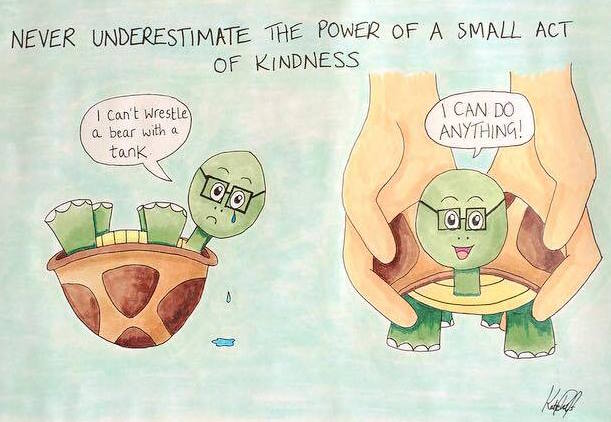
I guess my attitude to all this has changed fairly recently and has been during my time in hospital. When you are stuck in unfamiliar surroundings with unfamiliar people, anyone is going to feel alone, and that in turn made me feel pretty alone with my problems. Fighting them felt futile and every second pointless. It was like I was a tortoise lying upside down on my back waving my legs around, unable to roll back over, yet being asked to wrestle with a lion, a crocodile, three tigers, and a bear who had somehow developed the use of opposable thumbs and managed to get his hands on an armoured tank complete with canon. As I lay there flailing pathetically, I couldn’t help but think “why bother trying to fight this? I can’t stand on my feet let alone battle a pack of vicious animals with the use of military style transport and machinery”. However, I then received a sudden onslaught of kindness both from friends, family and strangers, and it made me wonder whether or not there might actually be a point in giving it my best shot.
When people feel emotions caused by kindness shown by other people, they tend to say things like that they were “touched” and “moved”, but to say that is to vastly underestimate what I felt. Indeed I was so touched I was practically black and blue all over with the force of it, and so moved that one morning I actually found myself several thousand miles away in the sahara desert, where it took staff on the ward a very long time to find me again (they say they the reason for the delay in locating me was a dodgy sat nav but I am suspicious that they got distracted by the abundance of sand and started building castles…nurses love sand castles). I felt like a gigantic boob with the worlds strongest wonderbra supporting me, and though I never imagined anything positive ever coming from feeling like a boob, here I was proved wrong.

Knowing I had all these people supporting me made me feel empowered and suddenly trying to wrestle all those animals seemed a lot less daunting. I had back-up, and if I joined forces with them then my beasts could be overcome. Furthermore, actually engaging in the battle suddenly seemed worthwhile. When flailing on my back (remember the analogy, I am a tortoise here), not only did I see the fight as impossible, but I saw it as something that didn’t matter because I didn’t care what happened to me. I didn’t care if the lion ripped off my head or the bear flattened me to a pancake in his armoured vehicle. To be honest, when I was admitted, I just wanted for it all to be over. With the support I received though, I realised that it wasn’t just my vote that counted in all of this, it wasn’t just a case of me not wanting to fight and that being the end of it. For some bizarre reason, a lot of other people did think it mattered. They did care, and they did want me to win the fight. There were people who didn’t want to see me torn to pieces, there were people rooting for me, people who wanted me around, so when it came to facing a challenge, lunch for example, I couldn’t help but think “Even if I don’t care and don’t want to do this right now, there are a lot of people who do care, and I am not going to let them down, so for now I will do it for them”.

The confirmation in the quote that when “I” becomes “we”, illness becomes wellness and the important message I want to get across here then, is that when it comes to fighting mental health issues, knowing you are not alone in your recovery can be as important as any other aspect of treatment. If you don’t have mental health problems yourself but know someone who does and you want to help but don’t know what to do, helping them doesn’t have to be as hard as you may think. You don’t need to study all the psychology books in the library to try and understand what they are going through. You don’t have to move in with them, rally them each morning with an inspirational speech and skip encouragingly beside them throughout the day. Trust me, just letting a friend know that you are there for them if they need, that you care about their battle and other simple acts of kindness will do more for them than you will ever know.
Alternatively, if you yourself are sitting there reading this and you have mental health problems, feel that nobody understands, are unable to talk to friends and family in real life about your struggles and feel completely alone, know that this is not the case. I may not know you personally, but I can assure you that I care about your battle and I am more than happy to support you in it. When you know you are not alone you gain power, and that is what I want to give to you. I want you all to know that I am one your side, and that I have three tanks with canons so big that those bears and lions don’t stand a chance. If simply knowing that is enough then great, but if you still feel alone and ever want someone who understands, email or message me. I may not give the best advice and hearing from a stranger may not be what you want right now, but if you need a hand to hold in this darkness, I am more than happy to lend you all mine.

Take care everyone.
Tortoise

Why “Self-Care” Is Important And How To Get Better At It

Pretty much every time I part from someone who knows that I have mental health problems, they will tell me to “take care” of myself. It is a lovely thing to say, and an instruction I very much wish I could follow, but for some reason I, much like many other people with mental health problems, find the act of self care incredibly difficult.
It isn’t a matter of being incompetent, if you asked me to take care of someone else I could do it very well, but being kind to myself is another story.

As you are all probably aware, I am currently in hospital trying to battle anorexia, but this week on top of all that going on in my head, I have the added joy of having developed shingles. To be honest when I was first informed of this I was rather excited, for it is not every day one is diagnosed with an illness that rhymes with jingles. As an impulse buy I ordered four large boxes of bells to be delivered to the ward because I really wanted to be referred to as “the patient with shingles who jingles”, but since they have arrived the novelty of shingles has very much worn off and I have lost the ability to go anywhere or do anything discreetly around the hospital anymore, because every time I move it sounds like the ward is being invaded by a troop of morris dancers or Santa’s reindeer.
Practically every hour staff are telling me to sit down, rest and take it easy, when I am anxious or upset and struggling they advise me to do something they know I used to and sometimes manage to enjoy like watch a film, read a book, play a video game or draw, but allowing myself to do these things feels selfish, indulgent and like a waste of time. It is like I always feel I have to be doing something productive, no matter how I feel, something of use to someone else or something to tick off of a to do list, for the act of “relaxing” serves no tangible purpose that I can use to justify it. This problem of self care is especially apparent here in hospital because I can see it in all of the other patients I am surrounded by, they all feel the need to do “something”, without realising that relaxing is “doing something”, it isn’t wasting time but is something vitally important that everyone should do a lot more often.

Whether you have mental health problems or not, everyone in this world has some level of stress and needs to allow themselves a bit of self care and a break for their overall wellbeing. Maybe one of the many reasons the number of people developing mental illnesses is on the rise, is because we are all so busy these days that we have forgotten the fundamental basics of taking care of ourselves. Doing things you enjoy (or if you have depression and find enjoyment difficult, doing things you used to enjoy/not giving yourself a hard time for lying on the sofa when thats all you feel able to do), taking time out, resting and, in short, being kind to yourself, is as important for your wellbeing as all the other crazy things people do in the name of healthy living, like getting enemas or taking cod liver oil tablets.

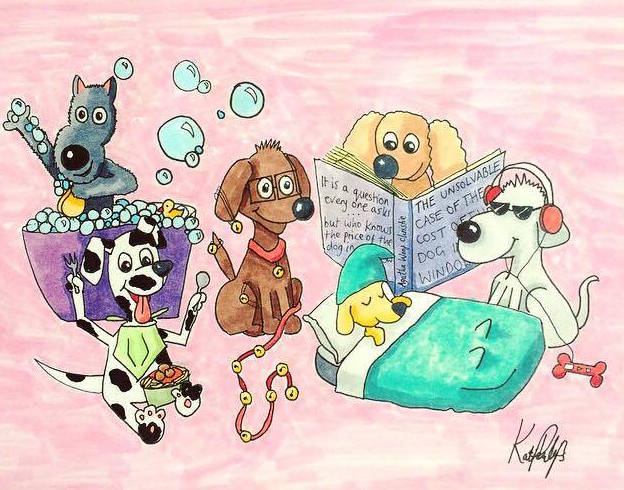
For this reason then, I have come up with an ingenious piece of advice to all people with mental health problems who struggle with self care, whether that be not allowing yourself to sit and rest because it feels lazy, not feeling worthy of taking a shower/getting dressed/putting on make up/ decorating your room to make it a little brighter, or even letting yourself take a nap. Actually even if you don’t have mental health problems and struggle with allowing yourself to slow down from the hectic stress of daily life in any sense, I would like to urge you in the name of both your physical and your mental health, to do one very important thing for me. That thing? To treat yourself like a puppy. I will even allow you free reign on the decision as to what breed of puppy you would like to treat yourself as (I would say the fluffier the better), and that is not a decision I would trust everyone with, so please, handle the responsibility wisely.

Now of course, by treat yourself like a puppy I am not advising you trot off to the vet to be neutered, microchipped, nor would I suggest entering yourself into Crufts. Trust me, it doesn’t work. (I tried to convince them I was a cocker spaniel to get into the agility round but they didn’t believe me. Told me that I was clearly a poodle and I was so offended I left). No, what I mean when I tell you to treat yourself like a puppy is to do for yourself and be kind/take care of yourself as you would do for a puppy. If you need to rest, allow yourself to nap, if you are hungry, allow yourself to eat, if you are dirty, allow yourself to wash, allow yourself to just sit, to be, to play, whether that be with a rubber ball, some sticks you found in the garden, or the human equivalent in recreational entertainment. Every time your head tells you not to do an act of self care like resting, washing, eating or playing because you don’t deserve it, take the former concept of you and remember that you are a puppy, and if you had a puppy, what would you do? Leave it to starve and force it to round up sheep without a break or rest or play? (For the duration of this post you also might want to imagine you are a shepherd with sheep to herd). Would you treat it so badly that the RSPCA were forced to come round, seize your canine companion and put you in prison for puppy cruelty of the first degree, never allowed to own a dog again in your life? No! You would let it rest and play and eat and wash without even thinking it was indulgent or selfish to do so and it is exactly the same as the right and need to take care of and be kind to yourself.

Obviously in an ideal world you would tackle your issue with self worth so that you felt able to be kind to yourself without having to pretend you were a cocker spaniel, but self worth can take a long time to develop, and it is important to have a way of managing a little self care whilst that self worth is germinating. No matter how low your opinion of yourself, you deserve to be kind and take care. Even the declaration of human rights states we have the right to be treated to a certain standard, and that includes the way in which we treat ourselves. It is illegal for someone to imprison someone without food or shelter, or to keep them from the things they love and hobbies that bring them happiness (that is my interpretation of “The right to your own things” anyway), so don’t let a voice in your head neglect you and treat you like some evil dictator.

One of the groups in the hospital I am in at the moment is all about learning to be kind to yourself and self care, so this isn’t even me telling you to try to experiment living in this crazy way of treating yourself nicely off the top of my head, taking care of and being kind to yourself is officially NHS approved and declared as important. Yes ok the group at the hospital isn’t telling me to pretend that I am a cocker spaniel, but for now that is how I am trying to manage self care until I have worked on the ability to be kind to myself as the mentally troubled, shingles ridden human that I am. So, for now, if you struggle with self care and find the concept of it too hard because of low self worth, please don’t be so hard on yourself. Join me, be a puppy, and treat yourself as such, with love, care, and maybe even with a little belly rub thrown in.

Self care puppies

Why Being Suicidal Is Not About Wanting To Die

Before reading this post please note that it involves trying to explain what being suicidal feels like, so if there is ANY risk of that triggering you in any way please click away now.

Suicide is a difficult topic to talk about because there are so many feelings that go alongside it. For some it can be immoral, too upsetting, something “selfish” people do, too sensitive, too dark, maybe even something that people avoid talking about because it is too difficult to understand why someone would commit such an act. For all of these valid and understandable reasons, suicide is not often talked about, it is a bit of a taboo, especially for people who find themselves plagued by suicidal thoughts on a daily basis.
To say you feel suicidal sounds melodramatic and “actually mad”, so I feel that a lot of people who feel that way keep quiet because they either don’t want the judgement/stigma that comes with honesty, or because they don’t want to be thought of as “crazy” and locked up in some imagined padded cell with a straitjacket and men in white coats. However I think that if more people were honest and able to openly talk about suicidal thoughts without any stigma, maybe more people would come forward to discuss how they feel, which could then save lives. Before this can happen though, I think more people need to understand what people mean when they say they are suicidal, rather than jumping to the conclusion that the person is insane and simply wants to die.

As it happens, or at least in my case, when I have suicidal thoughts/ideations/damn annoying brain intrusions that I wish would kindly leave immediately (that is the official medical term), it is nothing about wanting to die. Obviously I cannot speak for everyone who has ever thought about suicide, but from people I have spoken to, I have found a common ground in that a fair amount don’t exactly want anything. For many, suicide is actually more about not wanting something.

Imagine being on one of those step machines in the gym. I don’t know what they are called, but I am talking about the thing that is kind of like a treadmill but with steps instead of flat space, so you can effectively walk up a constant stream of stairs without actually going anywhere (what a productive way to spend your time!).
Imagine you have been on that same step machine for hours, constantly walking up stairs that take you nowhere. Understandably, after several hours you will be exhausted, fed up, in physical pain and unsure as to whether you can continue. There is however no off button on this machine (a severe design flaw), and you cannot get off it without falling into a giant tank of hungry sharks, poisonous jellyfish and squid with tentacles poised to strangle you the moment you hit the water (please note this is not often the case when it comes to machines in your local gym, but for the sake of example just humour me).
You don’t want to keep walking, but you certainly don’t want to fall into the lagoon of doom, so you force yourself to persevere in the hopes that if you keep pushing, eventually the machine will stop and you will be free. A week passes. The machine is still going, you are in agony, yet you persist. 9 months pass. You have been walking up these seemingly pointless stairs for as long as it take for a human to be created and born and you are in pain that cannot be described. You are worn out, spent of all your best efforts, and are the walking definition of “at the end of one’s tether”. You then look down and find yourself contemplating the only way you can see out of the situation, the lagoon of dooSuicide Squidm which is no less terrifying than the first day you found yourself on this godforsaken machine. Obviously you do not want to jump into the water, (you can’t swim and have a severe phobia of marine life), but after 9 months on this damn machine, the sharks and jellyfish look like the only/best option. When thinking about whether or not to jump, you are not thinking about what you want to do, you are thinking about getting away from the pain coursing through your body
, opting for the lesser of two evils, even if the evil hovering below you is a giant furious squid with a monocle (the squid isn’t actually wearing a monocle but this post is getting a bit heavy and I am trying to lighten the mood. I want this post to inform not drag readers into a bottomless depression).

To me, that is what feeling suicidal feels like, it isn’t a case of wanting to die, it is a case of
not feeling able to carry on. That said, the analogy is not perfect and I AM NOT SAYING THAT SOMETIMES SUICIDE IS THE ONLY OPTION. My explanation is HOW IT FEELS to be suicidal as opposed to the reality.

If the person reading this is well aware of the pain of suicidal thoughts, I want you to know that the reality of the situation is very different. Little do you know that whilst you are on that machine, helicopters and cranes are on the way to rescue you, the machine is going to run out of electricity, you are not going to be walking in that pain forever and there is always a way out or an escape even if you can’t see it. Things don’t stay the same forever, even the Spice Girls broke up eventually and we all thought that was a bond that would never be broken. Machines and depression or suicidal thoughts cannot survive into infinity and whilst you fight your way through I can guarantee there are a million people out there who want nothing more than to help you off that machine. It may not be today or tomorrow but some day a giant bird is going to appear with a rescue team on its back and you are going to have a way out that doesn’t involve the lagoon of doom or actual suicide. The important thing, is that you are alive to see that day, and hopefully ride off on that giant bird/life without these thoughts, that when on the stepper you never thought was possible.
If you can relate to this post in any way, please know that I am marching up those seemingly endless stairs alongside you, not knowing what to do but just hoping that one day that bird is going to come and all of this pain will be a distant memory.
This post is to explain how it FEELS to be suicidal to people who may not understand, but if you do understand please know that the feelings are not reality. They can’t be. Squid don’t even wear monocles.

Seriously though, If you are struggling with suicidal thoughts please tell someone right away, whether that be a friend, stranger on a helpline (you can call Samaritans on 116 123) or even go to A&E. Just don’t be afraid of talking about it, because staying silent is ultimately a hell of a lot more dangerous.

Take care peeps x

Suicide bird

How To Survive Social Situations When You Suffer From Anxiety

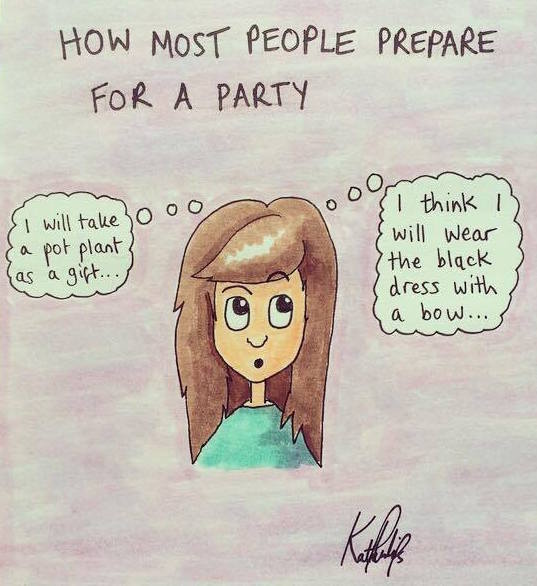
Last Saturday it was my Dad’s birthday party. Being a large, jovial social gathering packed with family members, friends and loved ones, I was of course terrified. Parties are always something people seem to get very excited about and dare I say look forward to in the “real world”, but in my world and the world of anyone with social anxiety they are a minefield of stress, uncertainty, embarrassment and awkwardness.
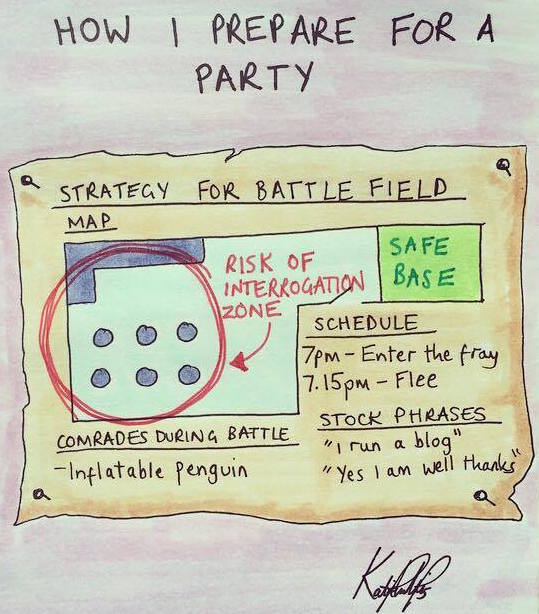
However, I somehow made it through the party this weekend by following a “Social gatherings survival guide” that I created as a military style strategy to manage the whole thing like an army preparing for battle. So, in the interest of helping anyone else out there with any level of social anxiety (aka my fellow soldiers), I thought I would share my survival guide to surviving the obstacle course in life known as “the situation in which you have to hang around people”…

Step One: Make a preliminary plan for the evening – As every good soldier knows, the key to success in battle (aka a social situation) is a step by step plan to follow, much like the guide I am writing here but far more specific and suited to the environment in which you have found yourself. Thinking “I am going out to a party tonight” can be very overwhelming, but if you break it down into pieces it becomes a little more manageable. For example “I will leave for the party at 7pm”, “I will drive to the party”, “I will stay for two hours” sounds far less intimidating. I often find that by setting a time limit I manage to get myself out the house by thinking “it is only two hours” and then sometimes the situation isn’t actually too bad so I can stay for longer having fooled my enemy (aka my brain) into allowing my excursion from safety. Whilst you have a plan though, it is also important to be open to being flexible should opportunities such as staying an extra hour arise. The plan is more of a comforting guide to have in your back pocket rather than a rigid set of actions that you must carry out, even if that means leaving when you are having fun, just because it is in the schedule.

Step Two: Set up a safe base/camp – When putting yourself in a potentially stressful situation it is always important to have a safe place to retreat to when things get too much. Forcing yourself to stand in the stressful fray of pass the parcel or musical chairs, when your anxiety really cannot handle it, does not a good soldier make, and it is important to know when you need a break to refuel on sanity. The safe place will ideally be a place some distance from the battlefield that is a little quieter. A lot of social gatherings in my family happen at my Aunt and Uncle’s house who thankfully are very accommodating to this particular soldier and always have a camp (aka the back bedroom with blankets and cushions) for me to camouflage myself in when things are too much. If you are going to a gathering in surroundings you are familiar with, plan your safe place in advance. This is unfortunately not possible when entering unknown territory, but as a hint, good safe places to seek out in most locations can be found just outside the party venue (aka by the door for fresh air), in a bathroom (not an ideal habitat but guarantees the safety of privacy), or, if you drove yourself to the gathering, in your tank (otherwise known as your car).

Step Three: Lower your expectations – When I entered the party on Saturday I felt an immense amount of pressure. Being a general guest in battle is one thing but being the offspring of the person whose gathering it is is like being suddenly promoted to Commander in Chief. Everyone at the party knew who I was even if I didn’t know them and being related to the host I felt it was my responsibility to ensure the evening ran smoothly, entertain everyone, serve the food and start the conga line. Obviously nobody else expected any of these things from me (which is somewhat sad as I do like a conga line), and people just wanted to see me there. When you go to a party do not feel the pressure to perform or act in a certain way or as if the responsibility of the evening’s success is on your ability to be a good guest, people don’t invite you to a gathering to serve a particular purpose, they just want to see you.

Step Four: Prepare stock answers – When in battle it is likely that you will be interrogated (aka asked polite questions by nice people who want to find out how you are.) This is one of the most stressful parts of an evening in my opinion, as I always find myself tongue tied and never know what to say even to simple questions like “What have you been up to lately”. Obviously it is impossible to predict which probing questions might be launched during socialisation, but some questions are more likely than others (in my experience people are more likely to ask what you are doing with your life than what you think would happen if the world was run by a power hungry fairy with a passion for pogo sticks), and it may help to plan stock answers to whip out when the occasion presents itself. For example this weekend, for the inevitable “what have you been up to?”, I prepared “I am currently running a fantastic blog that you should definitely follow because it is the best thing on the internet” rather than leaving it to my brain to come up with an answer on the spot which would have likely been something along the lines of “um…I am living at home because I am mentally ill but the other day I managed to touch a doorhandle without showering afterwards so that was an achievement ahh please stop talking to me”.

Step Five: Bring an inflatable penguin along with you – Yes soldier, you read that correctly, that is a key step to this plan. Like horror films, social gatherings are things that are easier to manage when you have a buddy or someone/something you can trust with you. If you can take a friend or even a small object like a heavy pebble to cling to when things are getting scary it can be a great help in grounding you and hopefully prevent any spiralling into total irrationality and panic.
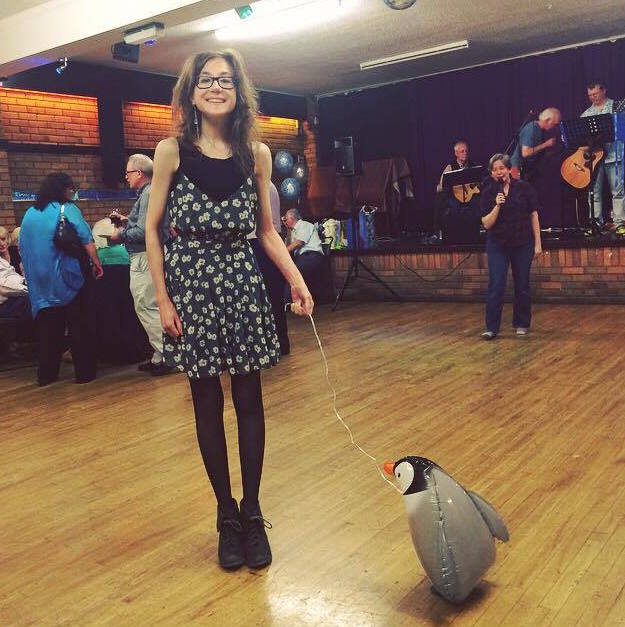
When my mum was buying things for this weekend’s party she foolishly took me to a balloon shop where she proceeded to purchase helium filled orbs with my dads age on them. How imaginative. Thankfully I was there to help/be an inconvenience, and by the time we left the shop, in addition to mum’s choices, I had obtained an inflatable penguin balloon on a lead which I proceeded to drag around the party with me for the duration of the evening. Sounds silly but it was oddly comforting and whenever I started to panic about someone coming over to talk to me I could just glance behind me and think “it’s fine, I have my inflatable penguin with me, what could possibly go wrong!”.

So there you have it chaps. That is my strategy guide and list of steps to get my fellow social anxiety soldiers through battle. Any situation involving a large group of people is going to still be scary, but hopefully with these tips you can at least feel a little prepared so that things are more manageable. Remember we are all in this war together and you are never alone. Now go forth my brave warriors, fight the fear, stay safe, follow my lead and commence mission socialise….

Social anxiety 1

Social anxiety 2

Oh, and for anyone who wanted to see a picture of my personal buddy this weekend…

Social Anxiety 3

What To Do If You Think Someone Is Struggling With A Mental Health Problem

Having mental health problems sucks, but so does seeing a person you care about struggling with them when you have no idea what to do. It can be frightening to see someone becoming more and more unwell without necessarily seeking help for whatever reason, and sometimes it is necessary for friends or family to step in. Unfortunately this can be a very awkward situation, after all nobody wants their friends to gather them round the fireplace for a good old “we think you are insane” discussion, so in this post I am going to try and help people who are concerned about someone’s mental health and don’t know what to do about it. These things are at least what I would like my friends and family to do if they ever suspected I had a problem, (though I would like to point out that there is no need to do any of these things now family, rest assured I am well aware that I am a bit funny in the head), so hopefully other people will find these approaches acceptable too…

OPTION ONE: The first and best way to deal with someone you love struggling with mental health problems alone is of course to approach them in some way and discuss your concerns. If you plan to talk to someone directly about the issue, the key with this is to not go in all guns blazing, in fact, do not involve a gun in the situation at all. If you must have a prop, take a cup of tea or something, everybody likes tea and nobody likes guns (a mantra that might make this world a better place if more political leaders followed it but I will try and stop wars at a later date, for now I am just going to tackle mental health problems. Please be patient.) The problem is that mentioning someone’s mental health in conversation is also one of the more difficult options as it can be an awkward topic to bring up. For this reason, if it were me, I would always suggest writing someone a letter (or email if necessary but a letter is more personal), instead of talking to them directly, and it is actually an approach that is beneficial to both parties. By writing a letter you can make sure you get all your points down and really say what you want to say clearly, rather than gabbling some incoherent speech out of nerves in the moment, that doesn’t really get what you want to say across. It also helps the person you are approaching, as having someone tell you that they think you are crazy is difficult and often embarrassing to hear. This embarrassment may then cause someone to become defensive and say things that they don’t really mean either, perhaps snapping back because they are insecure or laughing and trying to brush it off to distract you from the conversation (a technique I myself am world champion of). With a letter the person can read it in their own time and thus really think about it properly without giving in to the initial emotional response conversations can bring. It also gives them some privacy to deal with the topic and means that they can re-read it at a later date if it is something they want to think about and come back to. When it comes to talking to someone about their mental health, writing things down in a letter is awesome.

OPTION TWO: I would always say that bringing up someone’s mental health with the person themselves should be the first plan of action, as it can be upsetting to know you have been discussed by other people behind your back. However, in some circumstances, if for whatever reason, option one is too difficult or has been tried and failed and things are getting serious, talking to someone’s family can be a great second option. If there is a misunderstanding and the family can confirm the person is fine then great, but if not it is important for the person struggling to have some people close who are perhaps more aware of what is going on than they are. Families often miss things because they are around their loved ones so much that they don’t notice subtle gradual changes over a long period of time and sufferers may not realise what is going on either or be in full blown denial about it. Having a friend or outside point of view can therefore be really valuable.

OPTION THREE: People often think that mental health helplines are for people who are themselves mentally ill but this is not the case at all. Samaritans for example is available to anyone for any issue regarding mental health (or things that are nothing to do with the workings of the brain, you can call them about anything, even if you lose your keys and want to yell at someone, though I WOULD NOT advise this), so calling them to get some support may be a good thing to do so that you have someone looking out for you too. Samaritans don’t give advice, but if you are worried and have nobody to talk to about your friend, it can be therapeutic for you to get it off your chest and take care of yourself. There are also a lot of other helplines including ones like “Rethink mental illness” who may be able to offer advice, so I will put a few numbers at the end of this post. After all as my favourite nurse at my previous hospital said to me, “you can’t look after other people if you don’t look after yourself first”. Wise words indeed. Think of calling a helpline, or maybe visiting a mental health charity website, as fitting your own oxygen mask on a plane before you help others (only closer to the ground and with what I hope would be an ample supply of oxygen).

OPTION FOUR: Once you have managed to somehow bring up the topic of mental health with someone you care about, the next step should always be to get them to go to a GP. Maybe offer to go with them as support if that is possible, but either way it is their GP who will know the next course of action and will be able to discuss potential mental health services in their area.

OPTION FIVE: This one probably sounds really dramatic but if you are seriously concerned about someone’s mental health and attempts to bring it up with them or their family directly have not worked then it is always an option to go to A&E or call an ambulance. Obviously this isn’t something to do lightly and should only be done in extreme circumstances, but if you ever think someone is in immediate danger because of their mental health then it can be necessary. With this there is of course a potential risk of upsetting or annoying the person you are calling an ambulance for, but ultimately it is always better to have a very angry live friend than no friend at all.

Overall, approaching anyone because you are concerned about their mental health is never going to be the most pleasant experience and probably not a moment either of you will want to tweet about or document with an album on Facebook. Nevertheless I hope these options at least help give some kind of idea as to how to make it a little more bearable. Unpleasant or not, talking to people you are worried about is very important and shouldn’t be avoided. Who knows, one day the person you are confronting might thank you…and, if they don’t and get really angry at you doing any of these options, just tell them it isn’t your fault and that a weird bespectacled person on the internet was the one who gave you the advice that they followed, I am more than happy to take the blame.

Stay safe everyone and have a great day.

TeaAndGun


HELPLINES AND FURTHER ADVICE

Samaritans:
08457 90 90 90 – 24 hour support seven days a week

Rethink mental illness:
0300 5000 927 – Monday to Friday 9.30am-4pm
Rethink also have a really good web article about this whole topic here: https://www.rethink.org/carers-family-friends/what-you-need-to-know/worried-about-someones-mental-health

Carers UK:
0808 808 7777

Sane Line:
0300 304 7000 – 6pm-11pm every day

Support line:
01708 765200