Why We Need To Rename The “Loony bin”

In terms of mental health, there are many slang terms used to refer to a psychiatric hospital, (“nuthouse/funny farm etc), but while these terms are still offensive, there is a particular slang term that I think is particularly dangerous. I understand that slang is useful in society and I am not demanding the removal of all slang from now on, but issues can arise with slang when the term becomes more notorious than the correct phrase and actually alters the perception people have of whatever is being referred to. That is the unfortunately the case with the term “loony bin”.
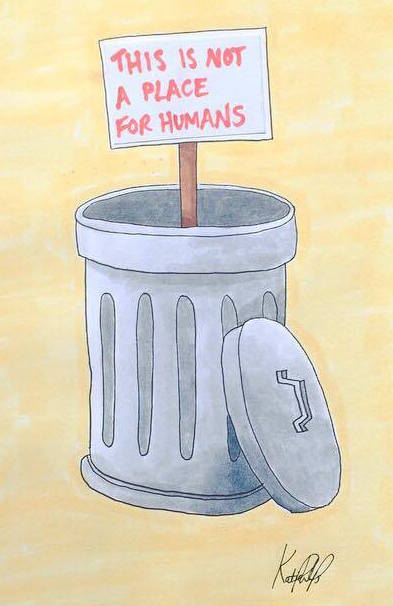
I realise calling a psychiatric unit a “nut house” isn’t accurate either, for example I have never encountered a “nut” when in hospital (other than the odd almond or macadamia in my fruit and fibre…I once heard someone claim they found a pecan in their bowl but I think that was just a myth so don’t take my word on it), but the “loony bin” slang term is particularly damaging as it conjures up ideas of a place into which the rubbish is tipped, a place that people don’t come back from and if anything is utter trash, it is that image.

I myself have had several admissions to various different “loony bins” and I can state with the utmost conviction that none of them bore any similarities to a bin, neither appearance wise or in terms of function. Firstly, on the whole they were all very clean (one had the bathrooms cleaned after practically every use so sometimes I was unable to shower BECAUSE they were being made extra clean), but more importantly none of the patients were anything like waste needing to be dumped.

The problem with the phrase isn’t even just damaging to the self worth of current or ex-patients. Potential inpatients may be scared of, and thus refuse admissions for treatment that they desperately need, because this whole “loony bin” perception has made people fear they will go in and never come out, that they are a lost cause who needs to be locked away from society for good. Admissions to a psychiatric hospital however, are not final destination. Instead they are more of a holiday. Ok, I will admit they are not exactly like a holiday, I know I would prefer a beach in the Caribbean over a stark white bathroom with a staff member watching me pee, but what I mean by this comparison is that they are a place that people come back from (albeit without the much revered tan or photo album). Going into hospital doesn’t have to be a terrifying endgame, define people or morph them into the branded mental patient to be impersonated at Halloween parties.

There is of course also the issue of this “bin” (a name of a place usually reserved for objects not people), being used as a place for “loons”. “Loons” sound like magical creatures, inhuman half breeds who are fundamentally different to “normal people”. The whole idea just emphasises the false distinction between “mental people” and “sane” ones when really they are both exactly the same. People in mental hospitals are not a different species, they are human just like you (unless dear reader, you are in fact a penguin in which case may I congratulate you on finding my blog without opposable thumbs).
I think it is comforting to label people with mental health problems as loons to be kept in a separate lidded inhuman/object bin world of restraints and locked doors, because by separating the sane and the insane, making a “them” and “us” situation, it perpetuates the idea that those crazy people are different and therefore you are not at risk of being contaminated. To think that a person screaming and being held down to be injected with anti anxiety medication is just like you is frightening and prompts all kinds of questions like “what if that happens to me”? It is nicer to think of all of that stuff as things that happen to “other” people, that the person cradling a wooden spoon and singing nursery rhymes is different, no possible image of you in the future. It is nice to put the lid on the idea and leave it outside the house for the rubbish collectors to remove so you don’t have to deal with it in your home.

The derogatory slang of “loony bin” and resulting “loon/human”, “them/us” dumping ground view of psychiatric units really is a use of language that has the ability make patients feel hopeless and forgotten, doomed waste discarded for good, and it creates judgement in people without mental health issues that just continue the stigma and fear that surrounds it all. I urge people to know that none of this is true.

For patients who have been admitted I want to say that life is not over, and being in hospital doesn’t mean that you are rubbish or damaged beyond repair and the landfill is not your future and final destination.
If anything I would say the slang for a psychiatric hospital should be “the temporarily out of order and in need of repair tray”, just like “normal” hospitals that treat only physical illnesses. It is not a place to be thrown in when you don’t have a place in the real world anymore, it is just a place in which you remain as human and as worthy of life as anyone else on the planet, you just have a few cracks in your porcelain skin that needs a little glue to help them stick back together.
We need to stop seeing psychiatric hospitals as bins or end games for the weird wastes of failed humanity, but as places for ordinary people who are just struggling in life and need a little support to get back into full working order, simply time and space to patch things up and get them well enough to leave that repair tray so they can go back home.
1

Veganism Vs Eating Disorders

I first became vegan in 2012, and at that time I didn’t know anyone else who was a vegan. From my viewpoint, they were pretty rare and sparse, much like some herbivorous creature David Attenborough would have to spend weeks stalking before he could actually get one on film. Recently however, I seem to be seeing a lot of vegans springing up all over the place. As a vegan myself, obviously I think this is great, as it strengthens a movement and cause that I agree with and am passionate about, but the concerning thing is that a lot of people I have seen suddenly start milking almonds are people in the eating disorder community (both online and in real life).
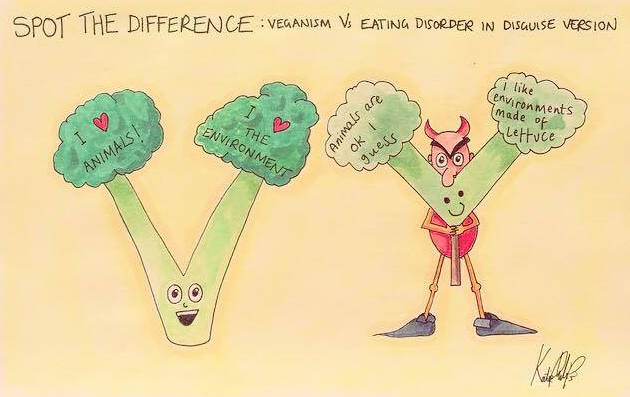
Obviously “veganism” and “anorexia” are two very different things, one is an ethical movement, the other a mental illness, so naturally being vegan does not mean that someone has an eating disorder, just as someone having an eating disorder doesn’t mean they are vegan. Nevertheless there can unfortunately be times when they cross over, and the lines between the two normally very separate labels become a bit blurred, much like the colours of a carrot and a stalk of broccoli do when you put them in a blender and switch it on high speed. It is here that the problems start, problems people need to be more aware of and open to discussing, as it is here people can start using veganism as a mask to cover what is really an eating disorder, a dangerous trick that can leave many people unaware that they have a problem or mean that others do not pick up on what is a potentially fatal illness.
In other words it is hard to work out which bit is broccoli and which bit is carrot, so I feel it is important for people with eating disorders who are vegan to question their lifestyle decision, not because it is wrong, but to make sure it is for the right reasons. Therefore in order to try and help people who are unsure about either themselves or a friends dietary choices, below I am going to list several things to look out for as signs that your veganism is actually something a lot more dangerous…

1. Why are you vegan? What was the initial cause or reason and how did you come to the decision? – When you or your friend became vegan, what was the drive behind it? Was it to benefit the environment? To fight animal cruelty? Or was it to use as an excuse to mask why you are taking things out of your diet? With eating disorders, veganism can sometimes unfortunately be used as a get out of jail free card. If you start refusing all standard cakes or ice cream, family may be concerned or question whether or not there is a problem. Wave the vegan flag however, and you have given yourself a more socially acceptable disguise for your refusal, as I think we can all agree that “I am not eating that because I am vegan” tends to go down a lot better than “I am not eating that because I have an eating disorder that is slowly killing me”.

2. Restriction or alternatives? – An important thing to bare in mind when considering someone’s veganism is how they go about it. For example, veganism is NOT about cutting things out, it is about swapping them. Used to get protein from meat and eggs? You can swap that for chickpeas and beans. Had your fat requirements from full fat dairy? Introduce yourself to Mr avocado and his civil partner Señor peanut butter. Veganism is about still getting all of your daily needs but from plant based sources, it is not about emptying all the cupboards and then living off a bag of lettuce.

3. The “Imagine you accidentally” game – Imagine you (as a vegan), ate something that was not vegan by complete accident and without having any way of knowing about the non-veganness before hand. What do you think? Is it all “oh my God I just ate something with cream in it I am going to get fat! My thighs will be wider than the widest wide thing in the Museum of very wide things”, or is it more along the lines of “Oh Damn! That is annoying, I feel guilty about the animals but I guess it was human error, not my fault and I will just have to check ingredients more thoroughly from now on”?

4. How has veganism impacted your lifestyle overall? – Obviously being vegan involves dietary changes, but changes are not limited to food alone. By deciding not to contribute to the exploitation of animals, you are deciding not to use animals for your own gain, not just deciding to avoid eating them and their produce. For example when I became vegan, my entire make up collection, shampoos, shower gels and toothpaste all changed to animal friendly versions. If the only aspect of veganism you care about is the food side of it then maybe examine why this is, to make sure it isn’t because the food changes are actually about something other than animal ethics. After all it makes little sense to avoid eating a cow whilst wearing a leather jacket, so finding out and questioning your stance and opinions on the non food related parts of veganism can be handy in giving you a clue as to where your head is at.

5. The Vegan bakery test – Imagine a friend wants to support your decision to be vegan and takes you to a vegan bakery. There are vegan brownies, cakes, muffins, the lot. When you look at the display what do you think? Is it a case of “Oh no my excuse to get out of cake is gone! What do I do? I must reach behind the counter, grab a wooden spoon and whack my friend on the head to distract them whilst I run away”, or is it more similar to “Oh my goodness I want that chocolate peanut butter muffin in my face immediately”. This test is a fairly good guide in my opinion as to how much your veganism is impacted by possible animal or disordered eating factors. It is also a good test as a guide to find out how much you like your friends, because if you are that eager to hit them in the face with a wooden spoon you may want to consider socialising with other people.

In an ideal world obviously I would love for everyone to be vegan, so I don’t want this post to be seen as telling people with eating disorders to run off and bite the nearest sheep immediately.
What I am saying is that if you are vegan or have a friend who has recently turned vegan, be sure to question it (especially if they have a history of eating disorders), and be fully aware of why that choice has been made. In my opinion a vegan diet is one of the healthiest diets around, so if you have an eating disorder and your veganism is a separate entity to it, then go ahead and carry on loving your lentils. Hell, have a shower in chickpeas and build a house out of a giant cabbage, just be sure to distinguish whether or not you are dealing with real veganism or a potentially fatal eating disorder wearing a vegan mask. After all, no cow is going to be particularly grateful that you stopped drinking its milk because of a voice in your head that is trying to kill you.

Stay safe all vegans and non vegans and people reading this in general. Cheerio for now.

Vegan

An Important Reminder For People Struggling With Mental Health Problems During Exam Season

Ah summer, a wonderful time of sunshine, drinks with umbrellas (as we all know if anyone needs a device to keep something dry it is a glass of liquid), and, less wonderfully, exams. No matter what kind of exam is being thrown at you, whether it be a GCSE, A-level, university finals or your N.E.W.T’s at Hogwarts, I think we can all agree that exams suck and are a very stressful part of the year for everyone involved, especially people with mental health problems who are pretty stocked up on stress and need no exam boards adding to it. If you have exams coming up I can guarantee you have been told how important they are by teachers and lecturers and if you are anything like me you will feel that they are the most important things in the world, but I want to provide an alternative voice to all that stress and pressure and let you know that in the grand scheme of things, exams and other education related worries are not important. Now I know what you are thinking, “why should I listen to a weirdo on the internet when I have educated officials telling me that these exams are vital to my future happiness?”. Well dear reader, because I am going to prove my point with an analogy using the absolute best thing about summer, ice-cream, and if that doesn’t get me credibility then I don’t know what will.

For the purpose of this post I would like you to imagine an ice cream cone. That empty cone represents your physical health, no emotions whatever, just the heart beating oxygen to carbon dioxide basics of being alive. Now add a scoop of ice cream to that cone (one involving chocolate or peanut butter preferably but I suppose you could use any flavour for your metaphorical ice cream…just not rum and raisin because that is nasty). That scoop of ice cream is your mental health, stress levels, emotional stability, any brain activity that involves quality of life, pain or pleasure, and makes you different from the empty ice cream cone of the amoeba. Now add a cherry to that ice cream cone. That cherry is exams/good results/fantastic education stuff in general.

If you went to an ice cream van in the real world and asked for an ice cream, you would expect at least a cone with a scoop of ice cream in. A cone is fine but it is worth nothing without the ice cream and without the cone the ice cream would have no “body” to chill in (literally). To be worth having, you need both the cone and the ice cream. Having a cherry added on the top would be nice, but without the ice cream and the cone it is pointless. Without those key components you just have a random cherry floating in the air and that is useless in terms of the ice cream experience (otherwise known as “life”). Exams alone are that useless floating cherry.

The most important things to focus on and look after throughout life, exams and education in whatever form, are your physical and mental health, because if you don’t have either of those things then exams have nothing to sit on.
When I was doing my A-levels I was absolutely terrified and my exams literally became a life or death situation. My head was compressed under so much pressure and my brain had made some kind of OCD rigid deal that I had to get straight A*’s or kill myself. No other grade would give me “permission to live”, not even an A which is an incredible grade to get as it is. My anxiety and OCD drive made a life or death situation out of “a star” and you know what that star is? IT IS JUST AN ASTERISK. IT IS PUNCTUATION. It is not the be all and end all goal of life, this mystical magical holy relic to be chased to the end of time. Nope. Look here is one now *. And another one *. Is “*” and therefore any grade worth the pressure and insanity placed upon exams?

The stress of exams, grades and dedicating all of your energy to revision is like chasing a floating cherry without the cone and ice cream needed to support it. If education is causing so much stress that your anxiety is out of control, if you are revising so much that you are “not having time to eat”, then that is not OK. At university I spent my entire time chasing that illusive floating cherry (otherwise known as “a first”). I read books obsessively, didn’t sleep, took notes on things with unnecessary detail and precision. Revision sheets were awash with bubble letters that I took hours colouring in using the order of colours in the rainbow. I had to get a first so everything had to be perfect, but I was so busy colour co-ordinating titles that I didn’t look after the cone or the ice cream and eventually everything fell down with nothing there to support it. I never took my final exams at university, I never wrote my dissertation or got the resulting “dissertation picture”, because I was in hospital. Thankfully I had the most amazing tutor and team at university so I was still able to graduate. Did I get a first? No. Has having a “2:1” rather than a first changed my life in any way? No. Do you know how often I get asked about my degree or A-level grades? How often someone asks to admire my colour co-ordinated revision notes with obsessively neat handwriting and bubble letters? Never, because in the real world none of it matters, what really matters is keeping yourself alive and able to function.
When you are in school I know that education feels like the world and grades are the tip of the mountain in importance, but when you leave school you realise that that mountain was just a mole hill and the real important mountains in life are actually living your life both physically and, hopefully, with some mental stability or quality that make it worth it. Getting an education or a dissertation picture are things in life, but they are not the ONLY things.

Obviously I am not telling you not to bother with revision, if you can handle it then that is great and of course you should do your best in exams, but you shouldn’t sacrifice your emotional or physical wellbeing to achieve, catch a cherry that is useless without the cone and ice cream to balance it on. An earlier hospitalisation during sixth form meant I had to go back a year in school so I did my A-levels a year late. Again it seemed like the biggest deal in the world, but I needed that time in hospital and that time out and eventually I got my exams, Ok they were a little late, but the only difference between my certificates and the ones my initial year received was the date. Also, I actually made loads of new friends in my new year, so in retrospect going back a year was not only vital but actually gave me some positive experiences with people I wouldn’t have met had I forced myself through exams the first time. Especially if I had died in the attempt.

In short, education can wait. Education can be done any time if needs be, but what cannot wait or be done at any time is keeping yourself alive and looking after your health. If you need to take time out, do it. Lower the pressure and expectations for grades. In short, give yourself a break, give yourself time to breathe. If you have exams and revision this summer then I wish you the best of luck and hope they go brilliantly, just please remember to look after that cone and scoop of ice cream first, and don’t kill yourself over a floating cherry that in the grand scheme of things matters nowhere near as much as the ice cream.

Ice cream

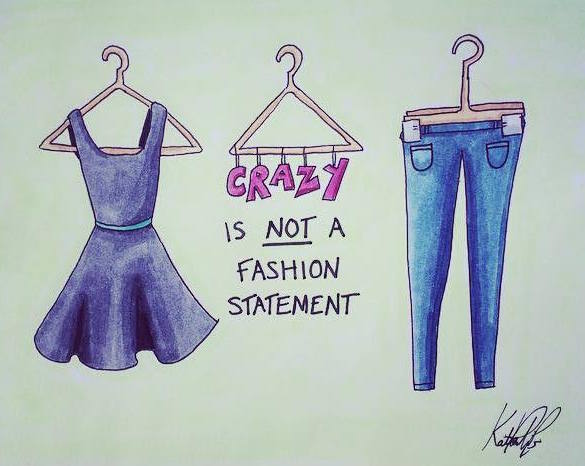
“Crazy Is The New Black” – Why Mental Illnesses Are Not A Fashion Trend

On Saturday night I went to a bar with two friends to watch the Eurovision Song Contest. I anticipated an evening of ridiculous dresses, flags being waved violently in my face, maybe even the odd dancer dressed as a potato. My hopes of such merriment were dashed when one of the presenters made a derogatory joke about mental health that did nothing but boost the stigma that my blog aims to destroy. AND there was no dancing potato. The joke? The “advertising” of a Eurovision Song Contest straitjacket to wear in celebration of the event because, as the presenter stated, “crazy is the new black”. Now I am not one to follow fashion trends so I don’t want to pass myself off as a fashion blogger, but in my opinion, that kind of statement and jokey interpretation of mental health problems went out of style around the 18th century and the fact that it was paraded on TV in 2016 is quite frankly something that has left my “flabber” well and truly “gasted”.

At first, after the comment had been made, I simply hated the presenter who had said it. I was ready to fly to Sweden to pull her off the air, but then I realised (around the time I was trying to hitch a ride to Sweden on the back of a pigeon who, alas, was no help in my mission whatsoever), that this joke was scripted and had therefore been approved by multiple people. Hell someone had even made a prop strait jacket, so this isn’t a little blip or misjudgement, this is a carefully considered statement that makes mental illness out to be a “cool trend”, that was viewed as acceptable for two hundred million viewers across the world.

I hate to whip out the “if this was a physical illness” card here, but seriously, think about it. Imagine if the woman had been advertising a Eurovision themed chemotherapy pump with feathers on it and claimed that “cancer is the new skinny jean”. People would have been up in arms, it would have been in newspapers, the demand for the removal of the presenter and script writer would have been widely documented, and Facebook would have been awash with furious people voicing their opinions. However, being mental health related, it was just swept under the carpet, nobody batted an eyelid other than a few distressed tweeters and bloggers online. Forgive me, but I have to ask what on earth is the difference between stating mental illnesses are “the new black” and saying cancer is “the new skinny jean” or whatever fashion trend is “in” these days? Cancer kills thousands of people a year? So do mental illnesses.
Maybe I am deluded to think that crazy isn’t a fashion trend and maybe I should pick up a copy of vogue ASAP, but in my eyes that joke is nothing like what “crazy” is to me.

Crazy is spending an hour putting on make up to go out with a group of friends and then crying it all off because you were so scared of tying your shoelaces incase the germs on them were to cause the end of the world. Crazy is being watched 24/7 for months, in the shower, on the loo, all of it because you are not trusted to keep yourself safe without constant supervision. Crazy is yelling at your mother because she cut a bagel incorrectly. Crazy is having to sleep with your hands on the pillow so the nurse watching you sleep all night can be sure you aren’t clawing your skin off under the duvet. Crazy is having to ask your friend to come into the bathroom with you to turn a tap on because you are scared to touch it yourself. Crazy is failed relationships because your partner cannot handle your mental illnesses anymore. Crazy is initially refusing to take an aspirin from a paramedic in the back of an ambulance who thinks you have had a heart attack, because he mentioned it was “lemon flavoured” and you fear that that may mean the tablet has calories. Crazy is having a separate room for exams at university so that you can cry and have panic attacks without disturbing other people. Crazy is being locked inside for months on end because the last time you were allowed out you tried to climb over a fence to escape the hospital you were detained in and had to be rescued by the fire brigade. Crazy is having to shower until the top layer of skin comes off and you are bleeding all over because only then can you be sure that the dirt is gone. Crazy is being the only person in your friend group who doesn’t have a job because you are mentally too unwell to work. Crazy is waking your mother up at 4am for a hug because you are too anxious to go to sleep. Crazy is taking menopause oestrogen supplements at 23 because you can’t eat enough to produce the hormone yourself and as a result your spine is riddled with Osteoporosis. Crazy is not being able to go to the toilet because your OCD says that it isn’t time yet. Crazy is going back a year in school because you missed yet another chunk of education being stuck in a psychiatric unit. Crazy is having nothing to say when family members ask what you have been up to, because they don’t count “I haven’t killed myself and have got out of bed every morning”, as an achievement. Crazy is being unwell for so long that you honestly can’t remember what normal is. Crazy is all of these things plus a hundred others that nobody can ever put into words. “Crazy” is the hell experienced by the millions of people across the globe who are struggling right now, but are too embarrassed and scared to speak out incase their worries are belittled, brushed aside or used as fodder for the next stigma supporting “joke”.

You can describe crazy in an infinite number of ways, but as the “new black?”. That is not what the word means to me.
If anything, crazy is the new “crisis in humanity”, and it is killing more people every day than your average fashion trend.

Crazy is the new black

“Who Am I?” – Anorexia And Identity

Have you ever wondered how people refer to you when you are not in the room and they don’t know or have forgotten your name? People refer to others using general but somehow specific terms all the time (my mum and I do this with contestants on Masterchef for example, this series we had “beardy man” and “Jam sandwich lady”), and it makes me think about how people refer to me. Rightly or wrongly I have always assumed that people call me “the anorexic one”, “the one who never went to school dinners”, “the one who disappeared into hospital for 10 months and then came back to sixth form 2 stone heavier” or words to similar effect, and it is one of the reasons that I find the concept of recovery so frightening and difficult to achieve. I feel that the label of being “anorexic” serves as a sort of identity both to me personally and for other people. In my head “anorexia” is my thoughts, it is all I think, it is what I do and who I am, so in my eyes if it disappeared, I would disappear too. I also feel this way about OCD sometimes, as that is also what I do and how I live/what I am, but the identity tie is mainly to the label of “anorexic”. After all, OCD is rarely used as an adjective to describe a person, you never hear the words “they are an OCDic.”

When anorexia first appears in someone’s life, it is sort of viewed as a separate thing, an added extra, an invader that is not part of the real person, or, in metaphorical terms, purple hair. People say that someone “has” anorexia much like they would say someone “has” purple hair due to some dye they have just bought, it is a temporary alteration to their being that will gradually wash out over time, it is not an integral part of who they are. If someone has it for a month, they will perhaps be known for that month as “the one with the purple hair” and then the label will change again as they themselves change style and perhaps career (e.g the brunette professional penguin tamer).
The problem is that the longer someone has purple hair, the more the purple hair becomes tied up with who they are as a person, they stop being a person with purple hair, the purple hair almost becomes them. When I was first diagnosed with anorexia it was an addition to who I was, a bit of purple colouring in my ponytail, but now after all these years I feel it has leaked all over me. The dye as it were hasn’t stayed in my hair, it has dribbled down into my skin so that my entire body is as violet as that girl who turns into that blueberry in Charlie and the Chocolate Factory when she eats the piece of gum Willy Wonka told her wasn’t finished. I no longer have anorexia as one has purple hair, I am anorexic, I am entirely purple from head to toe. If you scrub at my hair or my skin, the colour doesn’t just wash out anymore, it has been too long, it is embedded and to get rid of it you would have to peel away all of my skin completely which would in turn get rid of me too. That is how anorexia feels in terms of my identity, it is a thing that has become me and that now I am so entirely that it is impossible to remove. Without that label who would I be? My therapist is always correcting me when I say things like “I am scared of eating X” by saying “the anorexia is scared of eating X, Katie isn’t” but I don’t feel like that is true. I don’t have a voice telling me to avoid going over a certain number of calories, it is just my thoughts, it is just me.

A few years ago I went to hang out at a friend’s house with various people I had not met before (some may have called it a “party” but there were no balloons and in my eyes a party is not a party without rubber sacks of the host’s breath floating about, so I would call it a “jovial social gathering”). At some point in the evening some cake was brought out and handed around. The plate and thus the cake was offered to every guest individually, except me. Don’t get me wrong, I really appreciated it and was relieved. I hate the awkward moments when people offer me things that I then have to make up excuses to avoid, and knowing this my friend the host (lets call her Bertha for the purpose of this conversation), did not put me in that position. She knew I wasn’t going to have any cake so she didn’t insist on the whole “Cake?”, “Oh, no thank you” palaver that is often so embarrassing. However, this act of what was consideration for me and kindness of a friend aware of my difficulties, really got me thinking. When Bertha went round the circle she saw everyone as a person with the potential to eat cake, but when she got to me she saw someone or something different, she saw one of the “anorexic species”, a creature notorious for avoiding sweet treats. It felt like Bertha saw me as “the anorexic one”, I was different, and I had to wonder what on earth would it have been like if in the five minutes before the offering of the cake, I had been struck by the most wonderful bolt of lightening in the history of weather, and instantly cured of all mental health problems ever. What if I hadn’t had the illness that made me “the anorexic one”, what would be left, if anything, or would there just be a an empty space where the former anorexic had been?

I guess the point I am trying to make here and the point of this post/what I want more people to understand, is that there is a reason that anorexia is so hard to recover from. It is such a complex illness that both destroys and provides in ways that people may not think.
When sufferers are trying to fight but are struggling, it isn’t simply a case of being “scared of food” or ”scared of gaining weight”, often it is also a fear of what they will lose, of throwing away everything that they think they are, the removal of their core identity, leaving a hole they have no idea how else to fill.

Identity

(Apologies for the crease at the top of this image…I actually drew this picture for an appointment with one of my psychologists and the paper got creased on the way to the hospital. It was a good day for therapy but a bad day for my attempts at art.)

Why it is physically impossible to “look anorexic”.

A few weeks ago, the woman whose womb I once inhabited for 9 months (otherwise known as my mother), was chatting to a fellow human, and during the conversation my mother mentioned the fact that her offspring, aka me, has anorexia. The first response to be uttered (after the obligatory “Oh dear that is sad”), was the question “what size is she?”.

Has a more irrelevant question ever been asked? The answer is no. It is a question equivalent to asking someone with a broken leg “what colour is your cast?”, as if that will tell you about whatever funny business the bones are doing inside. Honestly I do not know what size I was before I heard of this incident, but right now I can assure you I am well and truly FURIOUS sized (like fun size chocolate bars only less fun, more rage.)
Unfortunately, this ridiculousness is a common response or question when someone hears that another person has an eating disorder, so I want to clarify one vital piece of information that everyone needs to know:

The weight or size of a person will never tell you how ill or how well someone is with an eating disorder.

Eating disorders (though obviously having implications in the “real world” in terms of behaviour around food/affect on physical composition of the body), are mental illnesses, the severity of which will never be judged by a number on the scales or a size on a pair of jeans. People with eating disorders can be underweight, a healthy weight or they can be overweight, but no matter what size, you will not be able to tell from their appearance what is going on inside their heads. Not only can you not tell the mental strain from appearance, you cannot tell the physical strain and the effect the illness is having on the body either. People with eating disorders die with bones popping out all over the place at a BMI of 2, but they also die whilst looking healthy or overweight because the physical complications caused by these illnesses are so much deeper and more complex than “weight loss”. Heart attacks caused by the body eating heart muscle for energy, electrolyte imbalances caused by purging and insufficient nutrition, and multiple organ failure caused by the general strain of eating disorders on the body are but three of the many ways people lose their lives in the fight and all of these things are invisible on surface level.

It isn’t even as if this misconception that eating disorders can be seen benefits anyone, as it is a dangerous belief for all involved. Sufferers may feel they aren’t really ill because they don’t look like the stereotypical skeletal pictures of people with eating disorders in the media, parents may not take their child’s issues to food seriously because they “look alright”, and medical professionals might deny input or treatment because the weight of the patient isn’t “too low” so they “can’t be that bad”. It is also an idea that even damages people who are trying to recover from an eating disorder, as sometimes help is withdrawn once weight is no longer “low” which is exactly the time that people need to be supported most.

Many people have even been refused treatment at all until the number on the scales is seen as corresponding to being “anorexic”, and until May 2013, there was actually a BMI criteria that had to be met in order to officially be diagnosed. Thankfully, the new DSM (basically a massive book that gives the lists of symptoms one needs to be diagnosed with any mental disorder) has revised this issue and anorexia can now be diagnosed in people of any weight, but despite this, the misconception still remains. It isn’t exactly unusual to hear the word “anorexic” used as an adjective to describe someone’s frail appearance, a casual turn of phase that further perpetuates the issue. Unless you have insanely magical x-ray vision and can see the thoughts and fears someone is harbouring about food (and if you do have such vision please go to a doctor as you are a medical marvel and could potentially help a lot of people with unseen medical conditions…or find buried treasure…but more importantly help people), you will never see a person “looking anorexic”.

The myth that eating disorders can be seen or measured is a dangerous, stigma inducing and potentially fatal story that needs to stop being told. If you really like myths, maybe give Theseus and the minotaur a go (it’s actually rather good, there is a maze with string, monsters and everything), but whatever you do please don’t believe the one I have attempted to debunk in this post.

12903879_10207275967351339_21790916_o