The Difficulty When Mental And Physical Progress Move At Different Speeds In Eating Disorder Recovery

In a few days time, I will have been in hospital for 16 weeks aka a grand total of 4 months, and because of this, I am often being asked questions like “How are you getting on?” or “are you feeling better?” which are both very complicated and difficult questions to answer when you are in treatment for an eating disorder. You see, on one set of paper work, things are going rather swimmingly and I am indeed doing much better, yet on the other set of paper work in my opinion, I am actually feeling and am “doing” worse than I ever have done in my life.

Oddly enough, this discrepancy between paper works is not because I have two very different doctors with opposing ideas writing sets of notes about my progress, but because when it comes to recovery from an eating disorder, there are two very distinct and different sides to it, the mental and the physical, and unfortunately these two sides do not work as sleeping otters do (aka hand in hand – yes, fun otter fact for you, otters hold hands when they sleep to make sure that they don’t drift away from each other. Apparently they also make waterslides and play with pebbles. Conclusion: Otters are cool).

Indeed the two sides to eating disorder recovery are so separate that I think that asking someone in treatment for an eating disorder how they are, is a question that needs to be asked twice, once for each side of recovery, because otherwise getting one coherent answer is impossible.

To be fair, towards the beginning of my admission, the physical and mental sides of how I was doing were fairly in sync. Mentally things were a bit all over the place and physically things were too. This then continued as I struggled to work with the program at the eating disorder hospital, until the introduction of my NG tube and since that most unwelcome introduction, everything has changed, in my eyes, for the worse.

Before, when I was mentally struggling and didn’t feel able to manage food, I was able to avoid it which obviously didn’t help my body very much but it prevented my anxiety levels from getting worse. Now though, since the NG tube, I have a constant and unavoidable source of nutrition and it doesn’t matter how I feel, food cannot be avoided. If I don’t eat, the food still goes in, and consequently my mind is in utter turmoil. My body on the other hand is as they say “loving life” and ironically, it is killing me.

Seeing as food is unavoidable now, I have been following my meal plan in one way or another for weeks and the affect this has had on my body is dramatic. I am gaining weight faster than I have ever gained weight before (perhaps because I have never had such an unavoidable source of nutrition stuck up my nostril before), so health wise, I am “improving”. I am no longer at a weight where I require a wheel chair, I am now able to stand in the shower for long periods of time, even on one leg (I am a fantastic flamingo impersonator these days), and when I get out of bed in the morning, the world doesn’t swim before my eyes and go black. Objectively these all sound like good things and for the medical professionals and my friends and family, these are good things but to me, these are terrible things.

I really don’t know how to explain this idea to people who may not have eating disorders as I know that to most people it sounds absolutely ludicrous. Physical health, the ability to stand in the shower and walk down the corridor are abilities to be appreciated not feared, but when you have an eating disorder, these abilities mean entirely different things.
To me, not being able to stand up without things all going fuzzy was a sign that I was “behaving” myself, a sign that I was doing a good job at punishing myself so the guilt I felt at being alive was lessened. Now though, I am unable to “behave myself” by not eating because even if I don’t eat the food will go in without my permission, so with things not going fuzzy, it is like a sign that I am doing something “bad” (even if it isn’t always me who is doing the eating), and I guess I am feeling all the guilt and shame as anyone else would were they to do something they thought was bad, like stealing or punching someone in the face.

Now I take up too much space in the world and with the weight going on as it is I take up more and more space each day, which is something I have always struggled with. When you hate something you want to make it as small as possible (or you want it to disappear altogether), you want it to take up as little of the world’s space as possible so as there is more room for the good things. In gaining weight I feel like a weed taking up too much space in the flower bed and stealing all the sunlight from the marigolds.

It is incredibly hard to watch this body you hate, morph in front of your eyes into this thing that is getting bigger everyday, getting “better” everyday whilst inside you are all the more depressed and tormented.
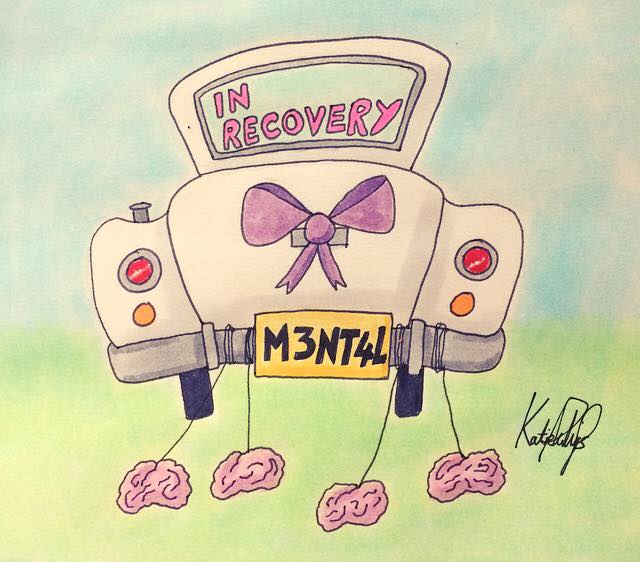
I don’t have any idea if I am making sense here because to be honest I am on so many medications right now that my brain is not functioning but if I had to resort to the good old Born Without Marbles way of explaining things, aka an analogy, it feels like my body and brain are one of those cars people drive off in after a wedding with tin cans on the back and “just married” scrawled across the rear windscreen.

My body is the car and as it gains weight it is zooming off full speed. Meanwhile my brain is the collection of tin cans tied to the back, being dragged along and through all of this road that it is not ready for, each can bouncing and denting, bruising and breaking a little more with every mile that passes. My body gains weight, my brain cracks a little more, I feel more broken, depressed and bruised and the faster my body goes the further it is from my brain which is actually all the way back at the starting line. I guess this analogy isn’t perfect because you could say “but your brain is moving in the right direction like your body if it is tied to the car” but that is where the analogy fails because that is not happening at all, like I said, as the car moves the brain just gets battered and even staff have admitted that in the past few weeks things have mentally become worse and worse as time has passed and weight has gone on.
Christmas day is a perfect example of this. When I woke up on Christmas day I was weighed (NOT something I asked Santa for and if I ever wake up to a set of scales in my stocking on Christmas morning again I swear to God I am marching to Santa’s grotto to give that beardy man a piece of my mind…and his scales back), and I had gained a lot of weight. On paper then and to the doctors, my body had got “better” but mentally the shock of it all had such a strain on my mind that I totally lost it. Within minutes I was having to take medication to calm down from the anxiety and agony and when my family came to see me for our two hour visit, the visit wasn’t better for the weight gain, it was worse. It should have been better logically, my body was healthier than the last time they had seen it but in becoming that way I became so upset, distressed and anxious that I had what we shall simply call “ a little incident” and I had to ask my family to leave early.

It is that which I think illustrates my point best as to how impossible it is to answer the question as to “how are things going” when you are in recovery for an eating disorder. Am I better? In a way, yes and I am getting “better everyday”, but in the other more important mental side am I better? Am I progressing? Not at all. I hate myself more than ever, I am more unhappy than ever and I feel more trapped than ever in a body that I no longer relate to. The distance between my body and mind is so great now that I have asked staff if there is any chance we can slow down on the weight gain so that my mind has got a chance to catch up but they are refusing and it all feels like I am being dragged and pushed too far out of my comfort zone. I am in hospital being treated for an eating disorder and the physical problem is being taken care of by a tube, but the mental aspect is being torn apart and I really don’t know how much longer I can handle it.

It is so frustrating trying to explain all of this and I guess in the end the main thing I want to do at the end of this blog post is apologise because I feel like I haven’t made any sense and that I have wasted your time with my incoherent waffle. Like I said though, I am on all sorts of crazy meds at the moment (to calm me down because I am in so much distress due to this whole struggling mentally with the physical progress my body is making right now when I am not ready for it), so please blame those meds and not my inabilities as a writer. I don’t understand half the things that are going on at the moment so explaining them coherently is somewhat difficult. I really am sorry. I am just so battered. I hope this makes some sense at least or that I have got the point across in some way that physical recovery and mental recovery for an eating disorder do not go hand in hand and can sometimes be literally travelling in opposite directions. “How are you doing?” is such a simple question but good lord when you have mental health problems is it a difficult one to answer.

Take care everyone x
RecoveryCar

Is It Ok To Give Food Related Christmas Presents To People With Eating Disorders?

As soon as winter rolls around, there are certain questions that suddenly pop up every time you interact with another human. These questions vary but include things like:
“Are you doing anything nice for Christmas?”
“What do you want for Christmas?”
“Do you really need to buy more penguin themed decorations this year?” (Yes. Yes I do)…
And of course the ever sigh inducing “Have you started your Christmas shopping yet?”

Due to the birth of commercialisation and consumerism (two things that, although very much involved in Christmas, were not actually born in Bethlehem and laid in a manger), Christmas shopping is a big stress over the festive season both for money reasons and of course wondering what the hell to buy for everyone. Mental health wise however, there are further complications because sometimes there is a question not just to what you should buy a friend or relative, but whether there is anything that you should definitely not be buying…

As you may know, I have a lot of friends with eating disorders and several of these friends have come to me in the past exasperated and fed up, poised with a story to tell me about a distant relative who sent them food as a birthday or Christmas present. I know a lot of people with eating disorders might get frustrated, find the gift insensitive, rude, or even cruel, like taunting an alcoholic with a bottle of gin, and the majority of people I know have stated that “people should not give food related presents to people with eating disorders”.

I think that one of the difficulties in this issue, is trying to decide whose responsibility it is for someone to manage the whole gift giving/receiving situation. Is it the responsibility of the person who is choosing the gift to give (maybe an unfair burden considering not everyone will know every personal detail of whoever they are buying for this December and surely if it is “the thought that counts” any present is incredibly kind and generous), or is it the responsibility of the person receiving the gift, to manage what it is appropriately for them?
If you give a Dolly Parton hater (for-shame! Come on now, you have to at least like Jolene? 9-5? IT IS A SONG ABOUT THE MONOTONY OF WORK LIFE! DOLLY GETS US!), a copy of Dolly Parton’s Greatest hits, whose responsibility is it to deal with the CD? The gift giver for not knowing about a person’s hatred of the world’s greatest country singer and for not being too careful, or is it the responsibility of the gift receiver to simply donate the generous present to a charity shop where it can be enjoyed by someone else who is able to appreciate a bit of “I will always love you” blasting from the speakers? However, what if a gift is medically inappropriate? Whose responsibility is it to manage then?

For example what about Horris who is deathly allergic to peanuts? Maybe Horris didn’t write a Christmas list this year (always a risky move), and maybe his third cousin twice removed’s husband’s goldfish wants to send Horris a gift (for he is a very generous goldfish), but is unaware of Horris’ unfortunate peanut condition.
If this lovely Christmas loving goldfish sends Horris three tonnes of peanut butter, a t-shirt made from knitted peanuts and a trip to the “World of Peanut” theme park with the “Ultimate Peanut Experience Peanut roller coaster” (you ride around the track within the shell of a giant genetically modified peanut and then at the end enter a flume tube filled with peanut butter that will leave you utterly soaked upon plunging into it). If Horris uses this ticket to the theme park, surely it is partly his fault for not taking proper care of his health requirements (aka the requirement to not plunge into a pool of peanut butter at 100mph in the shell of a giant peanut). Then again, what if Horris is so allergic that the mere sight of the ticket and the tonne of peanut butter sends him off in an allergic reaction without him having any warning of the deadly gift? Who do we blame? Goldfish or Horris? Surely this is a very different kettle of ethics than the previous Dolly Parton debate? So what about people with eating disorders?

On one hand, as a person with an Eating disorder myself, I can see the point of those who say that giving food as a present to someone with an eating disorder is inappropriate or something they don’t like happening. It can indeed be frustrating to be given food presents that you fear every year and are possibly unable to enjoy due to your illness. I have heard people with anorexia say that it makes them feel more isolated from the rest of the Christmas festivities because being given, say a Christmas present that is a box of merry smiling gingerbread men with chocolate buttons, a freshly cut yule log or a batch of homemade mince pies is like being shown something “normal” about Christmas that others can enjoy and that they may want to take part in like other people, but due to their illness, feel they can’t. Some could say that getting food presents makes them feel misunderstood or like their problems/disorders have not been taken seriously, belittled and assumed to be “a mild difficulty with food” that can easily be solved if you put a nice bow on a box of chocolate penguins, rather than a fully fledged eating disorder ruining their lives no matter how many bows you stick on top of that box of rich 70% cocoa waddlers.
As well as food presents for disordered eaters being problematic in the sense the present receiver may be too scared to enjoy them, there is also the risk that food presents could trigger someone in other ways, for example someone who feels the compulsion to binge and maybe purge afterwards. Some sufferers keep certain foods that they are likely to binge on out of the house to make them feel more in control, so when that food is suddenly handed to them wrapped in glittery ribbon tied paper, they struggle to deal with it in the way they might like to when fighting their disorder.

That said, though what I am about to say is something most Eating Disorder sufferers would disagree with, I don’t think that people should put a full-on ban on food presents for people with eating disorders and I think that getting a food present once in a while is more likely to help rather than hinder your recovery.
What if one Christmas as the countdown to the 25th was underway, you went into some form of new treatment that you started to find more beneficial than any you had tried before. What if an image of what life could be like without your eating disorder started to give you hope in a positive future and what if, like a Christmas miracle, your eating disorder backed off a bit and you felt strong and determined enough to kick some ass. What if in this Christmas miracle you became so inspired to fight your demons that you made a promise to join in on all the scary Christmas food things this year, finally buy that advent calendar, make that gingerbread house with the candy cane decorations, try one of Aunt Enid’s famous mince pies and join in on all the party canapé platters at the work Christmas buffet (I hear the brie and cranberry filo tarts and chocolate penguin profiteroles are a delight). What if all of these goals arise, all this determination to fight and join in with everyone else…and then nobody gives you the opportunity to do any of it because they are all too scared to offer you that filo tart or wrap up that tub of Celebrations. To me, that would be incredibly triggering, if I were to be there ready to fight, ready to eat and join in and everyone just left me out anyway because they assumed I wouldn’t do it. This year, considering i am in hospital and not particularly well right now, that assumption might be right but in my head, never being given food presents at Christmas or any other time of year like Easter or a birthday, is simply a way of other people confirming the idea you already have in your head that you don’t deserve or need food and therefore shouldn’t eat it. People treat you like an eating disorder and you will find it hard to see another identity for yourself. Furthermore, when would the food ban stop and would it ever? How would that be decided and wouldn’t that be more triggering in itself to have food presents suddenly reintroduced? If you have an eating disorder at one point, are families to avoid food gifts even if you are recovered “just incase” which again isolates you from certain celebrations. Yes food can be triggering as a gift but wouldn’t it be more triggering to be very unwell for years and then one year to be maybe doing a little better mentally and physically, so much so that people notice, give you food and then you freak out thinking that they are insinuating that you “aren’t ill anymore” or that they think you have put on weight so are clearly fine with eating again.
Personally to avoid all of these issues, when it comes to food presents, I would rather be treated as normal, like everyone else, receiving the odd box of Quality Street and being offered the iced mince pies. Even if I can’t accept the mince pies or have to give the Quality Street to my mum, I would rather they were there to make other people treat me “normally” until I am in a place to play that role of “normal person who eats food presents at Christmas and gets two candy canes stuck in their gums by getting a bit too enthusiastic when impersonating a walrus”.

Overall though, I guess that with this topic, it is impossible to make any conclusion because whether or not you give food to someone with an eating disorder is going to be a tricky thing to gauge and will vary from person to person. As I said, even I and my group of friends who share the diagnosis feel very differently about the topic so to be on the safe side, if you are wondering whether or not to give someone with an eating disorder a food related gift, you might want to check with the individual or maybe a relative of that individual first to see how they might react to it. There are many types of eating disorder and even people with the same one will experience them differently at different times, such as when they are going through periods of relapse or recovery, so as much as I would like to have given you a black and white simple answer (and we all know how much I love things that are black and white ahem penguins ahem), I am afraid I will have to conclude in a rather hazy grey as the answer will vary from person to person.
All I would say is, if you are the gift giver, try not to get too anxious or caught up in overthinking it because ultimately you have a 50/50 shot of getting it right and if you get it wrong, it isn’t your fault, nor does it make you a bad person. Similarly, if you are the receiver I am sorry if food present wise, things don’t go your way this year, but equally remember that other people may not be thinking as deeply into the meaning or significance of a box of chocolates as you might be and maybe it is just their way of trying to show they think you are pretty awesome. A Christmas present is a Christmas present, it isn’t a holy significant statement laden with meaning as to how someone views you or your body, it is a sign of appreciation, a sign someone cares, and at the end of the day, it is always the thought that counts.

Take care everyone x

Pudding blog

Is It Possible To Be Too Open About Your Mental Health?

TRIGGER WARNING: This blog post contains reference to certain medical treatments that can be used with people with eating disorders, so if that is something you would find unhelpful then please do not read it for your own safety. If you are like the witch in the Wizard of Oz who melts when coming in contact to water, THIS is your warning to STEP AWAY FROM THE FLUME.

In both the mental and physical health worlds, confidentiality is a BIG thing. When it comes to your wellbeing, there are a lot of rules between professionals, your medical notes and what can or can’t be said in front of friends and family.
Want to keep that random extra hand sprouting from your lower back a secret from Aunt Enid so that she doesn’t start knitting you an extra mitten every winter? No problem, medical confidentiality has got you covered (unlike your third hand which is now not going to have a mitten for Christmas).
Don’t want people at work to know that you have a condition that causes you to temporarily morph into a teapot whenever stressed? That’s fine. Tell the doctor and they will keep that tidily hidden away on a computer protected with lots of codes and National Health numbers that would make your deepest medical secrets hard to find, even if people were looking for them.
You see, when you are dealing with hospitals, everything is kind of like some kind of James Bond spy film, it is all very hush hush, very top secret, very “who can we talk about your bunions in front of” (which, coincidentally was the alternative title for the 1964 classic “Goldfinger” but Shirley Bassey didn’t want to sing about Bunions).
Not only is medical confidentiality important though, it is also fragile, and like all fragile things, this unfortunately means that it can very easily, even accidentally, get broken.

My question however, is if it is YOUR personal medical confidentiality, is it ok/are you allowed, to break it yourself? Are you allowed to be “too open” about matters that other people would usually keep private, in the interests of raising awareness of those issues?
Not to talk about any single person or specific situation in particular or anything (THIS ENTIRE BLOG IS ABOUT ME AND MY VERY CURRENT AND SPECIFIC SITUATION), but is it possible I ponder, for one to be too open say, about a mental health condition and the treatment that may be involved as a consequence?

Like I said, we are not talking about anyone in particular (THIS IS ALL ABOUT ME), but as a very rough, vague and unspecific example, lets go back to Monday the 27th of November 2017 at 10:01am when a link to a post on this fabulous mental health blog you might have heard of, was uploaded to try and give a rough update to readers of said blog regarding the situation (or rather, the colossal mess of a situation) of the writer.
Oh screw it, I cant keep the secret anymore. Ok yes! You are right! I am talking about my blog aka this blog and my situation last Monday when I tried to write a post to tell everyone the latest news and was incredibly vague about everything, which is unusual for someone who usually speaks honestly and openly about everything personal and mental health related. Why was I incredibly vague? Well, because I was scared after staff had raised concerns about me sharing certain things on my blog, which really freaked me out and had me very worried and confused.

Thing is, when it comes to medical confidentiality, I kind of see it like you see a piggy bank, it belongs to you, you can look after and protect it, but at the same time, you and you alone are allowed to break it.
Were you to go over to someone else’s house, find and destroy their piggy bank and run off with all the money inside (or say medical details), that would be wrong on many levels. It would be theft, it would be a breach of someone’s privacy, destruction of their property and the murder of a perfectly good ceramic piggy. If however you have your own piggy bank and, after several years of amassing various coins of experience, decide that you don’t mind sharing those experiences and spending those coins out in the world in the hopes of making a difference, and consequently smash your own ceramic oinker to smithereens with a mallet…I think that is ok, because it is your property, your information to share, your little piggy to destroy (and then mourn over appropriately of course).

It is still important to be responsible for your information of course, and I don’t believe people should, as it were, shove their information coins into other peoples faces whether they like it or not.
There should always be warnings to alert people when someone is talking about a sensitive issue that could be triggering or harmful to others, so that they as a reader can use their own personal responsibility to choose to remove themselves from potential harm. Nobody should be forced on a flume and plunged into a bath of emotions without the opportunity to get their rubber duck out but similarly, if you know you melt when you come in contact with water, maybe don’t go on a flume.

Admittedly this is more complicated with things like mental health problems which can sometimes cause you to do things, read things and get involved in things you might know deep down are harmful, but we can’t all be silent about everything, and if Donald Trump is allowed his own twitter account then I like to think I can spout my nonsense freely and use my free speech on my blog in my little corner of the internet.
That is how I see all this, all the drama that I have been caught up in over the past week about what it is and what it is not ok to share, whether there are some things that should be kept confidential and whether you can or can’t be “too honest” about personal matters, and it is that opinion that has led me to just throw caution to the wind and write this post being honest about things anyway.
This is of course merely my opinion, and I am sure there are many people out there who will disagree, but there we go, we can’t all like mashed potatoes made by the same recipe, opinions vary, some people don’t like lumps, some people don’t like pepper and others don’t like to read blogs about people who talk about mental health (weirdos). End of.

So what is going on? What has been happening? What have I been skirting oh so daintily around for the past fortnight? Well I will tell you because like I said, this is my piggy bank and if I want to take a mallet to it then I damn well will.
Basically, as you know, I have been in a psychiatric unit being treated for my eating disorder for the past 10/11 weeks, but things were not going well and I was not managing mentally or physically with any of this recovery business. It was then decided that we had reached a point where it wasn’t safe to keep me where I was anymore (which feels so weird and confusing to write as I still adamantly believe that I am perfectly fine and do not need any of the things going on around me, but that is a topic for another time). Anyway, as a consequence of various decisions regarding my mental and physical health last week, I had a week or so away over to a medical ward, and, if this post is going up in time and all the professionals stick to the current plan, I will hopefully have been transferred back to the mental health place on the Friday before you are reading this.

When you have an eating disorder there are a lot of physical complications that can happen as a result and there are sometimes a lot of things that may need to be medically treated as well as mentally, but the main reason for this transfer was so that I could be fitted with an Nasogastric tube (aka a tube that goes up your nose and then down into your tummy so that you can be given nutrition without having to eat it yourself if needed).
Some eating disorder units can do this procedure on site themselves and many do, but the one I am in has been unable to until now (hence why a few weeks ago I was talking about maybe being sent to Glasgow or somewhere else across the country). With no beds becoming available in time though, I had to just pop off to get it done on the medical ward and have some treatment over there. Like I said though, if all goes to plan, by the time you are reading this, I will be back on the mental health ward, still with my tube for a bit now it is safely up and running, but working to have it out as soon as possible which would be nice, as I am not thrilled about this new accessory (I would have preferred a bowtie but alas you cannot give someone nutrition through a bow tie. Not even a sparkly one). It was this whole tube thing that caused the staff to get a bit over excited with the “shushing” (picture a librarian after several hundred cups of espresso).

If I am trying to see from their point of view, I guess I can kind of sort of understand on some level. For example, I know there are some people who might find talk of NG tubes triggering, and unfortunately there are occasions and certain sufferers/people who see them as something to take pride in, something that proves they are “really ill”. This is of course ridiculous as every eating disorder is equally severe and serious and everyone is “really ill” regardless of whether they have been through certain treatment options or not. Even if you have never received any treatment for an eating disorder you are as ill as someone who may have been in therapy for years, and the last thing I would ever want is to give a message on my blog contradicting that.
However at the same time, whilst a tube is something I do not think one should be proud of, I do not think it is something to be ashamed of either and that was what stressed me out so much last week. I was all there ready to go ahead and write as per usual, and suddenly everyone was telling me that what I wanted to talk about was inappropriate, which had me paranoid that I should be ashamed of what was going on or that this happening meant that I had let everybody down by “failing” to get better, and thus not say anything at all just to be on the safe side. To be honest I don’t think a tube is anything to feel particularly anything about. It just is. Sometimes they just happen to get fitted to people who have eating disorders to help them try and get out of being rather stuck in a highly sticky syrup/velcro/superglue bound/sellotape/plaster situation.

If you are reading this and think that me admitting any of this is to be too open about mental health/confidentiality breaching then I am honestly sorry, but like I said, talking about mental health and my experiences within the realm of mental health treatment is something I am passionate about both in terms of reaching out to others, raising awareness, breaking stigma and misunderstandings about various illnesses and overall making people feel less alone and not as weird and isolated as I did when I kept all of my problems bottled up and never had anyone to relate to. Maybe I am breaking a piggy bank, but it is my piggy bank to break and it has been my decision to be honest about it.

I won’t go on about it any more now because writing this much is scary enough as it is, but I hope in the future I will be able to write about how this experience and tube feeding in general has affected me and how it can be used in treating people with eating disorders. It isn’t a nice topic, nor is it a nice experience, but it happens.
Now if you don’t mind, I am off to hide under my bed as I do when I post all scary blog posts that could potentially make someone angry with me/get me into trouble (I also need to hide from the cleaner…that is one thing nobody warns you about when you get a tube…when you have one in there is a genuine risk of being mistaken for a Henry hoover and dragged across a carpet snorting crumbs for three hours…) I hope this has been ok, I hope having this tube doesn’t mean you feel that I have let you down and if not I really am very sorry. I promise I am still trying.

Take care everyone x

PiggyConfidentiality

The Latest Mental Health News – When Mental Health Treatment Gets Rather Complicated

*Blog opens on a black screen, dramatic music plays, lights flash up to show the bespectacled author of Born Without Marbles sitting in front of a giant spinning globe, wearing a suit and looking very dapper* (Please note that it is the author wearing the suit and not the globe who has instead chosen an inflatable rubber ring as a wardrobe choice, for he is a globe with serious Saturn envy). Author holds up large piles of paper, shuffles unnecessarily, lays them on desk and then begins to speak*

Happy Monday everyone and welcome to the news. Not just any news though, for this is strictly the Born Without Marbles News.

*Globe with inflatable rubber ring spins for dramatic effect…more shuffling of paper*

Whenever you turn on the news these days to see what is going on in the world, the stories you see are usually incredibly depressing tales of natural disasters and various wars between countries who decide it is a better idea to settle their differences by blowing each other up rather than sitting down for a nice cup of tea and talking through their issues. If I were head of a country I know that would be how I would want to resolve any conflicts between nations (I would even have a special teapot for such occasions and there would always be biscuits rather than nuclear bombs or machine guns involved, which is nice because biscuits are far less toxic, noisy, and overall they are much tastier.) Today though I am coming to you with an update in news that is far more jolly, far more positive and exciting than anything you might have heard from some suited person on the television sitting behind a desk shuffling papers about, for I have GOOD news. What news? I AM OUT OF THE MENTAL HOSPITAL.

*Globe spins very excitedly and a party popper is released from an unknown location*

That is right folks, after 9 weeks I am off that psychiatric corridor and into the wonderful world of freedom and…hang on…wait…news just in through the ear piece…ah…yeah…Ok so good news we are out of the mental hospital…bad news is scrap the freedom bit as it is only because I have been transferred to a medical bed for more intensive treatment until I am stable enough to return to the psychiatric unit…hmm…that kind of puts a downer on things…this is awkward…but still yay to no guns or nuclear bombs in this broadcast!…And I do have biscuits!… *Holds up a pitiful broken packet of National Health Service own brand digestives, smiling desperately as a waterfall of dusty crumbs cascade into a pile on the floor*. Clearly it is a lot more difficult to be a cheerful news reader than I thought…

*Globe stops spinning…awkward silence…very awkward…like really awkward*

But back to the news update! As you know, last week I was talking about how unpredictable life is when you have a mental health problem and how currently things to do with my personal care and situation have been rather up in the air. On the positive side this last week has brought about decisions and actions that mean I am no longer up in the air, but have been brought back to earth out of the floaty confusion with a bit of a bump.
I think I mentioned the chance of me being transferred to another eating disorder unit last time because I really haven’t been managing where I am, but over the past week, no beds became available in time (SIDE SHOUT OUT TO THE GOVERNMENT STOP USING MONEY TO BOMB THINGS AND PAY THE POLITICIANS’ COFFEE BILLS AND MAKE MORE HOSPITAL BEDS FOR MENTAL AND PHYSICAL HEALTH FOR GOODNESS SAKE), and it reached the point where we had run out of time and I couldn’t really wait any longer. Thus another transfer had to be made, hence the update that I have now been moved to a medical bed to treat the immediate physical health issues that now need a bit of prioritising over the mental health side to having an eating disorder…

…And unfortunately, as brief as that update is…that is, frustratingly, all I can tell you this week. You see, a lot more has happened that I want to talk about because I am always one to be honest about mental health and do all that awesome awareness raising…

*Waves “I like to raise mental health awareness” flag*

…but recent discussions have taken place over the last week that mean that for now…that really is all I can say about what is happening, where I am and what medical treatment I am currently undergoing. To be honest it is all very “red tape” and “confidentiality” based stuff that I don’t quite understand but would rather clarify with official people first rather than getting myself into any trouble, which is really not needed in the Born Without Marbles world right now, as figures show that levels of troubles are already high above acceptable levels.

*Shows graph with a big red line going up. Arrow points to line labelled “Things that have gone wrong in 2017”…Cue a bit more paper shuffling and a random act of origami in which the aforementioned graph is folded into a lotus flower perfect for adorning a dinner table…It is passed to a member of the sound crew who lays it on a table at which 10 very important people then dine whilst commenting on the beauty of the lotus flower. They eat Salmon en croute*

Hopefully next week or at least sometime in the future I will be able to explain a bit more about what is going on but for now I just wanted to write a brief blog this week to update everyone on the fact that in terms of my mental health and mental health in general, I am personally in one of those “when mental health problems cause physical health problems” situations. Just wanted to at least say that because I also wanted to reassure people out there who may have been lovely enough as to send me concerned messages recently, that I am somewhat ok/being very well looked after and, though I may be hating it with every penguin loving grain in my body, I am in what other people would argue is “the best and safest place/situation right now”.

So yeah, I am afraid that is the blog post for this week. I really am sorry it was not the best/most exciting/most awareness raising but I guess it has raised an interesting discussion about confidentiality when it comes to talking openly about mental health, which I will be writing about a bit more when I am up to it, even if I am still not allowed to go into my current form of medical treatment sometimes used on people with eating disorders.

*Random party popper is released because this is the the Born Without Marbles news update and thus random party poppers and things that do not make sense are required at all times*

Anyway, I hope you are all well and know that I appreciate you all very much, especially if you read/watched this news broadcast to basically let everyone know that normal blogging activities will resume but I am currently somewhat out of order right now…kind of…although now I look at all I have said that is actually quite a lot of words for someone who thought that due to “circumstances” a BRIEF apology update blog was all that was possible this week…Note to self…learn to shut up…like seriously…for example right now…TAKE CARE EVERYONE X”

*Blog cuts to a giant map covered in rain clouds and lightening bolts where Gerry was supposed to be presenting the weather but isn’t because he got bored with the main part of the blog news for not being specific or interesting enough and went to the local bakery to get a sausage roll. Ironically he got rained on having forgotten his umbrella because he had not predicted a high chance of showers…Switch to spinning globe that aspires to be Saturn…fade to black*

NewsUpdate

The Difficulty Of Knowing What Counts As “A Behaviour” When You Have An Eating Disorder

How do you tell the difference between an elephant and a letterbox? You check to see which one has a trunk and which one is filled with neatly addressed handwritten letters that will soon be lost in the abyss that is “the postal service”.
How can you tell the difference between a brand new slipper and a boomerang? You throw it to see which one comes back and smacks you in the face.
So far so good (apart from the fact you may have just been smacked in the face with a boomerang or lost a perfectly good slipper), but now for the third question:
How do you tell the difference between the genuine preferences of someone with an eating disorder and the disordered behaviours of someone with an eating disorder? The answer? With extreme difficulty…if at all.

When you are on an eating disorder unit, the food aspect of things/what you can and cannot do with food, is a lot more regimented and controlled by sets of rules than it is in normal life.
Rules will vary depending on what hospital ward or inpatient unit you have been admitted to, but as a general list of examples these rules will be things like “no eating cereal with tea spoons”, “no breaking food up into tiny pieces”, “no sleeves at the dinner table”, “you must scrape the plate that you are eating from clean to complete the meal”, “only X number of minutes to eat your meal” and “no inserting parsnips into the nostrils of the person sitting next to you” (pretty sure that last one is also relevant in real life actually but I am not quite sure…my mother was never very clear when it came to table manners.)
These rules are often frustrating and can seem a bit harsh but they exist because often an eating disorder controls how a person eats and behaves around food, as well as how much or little of it they eat, so part of treatment during recovery involves tackling those food behaviours as well as things like the amount of food someone might be eating. Like I said it can be annoying, but it makes sense. Take the “you must scrape your plate to complete a meal” thing. It may seem over the top (and is a rule that will destroy the lovely willow pattern adorning all of your best crockery), but were it not for rules like that in hospital, there is the risk of people arguing that they have finished their meal when really all they have done is smear it across the good china.

With behaviours like that, I think it is easy to tell the difference between them and genuine food preferences as I don’t think I know any people without eating disorders who “prefer” trying to mash a lasagne into oblivion rather than consuming it.
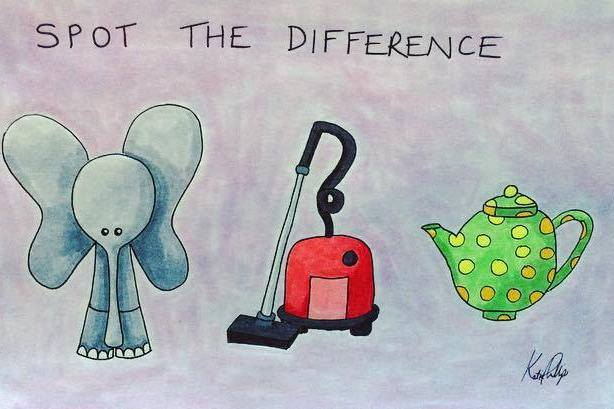
There are however, a lot of actions people do where it is far harder to tell if the person is making a genuine choice or following a behaviour, and in these situations it is less like trying to distinguish an elephant from a letter box, and more like trying to tell the difference between an elephant, a tea pot and a vacuum cleaner (if you line all three up together you have to admit they do look rather similar…trunks, nozzles and spouts are easily confused…I learnt that the hard way…and broke a teapot).

For example at the hospital I am in at the moment, there are certain rules regarding condiments such as “only two pepper/ketchup/vinegar/mayonnaise/brown sauce etc sachets per meal”. The logic behind this is that some people with eating disorders tend to totally cover their food with a certain condiment in order to make it all taste the same/spoil the food and make it taste horrible as a punishment etc.
Then again, as well as people who use pepper to burn the roof of their mouths off by using it excessively, there are people who use what looks like an excessive amount of pepper simply because they like it. Every time my Dad eats a meal he uses so much pepper that even people scuba diving at the bottom of the Atlantic start sneezing because he likes the spice, and I have a friend who uses what may look like a lot of salt because she has been brought up using that amount and things taste wrong without it. Neither of these people have eating disorders, but they would still struggle living by the rules that are in place to help someone in recovery from a disorder. I guess you could say that the way you tell the difference is to see which came first, the food preference or the disorder, but that isn’t as easy as it sounds. Eating disorders are sneaky, they slip into your life gradually without you really noticing, so it is rare for someone to be able to pin point the day they officially became unwell.

What if my Dad, who currently does not have an eating disorder, developed one in years to come and had to go into hospital? Or my friend who likes a lot of salt? They might, quite rightly, argue that their preferences existed years before their illnesses began and they may be right but the thing is, in hospital, that doesn’t really matter and this is where it gets frustrating. Once you are tarnished with the Eating Disorder brush, suddenly people assume that EVERYTHING you do around food is because of that disorder and they rarely give in or believe you even when you are expressing a genuine dislike. It can be really annoying when you know that your love of toast that is not particularly well cooked is because you like soft as opposed to crisp bread, yet when you are consistently told that everything you do is disordered, sometimes you can start to doubt and be unable to tell the difference between your own choices yourself (aka the is it an elephant, teapot or a vacuum cleaner situation).

How about timings and things like time limits on eating disorder wards? Admittedly they are necessary to avoid still working on Monday’s bowl of cereal at Sunday dinner time (rather soggy cereal I would imagine), but in addition to timings perhaps being affected by disordered thoughts or behaviours, people naturally have varying eating speeds. I certainly know that in my household my Dad will always finish his dinner a good 10-15 minutes before my mum for the simple reason that he has a bigger mouth and more violent set of gnashers (not abnormally large I might add…like he is still a handsome chap and isn’t frequently being mistaken for a shark who needs to be sent back to the aquarium…just clarifying…love you Dad.)

The main rule/“behaviour” that got me thinking about this topic however, the rule I have seen come up in every single one of my admissions to an eating disorder unit and the rule that is carved in a stone tablet and worshipped on a mountain guarded by holy cherubim:

“Thou shalt not dunk biscuits”.

Some of you reading this, who have never heard of such a rule, may be a little shocked, stunned and perhaps distressed to hear that there are people all over the country being forced to eat rich teas that have never actually taken a dip in a real mug of the beverage after which they are named (I know, it is upsetting but we can get through it).
Again, as with all hospital rules there is a reason behind it, that being that people sometimes submerge and drown their biscuits rather than dabbling in a quick dunk and then smear the soggy remains around the inside of their mugs or leave them in sorrowful abandoned mush mountains at the very bottom.

The issue though, comes when you are someone who wants to safely and appropriately dunk their biscuit, yet are prevented by the rule that may not be relevant to you. Of course rules have to apply to everyone on the ward to make them fair, but that is what is annoying, i.e. having an eating disorder and then having EVERYTHING you do with food put down to your disorder when maybe you have just grown up liking a lot of ketchup on your curly fries, or genuinely prefer the texture of a cookie that has had a quick swim in a mug of hot chocolate. Dunking biscuits CAN be a disordered behaviour, but it isn’t always.

Just imagine if the world had to live by eating disorder ward rules with the act of dunking a biscuit being classed as a disordered/unhealthy behaviour and thus banned for all. How would any of us ever eat an Oreo? The dunking aspect to those delights is even in the damn advert! They literally explain how to eat them on the packet! First you twist it, then you lick it, then YOU DUNK IT. If that bit was deleted from the process the country would grind to a halt and living rooms across the world would be filled with poor distressed people holding opened licked Oreos and crying out in agony “WHERE DO I GO FROM HERE?” Think of the number of teeth that would be broken on undunked ginger nuts!

You could maybe be a generous dictator and say that only people who appropriately dunk their biscuits are permitted to do so (something I have asked for on multiple previous admissions), but how can you tell if someone is dunking appropriately? What if someone is genuinely dunking for the resulting soggy biscuit end goal but is such a poor judge of the strength of their chosen biscuit that they get the timings wrong and remove their Custard cream or Bourbon from their brew not to find a perfectly melted vanilla or chocolate cream centre but instead a blank space, an empty half in which biscuit perfection had existed seconds before it was too late and the perfection turned into a sinking disappointment of heartbreak, sorrow and missed opportunities.
Should biscuit dunking be classed as an eating disorder behaviour just because it can sometimes be used as one or can it just be a preference?

Overall then it is clearly very difficult to tell the difference between an eating disorder behaviour and a genuine food preference, especially when you yourself have the eating disorder. I guess when it comes to people who have no issues with food the answer is obvious…until that person is unfortunate enough to develop the disorder and we are caught in the whole confusing “which came first the soggy biscuit or the mental health problem?” dilemma which has plagued scientists for years (scientists who I feel are doing valuable work but are also perhaps taking advantage of their right to order in free biscuits from the big companies under the guise of “research purposes”….)
Of course there will always be ways to figure out the disordered act from the genuine preference but it isn’t always as clear cut as the elephant and the letter box example and sometimes even knowing your own reasons for doing things can get you into a confused muddle of soggy biscuit yourself.

Take care everyone x

ElephantHoover

Things You Will Need When You Are Admitted Into A Psychiatric Hospital

Before you move house, you need to pack your life into a van. Before you go on holiday, you need to pack suncream and the inflatable dolphin into a suitcase, and before you go out rambling in the wilderness, you need to pack a picnic in a picnic basket (preferably one of those wicker ones with a gingham tablecloth and lots of little boxes inside…one must never go out rambling unless one is accompanied by a picnic).
There are however some things that are a little less fun to pack for, those being admissions to a hospital or inpatient psychiatric unit, which is nowhere near as much fun as a picnic (and involves 100% fewer wicker baskets…By God I love a wicker basket).

When I decided to write a blog about this topic I was therefore going to call it “Things you will need to pack for an inpatient admission” but as I have started writing I realised that sometimes when it comes to mental health hospital admissions, they are not planned like a two week cruise around the Mediterranean, and there is seldom time to “pack”. Even when an admission to a unit has been planned, you are going to be so nervous about it the night before that you forget to pack anyway, so instead here I thought I would offer a little help to all those who find themselves in that situation by providing a list of things that you will need during an admission to a mental health hospital.
It doesn’t matter if you are making a list of things to pack the night before or simply things you now need to start begging family/friends/online delivery people to bring to you because you were not prepared and only came onto the ward with a one way train ticket to Exeter (trust me, it happens…). Whatever the situation, this blog post is here for you, so lets get on and start this fabulous list of things you will need during an inpatient admission to a mental health hospital (things you will need if you have fabulous taste like me that is…)

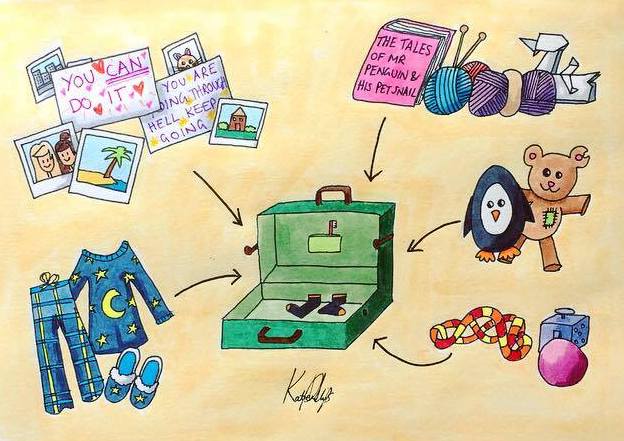
BASIC LIFE THINGS: You may think that this is a rather obvious logical point to make but remember, mental health admissions are stressful times where “obvious logical things” turn into “I like ducks”, and you would be surprised by the number of people who turn up to hospital without a toothbrush (warning, this may make teeth angry and cause them to phone the tooth fairy emergency helpline for immediate assistance. Don’t say I didn’t warn you.) So yeah…I am not going to list all the miscellaneous nonsense you may use every day, but as a general note to start off with, when you are in hospital, you are probably going to need a lot of the general nonsense you use everyday (toothbrush/toothpaste/underwear etc.)

MOTIVATION: Of course I mean this point in the emotional sense of the word, but when you are isolated in hospital it can be easy to forget why you are there and what you are doing in this inpatient bubble, so practical pieces of motivation to get you through are also essential. Things in this category can include photos of friends or family, motivational books about people who have been through recovery for your disorder, quotes or even little prompts to give you a little boost when your brain refuses to do the boosting for you (e.g taking something like a list of things you want out of life to have at your place at the table on an eating disorder ward to help at meal times). I have known a lot of people to go all out with motivation and to bring enough cards/quotes/photos to decorate their entire room into a cave of inspiration (if that is allowed on your unit and you are not in a stripped room that is), so if that would help you, do that. Personally though, I prefer not to put up too many decorations because I am always so hopeful about leaving that I refuse to accept the idea that I should settle because I may be there a while…

THINGS TO DO: When you are in a psychiatric hospital it is likely that there will be things going on. On the week days there may be things like therapy groups, 1:1 sessions and opportunities for visitors, but aside from all of those things and the “spare hours” that will be taken up by things like crying hysterically, you are still going to end up with a fair bit of free time, especially on weekends when it is quieter and a lot of patients may have leave. Keeping yourself occupied therefore is going to make time pass quicker and distract you (a bit) from what is going on. For example on my ward there is a current craze with origami and people are making paper cranes faster than I can count (I tried to get into Origami too and managed to unfold one of these aforementioned cranes into a normal square piece of paper again but apparently that “isn’t the point”). There are also patients who knit and live in giant balls of wool, people who colour with crayons, draw, and there are patients like me who get through the day either by writing or by tossing reality out of the window and reading to get lost into alternative fictional worlds (This week I read “The Secret Garden” a book I highly recommend for times in hospital when you cant go outside and see a real garden yourself.)

COMFY CLOTHES: The first time I ever packed for an inpatient stay, I put all of my nice going out clothes into my suitcase and took them to the hospital ready to co-ordinate my outfits every day so that I would “look nice” for the other patients. I also wore mascara to a place I was highly likely to start crying in upon arrival. I was an idiot.
Listen, I get it, people like to look nice both for themselves and for other people but let’s be real, a psychiatric hospital is not a fashion shoot (cameras are not allowed), and after five minutes neither you nor anybody else is going to care what anyone looks like because you are all too busy being caught up in fighting your head demons and managing general anxiety. Even if you are not worried about what you look like or what people are thinking of your sense of style, “nice clothes” are simply not practical. When you are in hospital you are going to want to be comfy. Imagine you need to curl up on your bed for a good sob or find that you are so anxious that you start having panic attacks and problems breathing. Maybe things have got a little bit out of hand and staff need to carry you somewhere, carry out a quick blood test or give you an injection to calm you down. All of those things are going to be a hell of a lot more pleasant (as fun/pleasant as being injected in the rear can be at least), and a lot easier/more comfortable if you are wearing comfortable clothes rather than a corset and, skinny jeans.
Don’t get me wrong, if you want to dress up because it makes you feel better/more human then feel free to do so. I know a lot of patients who still like to wake up, wear a fancy skirt and put make up on in the mornings because that is what works for them, makes them feel less “mental hospitally”, more normal and lifts their mood (I am not one of those people…) However, even the people with the nicest most fashionable clothes will need a onesie and a lot of baggy trousers for “those days”. I would also add slippers to this both because they are comfy footwear and make a nice slip slop sound as you walk down the corridors. Trust me, stiletto heels are not a good idea (they tear the evacuation slide…or am I getting psychiatric hospital attire confused with ideal footwear for planes…)

TACTILE/FIDGETTY DISTRACTION THINGS: When people get anxious, their bodies get filled with adrenaline, and to calm down, that adrenaline needs to be released. Often this can happen via what the professionals call “unhealthy coping mechanisms” and that is not ideal because…well…it is unhealthy, and therefore you need other practical tools you can use to keep your hands busy releasing adrenaline whilst the rest of you remains safe. These things are different from the “things to do” category because they are not things that require any particular concentration, brain power or coherent thinking, these are for the times when your head is so loud that you cannot remember the alphabet and just need something to cling onto. I personally have what is called a “Tangle” (this weird thing that can be bent into all different kinds of shapes), and a fidget cube. Other things people may use include stress balls, squeezable spikey rubber balls, fidget spinners and putty. Sometimes things like a pebble to hold or little pebbles to pass from one hand to the other can also be helpful, but I will leave that up to you to decide because some people may not find those items to be safe to be around in a stressful situation.

And now to the final category, the most important thing you will need for an inpatient admission to a psychiatric hospital…

SOMETHING TO CUDDLE: Enough said. I don’t care how old or cool you are, everyone needs a cuddle once in a while/all the time so pack a damn teddy bear for the love of God.

So there you go! All the things you could possibly need to survive an inpatient admission in a psychiatric hospital. Obviously feel free to take other things as well, but as a basic guide I would say this list is a good one to start with.
I should point out before I finish here that as well as a list of things you will need to take to an inpatient unit there is usually a list of things that you should not take (like sledge hammers…mallets are ok though), so on the whole as a final tip, when you are packing, stick to things that are softer and squishier than a pick axe. If you are currently in an inpatient admission or are approaching one I hope this list helps, and if you are not then thank you for coming along for the ride anyway! I am thinking of and supporting you all, wherever you are, you are not alone in your fight.

Take care everyone x

InpatientPacking

The Difficulties Of Communal Life In An Inpatient Setting

If you put one fish in a fish bowl, that fish will probably be very happy, especially if you give that fish one of those little plastic castles that sit at the bottom of fish tanks in cartoons. Fish love castles. Nothing makes them feel more content than a nice turret.

If you then add another fish to this bowl, there is a chance that both fish will be happy and will be able to enjoy their plastic castle together, ruling over their water sphere of a home like aquamarine royalty. Add another fish to the bowl however, and the chance of problems will naturally arise as while all fish love castles, every individual fin flapper has their own specific tastes and preferences. Some fish may like a drawbridge on their castle, some may enjoy a moat, maybe there are even a rare few who, dare I say, like their castles without those lofty turrets.
The more fish you add into the fishbowl then, aka the more individuals you have trapped in a confined space, the harder it will be for those individuals to breathe/swim about without accidentally smacking a passer by with a wayward fin and in this sense, psychiatric units are very much like fish bowls (except with really mentally ill fish and no castles…God I wish I had a turret…some fish don’t realise how good they have it).
Like fish bowls, psychiatric units are small confined spaces where you can often find yourself trapped living amongst a group of people you have never met before and it is unlikely that you will get along with all of them, not because any of them are bad people, but because all people, like fish, are different. I think it is easy to think of going into hospital as a very private, individual experience between the patient and their inner struggles and in essence I suppose it is, but that doesn’t take away the community side to inpatient treatment and how difficult it can be living in close proximity to people who are, like you, working through their own personal hell.

No matter how much you go into hospital focusing on yourself, I think a lot of people forget or don’t know about the community side that is bound to be a part of any inpatient admission. Every inpatient setting and inpatient group will have a certain feel, an ambiance if you will that creates some kind of atmosphere, be that positive or negative, on the ward. Sometimes that atmosphere can be constructive and helpful in advancing recovery but as with the fish in the bowl, eventually there are going to be disagreements about whether you install a drawbridge or start knocking down all the turrets, and that can be really difficult and affect your personal treatment more than you would like to admit.

It is a side of treatment that is really difficult to manage and not often discussed, but over the years I think I have realised that there is only one way to manage the difficulties of life in a fish bowl with your fellow mental mackerel, that way being:

  1. Be friends with everyone
  2. Ignore everyone

On the surface, trying to do both of those things are the same time sounds like kind of conflicting advice to give, but then again a lot of great things in life involve components which at first appear to be conflicting.
Just think of the person who invented sweet and sour sauce or the hero that discovered salted caramel. People said they were crazy, that their ideas involved too much conflict between opposing opposites, and where are those legends now? Living the high life in their very own castles (with turrets). And as for the naysayers? Why, they are all cowering shamefully in their hollow lives devoid of delightfully sticky sauce accompaniments with their egg fried rice and of sweet milk chocolate coated toffees set off by the salty tang of the sea.

Personally, I really struggle with the communal living side to hospital admissions and every time I go into an inpatient unit I privately vow to speak to no-one, close my eyes and hope that because I can’t see anyone else, they can’t see me either…But like I said, this is unrealistic and at the end of the day, it doesn’t matter how social or unsocial you intend to be, you do have to live with these people and if you want to survive a shared space of communal compromise, you are going to have to get along to some degree.

I guess it is very much like any communal office or work place where a group of people are forced to spend long periods of time together, regardless of whether or not you have anything in common. Though I have never worked in an office like you see in the movies with all the rows of desks and dividers, I highly doubt that people who do work in those kinds of places would be willing to give all of their colleagues their last Rolo, but you couldn’t get through the day if you held grudges and took things too personally, and I am pretty sure people would be fired if they weren’t at least civil to each other and forced themselves to be a little extra on the polite side.

Maybe you have an office neighbour called Janet who keeps stealing your stapler, puts empty cartons of milk back in the fridge after making a cup of tea and is well known for dropping those little white paper circles that fall out of hole punches all over your paperwork (if this is you then damn it Janet, pull yourself together and keep your little white paper circles to yourself for the love of God.)
If we all had a Janet and behaved as we wanted to (aka smacked her over the head with that stapler she clearly loves so much and changed all the passwords to “Empty milk cartons go in the bin Janet”), it is unlikely we would keep our jobs for very long and nobody would get anything done in life. To keep the country moving and employment rates up then, people tend to bite their tongue at work around their own personal Janets, to keep the peace. That is sort of what it is like in an inpatient setting. You will be in a close proximity to a variety of people for large portions of the day and basically if you want to survive, you have to treat others with all the kindness and respect that you can muster and get on, as good a group of friends as you can.

Sometimes it isn’t even hard to be friends with everyone in an inpatient setting and it is a thing that comes naturally with no extra effort required. After all you are all stuck in a very similar situation going through similar experiences that not everyone in the outside world can relate to. Whilst in hospital it is easy to feel disconnected and isolated from any friends or family members who come into visits talking about holidays abroad and new umbrella decorated cocktails they have tried, whilst the only trips you have been on have been to a walled garden and the only cocktails a brand new combination of anti-psychotics (little umbrella not included).
Fellow patients will be able to relate to that kind of thing and can certainly make you feel less alone. They can also be a great support system who you share a lot in common with and often the most helpful things you can find in treatment are people you can relate to, who maybe give tips as to what has helped them in the past. I have even had admissions where the whole group of patients have got on so well that it has actually been like one giant sleepover in a boarding school with friends and you build such strong relationships that you won’t know how you would have survived the inpatient experience without them. Dare I say it, on special occasions when the brain devils are not out to play, you may even have a few laughs and leave inpatient with a fondly remembered evening of choreographing dance routines to “Spice up your life” by the Spice girls, after a rebellious water fight to cool off in the summer in the wet room (not that I have any experiences of such things personally you understand).

That said, when inpatient it is also important to stick to the second “way” of surviving the experience, aka part two “Ignore everyone”. This is not to say that when a fellow patient greets you with “good morning”, you keep your eyes on the floor and pretend that they don’t exist (a nice smile and “morning” is a far nicer option for both parties involved), but you do need to keep yourself to yourself to a certain degree. As helpful as it is having people you can relate to, it can also be triggering in ways detrimental to your mental health and wellbeing.
When you are in the fish bowl, everything is intensified and feels more dramatic than it might do in the outside world. In the outside world for example, like in the workplace, there is one Janet out of a global population of several million billion thousand other humans (that is a rough estimate…I lost count). Thus your Janet/difficult person in life makes up a tiny 0.000004% of the population or something and so it is easy in a way to avoid that person, avoid conflict and take yourself out of a situation. Say however that when inpatient there is one person you don’t get on with and it is a 10 bed ward, that is ten percent of the population, so the actions of that person can feel a lot more dramatic.
It is therefore important not to get too caught up in other people’s business and let them affect you , rather it is safe to keep yourself to yourself with your blinkers on and focus on your recovery and goals for admission.
I know I really struggle with getting caught up in the inpatient bubble, very distracted and involved in the lives and worries of people in the other bedrooms along the corridor and it is only when you start to get things like leave that you realise there was a whole other world still outside of those walls and half of the things that were incredibly dramatic whilst on the ward are totally irrelevant back home. When you are in hospital, those people you see everyday are constantly on your mind because they are constantly in view, but when you are home with family and friends living your life and benefitting from all the hard work you did on the unit, you are unlikely to think of them at all (unless you keep photos of them on your bedside or something…don’t do that…that would be weird.)

As much as an inpatient stay is an individual experience then, there is a lesser discussed fish bowl style communal element and that is going to be difficult. There are however ways to deal with it, and for me, this blog post is how I get through and is the advice I would give to anyone else who is currently stuck in a mental hospital fish bowl or anyone looking to an admission in the near future. Never forget that any unit is really just a small glass orb on a coffee table and there is a flipping massive ocean to swim in when you get back out.

Now if you don’t mind, I am off to the nurses’ office to demand we get an immediate emergency supply of turrets on this ward. Fish get whole castles and damn it. I WANT A TURRET.

Take care everyone x

Fishbowl

Five Things You Need To know About Re-feeding During Eating Disorder Recovery

Whenever you enter treatment for any kind of eating disorder, you will often be given about a million worksheets, pamphlets and photocopied passages from text books, about the mysterious topic of “re-feeding”.
Indeed, over the years I myself have been handed many of these scientific attempts to explain the various processes the body goes through during re-introduction of food after periods of starvation, and having been through those various processes multiple times, I thought I knew it all. I thought that when it came to re-feeding a patient with anorexia, I was an expert, an oracle of knowledge when combining my scientific genius (aka facts I memorised in text books) and personal experience. So arrogant and confident was I in my “know it all” attitude, that had I been asked to take part in the UK gameshow Mastermind, I would have chosen “the re-feeding process in treatment from an eating disorder” as my specialist subject and would have had a cabinet built for the trophy in my living room before I had even answered the first question. Luckily, nobody has ever asked me to be a contestant on Mastermind because if that had happened, I would have looked like a fool and would have had a very sad and lonely, empty of trophies, trophy cabinet.

Today then, rather than sit and mope with regard to my lack of trophies (and whopping great useless cabinet in my living room), I thought I would use my current situation as “person attempting re-feeding” to share with you the five things everyone needs to know about the re-feeding process when in recovery from an eating disorder.
This is not just the explanations that you get from the science books, this is the Born Without Marbles, real life, honest guide to get you through all the surprises that can happen during the re-feeding experience, even if you have been through it before and think you already know it all…

1. Taking it slow is important: I think there is often this misconception that the more food you can get into a person who has been starving for a long time the better, when really, that can be quite dangerous. When your body isn’t used to being given food, it sort of turns off and goes into a stand-by mode, so booting it up again is a process that needs to happen gradually. It is like if you had an out of work clown, to get them back into juggling you need to start again with 3 soft balls rather than going straight in with 10 flaming knives and a live alligator riding a chainsaw. When coming into hospital for example, people are often started off on half portions to build up from gradually over the space of a few days, to avoid the body going into too much shock and sending your electrolytes and cardiac functions all berserk. Now, this is not an excuse to let your eating disorder sneak in with “well, if it is dangerous to eat much even though you are in recovery, you should probably just eat a little bit of lettuce” because NO. All I am saying is that when you are getting back into the habit of giving your body food, you need to be gentle and start off slowly, preferably under medical supervision/working with a dietician to keep you both physically safe and to make certain you are gradually building up to the amount of food you need rather than sticking to the initial “half portions” of the first stage.

2. Any weight changes on the scales are not going to make any sense: In life, I think we treat scales a lot like calculators, machines that give us logical results and answers to various calculations of input and output made over the week. Unfortunately this is not the case, especially during the re-feeding process of recovery from an eating disorder, and instead of giant body calculators, I would encourage you to treat scales like a very drunk friend following a night out at the pub. This is not to say I advise taking your set of scales to the local takeaway for some cheesy chips and a lamb kebab (scales prefer pizza with a side of garlic bread), rather it is to say you should take everything they say not as fact, more as a vague approximation of reality/what is going on. I am not going into specific numbers here, but when I was admitted to hospital almost three weeks ago (my how time flies when you are in a mental institution!), I ate less than I had been eating at home, due to anxiety and because everything served to me was different and none of it was what I considered one of my safe foods. After a week of eating less than half I had been previously, I stepped on the scales expecting to lose weight. To my horror, I gained. A lot.
“Oh my goodness” I cried out dramatically fainting on the clinic floor. “What is this? My body is broken! Everyone says that when you eat more food you gain and when you eat less you lose weight but I am defying medical science. Someone send me to a laboratory for experimentation!”
When the doctors increased my meal plan, I was even more terrified than I had been before, figuring that if I was already gaining when I wasn’t eating, were I to eat more, my weight would spiral up and out of control. Therefore I continued to restrict in an attempt to lose the weight I had gained…and I gained again.
Soon enough, I had no choice but to start complying a bit and eating a little more, so on the next weigh day, I braced myself for another increase in kilos. You can imagine my surprise then, when I actually lost all the weight I had gained over the previous week despite having eaten double the calories. Logically, that made no sense to me, but, bodies and weights do not make sense during the re-feeding process. As food is reintroduced, chemical reactions explode like fireworks throughout the body, electrolytes get confused, the fluid levels go all over the place so when you get on the scales, any shifts you see are likely to be “false” weights due to all the internal changes going on. Thus, going back to the drunk friend comparison, when they show you a number aka tell you a story summarising the night before, though they will be able to give you a vague idea of what is going on/what your body weighs, they will not provide a logical accurate explanation of your situation/true body weight that you can gain any real knowledge or conclusions from.

3. Your body is going to do some very weird things: When people talk about the re-feeding process they will often whip out phrases like “nourish to flourish”, as if the second you start eating again, sunlight will start shining from your eyes and you will find yourself skipping gaily in a field of daisies. Admittedly, one does need to nourish in order to “flourish” and become physically well, but again this is a gradual process, and at the beginning it is likely your body will do less flourishing and more random weird things that you never expected or understand.
You will probably get tummy aches and indigestion, feel full one minute and ravenous with hunger the next, your bowels may go to sleep or into overdrive, you may fall asleep all the time or even be unable to sleep at all, night sweats and drastic changes in temperature may occur, blood sugar levels will be unpredictably random (recently mine were highest after a day of very little food and then too low after the biggest meal of my admission so far – another reason why medical supervision in re-feeding is vital), and you may experience abdominal bloating as well as this weird thing called Edema. Edema is basically when your body goes through dynamic fluid shifts and parts of your body (mainly your feet and legs) may puff up.
This Edema thing has been especially bad for me this time and my legs and feet swelled up as if someone had thought I was a bouncy castle and plugged me into one of those air machines (during this time I learnt that life is hard when you are a bouncy castle as children are constantly jumping all over you. On the positive side, if you are business savvy you can charge them a few quid a time and make a tidy profit to buy yourself something nice/ice packs to soothe all the bruises made by violently jumping feet all over you).
I think the Edema one had me especially scared because naturally your mind will convince you that rather than water retention your legs are swelling with actual weight and fat, and as someone who is currently managing Edema I can hand on heart promise that is not true. Like I said, I swelled up like a bouncy castle, but after keeping my feet elevated for the past fortnight my legs and feet have started to deflate a little. It feels as if it is a disaster and going to last forever, but it DOESN’T. Me warning you of all these things is not to put you off the re-feeding process, far from it, as it is far more dangerous to remain undernourished with no chance of flourishing in the near future. Instead what I am trying to do here is let you know what might happen so that if it does, you are prepared and know that this kind of thing is totally normal and it is not an excuse for your eating disorder to convince you that it is your body and yours alone being weird and “rejecting food”.

4. Your mind is also going to do some very weird things: You would think that with your body off galavanting and causing mayhem, your mind might perhaps wait to kick up a fuss until after all the physical stuff is over, but no, your mind is going to go a galavanting as well and will also be doing some very weird things. The re-feeding process is very much like the descriptions of puberty I was given in a lesson by my primary school teacher (good Lord was that a terrifying conversation), in that your emotions are going to go all over the place. Like I said, when you are not eating, your mind and body go into standby mode and occasionally emotions shut down. When you start eating again however, the emotions turn back on at weird and unpredictably inappropriate moments. One minute you will be numb and feeling nothing at all, the next you could be laughing hysterically at your shoe, then you will be filled with rage for no particular reason before being overwhelmed with sadness and crying yourself to sleep…It is a lot more fun than it sounds…actually it is not, but again this is not to put you off the process, rather so that you know what to expect!

5. It is different every time: This is probably the most important lesson I am currently learning as I go through the re-feeding process and I imagine it will also be the most important one for people who, like me, have been through it several times before and may be reading this thinking “this is not new information, I know what to expect” much as I may have two weeks ago. I thought that because I knew how my body had reacted to re-feeding before, I would be able to predict how it would be this time round, but that was not the case. Every time you go through re-feeding it will be a different experience and your body will react differently. The longer you have been ill or the more trauma your body has been through, the weirder the experience may be. Like I said, I have really struggled with Edema this time round, and the reason I mentally struggled with it so much is because it has never happened to me before.
I knew all about it and had seen it happen to other people, but when my legs swelled up I was convinced that it was real weight rather than water retention, because my body hadn’t reacted like that on any previous occasion and therefore I thought that kind of problem could never affect me. Had I had Edema before I think I would have coped better with it, as well as the weird things I have noticed this time round on the scales, but it was the fact that “my body doesn’t do this usually” that had me frightened that something was going on and I was actually gaining and swelling with actual weight. Just because your body hasn’t done something before it doesn’t mean it won’t give it a whirl this time and if there is one thing I would want you to take away from this post it is that for all the preparations you make, this is still going to feel very random and very unpredictable…

…What a great final point to end on! Basically I have just told you a list of things to expect during re-feeding and then told you to go into it with no expectations because you cannot predict what will happen…hmm…Great advice…Good one Katie…

To be perfectly honest with you all, I have no idea what is currently going on with my body, what it will do tomorrow and quite frankly I don’t understand a damn word or second of this re-feeding malarky right now.
All I know is that it is scary, it doesn’t feel necessary to me, and I am still doubting the words of every doctor I come into contact with/struggling to accept or trust any of this.
Regardless of any of the mental rationale behind this admission or eating however, this is an honest account of what is and what can happen physically during the re-feeding process as I am trying to get through it, so if you have ever wanted to know what to expect or are going through similar things and are scared, you know that it is not just “your” body being weird and that there is someone else out there with swollen legs covered in the bruises of toddlers who have mistaken you for a bouncy castle.

Take care everyone x

Refeeding

How It Feels To Be Recalled To Hospital Under A Community Treatment Order

If someone had asked me what it feels like to be recalled on a Community Treatment Order (part of the Mental Health Act), before it had ever happened to me, I am not sure what I would have said. Possible guess answers that I might have offered would have probably included things like “scary”, “shocking” or “dramatic”. Probably one of the last answers I would have given, would have been “it feels like having your car stolen by a band of incredibly apologetic thieves who are very sorry for your loss”. However, as it turns out, that is exactly what it feels like…

As you will all know from the fabulous explanation of the Mental Health Act that I posted last year and linked to again last week (hint…it is right here: Demystifying The Mental Health Act…With Penguins), when you have a CTO, you have a list of conditions hovering over your head which must be adhered to if you want to avoid being legally recalled to hospital. Rather than conditions hovering like ominous wasps at a picnic who like a look at your jam sandwiches though, I like to think of them as “things that hold you accountable” or “reasons to do things”.
Every time I was scared to challenge my eating disorder and follow my meal plan I had an argument I could use, that being, “you have to do this because otherwise you will lose weight and go back to hospital”. It was a system that worked but admittedly I felt really trapped by it.
Every day I would wake up and force myself to eat a number of calories that made me feel depressed, knowing that it would keep me at my CTO weight which felt equally depressing.

All I wanted to do was give up, give in and lose weight but I felt I couldn’t because that would only involve being recalled to hospital which was simply not an option. My CTO weight was the border to a war zone and I was not taking a single step into no man’s land.
Then however, the recent hospital surgery medical drama, naturally led me to lose weight and I crossed that barrier without even intending to. Before, that CTO number had held a power over me, every digit had felt significant, like a law from the gods that I would probably find carved into one of those massive rocks at Stonehenge if I visited and looked close enough (a lot of people have theories as to why those mysterious stones are there including “for religious reasons” and “rituals”…My theory is that they were simply put there by some cheeky prankster who wanted to leave a pile of stones lying around so that future generations would ask “why the hell are those stones there?”)

When I went under the weight however, the power of that number and the spell was broken. I had thought that one step over the border would have resulted in guns and tanks sending bullets and bombs flying all over the place…but nothing happened. Of course it would have had the weight loss been “my” fault, but I had an excuse, my appendix did it not me, so it was almost allowed. Obviously the CTO weight still mattered and I had to get back to it, but with this medical “it isn’t my fault” get out of jail free card, I knew that I could take advantage and lose more weight without getting into trouble.

Thus it was that, as you know, I ventured further into no man’s land, and it was a sudden surprise when after all this “oooh this feels quite safe and allowed” turned into the previously expected “guns and tanks and swords and back to hospital for you”. Unsurprisingly, it was pretty distressing and traumatic, so a lot of people have been very sympathetic which has been lovely. I really appreciated comments from people online who were not directly involved in the situation because they felt genuine, but it is when we get to the words of the people closest to me that we get to this whole “I feel like I have had my car stolen”.

To use another analogy, I suppose you could view my body as a car that the garage have been keeping very strict rules on. I may have owned the car but there were restrictions as to what I could do with it, what colour I could paint it and how far I could drive. Then, when the CTO barrier was broken, I suddenly regained control over that car, so I grabbed that wheel, painted it purple and zoomed off into the distance (I suppose if we are combining this with the other analogy I zoomed it off into former no man’s land…just like people did with BMWs in World War Two…I may need to retake GCSE history).
With the car all to myself I set my speed limit, I pumped the tyres to a level that I wanted and I filled every seat with penguins because that is what I wanted to do. I could chose…until I was ambushed by bandits who seized the car and stole it, meaning that it didn’t belong to me anymore. Suddenly they would decide how much petrol went in, how plump the tyres were and how many miles it could run and my opinion was irrelevant (the bandits in this analogy being all the doctors and psychiatrists who recalled me to hospital).
Naturally, having just had my car stolen, I was not best pleased. Thing is, when you ACTUALLY have your car stolen you never tend to see the thieves who are the new owners enjoying a trip around the block in what used to be your very own automobile, and they are unlikely to be very apologetic.

Being in hospital though, I am not only seeing the “thieves” every day, I am living with them, and watching them abuse my car. The doctors and therapists decide what I eat now, when I sit down, where I can go and it is all very hard so I try to talk and work through it with them. I say how scared I am to eat, how scared I am to gain weight, how scared I am of everything and like many people online said last week, they say things like “I am so sorry you are in this position”, “this must be very hard and scary for you” but unlike when people online say it, it makes me angry, and all I can think is “WELL YOU CAN’T BE THAT DAMN SORRY BECAUSE YOU ARE THE ONE DOING ALL THIS. YOU STOLE MY CAR, I AM UPSET ABOUT IT AND CRYING AND NOW YOU ARE SAYING HOW SORRY YOU ARE ABOUT THE SITUATION BUT YOU ARE THE THIEVING, HYPOCRITICAL VAGABOND! VAGABOND I SAY!”

I don’t believe that they can really be sorry because they have what they want, they have the car and are legally allowed to do whatever the hell they want with it. I feel the same way about professionals as I do about close family members like my mum, which I know is terrible and I know I shouldn’t feel that way, yet still as much as I love our visits and I would not be able to get through this place without her, what I get out of them is entertainment, love, company, kindness and knickers (she brings in my clean washing…thanks mum). What I do not want from my mother, is sympathy because in my eyes she is kind of like a thief. Admittedly she did not do the legal act of stealing the car, but she gets something out of it, she now has a say over the car and the thieves will take her views into account. If my mum insists on yellow wheels and the thieves like that idea, those wheels will be the colour of sunshine within 24 hours. She could not have stopped the legal act from taking place but she has more say in it than I think she has used, I am sure if the next of kin kicked up enough of a fuss someone would have to listen, but no fuss has been kicked. On top of that, by me eating and being forced to stay in this hell hole gaining weight, she has benefitted from the thieving.
Again it sounds AWFUL to describe it like that, to compare my mum to someone who is in cahoots with criminals and joyrides around with lemon wheels, when I know she would argue that all she has actually done is not try to stop the people attempting to save the life of her offspring by their actions. She isn’t joyriding (my mum is not a joyful driver…especially if there is a cyclist nearby), she is finally offloading this nightmare she has been living with to professionals who can look after it instead and she can finally sleep rather than stay up into the early hours arguing about sweetcorn. She is benefitting because she gets a break, because as I gain weight she will feel safer and therefore I assume happier yet again, any “I know this is hard and horrible and I am sorry” inspires that same “WELL MAKE THEM GIVE ME THE DAMN CAR BACK AND WHY DID YOU PAINT THE WHEELS YELLOW” rage.

That is why if you were to ask me “how does it feel to have been recalled on your CTO and sectioned back in hospital” I would tell you that it feels like some very apologetic thieves (some of whom are related me), have stolen my car.
Now I am just watching them all make the changes they want, implementing the modifications they have decided, desperate to run out and stop them but with my hands tied. I am just an observer watching people do things to my car, watching things happen to this body that I have had to disconnect from and pretend isn’t mine anymore for my own sanity. I guess a more accurate explanation/analogy then would be to say it is like having your car stolen and then having the thieves force you to be a mechanic carrying out every wish of theirs or risk being whacked on the head by a spanner, but that isn’t how it feels. It feels like things are being done to me, any movements I make are via the puppet strings that they hold, I have no say. When it comes to living with an eating disorder you don’t have much say or control either, but this feels different, this feels more stripped, more naked. This is not my body, it is just a body that I am trapped in, and I am witnessing it be torn to pieces every day. Every meal. Every bite.

CTORecall

The Difficulty Of Trusting Psychologists When You Have Mental Health Problems

Trigger warning: This post mentions the eating disorder behaviour of distorting your weight from professionals, so if that would trigger you then flee! Flee I say!

When I was younger, I was always taught not to trust someone who promises to give me sweets if I climb into the back of their van (unless of course those sweets involve any kind of combination of chocolate and peanut butter in which case who cares about potential kidnap, get in the damn van and don’t let those beauties drive away).
Unfortunately, somewhere in my brain as I have got older, “don’t trust strangers with sweets in a van” has morphed into “don’t trust psychologists” (regardless of whether or not they drive a van containing a portable candy heaven). Turns out however that when psychologists say they are going to do something and give you ultimatums, you should believe them.

Since coming out of hospital post “appendix explosion gate”, every week in my eating disorder appointments my psychologist has been telling me that I need to increase my intake in order to regain the weight I lost. To be fair, I have been trying, but a problem I have is that unless someone gives me specific deadlines for things I am scared to do, I will procrastinate until my arms fall off and tentacles grow in their place (not eight tentacles like an octopus though…that seems a little excessive…four is enough for me thanks.)

Every time my psychologist would tell me to increase I would hear her, try, but ultimately think “it is fine, she will just say the same next week and I will do it then”. Two Tuesdays ago though, my psychologist gave me a proper ultimatum with proper dates and deadlines by which I had to carry out her instructions. I was given one week to gain a certain amount of weight with the alternative being that I would be recalled back into hospital under the Mental Health Act. Seeing as how my brain works, you would think that this fairly clear statement would be easier to adhere to than the alternative casual “you need to eat more”, but still my head found ways to procrastinate, not because I wasn’t listening, but because I didn’t believe her. This was a mistake.

As much as I know I am mentally not very well at the moment in some aspects, physically I am finding it hard to see that there is a problem at all. Hearing threats and statements about my health that are designed to scare me, therefore make little sense. It is like telling someone over and over again that they are going to die of alcohol poisoning and that their liver is failing because of alcohol when they know that this can’t be the case because they haven’t touched a drop of liquor in their lives.

Back home I tried to increase but I was so scared of gaining weight that it didn’t go well, partly because I didn’t believe the “consequence” I was told about were I to fail to do so. Still, I didn’t want my psychologist to be disappointed or angry with me for failing her, so on the morning of weigh in I drank the weight I had needed to gain in water so that the scales would show the increase required and keep everyone happy. I hate “water-loading” before weigh in (aka the behaviour some people with eating disorders do whereby they drink a lot of water prior to weigh in to manipulate their weight on the scales and prevent therapists from knowing their true weight). It always freaks me out because even though I can know that I have just drunk water, whenever I see the number go up on the scales, my head will convince me that it is real weight and not just excess fluid swishing about in my bladder.

Thus I stepped on the scales prepared to be triggered, but somehow, it didn’t work, and I saw that I had not reached the goal set for me at all. Initially I didn’t really panic because I thought as always that my psychologist had been lying and that I could get out of it. I thought I could easily insist that I would just “meet the target” next week, but she hadn’t been lying and to my utter shock and horror, I couldn’t get out of it. What happened next? Well, considering I am writing this at a hospital desk in an inpatient eating disorder unit, I think you can guess. That’s right, that is the update this week, Born Without Marbles is back in the loony bin, and to be blunt, it sucks.

People keep saying things like “at least you know the place” and “you have done it before” but that doesn’t serve as much comfort because even though I know that, this time it feels different, so unnecessary and therefore scary. If you believe there is a physical problem it is easier to understand the need to take the medicine needed to cure it (in my case that medicine being “Food/general nosh”), but this all feels like one terrible mistake. I don’t need to be here and thus I do not need the medicine.

I am almost waiting for ward round on Tuesday where everyone discusses how things are going and for them all to turn around, apologise for the inconvenience and send me on my way.

The scales may say that I am under my CTO weight (a full explanation of the Mental Health Act and CTO’s can be found here: Demystifying The Mental Health Act…With Penguins, but basically a CTO is a legal document under which you are sectioned but allowed to live in the community as long as you adhere to certain conditions aka in my case, stay above a certain weight), but I don’t think I have actually lost any weight. I can read the scales and everything so I know that the number is lower but I am 100% sure that this is purely because I had my appendix removed and thus the weight of a whole organ has gone. If you chop someone’s arm off their weight is obviously going to go down but it doesn’t mean they have lost “weight” all over, it just means that there is some rude reckless person running around cutting people’s arms off.

I am so scared in here and I don’t know what to do. I am trying my very best to work with people and “listen to the professionals” but it is harder than I thought. Trusting them feels the same as trusting all those terrifying people with vans and sweets when I was a child (especially that particularly frightening lollipop obsessed child catcher in Chitty Chitty Bang Bang…seriously if you ever need to teach kids that “don’t get into vans with sweets lesson” just show them that film and you will be sorted…of course they will also learn that cars can fly and that dressing up as a Jack in the box will get you through security at a royal palace, but I think the worth of the sweets lesson trumps the potential misinformation spread by the latter).

So yeah…Mental health awareness lesson of the week: trusting professionals with medical degrees and things who should technically know more than you is hard when you have mental health problems. Very hard.

Other than that, I don’t really know what to say today. I just want to go home. I feel I should write an extra good, extra long blog today considering I am in hospital and certainly have free time to write but the words won’t come. Maybe I should offer them some sweets as encouragement.
I am also struggling to keep this update upbeat rather than explode all over you, so I think I will sign off for now and hope that I am a little bit more coherent in the next post. Sorry.

Take care everyone x

ChildCatcher