Life Lesson: Running Away From Your Problems Is Not A Good Idea

Last Wednesday (the 22nd of June if you want to put it in your diaries for next year), was my 24th birthday. I anticipated a day of being at home with my family and playing on my new games console, but things did not go exactly to plan, much like the rest of this week. So, for today I wanted to use this post to provide a brief personal update on my current situation, as I feel it will be necessary for you all to know for the next few weeks of blogging delights, and the whole thing has taught me a little lesson I wish to share with you, the lesson being that you cannot run away from your problems. Actually that is a lie, you can run away from your problems very easily, but they will chase after you, and those little buggers can run fairly fast (so fast that I am convinced that they are on steroids and am hereby requesting that “Problems” are not allowed to race at this years olympics).

But I am getting ahead of myself, spouting lessons before I have explained how I learnt them, so let us go back to the beginning, by which I mean my 24th birthday rather than the dawn of time and the dinosaurs.

So, on the 24th of June at 10:30am my dad picked me up from my house to attend my appointment at the hospital and there I sat in the waiting room until my Psychologist arrived. I was taken to be weighed as per usual (a fairly disappointing experience, as the scales were just as they always were, no balloons/ribbons on the scales to celebrate my birthday or anything), and then we went through to talk. Had barely been chatting for five minutes however, before my psychologist presented me with an unexpected birthday present, this year, the very unwelcome surprise of an inpatient bed in hospital due to recent deterioration in my mental health, the bed being for Friday, less than 48 hours away. Now I know that people say that it is the thought that counts, and if anyone offers you a gift for your birthday you should be grateful and say thank you, but suffice it to say that I was not at all impressed with this suggestion, and couldn’t help thinking that my therapist should do any future present shopping for friends and family on amazon. I would rather she had given me a moustache maintenance kit for a gift, and I don’t even have a moustache…yet.

It was all pretty unwanted and sudden in my eyes, not the birthday party I wanted at all, so I left feeling rather deflated, much like the non existent balloon my therapist had failed to put on the scales to add a bit of merriment to weigh day proceedings. Luckily my mum later cheered me up by taking me to the park I used to frequent as a child to play on the swings, a far jollier birthday activity. I then played my new games console all evening, so I managed to have a nice birthday in the end by generally ignoring all worries about hospitals and anything other than which character I wanted to be in Mario Kart. (Incase you are interested I picked Toad because he looks like a mushroom and if you don’t find pleasure in watching a man who looks like a piece of spotted fungi zoom around a racing track throwing bananas, then quite frankly there is no hope for you). Basically, I ran away from my problems and pursued my dreams of winning the grand prix instead.

The next day however I was rudely awaken by my problems (quite literally, my therapist phoned me whilst I was still in bed dreaming of penguins), and she told me once again that I should go into hospital the next day. Again, I refused and got on with my day, but a little later I got another phone call that suggested the problems I was avoiding were rapidly gaining on me, this time the notification of a Mental Health Act assessment later that afternoon. My parents have since told me many a time, that it would have been the best idea to just remain calm and attend, but as a natural born problem avoider without marbles, I decided to do the next best thing, aka run away on bus and then a train to Exeter. Do I have family or friends in Exeter you ask? No. Did I have a place to stay or plan in Exeter at all you cry? No. I quite simply had no idea what I was doing other than getting away from the situation and possible hospitalisation to be re-fed back in Bristol. Unfortunately things got a little messy around this point, and though I caught the train and found myself hurtling across the English countryside at 65mph, the mess I had got myself in was hurtling right alongside (not even on a train, the mess was literally running alongside the track that fast. Steroids I tell you. STEROIDS). I won’t bore you all with the details, but in summary, my problems burst on the train to seize me no matter how hard I tried to deny any of it was happening, and a few hours later they had rudely dragged me back to Bristol where I was sectioned under section three of the Mental Health Act and admitted to an eating disorders hospital right away with none of the things I would have needed to pack. All I had in my bag was my wallet and my train tickets to Exeter, which I had well and truly learnt were of no use in my current predicament.

So, that pretty much brings me to my present situation, legally detained in hospital, unsure of how long I will be here and frightened in relation to every aspect of my life. Worst of all, the hospital in which I am detained doesn’t even have wifi (I am officially back in the stone age), and I will admit that one of my worries when I woke up the next day was you, my dear little internet blog readers. Though a small crowd I admit, you are in all honesty a key motivation for me to keep kicking ass as much as I can. I have no control of my personal life at the moment, but I still have my blog and writing to escape to so that is what I am focusing on for now to get me through. That said, without wifi posting this is going to be an almighty challenge, so if it is Monday and you are reading this then another lesson we will have learnt from this week is that I am a technological genius who is more educated in the ways of computer than Bill Gates.
Thankfully, as one positive to brighten up this rather bleak post, I do at least have some of my things in my hospital room now, as my mother was kind enough to bring the basics in, and it is always nice to have your own toothbrush and teddies when trapped under stressful circumstances. I guess that is yet another lesson right there: never underestimate the power and importance of clean teeth and something to cuddle.

I really hope you can all forgive me for this slightly indulgent post that is all about my personal mental health and situation, rather than stigma reducing information or any advice I can offer, but to be fair this is my birthday week, and if you can’t be a bit indulgent and have a ramble about yourself on your birthday then when can you? I promise normal/more interesting blogging will resume next week when I have settled in and know what is going on in my life, but for now I hope you can all at least take away the main lesson I have learnt and point of this post that in some ways we can all benefit from it, that being that when it comes to mental health issues and things generally in life, you cannot run away from your problems as they will always catch up with you eventually, (even if you are on a train to Exeter).

Orange.jpg

(For the purpose of this picture I have envisaged my problems as a giant orange with a satsuma for a nose. This is not because of any symbolic significance related to oranges or their complex segmented form, it is simply because I really do not like oranges and never miss an opportunity to draw them in a bad light).


Why Being Suicidal Is Not About Wanting To Die

Before reading this post please note that it involves trying to explain what being suicidal feels like, so if there is ANY risk of that triggering you in any way please click away now.

Suicide is a difficult topic to talk about because there are so many feelings that go alongside it. For some it can be immoral, too upsetting, something “selfish” people do, too sensitive, too dark, maybe even something that people avoid talking about because it is too difficult to understand why someone would commit such an act. For all of these valid and understandable reasons, suicide is not often talked about, it is a bit of a taboo, especially for people who find themselves plagued by suicidal thoughts on a daily basis.
To say you feel suicidal sounds melodramatic and “actually mad”, so I feel that a lot of people who feel that way keep quiet because they either don’t want the judgement/stigma that comes with honesty, or because they don’t want to be thought of as “crazy” and locked up in some imagined padded cell with a straitjacket and men in white coats. However I think that if more people were honest and able to openly talk about suicidal thoughts without any stigma, maybe more people would come forward to discuss how they feel, which could then save lives. Before this can happen though, I think more people need to understand what people mean when they say they are suicidal, rather than jumping to the conclusion that the person is insane and simply wants to die.

As it happens, or at least in my case, when I have suicidal thoughts/ideations/damn annoying brain intrusions that I wish would kindly leave immediately (that is the official medical term), it is nothing about wanting to die. Obviously I cannot speak for everyone who has ever thought about suicide, but from people I have spoken to, I have found a common ground in that a fair amount don’t exactly want anything. For many, suicide is actually more about not wanting something.

Imagine being on one of those step machines in the gym. I don’t know what they are called, but I am talking about the thing that is kind of like a treadmill but with steps instead of flat space, so you can effectively walk up a constant stream of stairs without actually going anywhere (what a productive way to spend your time!).
Imagine you have been on that same step machine for hours, constantly walking up stairs that take you nowhere. Understandably, after several hours you will be exhausted, fed up, in physical pain and unsure as to whether you can continue. There is however no off button on this machine (a severe design flaw), and you cannot get off it without falling into a giant tank of hungry sharks, poisonous jellyfish and squid with tentacles poised to strangle you the moment you hit the water (please note this is not often the case when it comes to machines in your local gym, but for the sake of example just humour me).
You don’t want to keep walking, but you certainly don’t want to fall into the lagoon of doom, so you force yourself to persevere in the hopes that if you keep pushing, eventually the machine will stop and you will be free. A week passes. The machine is still going, you are in agony, yet you persist. 9 months pass. You have been walking up these seemingly pointless stairs for as long as it take for a human to be created and born and you are in pain that cannot be described. You are worn out, spent of all your best efforts, and are the walking definition of “at the end of one’s tether”. You then look down and find yourself contemplating the only way you can see out of the situation, the lagoon of dooSuicide Squidm which is no less terrifying than the first day you found yourself on this godforsaken machine. Obviously you do not want to jump into the water, (you can’t swim and have a severe phobia of marine life), but after 9 months on this damn machine, the sharks and jellyfish look like the only/best option. When thinking about whether or not to jump, you are not thinking about what you want to do, you are thinking about getting away from the pain coursing through your body
, opting for the lesser of two evils, even if the evil hovering below you is a giant furious squid with a monocle (the squid isn’t actually wearing a monocle but this post is getting a bit heavy and I am trying to lighten the mood. I want this post to inform not drag readers into a bottomless depression).

To me, that is what feeling suicidal feels like, it isn’t a case of wanting to die, it is a case of
not feeling able to carry on. That said, the analogy is not perfect and I AM NOT SAYING THAT SOMETIMES SUICIDE IS THE ONLY OPTION. My explanation is HOW IT FEELS to be suicidal as opposed to the reality.

If the person reading this is well aware of the pain of suicidal thoughts, I want you to know that the reality of the situation is very different. Little do you know that whilst you are on that machine, helicopters and cranes are on the way to rescue you, the machine is going to run out of electricity, you are not going to be walking in that pain forever and there is always a way out or an escape even if you can’t see it. Things don’t stay the same forever, even the Spice Girls broke up eventually and we all thought that was a bond that would never be broken. Machines and depression or suicidal thoughts cannot survive into infinity and whilst you fight your way through I can guarantee there are a million people out there who want nothing more than to help you off that machine. It may not be today or tomorrow but some day a giant bird is going to appear with a rescue team on its back and you are going to have a way out that doesn’t involve the lagoon of doom or actual suicide. The important thing, is that you are alive to see that day, and hopefully ride off on that giant bird/life without these thoughts, that when on the stepper you never thought was possible.
If you can relate to this post in any way, please know that I am marching up those seemingly endless stairs alongside you, not knowing what to do but just hoping that one day that bird is going to come and all of this pain will be a distant memory.
This post is to explain how it FEELS to be suicidal to people who may not understand, but if you do understand please know that the feelings are not reality. They can’t be. Squid don’t even wear monocles.

Seriously though, If you are struggling with suicidal thoughts please tell someone right away, whether that be a friend, stranger on a helpline (you can call Samaritans on 116 123) or even go to A&E. Just don’t be afraid of talking about it, because staying silent is ultimately a hell of a lot more dangerous.

Take care peeps x

Suicide bird

Why We Need To Rename The “Loony bin”

In terms of mental health, there are many slang terms used to refer to a psychiatric hospital, (“nuthouse/funny farm etc), but while these terms are still offensive, there is a particular slang term that I think is particularly dangerous. I understand that slang is useful in society and I am not demanding the removal of all slang from now on, but issues can arise with slang when the term becomes more notorious than the correct phrase and actually alters the perception people have of whatever is being referred to. That is the unfortunately the case with the term “loony bin”.
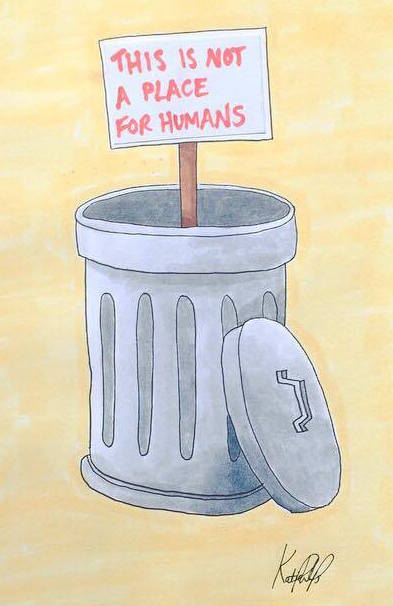
I realise calling a psychiatric unit a “nut house” isn’t accurate either, for example I have never encountered a “nut” when in hospital (other than the odd almond or macadamia in my fruit and fibre…I once heard someone claim they found a pecan in their bowl but I think that was just a myth so don’t take my word on it), but the “loony bin” slang term is particularly damaging as it conjures up ideas of a place into which the rubbish is tipped, a place that people don’t come back from and if anything is utter trash, it is that image.

I myself have had several admissions to various different “loony bins” and I can state with the utmost conviction that none of them bore any similarities to a bin, neither appearance wise or in terms of function. Firstly, on the whole they were all very clean (one had the bathrooms cleaned after practically every use so sometimes I was unable to shower BECAUSE they were being made extra clean), but more importantly none of the patients were anything like waste needing to be dumped.

The problem with the phrase isn’t even just damaging to the self worth of current or ex-patients. Potential inpatients may be scared of, and thus refuse admissions for treatment that they desperately need, because this whole “loony bin” perception has made people fear they will go in and never come out, that they are a lost cause who needs to be locked away from society for good. Admissions to a psychiatric hospital however, are not final destination. Instead they are more of a holiday. Ok, I will admit they are not exactly like a holiday, I know I would prefer a beach in the Caribbean over a stark white bathroom with a staff member watching me pee, but what I mean by this comparison is that they are a place that people come back from (albeit without the much revered tan or photo album). Going into hospital doesn’t have to be a terrifying endgame, define people or morph them into the branded mental patient to be impersonated at Halloween parties.

There is of course also the issue of this “bin” (a name of a place usually reserved for objects not people), being used as a place for “loons”. “Loons” sound like magical creatures, inhuman half breeds who are fundamentally different to “normal people”. The whole idea just emphasises the false distinction between “mental people” and “sane” ones when really they are both exactly the same. People in mental hospitals are not a different species, they are human just like you (unless dear reader, you are in fact a penguin in which case may I congratulate you on finding my blog without opposable thumbs).
I think it is comforting to label people with mental health problems as loons to be kept in a separate lidded inhuman/object bin world of restraints and locked doors, because by separating the sane and the insane, making a “them” and “us” situation, it perpetuates the idea that those crazy people are different and therefore you are not at risk of being contaminated. To think that a person screaming and being held down to be injected with anti anxiety medication is just like you is frightening and prompts all kinds of questions like “what if that happens to me”? It is nicer to think of all of that stuff as things that happen to “other” people, that the person cradling a wooden spoon and singing nursery rhymes is different, no possible image of you in the future. It is nice to put the lid on the idea and leave it outside the house for the rubbish collectors to remove so you don’t have to deal with it in your home.

The derogatory slang of “loony bin” and resulting “loon/human”, “them/us” dumping ground view of psychiatric units really is a use of language that has the ability make patients feel hopeless and forgotten, doomed waste discarded for good, and it creates judgement in people without mental health issues that just continue the stigma and fear that surrounds it all. I urge people to know that none of this is true.

For patients who have been admitted I want to say that life is not over, and being in hospital doesn’t mean that you are rubbish or damaged beyond repair and the landfill is not your future and final destination.
If anything I would say the slang for a psychiatric hospital should be “the temporarily out of order and in need of repair tray”, just like “normal” hospitals that treat only physical illnesses. It is not a place to be thrown in when you don’t have a place in the real world anymore, it is just a place in which you remain as human and as worthy of life as anyone else on the planet, you just have a few cracks in your porcelain skin that needs a little glue to help them stick back together.
We need to stop seeing psychiatric hospitals as bins or end games for the weird wastes of failed humanity, but as places for ordinary people who are just struggling in life and need a little support to get back into full working order, simply time and space to patch things up and get them well enough to leave that repair tray so they can go back home.

1

How To Survive Social Situations When You Suffer From Anxiety

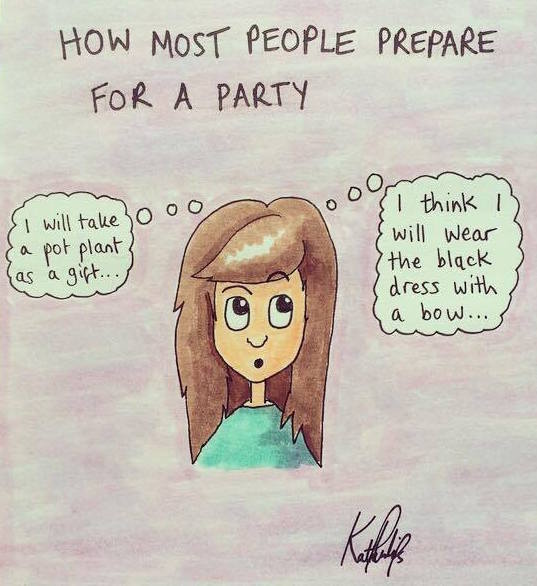
Last Saturday it was my Dad’s birthday party. Being a large, jovial social gathering packed with family members, friends and loved ones, I was of course terrified. Parties are always something people seem to get very excited about and dare I say look forward to in the “real world”, but in my world and the world of anyone with social anxiety they are a minefield of stress, uncertainty, embarrassment and awkwardness.
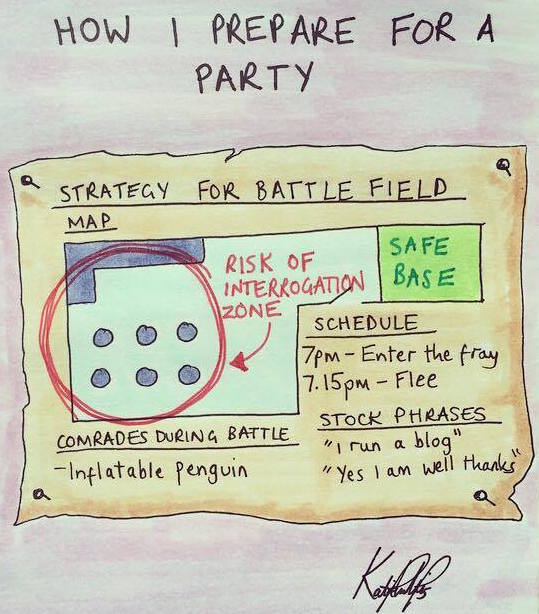
However, I somehow made it through the party this weekend by following a “Social gatherings survival guide” that I created as a military style strategy to manage the whole thing like an army preparing for battle. So, in the interest of helping anyone else out there with any level of social anxiety (aka my fellow soldiers), I thought I would share my survival guide to surviving the obstacle course in life known as “the situation in which you have to hang around people”…

Step One: Make a preliminary plan for the evening – As every good soldier knows, the key to success in battle (aka a social situation) is a step by step plan to follow, much like the guide I am writing here but far more specific and suited to the environment in which you have found yourself. Thinking “I am going out to a party tonight” can be very overwhelming, but if you break it down into pieces it becomes a little more manageable. For example “I will leave for the party at 7pm”, “I will drive to the party”, “I will stay for two hours” sounds far less intimidating. I often find that by setting a time limit I manage to get myself out the house by thinking “it is only two hours” and then sometimes the situation isn’t actually too bad so I can stay for longer having fooled my enemy (aka my brain) into allowing my excursion from safety. Whilst you have a plan though, it is also important to be open to being flexible should opportunities such as staying an extra hour arise. The plan is more of a comforting guide to have in your back pocket rather than a rigid set of actions that you must carry out, even if that means leaving when you are having fun, just because it is in the schedule.

Step Two: Set up a safe base/camp – When putting yourself in a potentially stressful situation it is always important to have a safe place to retreat to when things get too much. Forcing yourself to stand in the stressful fray of pass the parcel or musical chairs, when your anxiety really cannot handle it, does not a good soldier make, and it is important to know when you need a break to refuel on sanity. The safe place will ideally be a place some distance from the battlefield that is a little quieter. A lot of social gatherings in my family happen at my Aunt and Uncle’s house who thankfully are very accommodating to this particular soldier and always have a camp (aka the back bedroom with blankets and cushions) for me to camouflage myself in when things are too much. If you are going to a gathering in surroundings you are familiar with, plan your safe place in advance. This is unfortunately not possible when entering unknown territory, but as a hint, good safe places to seek out in most locations can be found just outside the party venue (aka by the door for fresh air), in a bathroom (not an ideal habitat but guarantees the safety of privacy), or, if you drove yourself to the gathering, in your tank (otherwise known as your car).

Step Three: Lower your expectations – When I entered the party on Saturday I felt an immense amount of pressure. Being a general guest in battle is one thing but being the offspring of the person whose gathering it is is like being suddenly promoted to Commander in Chief. Everyone at the party knew who I was even if I didn’t know them and being related to the host I felt it was my responsibility to ensure the evening ran smoothly, entertain everyone, serve the food and start the conga line. Obviously nobody else expected any of these things from me (which is somewhat sad as I do like a conga line), and people just wanted to see me there. When you go to a party do not feel the pressure to perform or act in a certain way or as if the responsibility of the evening’s success is on your ability to be a good guest, people don’t invite you to a gathering to serve a particular purpose, they just want to see you.

Step Four: Prepare stock answers – When in battle it is likely that you will be interrogated (aka asked polite questions by nice people who want to find out how you are.) This is one of the most stressful parts of an evening in my opinion, as I always find myself tongue tied and never know what to say even to simple questions like “What have you been up to lately”. Obviously it is impossible to predict which probing questions might be launched during socialisation, but some questions are more likely than others (in my experience people are more likely to ask what you are doing with your life than what you think would happen if the world was run by a power hungry fairy with a passion for pogo sticks), and it may help to plan stock answers to whip out when the occasion presents itself. For example this weekend, for the inevitable “what have you been up to?”, I prepared “I am currently running a fantastic blog that you should definitely follow because it is the best thing on the internet” rather than leaving it to my brain to come up with an answer on the spot which would have likely been something along the lines of “um…I am living at home because I am mentally ill but the other day I managed to touch a doorhandle without showering afterwards so that was an achievement ahh please stop talking to me”.

Step Five: Bring an inflatable penguin along with you – Yes soldier, you read that correctly, that is a key step to this plan. Like horror films, social gatherings are things that are easier to manage when you have a buddy or someone/something you can trust with you. If you can take a friend or even a small object like a heavy pebble to cling to when things are getting scary it can be a great help in grounding you and hopefully prevent any spiralling into total irrationality and panic.
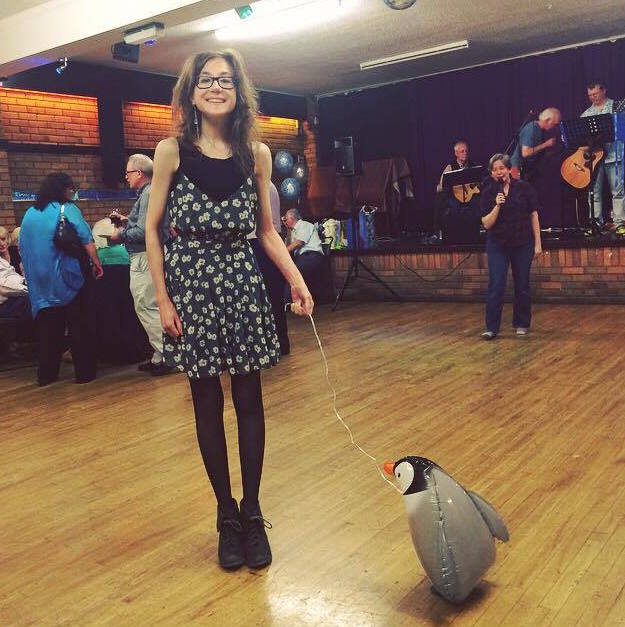
When my mum was buying things for this weekend’s party she foolishly took me to a balloon shop where she proceeded to purchase helium filled orbs with my dads age on them. How imaginative. Thankfully I was there to help/be an inconvenience, and by the time we left the shop, in addition to mum’s choices, I had obtained an inflatable penguin balloon on a lead which I proceeded to drag around the party with me for the duration of the evening. Sounds silly but it was oddly comforting and whenever I started to panic about someone coming over to talk to me I could just glance behind me and think “it’s fine, I have my inflatable penguin with me, what could possibly go wrong!”.

So there you have it chaps. That is my strategy guide and list of steps to get my fellow social anxiety soldiers through battle. Any situation involving a large group of people is going to still be scary, but hopefully with these tips you can at least feel a little prepared so that things are more manageable. Remember we are all in this war together and you are never alone. Now go forth my brave warriors, fight the fear, stay safe, follow my lead and commence mission socialise….

Social anxiety 1

Social anxiety 2

Oh, and for anyone who wanted to see a picture of my personal buddy this weekend…

Social Anxiety 3

An Important Reminder For People Struggling With Mental Health Problems During Exam Season

Ah summer, a wonderful time of sunshine, drinks with umbrellas (as we all know if anyone needs a device to keep something dry it is a glass of liquid), and, less wonderfully, exams. No matter what kind of exam is being thrown at you, whether it be a GCSE, A-level, university finals or your N.E.W.T’s at Hogwarts, I think we can all agree that exams suck and are a very stressful part of the year for everyone involved, especially people with mental health problems who are pretty stocked up on stress and need no exam boards adding to it. If you have exams coming up I can guarantee you have been told how important they are by teachers and lecturers and if you are anything like me you will feel that they are the most important things in the world, but I want to provide an alternative voice to all that stress and pressure and let you know that in the grand scheme of things, exams and other education related worries are not important. Now I know what you are thinking, “why should I listen to a weirdo on the internet when I have educated officials telling me that these exams are vital to my future happiness?”. Well dear reader, because I am going to prove my point with an analogy using the absolute best thing about summer, ice-cream, and if that doesn’t get me credibility then I don’t know what will.

For the purpose of this post I would like you to imagine an ice cream cone. That empty cone represents your physical health, no emotions whatever, just the heart beating oxygen to carbon dioxide basics of being alive. Now add a scoop of ice cream to that cone (one involving chocolate or peanut butter preferably but I suppose you could use any flavour for your metaphorical ice cream…just not rum and raisin because that is nasty). That scoop of ice cream is your mental health, stress levels, emotional stability, any brain activity that involves quality of life, pain or pleasure, and makes you different from the empty ice cream cone of the amoeba. Now add a cherry to that ice cream cone. That cherry is exams/good results/fantastic education stuff in general.

If you went to an ice cream van in the real world and asked for an ice cream, you would expect at least a cone with a scoop of ice cream in. A cone is fine but it is worth nothing without the ice cream and without the cone the ice cream would have no “body” to chill in (literally). To be worth having, you need both the cone and the ice cream. Having a cherry added on the top would be nice, but without the ice cream and the cone it is pointless. Without those key components you just have a random cherry floating in the air and that is useless in terms of the ice cream experience (otherwise known as “life”). Exams alone are that useless floating cherry.

The most important things to focus on and look after throughout life, exams and education in whatever form, are your physical and mental health, because if you don’t have either of those things then exams have nothing to sit on.
When I was doing my A-levels I was absolutely terrified and my exams literally became a life or death situation. My head was compressed under so much pressure and my brain had made some kind of OCD rigid deal that I had to get straight A*’s or kill myself. No other grade would give me “permission to live”, not even an A which is an incredible grade to get as it is. My anxiety and OCD drive made a life or death situation out of “a star” and you know what that star is? IT IS JUST AN ASTERISK. IT IS PUNCTUATION. It is not the be all and end all goal of life, this mystical magical holy relic to be chased to the end of time. Nope. Look here is one now *. And another one *. Is “*” and therefore any grade worth the pressure and insanity placed upon exams?

The stress of exams, grades and dedicating all of your energy to revision is like chasing a floating cherry without the cone and ice cream needed to support it. If education is causing so much stress that your anxiety is out of control, if you are revising so much that you are “not having time to eat”, then that is not OK. At university I spent my entire time chasing that illusive floating cherry (otherwise known as “a first”). I read books obsessively, didn’t sleep, took notes on things with unnecessary detail and precision. Revision sheets were awash with bubble letters that I took hours colouring in using the order of colours in the rainbow. I had to get a first so everything had to be perfect, but I was so busy colour co-ordinating titles that I didn’t look after the cone or the ice cream and eventually everything fell down with nothing there to support it. I never took my final exams at university, I never wrote my dissertation or got the resulting “dissertation picture”, because I was in hospital. Thankfully I had the most amazing tutor and team at university so I was still able to graduate. Did I get a first? No. Has having a “2:1” rather than a first changed my life in any way? No. Do you know how often I get asked about my degree or A-level grades? How often someone asks to admire my colour co-ordinated revision notes with obsessively neat handwriting and bubble letters? Never, because in the real world none of it matters, what really matters is keeping yourself alive and able to function.
When you are in school I know that education feels like the world and grades are the tip of the mountain in importance, but when you leave school you realise that that mountain was just a mole hill and the real important mountains in life are actually living your life both physically and, hopefully, with some mental stability or quality that make it worth it. Getting an education or a dissertation picture are things in life, but they are not the ONLY things.

Obviously I am not telling you not to bother with revision, if you can handle it then that is great and of course you should do your best in exams, but you shouldn’t sacrifice your emotional or physical wellbeing to achieve, catch a cherry that is useless without the cone and ice cream to balance it on. An earlier hospitalisation during sixth form meant I had to go back a year in school so I did my A-levels a year late. Again it seemed like the biggest deal in the world, but I needed that time in hospital and that time out and eventually I got my exams, Ok they were a little late, but the only difference between my certificates and the ones my initial year received was the date. Also, I actually made loads of new friends in my new year, so in retrospect going back a year was not only vital but actually gave me some positive experiences with people I wouldn’t have met had I forced myself through exams the first time. Especially if I had died in the attempt.

In short, education can wait. Education can be done any time if needs be, but what cannot wait or be done at any time is keeping yourself alive and looking after your health. If you need to take time out, do it. Lower the pressure and expectations for grades. In short, give yourself a break, give yourself time to breathe. If you have exams and revision this summer then I wish you the best of luck and hope they go brilliantly, just please remember to look after that cone and scoop of ice cream first, and don’t kill yourself over a floating cherry that in the grand scheme of things matters nowhere near as much as the ice cream.

Ice cream

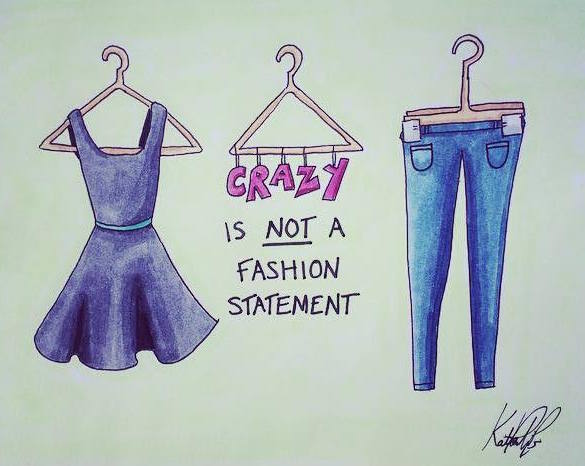
“Crazy Is The New Black” – Why Mental Illnesses Are Not A Fashion Trend

On Saturday night I went to a bar with two friends to watch the Eurovision Song Contest. I anticipated an evening of ridiculous dresses, flags being waved violently in my face, maybe even the odd dancer dressed as a potato. My hopes of such merriment were dashed when one of the presenters made a derogatory joke about mental health that did nothing but boost the stigma that my blog aims to destroy. AND there was no dancing potato. The joke? The “advertising” of a Eurovision Song Contest straitjacket to wear in celebration of the event because, as the presenter stated, “crazy is the new black”. Now I am not one to follow fashion trends so I don’t want to pass myself off as a fashion blogger, but in my opinion, that kind of statement and jokey interpretation of mental health problems went out of style around the 18th century and the fact that it was paraded on TV in 2016 is quite frankly something that has left my “flabber” well and truly “gasted”.

At first, after the comment had been made, I simply hated the presenter who had said it. I was ready to fly to Sweden to pull her off the air, but then I realised (around the time I was trying to hitch a ride to Sweden on the back of a pigeon who, alas, was no help in my mission whatsoever), that this joke was scripted and had therefore been approved by multiple people. Hell someone had even made a prop strait jacket, so this isn’t a little blip or misjudgement, this is a carefully considered statement that makes mental illness out to be a “cool trend”, that was viewed as acceptable for two hundred million viewers across the world.

I hate to whip out the “if this was a physical illness” card here, but seriously, think about it. Imagine if the woman had been advertising a Eurovision themed chemotherapy pump with feathers on it and claimed that “cancer is the new skinny jean”. People would have been up in arms, it would have been in newspapers, the demand for the removal of the presenter and script writer would have been widely documented, and Facebook would have been awash with furious people voicing their opinions. However, being mental health related, it was just swept under the carpet, nobody batted an eyelid other than a few distressed tweeters and bloggers online. Forgive me, but I have to ask what on earth is the difference between stating mental illnesses are “the new black” and saying cancer is “the new skinny jean” or whatever fashion trend is “in” these days? Cancer kills thousands of people a year? So do mental illnesses.
Maybe I am deluded to think that crazy isn’t a fashion trend and maybe I should pick up a copy of vogue ASAP, but in my eyes that joke is nothing like what “crazy” is to me.

Crazy is spending an hour putting on make up to go out with a group of friends and then crying it all off because you were so scared of tying your shoelaces incase the germs on them were to cause the end of the world. Crazy is being watched 24/7 for months, in the shower, on the loo, all of it because you are not trusted to keep yourself safe without constant supervision. Crazy is yelling at your mother because she cut a bagel incorrectly. Crazy is having to sleep with your hands on the pillow so the nurse watching you sleep all night can be sure you aren’t clawing your skin off under the duvet. Crazy is having to ask your friend to come into the bathroom with you to turn a tap on because you are scared to touch it yourself. Crazy is failed relationships because your partner cannot handle your mental illnesses anymore. Crazy is initially refusing to take an aspirin from a paramedic in the back of an ambulance who thinks you have had a heart attack, because he mentioned it was “lemon flavoured” and you fear that that may mean the tablet has calories. Crazy is having a separate room for exams at university so that you can cry and have panic attacks without disturbing other people. Crazy is being locked inside for months on end because the last time you were allowed out you tried to climb over a fence to escape the hospital you were detained in and had to be rescued by the fire brigade. Crazy is having to shower until the top layer of skin comes off and you are bleeding all over because only then can you be sure that the dirt is gone. Crazy is being the only person in your friend group who doesn’t have a job because you are mentally too unwell to work. Crazy is waking your mother up at 4am for a hug because you are too anxious to go to sleep. Crazy is taking menopause oestrogen supplements at 23 because you can’t eat enough to produce the hormone yourself and as a result your spine is riddled with Osteoporosis. Crazy is not being able to go to the toilet because your OCD says that it isn’t time yet. Crazy is going back a year in school because you missed yet another chunk of education being stuck in a psychiatric unit. Crazy is having nothing to say when family members ask what you have been up to, because they don’t count “I haven’t killed myself and have got out of bed every morning”, as an achievement. Crazy is being unwell for so long that you honestly can’t remember what normal is. Crazy is all of these things plus a hundred others that nobody can ever put into words. “Crazy” is the hell experienced by the millions of people across the globe who are struggling right now, but are too embarrassed and scared to speak out incase their worries are belittled, brushed aside or used as fodder for the next stigma supporting “joke”.

You can describe crazy in an infinite number of ways, but as the “new black?”. That is not what the word means to me.
If anything, crazy is the new “crisis in humanity”, and it is killing more people every day than your average fashion trend.

Crazy is the new black

What To Do If You Think Someone Is Struggling With A Mental Health Problem

Having mental health problems sucks, but so does seeing a person you care about struggling with them when you have no idea what to do. It can be frightening to see someone becoming more and more unwell without necessarily seeking help for whatever reason, and sometimes it is necessary for friends or family to step in. Unfortunately this can be a very awkward situation, after all nobody wants their friends to gather them round the fireplace for a good old “we think you are insane” discussion, so in this post I am going to try and help people who are concerned about someone’s mental health and don’t know what to do about it. These things are at least what I would like my friends and family to do if they ever suspected I had a problem, (though I would like to point out that there is no need to do any of these things now family, rest assured I am well aware that I am a bit funny in the head), so hopefully other people will find these approaches acceptable too…

OPTION ONE: The first and best way to deal with someone you love struggling with mental health problems alone is of course to approach them in some way and discuss your concerns. If you plan to talk to someone directly about the issue, the key with this is to not go in all guns blazing, in fact, do not involve a gun in the situation at all. If you must have a prop, take a cup of tea or something, everybody likes tea and nobody likes guns (a mantra that might make this world a better place if more political leaders followed it but I will try and stop wars at a later date, for now I am just going to tackle mental health problems. Please be patient.) The problem is that mentioning someone’s mental health in conversation is also one of the more difficult options as it can be an awkward topic to bring up. For this reason, if it were me, I would always suggest writing someone a letter (or email if necessary but a letter is more personal), instead of talking to them directly, and it is actually an approach that is beneficial to both parties. By writing a letter you can make sure you get all your points down and really say what you want to say clearly, rather than gabbling some incoherent speech out of nerves in the moment, that doesn’t really get what you want to say across. It also helps the person you are approaching, as having someone tell you that they think you are crazy is difficult and often embarrassing to hear. This embarrassment may then cause someone to become defensive and say things that they don’t really mean either, perhaps snapping back because they are insecure or laughing and trying to brush it off to distract you from the conversation (a technique I myself am world champion of). With a letter the person can read it in their own time and thus really think about it properly without giving in to the initial emotional response conversations can bring. It also gives them some privacy to deal with the topic and means that they can re-read it at a later date if it is something they want to think about and come back to. When it comes to talking to someone about their mental health, writing things down in a letter is awesome.

OPTION TWO: I would always say that bringing up someone’s mental health with the person themselves should be the first plan of action, as it can be upsetting to know you have been discussed by other people behind your back. However, in some circumstances, if for whatever reason, option one is too difficult or has been tried and failed and things are getting serious, talking to someone’s family can be a great second option. If there is a misunderstanding and the family can confirm the person is fine then great, but if not it is important for the person struggling to have some people close who are perhaps more aware of what is going on than they are. Families often miss things because they are around their loved ones so much that they don’t notice subtle gradual changes over a long period of time and sufferers may not realise what is going on either or be in full blown denial about it. Having a friend or outside point of view can therefore be really valuable.

OPTION THREE: People often think that mental health helplines are for people who are themselves mentally ill but this is not the case at all. Samaritans for example is available to anyone for any issue regarding mental health (or things that are nothing to do with the workings of the brain, you can call them about anything, even if you lose your keys and want to yell at someone, though I WOULD NOT advise this), so calling them to get some support may be a good thing to do so that you have someone looking out for you too. Samaritans don’t give advice, but if you are worried and have nobody to talk to about your friend, it can be therapeutic for you to get it off your chest and take care of yourself. There are also a lot of other helplines including ones like “Rethink mental illness” who may be able to offer advice, so I will put a few numbers at the end of this post. After all as my favourite nurse at my previous hospital said to me, “you can’t look after other people if you don’t look after yourself first”. Wise words indeed. Think of calling a helpline, or maybe visiting a mental health charity website, as fitting your own oxygen mask on a plane before you help others (only closer to the ground and with what I hope would be an ample supply of oxygen).

OPTION FOUR: Once you have managed to somehow bring up the topic of mental health with someone you care about, the next step should always be to get them to go to a GP. Maybe offer to go with them as support if that is possible, but either way it is their GP who will know the next course of action and will be able to discuss potential mental health services in their area.

OPTION FIVE: This one probably sounds really dramatic but if you are seriously concerned about someone’s mental health and attempts to bring it up with them or their family directly have not worked then it is always an option to go to A&E or call an ambulance. Obviously this isn’t something to do lightly and should only be done in extreme circumstances, but if you ever think someone is in immediate danger because of their mental health then it can be necessary. With this there is of course a potential risk of upsetting or annoying the person you are calling an ambulance for, but ultimately it is always better to have a very angry live friend than no friend at all.

Overall, approaching anyone because you are concerned about their mental health is never going to be the most pleasant experience and probably not a moment either of you will want to tweet about or document with an album on Facebook. Nevertheless I hope these options at least help give some kind of idea as to how to make it a little more bearable. Unpleasant or not, talking to people you are worried about is very important and shouldn’t be avoided. Who knows, one day the person you are confronting might thank you…and, if they don’t and get really angry at you doing any of these options, just tell them it isn’t your fault and that a weird bespectacled person on the internet was the one who gave you the advice that they followed, I am more than happy to take the blame.

Stay safe everyone and have a great day.

TeaAndGun


HELPLINES AND FURTHER ADVICE

Samaritans:
08457 90 90 90 – 24 hour support seven days a week

Rethink mental illness:
0300 5000 927 – Monday to Friday 9.30am-4pm
Rethink also have a really good web article about this whole topic here: https://www.rethink.org/carers-family-friends/what-you-need-to-know/worried-about-someones-mental-health

Carers UK:
0808 808 7777

Sane Line:
0300 304 7000 – 6pm-11pm every day

Support line:
01708 765200

An Attempt At Explaining Self-Harm:

Before anyone reads this I just want to put out a brief trigger warning that this post discusses the purposes and reasons as to why people may self harm so if that would trigger you in anyway please click away and read Harry Potter instead.

As I am typing this I am honestly surprised at how uncomfortable I feel discussing this topic. I am fairly open when it comes to my mental health, partly because I am currently unable to hide it, and partly because I want to reach out to other people to either help or offer a bit of company in what can be a very lonely battle of the mind. Writing a post that acknowledges that I self harm however is somehow harder than waffling on about having anorexia, OCD or depression as I find it really embarrassing. I feel when it comes to self harm there is a particularly high level of stigma and misunderstanding, it being a common belief that people do it for attention. For this reason I feel a lot of shame admitting that it is something I struggle with, which is silly because it isn’t something to be ashamed of at all. Equally it isn’t something to be proud of, it is just something that exists as a problem for a lot of people, and so I am going to try and explain it here as best I can to anyone out there who can’t get their head round it. Maybe if more people talk about it and understand, we can all be open and able to deal with it rather than keeping it as a shameful secret that will never get better unless it is talked about.

As always I cannot speak for everyone with this issue but I am going to at least provide a list of three reasons as to why personally I struggle with self harm and perhaps other people will be able to relate. I also just want to preface these points by saying that in explaining the rationale behind self harm I am not justifying it as a good thing to do whatsoever, it is an unhealthy coping strategy that needs to be talked about and treated to find alternative ways of managing difficult feelings that are not so damaging. Still, you can’t find an alternative until you know what purpose self harm serves in general or for you personally, so here goes:

1. It provides a release: When I am feeling particularly anxious/stressed/upset, it can feel like I am physically bursting with the emotions coursing around my body. It is like that buzz of adrenaline you get when you are scared of something, your skin prickles, you can feel your heart beating and the extra energy pulsing through your veins. You are full of so much extra emotion that you are going to burst like the lid off a pan of frantically popping popcorn. Without the heat on, the popcorn kernels fit in the pan, but with the heat/distress they expand and burst all over the place because they, like the emotions and upset, take up too much room. When I feel like a bursting pan of popcorn (and we all know what a common feeling that is), self harm is a way that helps release some of the pressure, it is lifting the lid a little so that some of the popcorn banging around inside can get out.

2. It makes the pain you feel visible, understandable and treatable:  A lot of the time, feeling extremely depressed or upset for no logical reason can be frightening as you know it doesn’t make sense for you to feel so distressed over nothing. When I self harm I make the pain that is frightening me understandable. I feel the same pain I was feeling but I can see where the pain is coming from, no longer is it an unknown mental pain, I know the source. I hurt because I have a wound, the pain makes sense and I know that physical wounds can heal, I can do something about it, I know what to do to treat it, and I can be proactive in it getting better. It is still unpleasant, but it is a distraction from the mental pain that was previously occupying all of my brain space, a pain that I couldn’t treat, nor did I know for certain if it was ever going to go away.

3. It serves as a punishment to relieve guilt: Like many people in this world, with or without mental health problems, it could be argued that I have low self esteem. I find this hard to believe, as rather than low self esteem I feel I have an accurate understanding of my inadequacies as a human, a self awareness that I am a terrible person, but I have been told this is all lies and the whole low self esteem thing by many people over the years so I try my best to believe them. Anyway, because of the way I feel about myself, I feel guilty for taking up a place on this planet. I feel guilty for wandering around this planet and forcing others to deal with my presence when they would be a lot better off without me, I feel bad for using up oxygen that would better be spent passing through the lungs of someone else. Self harm is a sort of punishment to lessen the guilt of living, it is to make up for my crimes committed just by existing. I am also not asking for people to tell me that I am not a terrible person because I have never been able to believe anyone else’s opinion (which is hilarious really…I think I am the worst person in the world yet simultaneously think I am right about everything…), but if I had to give a comparison to try and help people make sense of all of this, I would basically sum this point up as “I am Dobby the house elf”. I am sure everyone has read the Harry Potter books (and if you haven’t you really should), so I won’t explain this likeness in too much detail, but basically, like Dobby, when I do something wrong I feel I have to do something to punish myself for it.

Sitting here and reading all of that back, I feel as naked as the day I arrived on this planet (remain calm, I am technically wearing clothes right now, I just feel a bit exposed considering I am letting people into a piece of my brain). Still, this is important stuff, and like I said before if nobody talks about it then self harm becomes this big taboo that will never be understood. Again, this explanation of self harm is not condoning it in any way and if you are struggling please seek help right away as there are certainly other ways to fulfil the purpose self harm has in your life. I myself am currently working to battle this issue and find alternative coping mechanisms. When I find some good ones I will certainly be making a post about them to try and help people if possible.
Until then, please stay safe everyone, take care, and know that I am sending a lot of love and support to you all.
P.S Just going to end this post with a quick clarification to clear up any confusion resulting from my comparison of myself to Dobby the house elf. Though I admit I have a self harm punishment style likeness to Dobby, that this is the ONLY similarity I have to Dobby. I want it known that, contrary to popular opinion, I am not in fact a house elf, and that my job last December was as a CHRISTMAS elf. We Christmas elves are indeed a very different species, so to make that plain, below I have provided a brief diagram to demonstrate some of the key differences between House elves and Christmas elves. I hope this helps. Thank you.

13016527_10207452802652111_225240455_o
P.P.S If you read all of this then as a reward here is a photo of me as a Christmas elf. Feel free to make it your screensaver.

13022306_10207450610957320_356436679_n

6 Ways To Explain Depression To People Who Don’t Really Understand It:

Living with depression is incredibly hard, but to people who don’t live with it, so is comprehending what it actually feels like to suffer with an illness that is often brushed off as “just being a bit down in the dumps”. For this reason, to try and help more people understand the condition, I have come up with 6 examples of the way depression feels for me in ways I hope are easily understood or related to by anyone.

1. The “night before dread”: You know when it is the day before something you really do not want to do/are frightened of? Like the first day back at school after the summer holidays or a rectal exam? That feeling of absolute dread when you look forward to the next day’s unpleasant events that you cannot get out of? That dread of the next day is what depression feels like, only you feel it every day, all day for no reason whatsoever. You look to the future and realise that there is no impending rectal exam or reason for you to feel this way at all, which in theory should make you feel better but it doesn’t. It actually feels more frustrating, because unlike when you know what you are dreading and know you will feel better when the looming event is over, when you are dreading nothing in particular, you don’t know how to get that “nothing” out of the way so that you can feel better and move on with your life.

2. The “head in a bucket”: For me, depression often feels like having your head in a very heavy immovable bucket. It is pitch black all around and darkness is all you can see. At the same time people are standing beside you without a bucket on their head, telling you to look at trees, pretty flowers and positive things in life, which would be all well and good if your head wasn’t stuck in a bucket. They tell you to look on the bright side, to look at the sunshine/how lucky you are and you really try. You squint and turn your head for hours desperately trying to see what they see but no matter how hard you try all you see is darkness, not because you aren’t wanting to see the light, but because that damn bucket on your head is blocking it all out.

3. The “Robot driver”: Many days I wake up once in the morning, and then again sometime in the afternoon, having lived part of my day without really realising what was going on. It feels as if my body has gone on autopilot and turned me into a robot carrying out all the daily tasks required of me without really being present or noticing what is going on at all. It is like when you drive yourself home sometimes (not that I can drive but I hear this is a common experience), and then when you get to your front door you don’t remember the drive because you were too distracted thinking about how fantastic penguins are. The difference is that with the depression robot automaton example, you don’t know what you were distracted by, what you were thinking about or whether you were actually conscious or present at all. Your body has just been moving around with no-one inside.

 
4. The “frozen mute weird coma active mind thing that I cannot think of a good name for”: Imagine someone has super glued your tongue to the roof of your mouth. They have also injected you with some weird substance that means you physically cannot move your limbs or your face and you cant really feel them either. If someone touches your arm you can see it happening but you can’t feel the other person on your skin. Mentally your brain is active and you are thinking things like “I really should get up do something productive right now” or “I have so much to do and I have to get on for goodness sake move”, but still your body is too numb to respond and you can’t even open your mouth or speak to tell anyone what is going on.

5. The classic “Wading through treacle” but with weights tied to your ankles: This example pretty much says it all in the title, but basically just imagine trying to walk across a football pitch which is filled up to your chin with treacle (an unfortunate consequence of an explosion and resulting flood at the local treacle factory. Thankfully I can assure you all that nobody was harmed in the explosion but a hell of a lot of treacle has been wasted by spreading itself across this football pitch). You also have heavy weights strapped to every limb so every step is a huge effort, yet still you try as hard as you can and use all your strength to get to the other side of the pitch. In reality though, that struggle merely corresponds to the task of cleaning your teeth, so to get through the entire day there are still hundreds more pitches of treacle in front of you that you must pass through before you can just give up and go back to sleep again.

6. The “Deserted Wasteland”: Sometimes depression feels like you are standing out in the middle of a deserted wasteland (you wouldn’t have guessed this from the title of this one but just go with me and don’t feel too surprised), where all around you there is just barren empty land. There is no grass, no trees, no sign of life anywhere around as far as your eyes can see. You can have a hundred members of your family and friends in the real world trying to look after you and supporting you through it, so you shouldn’t feel so isolated but no matter what is going on in the “real world”, mentally, in the desert, you are always completely alone.

Now I will admit that this is not the jolliest list of examples ever to exist, but to be fair depression isn’t the jolliest thing in the world, so I guess you could say I have done a pretty good job…Anyway, I hope this list helps someone supporting a friend or family member with depression to understand what they may be feeling. Also if you are a fellow sufferer/bucket wearer, I hope you find some solace in the fact that you are not the only person that feels like this and that there are people out there who understand, even if they only exist on the internet.

12991792_10207405253143403_1489098019_o


What are they doing about the fact that you are insane?

Every time my parents pick me up from a psychiatric appointment, they ask me the same questions:

  1. “So what did they do to you today?”
  2. “What are they doing about the anorexia/OCD/depression?”

They are only trying to be nice and just want to understand more about what is going on with the crazy person living in their house, but I often wonder what exactly my parents expect me to answer when they ask me these kind of questions.
What did they do to me? Well first I was strapped to a table and then they hit me on the head with a mallet to smash the crazy out. What are they doing about the anorexia/OCD/depression? They are cornering it with a sleuth of angry bears (that is actually what a group of bears is called, “a sleuth”, trust me I looked it up on google), so that it runs off of a cliff into a flange of angry baboons (I may or may not have just discovered a website that tells you what the collective names for various kinds of animals hence the uses of ‘sleuth’ and ‘flange” in this post).

The truth is, the psychologists and psychiatrists and support workers I see don’t “do” anything, but at the same time that does not mean they don’t do anything. Sometimes I may do pieces of “work” or try courses of various therapies, discuss changing my medication or upping the dose, but on the whole the majority of my appointments are taken up by simply talking about things. If I say that to my parents, they worry that because nothing is being “done”, I am not receiving any treatment, but what many people don’t realise is that simply talking as a treatment, is seriously underrated.

By telling someone how you feel, you can release some of the emotions you are bottling up; by explaining a problem you are having to someone who doesn’t understand, you may understand things that even you didn’t know you were feeling; and by sharing a secret or a burden/pain, you share the weight of it and are allowed a little brain space to breathe. Like they say, “a problem shared is a problem halved”, not that I know who they are but they seem pretty smart to me. I know it all sounds very wishy washy, which is probably why the idea of “just talking” is sometimes not viewed as “treatment”, but mental health issues are far more complex and confusing than people can really comprehend, and you only learn about them through exploring. I have been in treatment for over a decade yet still I often realise things about my illnesses and my relationship to them that I didn’t know before, just by talking things through.

I suppose the message I want to get across in this post is that when it comes to recovery from mental health problems, it isn’t straight forward, there isn’t a set thing to “do” or fixed course you follow. As cheesy as it sounds, recovery really is a journey of self exploration, and everyone/everyone’s journey is different. People are individual and unique, so their experiences of their illnesses are individual and unique, different and relative to them alone, so “just” talking about things is really important. Only when you really understand what is going on with you and how your life is affected personally, can you really tackle the problem. If you are just starting to receive therapy or are supporting a loved one in therapy and are worried that nothing is really “happening”, please do not feel despair. It may not feel like it, but things really are being “done” and you are working towards recovery even if you don’t realise it right now. Words are power. Use them.

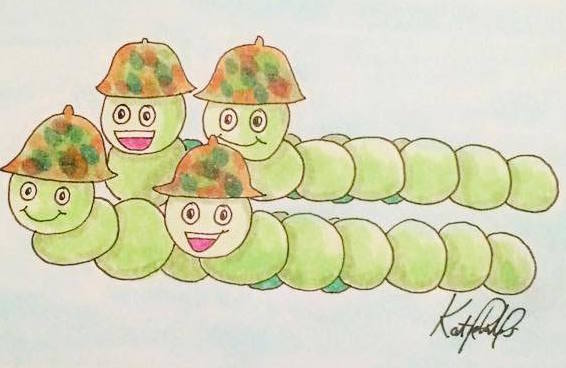
Just going to end this post here by letting you know that a group of is caterpillars is called an army. How hilarious is that? The answer is very. Caterpillars are literally the most non-threatening looking animals in the history of the world, yet still if a lot of them came into your house you would have to say that you had been invaded by an army. Now if you don’t mind, I am off to gather my own caterpillar army to help in my quest to destroy mental health stigma. Cheers.

12922297_10207348201637151_15230091_o