“I Wish I Had The Self Control To Be Anorexic”

Several times in my life I have heard the phrase “I wish I had the self control to be anorexic” and, considering I am now writing this blog post about this phrase, you can safely assume that I have a lot to say about it.
You may be thinking “Katie, you already wrote a post about people wanting anorexia and how silly that is, why are you repeating yourself?” (a post you can find at the link here: A Message To All The People Out There Who Are “Pro-Ana”), but please hold that thought as I actually think that the problem with this phrase is not about people wanting eating disorders.
Indeed, unlike people who are “pro-Ana”, in my experience, people who say this are not actually craving the bulging rib cage and hip bone images promoted on “pro-Ana” websites. The mistake these people make is not that of idolising a mental illness, rather it is of completely misunderstanding what an eating disorder actually is and what it is like to suffer from one.

I think when it comes to illnesses such as anorexia, there is a misconception that when people with the illness don’t eat, it is because of their will power or an extreme superhuman ability for self-control. They assume that sufferers feel hungry and want to eat but powerfully override the primal urge to seek food because they are strong, yet in my experience, it is the total opposite, and it is in the times that I am unable to follow this primal urge that I feel the weakest that I have ever felt in my entire life (even weaker than the time I was beaten in an arm wrestle by an rather arrogant and ambitious sloth I met drinking tequila in a bar a few years ago…that was a BAD evening.)

Whenever I miss a meal or don’t eat a free sample handed to me in a supermarket, it isn’t because I implement my ability to make decisions/affect my actions as the word “control” implies. Instead, it is because I am not in control at all, a point I think is easier to explain if we take a trip down memory lane and travel back in time to any birthday I have had over the course of the last decade.

Most years, when it gets near to my birthday, if I am out shopping in a supermarket with my mum, when we walk past the birthday cake section, she will look at the birthday cakes and sigh. Following this signal, we may have a wander over to look at all the intricately decorated creations topped with thick white icing and pictures of various Disney characters (I don’t look at the plain old boring cakes for “adults” that simply say “Happy Birthday”. Seriously who wants one of those when you can have an sponge shaped like a minion or a giant chocolate caterpillar with a cheeky grin?!), and then after five minutes of eye wandering my mum will turn to me and ask the question “can I get you a birthday cake this year?”.
Now, if I had any degree of “self-control” when it comes to food and my ability to nourish myself, I can honestly say I would turn to my mother in these moments and say something along the lines of:

“Can you buy me a birthday cake? Why of course! There is no question regarding such a matter! It is my birthday in two weeks and I simply cannot celebrate the occasion without a cake! Quick! Let’s go around all the supermarkets and bakeries in the area to try and find the biggest penguin shaped chocolate cake available. I want nothing more than to share such a delight with all of my nearest and dearest friends! Ooh can I please reserve the chocolate beak for me because it is my birthday? I do love a chocolate beak! Hurry mother, let us away to the automobile and get started on this quest immediately!”.
I would probably then insist we head to the candle area to pick the most garish, brightly coloured candles on offer to adorn my perfect penguin centrepiece, poised and ready for the moment when I am ready to blow out the flames and make a wish that Helena Bonham Carter hurries up and marries me already.

That is the response of a Katie who is in control. Unfortunately though, we haven’t seen “In Control Katie” around much lately. That Katie popped out for bread about ten years ago leaving an out of control mess in place, and since then we haven’t heard anything (better be picking up some damn good bread is all I can say…I’m talking a good quality ciabatta or we are going to have issues).
Therefore, with “In Control Katie” otherwise engaged on a mission to find a tasty source of carbohydrates, it is the “out of control” one that turns to Mum year on year with a dejected look and says: “I wish. Maybe next time”, at which point we agree to try again next year before repeating the annual routine in roughly 365 days time.
I know it would mean the world to my mum to buy me a giant penguin birthday cake to share with her/the family, and I desperately want to accept her offer each time mainly because I want to see her reaction. I want to see her face light up with the brightness of a birthday cake candle, filled with hope that for once she can do something that normal mothers do rather than having to come up with some kind of eating disorder friendly replacement for her neurotic offspring (e.g. the act of sticking a candle in a pink lady…the kind of apple I mean…not an unsuspecting blushing female who doesn’t know what’s coming).
When I do not accept the offer of a proper birthday cake then, it is not because I don’t want to, it is because my mind throws up barriers that make me feel that I physically can’t.
It is like a “normal” person standing in front of a bonfire and wanting to put their hand in it to retrieve a particularly nice log. They can look into those flames and want to put their hand in to get the log (this person really likes logs), but no matter what, they can’t. Of course they are physically capable of moving their arm into the vicinity of the fire, but the fear of pain stops them (no matter how much they like logs).
Saying “I wish I had the self-control to be anorexic” then, is basically like saying “I wish I had the self-control not to put my hand on a bonfire”. Of course eating and setting yourself aflame aren’t the same thing, one is vital for life whilst the other is downright ridiculous and not something I advise anyone to try at home or anywhere else for that matter, but the similarity exists in the sense that both the person who doesn’t put their hand in the fire and the person with the eating disorder do not carry out their actions because of self-control, rather it is because they are both scared and fear the pain that could result from their actions.

Whenever you hear yourself or anyone wishing they had the “self-control” and “will power” to eat like someone with an eating disorder then, please know that when it comes to eating disorders, self-control has absolutely nothing to do with any of it. When someone is unable to keep themselves healthy by eating enough, it is because they are not in control, and because the reins of decision are actually being held hostage by an evil dictator in their head who is trying to kill them.
If I had self-control and willpower over my life I could write a list of about a million things I would use it for. The ability to fill my mother’s eyes with disappointment, to refuse sharing a dessert with a friend or turn down the offer of a birthday cake would not be on there.

Take care everyone x

ControllingPea

Why It Can Be Scary To Take Medication For Mental Health Problems

Recently, my psychiatrist prescribed me a new medication to help me with some of my mental health problems. I am on various medications already with a variety of different purposes and have been for some time, but in terms of what these new tablets are “supposed to do”, the aim is for them to reduce some more of the anxiety that my current medications are allowing to linger long after they have done their jobs. Ironically though, despite having had this packet of anti anxiety medication on the kitchen worktop for over a month, I am too anxious to take them.

I think being scared of taking medication for a mental health problem is extremely common and to be fair it would be weird if people weren’t a little afraid of whatever tablet their doctor has recommended them to take. A big reason for this is of course the long list of side effects that comes in any box of medication from Calpol to Morphine, although when you think about it there are no medications that have side effects, there are only effects.
Tablets do a lot of different things and it is the scientists/elves (I am not sure who makes medicine these days but I am sure it is one of the two) who decide which effects to put in the “Purpose of tablet” column and which go in the “side effects” column, aka the effects that are harder to advertise. For example, for some people Paracetamol can have the effect of giving them yellow skin so that effect is categorised as a side effect because that effect is less easy to advertise than the more attractive “this will help take your head ache away” effect (unless of course you are dealing with someone who wants yellow skin so that they can look like a Simpson, in which case I suggest body paint which is probably a lot safer).

I think mental health medication is scarier to take than “normal” body medication though, because there is a fear that it will fundamentally change you as a person, your characteristics, interests and identity. When you take a physical medication that may turn your skin the colour of a freshly picked banana, there is a separation there between you and the skin. Ok the skin is your skin, but aside from holding all your body parts together your skin doesn’t affect who YOU are and no matter what the colour of your skin, you will be the same person you were before and will be able to react and interact with friends and family in the same way as you did prior to your sudden transformation into a Simpson. The skin is just the irrelevant wrapping paper on the more important gift. If you wrap a new video game in white paper and then colour it yellow, you will still have the same present inside.
With mental health medications however, they are designed to interfere with how your brain works and the side effects of that can feel more personal. By changing your mind, it feels that they are changing an integral part of you, so that one second you could be a lover of Julie Andrews dancing round your kitchen belting out “the hills are alive” and the next you are on some uncontrollable rampage to burn every copy of the Sound of Music and Mary Poppins
I think we can all agree it is infinitely less stressful to take a tablet that might change the colour of our wrapping paper rather than one that risks turning the games console under the Christmas tree you have been waiting months for, into a sardine which in comparison is about as much fun as…well…a soggy sardine.

Indeed, I know from experience that medications can change fundamental parts of my personality. When I was a teenager there was one medication that practically turned me into the incredible hulk. I was filled with rage all the time, a rage without reason, and I became violent and out of control. I am really ashamed of a lot of things I did during that time of constant fury, as it changed my character so dramatically that I ended up doing a lot of things I wouldn’t normally do like kicking through a glass door.
As well as medications that have changed my character, I have experienced medications that have simply had mental side effects that were unpleasant such as one tablet that pretty much knocked me out and left me sleeping twenty four hours a day. I guess it did its job of reducing the number of OCD rituals I was carrying out, but that was only because I was a comatose zombie who could barely lift a duvet let alone shower for several hours.
I have also been on a medication that gave me hallucinations (if the police are reading this I would like to make it clear that these tablets were prescribed to me by a medical professional and were not in any way purchased in a dark alley from someone in a rather large coat). This was yet another unpleasant side effect, and every day I found it even harder to tell the difference between what was real and what wasn’t, what had happened in reality, and what was just a figment of my imagination. Luckily, during this time I was in hospital so there were nurses around constantly to help me distinguish between the two or sit with me through the scary ones, and though a lot of that time is a blur, looking back I find it easier to separate events that actually happened during that time from the more fantastical fictions written by my dodgy brain chemistry, based on what things are most likely to be true. For example nowadays I reason that it was most likely a hallucination when one of the nurses danced around my bed waving an assortment of Hawaiian shirts but obviously real life when I was awarded the Nobel prize for literature and rode around the country on an ostrich…I just wish I could find the prize money…and the ostrich…

It is also scary to take a mental health medication because the same medication can affect two people in completely different ways so it is impossible to hear of someone else’s experience with a particular tablet and know what to expect when you swallow it yourself, so you sort of go into it blind like some medication Russian roulette. Will you continue dancing around the kitchen singing “supercalifragilisticexpialidocious” or will you wake up next day to a smouldering pile of ashes in which you can vaguely make out the image of Julie Andrews dressed as a nun.
Indeed I have friends who have taken the same tablets as I have but with completely different results, and the medication that turned me into the Incredible Hulk (a medication I was swiftly removed from), is the same medication as the one that my friend has been taking for years because for her, the effect is far more calming than the urge to kick through the conservatory door.

With this medication I have been prescribed most recently though, the fear I have isn’t actually one that is related to the fear that it will change my brain chemistry and me as a person. To be honest things are so difficult at the moment that I wouldn’t give a curtain wrapped Von Trapp child if the medication changed me as a person (please forgive me Julie Andrews).
No, this time, the fear is more about the physical side effects listed in the instruction manual, most specifically the one that says “possible weight gain”. I know that whenever medications put this as a side effect it generally means that the tablets may increase a person’s appetite, consequently leading them to eat more food and gain weight because of that, rather than directly from the medication itself, so as someone with an eating disorder who eats the exact same rigid meal plan and amount every day without taking heed of hunger cues, that reason for weight gain would not happen to me. However again, as someone with an eating disorder, the fear of risking a random weight increase because of a tablet, even if I don’t change my diet, is terrifying. If that were to happen I would feel totally out of control, more anxious and likely to restrict my diet more than I already do. It is a difficult thing to balance, on one hand I could take this new medication and it could help me with anxiety, and on the other it could simply make things worse.

I know that medication is not always the answer, neither does it solve all your problems (a topic I really want to come back to sometime if you are willing to stick around as a reader of my blog…I will give you cookies…), but right now I do think that I need to give this medication a go considering the fact my brain isn’t responding to any of the other therapies/attempts to sort it out. In a few weeks time my psychiatrist will ask me how the new medication I have been taking for the past few months is going and at the moment I will have nothing to tell him because all I have done is look at it and I can wholeheartedly confirm that staring at the tablet has had no therapeutic benefit to me whatsoever. I really am determined to try it…at some point…possibly…definitely…I think…It is just the case of taking the first one and getting over that hurdle, cracking out a pot of maple syrup – going with the grand advice that a spoonful of sugar will make the medicine go down and not my weight go up…Good lord, where is Mary Poppins when you need her eh?

Take care everyone x

WheelOfFortune

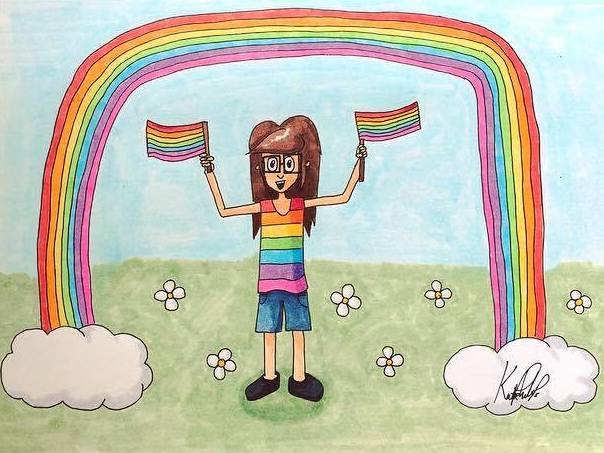
Mental Health Problems In The LGBTQ+ Community

This is just a little note to say that this post mentions incidents involving self harm so if that would trigger you, I thank you very much for joining us today but maybe go and treat yourself to a good cup of tea and biscuits instead. Safety first pals!

I once had a psychologist who, during a talk about my mental health and how broken my brain is, asked me if I thought any of my issues “were because of being gay”. I was appalled.

“How dare you!” I replied. “What homophobic nonsense is this? I am deeply offended! You think people who are gay must also be mad because nobody with common sense would be queer? For-shame! A plague unto you and your ancestors! Watch me flounce out of this room waving my rainbow flag in a fury! Watch me flounce I say!” (please note that this was what I replied in my head…in reality I think I just squinted my eyes a bit and formed a quizzical expression).

At the time I didn’t see what being a member of the LGBTQ+ club, had to do with my mental health at all, but after a little bit of discussion, research, and no actual flouncing, I realised that this psychologist was on to something.
Turns out, rainbow folk in general show higher levels of anxiety, depression and suicidal thoughts than heterosexuals, so seeing as it is Pride month in the UK this month, I thought I would use this post to think about why that might be. It’s like that old saying, “if you are gay and you have mental health problems, it is your duty to mush those experiences together and write a blog about it.”

In my experience,I wouldn’t say that for me personally, being a member of the LGBTQ+ community has been THE trigger that led to all of my personal mental health problems, although I know that for some people, it can be.
Often I think it can be things like homophobic bullying and external discrimination that are the reason people who are LGBTQ+ might go on to suffer problems, and in that respect, I have been very lucky.
I have never been bullied for my sexuality, my family have always been very accepting (my mum to the point where she is basically a walking gay pride parade all year round and always gets very excited/becomes a fan every time any celebrity comes out as a homosexual), and I live in a country/time period where it is safe for me to be “out” without fearing arrest.
The only discrimination I have ever had has been the odd homophobic slur shouted out of a car window at me as I was walking down the street, but this has never really bothered me as I don’t have that much respect for the opinions of people who shout abuse out of car windows… I might admire their ability to project with their vocal chords out of a moving vehicle, but when it comes to their judgements on who I fall in love with, frankly, I don’t give a damn.

However being LGBTQ+ has certainly affected me because of discrimination, it is just that all of that discrimination came from my own head and in the early days of my queerness, led me to feeling very ashamed.
Nobody in my external surroundings was telling me I was weird or shouldn’t be gay, but my head was, and consequently I was scared to tell anyone about it incase they felt the same. Indeed I decided that rather than tell anyone, I would start a grand “make Katie straight” mission so that nobody would ever have to find out. You may wonder how on earth one goes about “de-gaying themselves” as surely to do so is impossible, and in that assumption, you would be right. Little old me however, was convinced otherwise.

The idea came to me whilst watching a television program which funnily enough, was about a straight woman seeing if she could undergo treatment to turn her gay…Good lord they show some weird things on TV these days…
Anyway, in the program, this woman was told by some mad scientist to use this machine that would give her electric shocks every time she thought something heterosexual in an attempt to recondition the brain to stop thinking those things. The theory was that if your brain experiences an electric shock every time you think about something, it will stop thinking about that thing (either that or your hair will stick out all over the place forevermore and you will run up one hell of an electricity bill).
Unfortunately, I did not have an electric shock machine. I did however, have access to a lot of sharp things around my household, and I think you can guess how things went from there without me providing any more detail. As part of my “make Katie straight” plan, I set about trying to literally cut the gay part away from me, a futile pursuit considering “gayness” is not an extra body part or a long fingernail you can clip away at until it is gone. Unsurprisingly, that plan didn’t work, but it did get me into a cycle of self harm that I couldn’t get away from and still struggle with to this day.

Admittedly, my struggle with self harm is not about being gay anymore, but the whole situation introduced the idea of self harm as a punishment, a coping mechanism to try and remove guilt or shame I was feeling about anything in life.
Rather than being a punishment for being gay, it has become a punishment for things like bad marks on a test at school, or saying something mean in an argument, and I actually used to keep a little notebook in my pocket throughout the day to keep track of my “crimes” so I knew how many “punishments” I deserved later.
At first I was only doing a few things “wrong” a day, but because I was scared to talk to any of my psychologists about it as that would involve telling them how self harm started, and though I was ok with being gay, I didn’t expect everyone else to be. Consequently the notebook of punishments escalated and got so out of hand that after a few months, every action was considered a crime deserving of punishment, from using a “large blob of toothpaste” (which would use up the family tube sooner and lead to money needing to be spent on a new one), to “not smiling well enough at my friend in the corridor at school”.

It wasn’t until my mum found some blood soaked clothing in my bag which I had been trying to smuggle into school to wash in the school sink before she could see it in the laundry, that the whole self harm as punishment thing came out, and even then I wouldn’t tell people how it had started.
By the time I did tell people that I was gay, I had already been in therapy for 8 years or so and had been through two admissions to psychiatric hospitals, always keeping that part of my identity hidden. Like I said, being gay has never been a cornerstone in the almighty Jenga tower of my insanity so I don’t think that keeping that part of me a secret severely hindered my treatment. I was still able to talk openly and honestly about the depression, OCD, BPD related problems and anorexia in therapy, yet although it isn’t the source of my mental health problems, when I finally came out to professionals it did serve as some kind of relief. Whether it had been important to OCD or not, I always had to watch what I said in sessions incase I accidentally let a possible clue slip like “I LOVE HELENA BONHAM CARTER AND I WANT TO MARRY HER IN A BIG GAY WEDDING WITH A BIG RAINBOW CAKE BECAUSE I AM A BIG GAY MYSELF”. Being able to talk openly without worrying about that certainly made a difference and made me feel more connected to my therapists, because I think if you are ever keeping a secret from anyone, you are automatically reserved around people even when that secret isn’t being discussed.

As you can see then, compared to some members of the LGBTQ+ community with mental health problems, being queer hasn’t had anywhere near the impact on me that it has on other people. In essence, being gay is the vanilla extract in my giant cake of insanity rather than the flour of which the majority of the cake comprises.
That said there are a lot of LGBTQ+ folk out there who struggle so much with their identity either due to judgement from outside sources or internal judgement on themselves, that being LGBTQ+ can be a direct cause of certain conditions like depression or anxiety and it is for these people that we need to talk more about this kind of thing in the hopes that they will be able to seek help themselves. If shame about your identity leads you to having mental health problems, it is likely that shame will prevent you from seeking help for them, and as we all know that is just going to make things worse.

In this post I do not want to do a shoutout to all the LGBTQ+ people out there who are hiding in the bushes and tell them to run about telling everyone about their identity, because I understand that for some people in certain families or countries, that might not be safe for them.
All I want to say is that if you are struggling and feeling like there is nobody to turn to, you are not alone and I can promise you that there are people out there who understand (I am one of them. Hello, it is nice to meet you. My name is Katie and if you bring me penguins we can be best friends). If being LGBTQ+ is causing mental health problems and it is not safe for you to speak to people around you, there are hundreds of LGBTQ+ mental health charities out there for every country (I will link a page recommending some existing in the UK below), and if you can, I would encourage you to reach out to them for support.
I am not going to demand you just get a rainbow flag and feel proud because it is pride month, as I understand it is not as easy as that, but I do hope to offer some sense of reassurance that being LGBTQ+ is NOT something anyone needs to to be ashamed of or punished for, no matter what that voice in your head tells you.

Take care everyone x

RainbowBlog

https://www.mind.org.uk/information-support/guides-to-support-and-services/lgbtq-mental-health/useful-contacts/#.WV0XKlKZPVo


How Summer Can Affect People With Eating Disorders

When you live with an eating disorder, there are a lot of things that can affect it. For example my eating disorder rules are often impacted by things like my location, what time it is, who I am with, what is going on for the rest of that day, and, as I have learnt very recently, what season it is.

I have always known that things like the season can affect my eating disorder, but never have I realised this more than this summer, especially the past few weeks of June. If you do not live in England you may not be aware of what has been going on, so to clue you in, you should know that for the majority of June, England has been doing its very best impersonation of a Sauna. IT WAS 34 DEGREES.
For those of you who are used to living in hot countries this may not sound particularly hot, but for people who have always lived in England, 34 degrees feels like you are wearing three hundred woollen jumpers and have been thrust into a furnace with a hot potato shoved down your trousers, a feeling that is not helped by our inability to go for more than 24 hours without a good cup of hot tea (seriously we can’t do it. This isn’t a joke. Tea withdrawal disease is a very serious problem in the UK and 90% of hospital admissions are poor folk who cannot find their favourite teapot).

Now when the weather is hot, people like to take off their clothes or at least wear as few clothes as possible. Gone are the winter coats and snow boots and out come the shorts and crop tops, items that I find rather terrifying due to my eating disorder and body confidence issues. Throughout the year I live in large baggy jumpers so as to cover my body up and out of sight, so that people cannot see all of the disgustingness I see when I look in the mirror, which is a slightly problematic practice when the weather is hot. In summer when you have an eating disorder or body dysmorphic issues, you basically have two choices, stick to your normal wardrobe and roast to death or wear sensible clothes that allow a little bit of breeze here and there but that simultaneously leave you incredibly uncomfortable/stuck in the high street rigid with anxiety because you are wearing a pair of shorts.

I don’t know about anyone else, but I also find summer and warm weather extremely triggering to my eating disorder because I am so used to being cold and being cold is a symptom of being “unwell”. Indeed being cold is a feeling so synonymous and such a documented symptom for people with eating disorders that thermometers were shoved in our ears multiple times a day in hospital to see if we were at risk of hypothermia (an unpleasant experience though I suppose better than that of having a thermometer shoved anywhere else…).
Every time I say or am told by someone that I feel cold, doctors will say things like “it is because you are underweight” or “it is because you don’t eat enough”, so when I am not cold, I panic.
Due to the association with being cold to not eating enough, if I feel warm or heaven forfend “hot” at any time, my head will immediately convince me that it is because I must have accidentally eaten ten buckets of lard and have gained one thousand kilograms. If I feel warm, my eating disorder states that I also must be fat.
It is completely nonsensical but I cannot help it. As much as I try to apply logic to the situation, my brain will always convince me that being warm has absolutely nothing to do with the giant ball of fire burning in the sky (aka the sun…calm down this is not the apocalypse), and has everything to do with what I have eaten and how much I weigh. For me then, eating becomes a lot harder in the summer time because it is easier for my eating disorder to convince me that I don’t really need the food seeing as I am already abundantly covered in enough flesh to keep me toasty warm.

Another problem I have faced this year more than ever, is that of the longer daylight hours we have in summer. I know a lot of people find that sunlight is beneficial to their mood and can actually help them with mental health problems like depression, but for me it is the opposite. I hate sunshine (which is why I live in the UK).
In the sunshine everything feels too bright, too loud, too intense, and I feel calmer in the quiet winter months when people are tucked up inside rather than running around out doors with no clothes on.
I have also always struggled to eat when the sun is up, a problem that has somehow got worse this year. You see, I am currently sectioned under a CTO, a part of the mental health act that means I am allowed to live at home as long as I adhere to certain conditions like staying above a certain weight and going to appointments. I want to say that my main motivation to eat is to be healthy but as true as that is, I am ashamed to say that if I am completely honest, the main push that gets me eating is the fear of going back into hospital and having to eat more food and gain more weight. In the day time however, that fear is not as strong. When the sun is up my brain thinks “hey it is fine, you will stay above your CTO weight, if you don’t need to eat now, you can do it later”.
When the sun is down, there is no later though, and I realise that if I want to maintain my weight and with it my freedom, I am going to need to get some munchies out. The problem is that I know my weight will be acceptable as long as I eat and does not depend on when that eating happens, so naturally as with most things you fear/dread in life, I avoid it as long as possible.
In the winter, this was not such a problem because it was dark by 4pm, but in the summer with all this daylight savings malarky, it isn’t dark until around 10pm and as the months have gone on I have found my eating getting later and later in the day until the point I am at as I write this, a point where I am basically carrying out a year long, eating disorder motivated version of Ramadan. This would make sense if I was a particularly devout follower of the Muslim faith, but my adherence to such rules is not driven by a special spiritual meaning or importance, it is is because I have an eating disorder in my ear who is a total idiot.

In summer as well as taking their clothes off, people tend to change their way of life in the sense of what food they eat and the roast dinners and steamed syrup puddings of the winter time are replaced by cold salads and ice cream.
Again however, this is another seasonal transition that my eating disorder leaves me struggling with, because I eat exactly the same foods in the exact same proportions every day and one of these foods is porridge, aka that boiling hot bowl of oats that most people don’t whip a pan out for until there is a significant chill in the air.
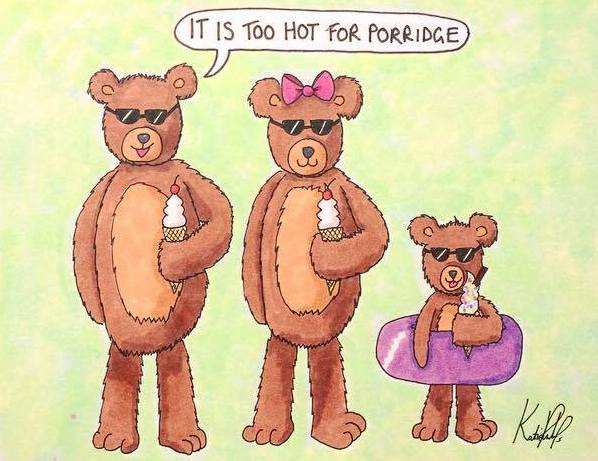
When it is 34 degrees outside, nobody in their right mind would start getting oats out of the cupboard to perform their daily Goldilocks’ impression, but I am not in my right mind, so that is exactly what I do (the slight difference in my impersonation being that I am a brunette version of Goldilocks…Oh yeah and I don’t break into people’s houses to get my oats, especially if those people are bears).

In June then, during the hottest week England has seen in my lifetime, I was stuck in the predicament of being boiling hot and thus convinced that I didn’t need to eat because I was clearly obese. Then by 10pm when the CTO fear would hit me, I would force myself to eat despite being so warm, only I would trigger myself even more and make it even harder by making the food I was consuming a steaming bowl of porridge.
“Eat cold porridge” I hear you cry, “try overnight oats which is the exact same thing but you don’t cook it”, yet even that couldn’t solve my problem as OCD has rules about how porridge is prepared and naturally has me convinced that unless my porridge has been cooked for exactly 4 minutes and 40 seconds with stirring at the appropriate intervals, I will kill everyone on the planet. What logic!

As you can see then, summer/the season and weather in general is one of the many things that people may not think about affecting people with an eating disorder, another thing that complicates the simplified idea that people with eating disorders “just don’t eat”.
They are complex creatures, mysterious as the dark side of the moon (10 points to anyone who got that reference), and the control they hold over a person’s life creates anxieties and difficulties most people might not think about. I am of course happy for everyone out there who loves summer and if you are one of those people living in England, I really hope you are having a lovely time in the June sunshine and are feeling as sunny as…well…the sun…
In the meantime I guess I will just have to suck it up and count down until the winter months when jumpers, porridge and 24 hour darkness are socially acceptable again. My God I am a jolly soul!

Take care everyone x

SummerBear

Birthdays And Mental Health Problems

When I was younger and heard adults saying things like “I just want to forget about my birthday this year”, I thought that adults were crazy and needed to seriously reconsider the way in which they were living their lives. Why on earth would anyone ever want to forget about their birthday?

For me, birthdays were something to look forward to and something I couldn’t forget about if I tried. Birthdays were about choosing which soft play area you were going to take all of your friends to for the party, buying rainbow coloured bouncy balls to fill party bags with and deciding whether you wanted a Thomas the tank engine or Spice Girls birthday cake ready to decorate with a flaming beacon of candles. Birthdays were about unwrapping incredibly exciting and complicated plastic contraptions that you would then spend the rest of your day watching your mum struggle to assemble amidst an encyclopedia of instructions in every language but English, before finally making it look like the thing on the box, only to realise that batteries were not included, causing your mother to curse the creators of Toys R Us and howl at the moon until the early hours of the morning, Barbie’s camper van standing motionless and taunting you from the corner. Birthdays were about wearing a badge with your age on it to school so that everyone would know how very mature you were and how much respect they should bestow upon you, and no birthday was complete without a trip to TGI Fridays where you would stand on your chair like a king whilst a chorus of red and white striped waiters belted out “Happy Birthday”, the performance concluding with rapturous applause from all around and, if you were lucky, an extra gummy worm in your Mississippi mud pie. With all that to look forward to, how could anyone dread a birthday?

I was sure that I would always look forward to my birthday and would never be one of these fools who looked upon the occasion with anything other than spine tingling excitement. I was wrong.
For the past few years, despite little Katie’s best intentions, I have become one of those people who wants to forget about their birthday, and I think it is because as you get older, birthdays don’t mean the same things as they used to. They become less about gummy worms and birthday cakes and more about time passing you by, life passing you by, which isn’t something you really care about when you are younger and your main focus is getting the bit of icing on the cake that has your favourite cartoon character on it. On top of that however, when you are mentally ill, I think they are especially hard because for me at least, a birthday can feel like a reminder that you have wasted another year drowning in anxiety and the older you get, the longer you have been stuck with this mental illness bothering you all the time.

That said, I guess you can sort of see birthdays and that marker of time passing as a positive thing. This year for example, I turned 25 (I did it last Thursday as a matter of fact and luckily, despite all the dreading and worrying about it talked about in this post, I really did have a lovely birthday, so if you sent me a birthday message or said hello to me at all on the 22nd June then thank you for being someone who made it special. I really appreciate you all so much). Alas! I must get back to the point!
So, turning 25 means I will have been unwell for 14 years. On the plus side, whilst a depressingly long time, it is an improvement in the sense that I can say the number 14 because it is a safe number, unlike the number I used to have to say, (the one that comes between 12 and 14), which is a somewhat difficult number for me to handle in terms of OCD (YAY SILVER LININGS).
Also there is something rather motivating about birthdays in that they often inspire you to make goals of things you are unhappy about and want to change before the next one.
Indeed, I think that as the number of years I have been ill has gone up, the more motivated I have become to fight my illnesses and push as hard as I can for recovery even when it involves doing something scary.

During the first years of my illness when I had to go back a year in school and take time out of education to go into hospital, I was motivated to fight purely because my illnesses were making me unhappy, but not so much because I realised what I was missing out on whilst stuck in my head. Ok I often couldn’t leave the house and I missed out on a few sleepovers with friends, a couple of school trips and several opportunities to share a pizza and watch a movie on a Saturday night, but to begin with, missing the odd pizza isn’t that big a deal. Obviously I would have liked to have done all the things like going bowling with friends and eating popcorn at the cinema, but for me being safe at home not having to touch or eat anything, felt a lot more comfortable. I would have rather stayed in my little bubble avoiding as much anxiety as I could, even if that meant being a little bit lonely, than go out of my bubble and cause myself a lot of distress trying to wear a pair of bowling shoes or eating a mouthful of popcorn. Staying safe was my priority, and if that meant missing out on a few sleepovers/meant less terror, that was a necessary sacrifice I would take. Why terrify yourself for weeks and weeks just trying to get the courage to see a friend for an hour? Better just to avoid it.

However the longer you live with mental illness, the more those little things add up over the years, and suddenly you find you have not just missed the odd sleepover, you have missed hundreds of sleepovers, hundreds of moments in which people took photos and made memories that they reminisce about and fondly recall with sentences beginning “Oh my goodness do you remember when…”. After several years, you haven’t missed one bucket of popcorn, you have missed an entire swimming pool worth of popcorn (not that I advise you put popcorn into a swimming pool…just trying to get the image of how much popcorn we are talking about across), and that amount of popcorn can’t be caught up on as easily as the one bucket you missed in the first place. As the days become months and the months become years, you realise just how much of your life you have missed out on because you were too scared to take part in it, and suddenly the motivation to work even harder to stop the years passing by without you noticing increases, because you finally understand how rubbish it feels to be left so far behind everyone else.

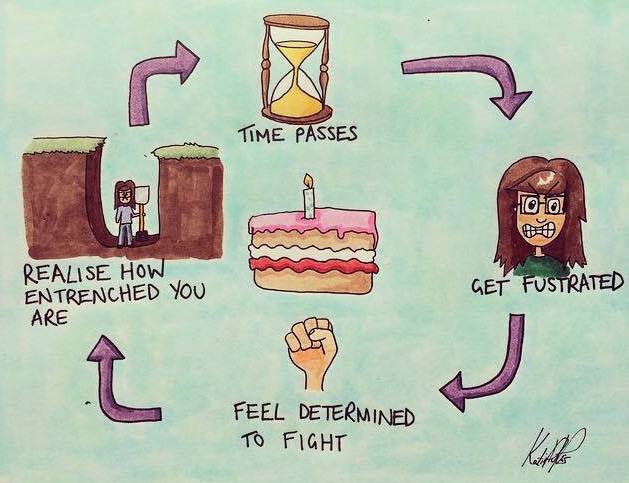
However at the same time, whilst the longer you live with a mental illness the more anger and frustration you have at it to motivate your recovery, the further entrenched you are in that illness and thus the harder it feels to get better. It is a catch 22 situation, the most vicious of all the vicious circles.

Time passes, you get angrier at all the time wasted, you become more motivated to fight but then find it is harder to fight than the first day you tried to challenge yourself because the illness has used the time wasted to dig its claws into you even further. Odd things that started out as little quirks to keep yourself safe become engrained habits and habits are a lot harder to break than things you only did a few times. I have smoked only one cigarette in my life and I will be honest, I hated it. It was like swallowing a smelly smokey fire. Therefore deciding to “give up” on the idea of smoking after that cigarette was not a challenge at all. I had spent longer as someone who didn’t smoke than I had spent as someone who did, it wasn’t a habit and I was not addicted or used to the comfort or feeling of a cigarette in my hand. Now however, I have officially been mentally ill for longer than I have ever been not mentally ill and I have dug myself into a hole so deep that it is far harder to get out of. Years ago I didn’t go to a meal out with friends because it made me uncomfortable, but that uncomfortable feeling has built over the years, and now I don’t go because I am terrified. Eating out doesn’t make me anxious, it makes me feel like I am dying on the inside. The longer you are ill, the more set in your ways you are and the harder it is to get better.

This year then, as always, though I dreaded my birthday as it scares me to think how long I have been trapped in my own mind, I am trying to see it as a positive motivation for change, an opportunity to say “this past 14 years has been hell and I am determined to fight as hard as I can to make sure that number doesn’t go up by one every time my age does”. I am fed up, truly angry every year as I see the growing list of all the opportunities I have missed out on and I really do want things to be different. It is just difficult, ageing with mental illness. As the years pass you may feel more motivated, but at the same time, you just feel more trapped.

Take care everyone x

BirthdayBlog

Why Are Eating Disorders Competitive?

Many people are aware by now of the dangers of eating disorders, the emotional inner turmoil, the isolation, and the potentially fatal consequences. However, one of the biggest dangers that isn’t quite as discussed is the fact that eating disorders can be incredibly competitive. It sounds odd and it is quite hard to explain how an illness can be competitive, but basically if anorexia was ever personified, it would be the person who becomes dangerous when playing board games and is prone to breaking valuable ornaments in the home over an unlucky roll of the dice in a game of Monopoly.

I think most people, often and unknowingly, see other homo sapiens as threats for many different reasons in every day life. At work you may feel in competition with someone to get a promotion, in a supermarket you might choose the best looking bunch of bananas so that yours will be better than those of whatever potassium craving customer comes after you, or in a car park you might discreetly race another vehicle to get the last available space. Maybe your competitive streak involves competing with your gaming arch-nemesis to be captain of the tiddlywinks championship team, whatever it is, at some point in every day, whether we realise it or not, most of us enter into little competitions with our fellow humans and in turn those people become threats.

It is rare however, for people to compete with another person’s illness, and I have often wondered why eating disorders are so different in that respect. Possible reasons I have come up with are things like the tendency for people with eating disorders to naturally be high achieving perfectionistic people, or that eating disorders are an illness that usually involve a lot of numbers and in turn, ways the illness can be “measured”. Obviously, in reality the severity of someone’s eating disorder is impossible to measure no matter how many scales you weigh them on or how many calories you see them eat, but no matter how incorrect the idea, people who do not really understand eating disorders to be a mental illness rather than a physical one, tend to measure the severity of an eating disorder by the physical effects they can potentially lead to. If people see a thin person they will wrongly assume that person to be more “anorexic” than their equally troubled neighbour who just so happens to be a healthy weight. With other illnesses though, this ability to gauge how ill someone is just by looking at them, however inaccurate the final judgement may be, is far more difficult in comparison. For example two people can have a liver disease but when they are walking side by side in a park, you cannot guess as easily who you perceive to be the sickest unless you take a few blood tests and maybe open them up with a scalpel (which would probably lead to them asking why you were wandering around a park asking people for blood tests and performing major operations).

When an illness is seen as focused around numbers then, comparison and thus competition tends to breed. Over the past decade I have met people whose eating disorders have led them (for I highly doubt someone’s individual personality would compete about such things), to compete with regards to numbers as to how much someone weighs, what their BMI is, how many calories they consume, even obscure things like who takes the longest to eat a meal, who has been into hospital the most times or who has the lowest white blood cell count. It is a disgusting, sick and twisted side to the illness since you are basically competing to see who can kill themselves the best, but I cannot deny it happens.
For this reason I actually think the more distanced a sufferer attempting recovery is from the intense eating disorder community, the better. If you are living in the middle of nowhere with a family of healthy people, you simply have your eating disorder to wrestle with (and lord knows one is still far too many). In hospital settings like inpatient eating disorder units, therapy groups, or even social media recovery accounts online, you are surrounded with other sufferers and thus other eating disorders to battle with. Don’t get me wrong, it is lovely to have people you can relate to, but the ability to relate to other people who are unwell and spending large amounts of time with them can lead to a loss of perspective.

Gathering a group of people with eating disorders together, either physically or online, is sort of like gathering a group of wild gorillas in the middle of the rainforest (I would avoid both of these gathering activities if I were you as neither are particularly safe…if you are an avid collector or gatherer may I suggest gathering stamps or Pokemon cards instead).
There are probably a hundred reasons as to why gorillas sometimes stand on their haunches and beat their chests, but from my dedicated research and observation (I watched Tarzan), when a gorilla beats its chest in front of another gorilla, it can be interpreted as “look how big and mighty I am! Have you ever seen such a fine specimen of gorilla? Look at my hairy arms! They are fabulous! I am the best gorilla in all of the world and far superior to you! I am the best! Leave my forest or I will strike your hairy behind! Back off I say! Flee! Flee!”.
All the gorillas in the rainforest will naturally want to be best gorilla around to ensure their survival, establish their right to the most attractive mate or the biggest banana. They aren’t doing it for laughs (maybe the odd titter), but they are naturally born with that competitive instinct so that they can stay alive.
Similarly, when a group of people with eating disorders gather, their internal eating disorder gorillas perk up and start beating their chests to let everyone know that they are the best and strongest eating disorder around. Ironically though, unlike the real gorillas, the “winner” in terms of measuring who is the most physically ill from their eating disorder, the thinnest or the one who has gone the longest without eating, is the least likely to stay alive the longest.

If you are reading this as a healthy minded person you are probably thinking that competing as to who can lose the most weight is ridiculous and sick, and when it comes to that judgment, you would be right.
However I think people often forget how much competition there is with regard to weight loss even in “healthy” circles. On TV shows like The Biggest Loser, people compete to see who can lose the most weight with a cash prize for the winner, and though perhaps less extreme than competing with white blood cell counts, surely this is similar? What about in local weight loss clubs when people compete with their next-door neighbour to see who can lose more weight than anyone in their area in order to be awarded with the sash declaring them “Slimmer of the Year”. When you think about it, in our society, competing around food and weight is not as alien an idea as people with eating disorders can make it seem.

There is however one reason people often suggest as the answer to the “why are eating disorders competitive” question, that I strongly disagree with, and that is the idea that people compete purely because they want to be the “thinnest” and that the competitive drive is all about vanity and outer appearance. If anything, I think the drive is the total opposite to vanity, and more to do with insecurity and low self esteem regarding the internal self.
When you live with an eating disorder you basically live with a voice in your head telling you that everything you do is wrong and no matter how hard you try to please it, it will never be satisfied or see your “efforts” as enough. No matter what you eat, your eating disorder will tell you it was too much. Even if the portion was initially decided by your eating disorder, it will tell you that you could have left a bit or maybe it will tell you that you ate it wrong; too quickly, too slowly or with the wrong sized mouthfuls. Whatever you do, the voice will tell you you are not living up to the standards you should be, you are not good enough.
My drive to lose weight is not to see a nice patch of rib cage, it is to achieve something that my eating disorder tells me is “better” than my former self. Of course there is nothing “better” that can come from starving yourself and if I were talking to any other sufferer I would tell them that the “best” they can be is the healthy version of themselves who is able to nourish their bodies and enjoy a healthy relationship with food. Yet still when it comes to me, the eating disorder somehow manages to manipulate my thoughts in that direction that I am a “better” me, less repulsive, less annoying, less deserving of a punch in the face, if I stick by my eating disorder’s rules. I am constantly held up between my past self, current self and encouraged to compete against them to reach this “superior” future me. When you add another sufferer into the mix then, it is yet another person for my eating disorder to compare me to. No longer is it telling me to lose weight or starve because I am not good enough compared to the potential me I could become if I were to behave myself, now I am also not good enough compared to the person or group of people surrounding me. I don’t follow the rules to the standards my eating disorder would like in an ideal world, and when I am around other people it tells me that I am even more inferior because they are following these stupid rules better than me. I don’t feel competitive because I am vain and want people to admire my collarbones, I feel competitive because I despise myself, because behaving well and following all my rules gives me a sense of self worth, a sense that I am doing something right, so if I am not following the rules “the best”, then I am not good enough.

So why are eating disorders competitive? Well, there are many reasons from internal anorexia gorillas to self hatred, perfectionist personality traits or the ability to compare and misunderstand the importance that physical numbers have to play in a mental illness. Obviously this competitive undercurrent is wrong, needs to be tackled and is disgustingly disordered, but we are dealing with eating “disorders” so I suppose it makes sense. What I want more people to know though, is that of all the reasons, as sick and twisted and horrible as they are, they are not reasons that derive from vanity or any sense of bodily pride compared to the person in the next bed to you. If anything it is about desperation to be good enough in the eyes of a devil that is constantly telling you you are worthless, both in yourself, and in comparison to everybody else.

Take care everyone x

HairiestGorilla

Eating Disorders Away From The Table

If I were to hand you a pencil and ask you to draw a person who, in the moment depicted, was struggling wth their eating disorder, you would probably draw an image of a person sitting at a meal table with a plate of food in front of them (Unless you are anything like my mother who instead, when given a pencil and asked to create a picture, will throw that pencil back in your face and run for the hills screaming “I can’t draw – leave me alone!”)
On one hand, drawing someone at a table would be right as it is likely that if someone has an eating disorder, meal times are going to be difficult for them. However I think there is an idea that when you have an eating disorder your struggles come into action at the dinner table and depart once the meal is over, a nice idea, though one that is unfortunately far from the truth.

For me at least, my eating disordered thoughts are there from the second I wake up and my first thoughts of the day will be about food and how much/what I am planning on eating during that day. It is silly really, because everyday I eat the exact same foods in the exact same amounts, so there is no decision to be made and any dithering is futile. There is no point in wondering whether or not I want Coco Pops or toast, I can ponder and postulate pancakes and Pop Tarts all I like but no matter what, the first thing I will eat that day remains the same as every other, in the same amounts and even on the very same plate. It is also pointless to think about this from the second I wake up as currently I am struggling with this rule that I cannot eat when the sun is up so, being summer, the first meal is usually hours away and shouldn’t be an immediate concern.
Nevertheless, every morning the thoughts and worries about what I am going to eat are immediately there, thinking about infinite options, things that might be healthier, lower calories/lower fat, before inevitably settling with the usual. It is like this for every meal no matter how far away that meal is, be it hours, days, even years.
There are several reasons why I have the same foods every day. For one thing I know what my weight does/how my body reacts to this meal plan, but mainly I stick to the same thing because it removes the need to debate the decision for hours each day.
Everything is planned down to the smallest most specific detail, I don’t just eat an apple a day, I eat a Pink Lady apple specifically to avoid the chance of spending three hours debating between a Golden Delicious or a Granny Smith, yet even if I know the debate is heading nowhere, it still arrives before every meal. I will spend the hours leading up to it debating the options and calculating various calorie amounts without ever getting an acceptable result.

Then, even when the inevitable decision has been made, the eating disorder is still there for the food preparation extravaganza, controlling every movement and weighing out ingredients to the exact gram, no matter how long it takes. I often weigh things multiple times on different scales to check that one set isn’t lying to me (I once saw a set of kitchen scales on Jeremy Kyle who failed the lie detector test. Turned out he WAS the child’s father and I have never trusted a pair of scales since). As always, the weight will be the same on every set of scales, but still I will spend time worrying that the food I was weighing was “different to usual” and that I randomly managed to pick up an incredibly dense courgette with twice the calories of a normal one.
Food prepared, there is then the obvious struggle people know about, the bit we all picture when we imagine someone with an eating disorder, the eating that takes place at the dining table. However even when I leave that table, the battle is still going on, and rather than sitting at the table politely waiting for the next meal, anorexia follows me rabbiting on about what went on at the table and the meal that, for everyone else, was over hours ago.
Did I eat too quickly? Did I eat too much? Do I feel fuller than usual, aka a sign that the scales were lying earlier and I was dealing with a magically calorie dense genetically engineered superhuman courgette? Have I gained weight that I can see? All of these questions swirl around in my brain amidst the thick soup of guilt and I replay the meal in my head over and over again incase I missed some key piece of evidence of something that I should be worrying about. I said in the part about worrying about meals before they occur that the meal can be hours or weeks away, and similarly the worrying afterwards can carry on for years after I put my knife and fork down on a plate.

Eight or nine years ago, during one of my admissions to hospital, I had a meal involving mashed potato. I had been eating the hospital mash for months and months before so I knew exactly what to expect, yet there was one particular day that the mash tasted different. They say variety is the spice of life, but as I ate that mash the difference frightened me and as someone with an eating disorder I wished that variety would keep its peppery little paws off my food thank you very much.
At first I wasn’t sure what the difference in the meal was but then it hit me that the mash tasted sweeter than usual. Immediately I became convinced that someone had mashed a doughnut into it and hoped I wouldn’t notice. Other than the slightly sweeter taste I had no evidence to support this theory, hospitals were not struggling with an epidemic of caterers with an uncontrollable urge to shove an iced ring into every dish, but that sweet taste was enough to have me convinced. It has been 9 years and yet I still think and worry about the doughnut that I am convinced was in my mashed potato nearly a decade ago.

Every waking hour between meals is consumed with food fears and often every sleeping hour is too. Not only does anorexia not live at the dinner table, it doesn’t live in the land of conscious thought either, and is well known to infiltrate and get its claws into the snoozetastic unconscious place known as “The land of nod”.
I have nightmares most nights, all of them with varying storylines, characters and background music, yet a lot of them have similar themes, one of these themes being food. I will dream that I have been held up at gun point and forced to eat an entire chocolate cake, before waking up and fearing that I did it for real and that I therefore have to go for X amount of time without food to make up for my behaviour. On many occasions I have woken up so convinced that I have eaten something that was actually part of a dream, that I have had to search the kitchen for evidence to prove to myself it wasn’t real. One specifically memorable dream involved me cooking and eating a gigantic spaghetti bolognese and the fear upon waking made me feel so sick that I had to go downstairs and check cupboards to see that all the pans were clean, the pasta wasn’t open and the bin was bolognese free, so I couldn’t have cooked and made it for real (apparently my brain believes I might unconsciously cook and eat a meal but draws the line at the idea that I would have washed up afterwards.)
I also dream about exercise and whilst some people have unconscious thoughts that lead them to sleepwalk, mine sometimes drive me to do sleep sit ups on autopilot so that I will wake up halfway through a set, stomach muscles aching, out of breath, wondering what the hell is going on.

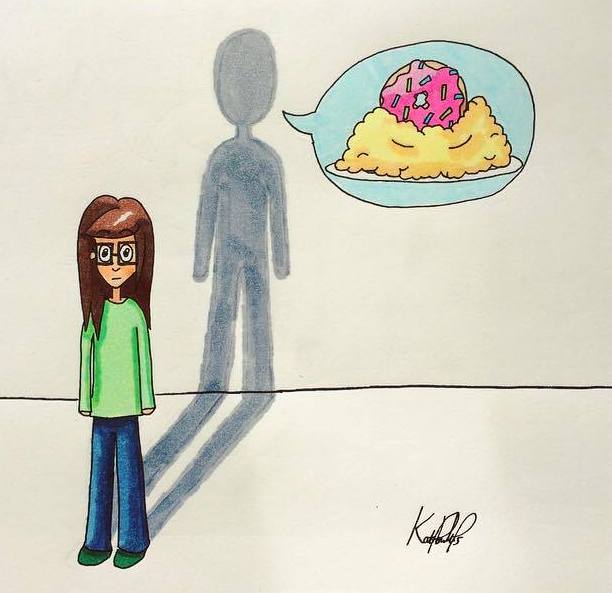
For me then, having an eating disorder isn’t just about struggling at meals, it is about being constantly controlled and dictated to 24 hours a day 7 days a week, a voice that follows me no matter where I go or how unconscious I am, interfering with thoughts and my ability to function even when food is nowhere nearby. It is a nice idea to assume that eating disorders do just live at the table and that meal times are the only difficult times for sufferers, but to tell you the truth, when you have an eating disorder, that devil will stick to you like an unrelenting shadow.

Take care everyone x

EatingDisorderTable

Embarrassing Incidents Caused By Mental Health Problems

I talk a lot on this blog about what it is like to live with various mental health problems, often waffling on about how exhausting, traumatic, frustrating and upsetting it is to have a brain that doesn’t want to co-operate with your goals in life. What I rarely talk about though, is that sometimes, as well as being all those serious things, living with mental health problems can just simply be damn embarrassing and leave you in awkward situations that you later look back on and feel like a fool.
Indeed, every time I have played one of those truth or dare games and the question has been “what has been your most embarrassing moment?” the first answer that has sprung to mind has been something related to mental health. It is also a question that often comes up when playing getting to know you games in any team building exercise you have found yourself roped into, yet every time I am asked such a question I never feel able to be honest because admitting to some of the nonsense you can get into when battling a mental illness, to a bunch of people who don’t understand such things, can sometimes be more embarrassing than the situation you are meaning to describe.

When it comes to picking an embarrassing mental health situation I have a bag full of examples to chose from (the one with the fireman or the “box of soggy kale in the cinema” incident are particular gems), but for today I think I am going to go with one of my more recent exploits that occurred during what I thought would be an innocent little trip to the supermarket.
As always mum and I were doing the food shop together and I was, as always, sticking right by her side, the childhood lesson that you should never run off on your own in a supermarket still burned into my brain as well as the fear of such a thing happening (when I was younger I lived in terror of the idea that one day I would have to have my name read out by some lady on a tannoy as the idiot who got lost and was found sobbing in an aisle of loo rolls. The shame of it!)
There is, however, one aisle in the supermarket that I am not a fan of, that being the meat aisle, so when my mum wheels her trolley down there I often hang out in the adjacent aisle and wait very patiently without panicking about my name being read to the entire shop over any tannoys. As I was waiting in the next aisle during this particular expedition, I noticed a woman enter from the other end, her arms extended out wide to carry a large pile of groceries.
To be honest, this woman (lets call her Bertha), really should have had a basket, but I think she was doing one of those whip rounds where you only plan on popping in to get a pint of milk and end up leaving with some Bombay mix, three jars of pickled onions, and a birthday cake in the shape of a caterpillar. I ignored dear Bertha in the beginning, and each of us continued along our merry ways without taking much notice of each other…

Then it happened.

Disaster struck.

Bertha, dropped her yoghurt. *Clashes cymbals for dramatic effect*

It was like watching a car crash in slow motion only with fewer screeching tyres and more rapidly descending low fat dairy products. Now, Bertha, aka dropper of the yoghurt, would have probably liked to have reached down to retrieve her shopping herself, but as I mentioned, Bertha was carrying a lot of groceries and in her defence was rather incapacitated (again, this woman really needed a basket). Had she bent down to retrieve the yoghurt herself, she would have risked an overflow of all of the other food items she had clasped to her chest, smashed jars, broken Bombay mix, wonky caterpillars, aka, total disaster.
As I looked at her carrying those groceries and saw the yoghurt fall to the floor, I instantly knew what was going to happen next. I was the only other person in the aisle. Bertha was going to ask me to pick up the yoghurt. *Clashes cymbals again as a blood curdling scream is heard over some hidden speaker system*

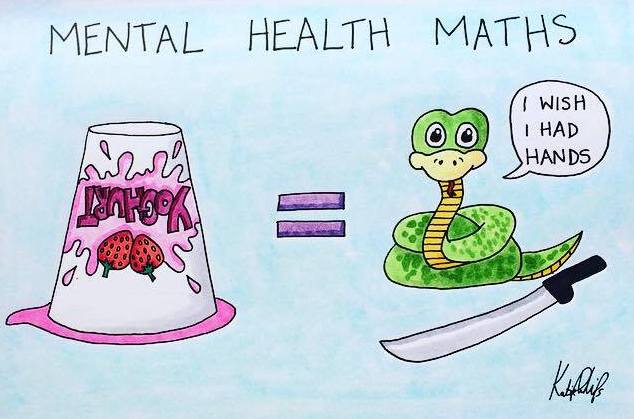
To most “normal” people/sane people, the idea of being asked to pick up a yoghurt is probably not that terrifying, but to someone with OCD who fears touching anything that has been on or near the floor, it was a nightmare. If I had to explain it, someone asking me to pick something off the floor gives me the anxiety someone would feel were they asked to pick up a rattlesnake carrying a machete…in its non existent hand…(note to self, next time when trying to think up an analogy, think of an animal with hands…)

The second that yoghurt hit the floor, I immediately set about looking like the busiest person ever to exist, in the hopes that Bertha would not ask me for assistance out of awareness that I was on a very important mission of my own. I snapped my head away from the yoghurt to the shelves and feigned a deep interest in a bottle of olive oil (rookie error, nobody is ever interested in olive oil. I should have gone for pasta but alas, retrospect is a wonderful thing). I stared at this bottle of olive oil and peered at it so closely you would have thought the meaning of life was inscribed in tiny letters along the side of the label, as if this olive oil was the most fascinating and wonderful thing I had ever seen. My acting was impeccable, several people from the frozen section even applauded despite their distance from my performance, and sent fan mail which I received a few days later. Bertha however, did not take the hint. Despite my acting performance, Bertha saw me and my bottle of olive oil and said in a voice that sent shivers down my very spine “excuse me can you please pick up my yoghurt?” *clashes cymbals so violently that they break into a million pieces and the very centre of the earth explodes*

Looking back, you may ask me why I didn’t just say that I had OCD and couldn’t help, before venturing off to find someone better suited to the needs of someone who needs their yoghurt risen from the ground like some 21st century Lazarus. If I had had a leg disease or something, I would have had no problem in saying “sorry I am currently disabled because of my leg disease” yet for some reason it seemed unacceptable to say “I am currently disabled because my brain is broken”. It doesn’t make any sense, both are a disability and both physical and mental illnesses impact and interfere with your life, but still I couldn’t be honest because saying I had OCD felt a million times more embarrassing than saying I had a leg disease. This sounds especially weird for someone who is able to speak openly about their mental health problems online without shame, but then again I think that is because I don’t really believe that anyone is reading my blog and if they are (hello you), I know they can’t see me hiding behind a cushion in the corner as they do so. For some reason I found that I couldn’t tell Bertha the truth, provide her with an explanation as to why I was scared to pick up her yoghurt, so instead I did the next best thing. I ran away. As I sprinted off into the distance I didn’t look back, but in my mind I can still see the imagined image of Bertha standing there over her yoghurt, Bombay mix tucked under her chin, staring after me and wondering what on earth was going on.

I grabbed my mum and dashed us out of the shop before we could buy anything (we were all very hungry that week), and by the time we got home I felt terrible. Ok I was embarrassed but I also felt incredibly guilty. Here was this poor woman asking me for yoghurt help, and I ran away.
It just makes me wish that there was less shame and less embarrassment over disabilities caused by mental illness, so that people could be honest in that kind of situation. I truly dream to live in a world where one day it will be possible to say “I am scared to pick up your yoghurt because I have OCD” without looking like a lunatic and whilst being taken as seriously as anyone with a physical and more visible impairment. Maybe I am underestimating Bertha and maybe she would have been understanding, but still you have to admit it is more likely she would have raised an eyebrow at the mental illness excuse as oppose to the leg disease thing.

If any of you out there have found yourselves in similar embarrassing situations in which your mental health problem made you feel like a fool, I hope you see this post as a comfort. Remember you are not alone in feeling like a bit of an idiot because there is someone out there who left a woman with her yoghurt on the floor, but more importantly, remember that when in the supermarket, one should always remember to pick up a basket before heading for the yoghurt.

Take care everyone x

Yoghurt

The Problem With Before And After Photos In Eating Disorder Recovery

A few months ago, towards the end of February, it was Eating Disorders awareness week, so naturally I did as I always do on this occasion and buried my head in the sand for the duration of the week (I also allowed children to use the remaining sand to build sand castles atop my hiding place because I am such a lovely person). This may sound like odd behaviour for someone who is constantly talking about mental health problems like eating disorders in order to raise awareness and for someone who has a strong disliking of sand, but then again odd behaviour is what I am known for. Literally.

The reason that I avoided the internet during that week, and indeed avoid it every year, is that it is a week in which social media is filled with “before and after” pictures, aka photos of someone taken during the depths of their illness, compared to a later photo taken post/during recovery. Don’t get me wrong, these photos certainly have their place and I would be lying if I were to say that I have never been inspired by any of them. Often these pictures will come with an empowering and motivating story of someone’s journey in recovery and triumph over anorexia, and that is brilliant. That is something that should be celebrated, and those stories  are shared throughout the Eating Disorder community to encourage others to fight their illnesses and to give hope to those who doubt recovery is truly possible. I love these stories but it is not the stories of recovery that I have a problem with, rather I have a problem with the “before and after” photos that are often involved in telling the triumphant tale.

Firstly, these images will usually show the person in the depths of their illness as an incredibly underweight individual, with ribs popping out so far all over the place that you could easily use them as a xylophone. Regardless of the inspirational intention with which they were posted, there is always the risk of these pictures going on to be triggers for other sufferers or, dare I say it, “thinspiration” for all those misguided souls who think that anorexia is something to aspire to. They can also make sufferers who are perhaps not as underweight (or who are unable to see themselves as that underweight) consequently see these images and feel that they cannot seek help because they aren’t “thin enough” or “bad enough”, when encouraging people to seek treatment is supposed to be the whole point of a week dedicated to educating and raising awareness of eating disorders. Similarly, in their representation of someone with an eating disorder and someone without, they encourage the myth that eating disorders are about being thin and that eating disorders can be seen, (a myth I have tried to tackle here: Why it is physically impossible to “look anorexic”.)
For people who do not know much about eating disorders and who do not have the time or interest in reading full accounts of recovery journeys, these snapshots may be the only experience they get of someone with an eating disorder, so the risk is that the stigma and lesson of “ill is underweight”, “well is a healthy weight” will be perpetuated without taking into account the far more complex and important internal and mental struggle that is having an eating disorder.

Similarly, as an image to summarise recovery, I feel it is problematic in that the main difference that is visible between the two pictures is weight, which implies that the main difference one goes through is the difference of the number on the scales. It suggests that in recovery, the biggest thing you “gain” is weight, when really weight is probably the smallest of all the things I have seen people gain in recovery. I may not be able to speak as a recovered person myself, but of all the friends I have watched beat their eating disorders into a soggy pulp on the ground that is no longer able to control their lives, the change in their weight has been the least significant change of all. Okay there is a change in weight and perhaps clothes size, but when I see my recovered friends, I do not see the change in their BMI, what strikes me most is the change in their lifestyle and their overall presentation as a person. To me they have not gained weight as much as they have gained themselves. When you are in the depths of your eating disorder, as much as you fool yourself, you cannot maintain a normal life. Your ability to have a job, have normal relationships with people, be happy or even function are seriously compromised, and these things are all aspects of life that can be improved on with recovery. I have seen friends go on to study medicine at university, have romantic relationships, give birth to children, climb mountains (I am talking proper big mountains like Kilimanjaro), and travel the world. They have regained their ability to properly smile, to laugh without having to fake it, and to me seeing all those photos of them skydiving in Australia or getting married and having babies have been far more significant and noticeable changes than what size jeans they wear. It is these aspects of recovery that are the really important reasons that people need to fight and it is these changes in lifestyle that are the really inspiring stories. Yes weight gain is a part of the journey, but what is more important is the places that weight can take you, for example to medical school or up a flipping huge mountain.

On a similar note, my other issue is that I feel before and after photos simplify the process of recovery. In one picture you probably have someone who is underweight and either looking miserable or faking a smile out of dead eyes, and in the other you have someone who has gained weight and perhaps, is beaming at you with genuine joy. This then makes recovery very straight forward, “Being underweight make you unhappy and thus gaining weight will make you happy”. It automatically assumes that the happiness comes as the weight increases, without highlighting the far more complicated journey in getting that weight to be there.

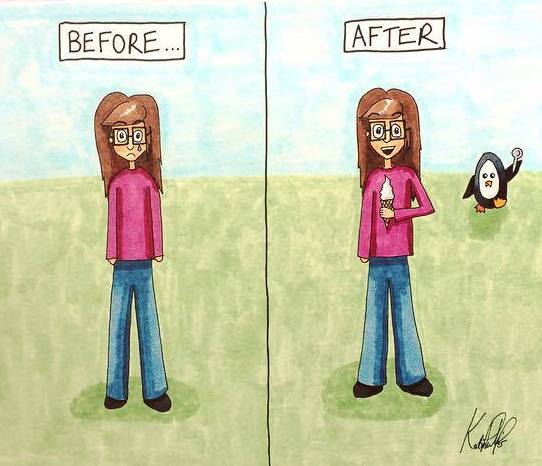
It is hard to explain exactly what I mean, but it is like looking at a picture of someone standing in a field looking miserable, and then another photo of them smiling in the same field but with the addition of an ice cream. At face value then, you can look at these pictures and think “well a person was sad because they didn’t have an ice cream but then they got an ice cream and they were happy” , simple. What the picture will not tell you however, is how that ice cream got there. Little would you know that the person had not simply walked up to the nearest ice cream van, asked for a 99p Mr Whippy and walked away smiling, just as the person in recovery had not simply gained some weight, and in turn, a smile (side note did you know that they don’t even do 99p Mr Whippys anymore? They are now at least £1.50! How do those ice cream men still have the nerve to play jolly tunes as they patrol the streets for customers now that they are basically performing daylight robbery rather than offering a merry treat. You can play Greensleeves all you want but that doesn’t change the fact you are making me re-mortgage the house to buy myself an ice cream. SHAME ON YOU ICE CREAM MEN. SHAME ON YOU.)

Anyway, what the picture doesn’t show is that to acquire their ice cream they were forced to go on a perilous test of their endurance, that pushed them to the limits of mental and physical strength. To get that ice cream in the picture, that person had in fact had to walk across continents and cross oceans to America, the largest producer of almonds in 2014 I will have you know, and then had to hand pick hundreds of almonds ready to blend into a creamy milk worthy of a tasty frozen dessert (this person was lactose intolerant so almond milk was the milk required for the job.)
Then, exhausted from months of trekking, nut picking and milk making, that person had to swim across even more oceans into the freezing cold pole of the Arctic where they stirred their almond milk with a wooden spoon atop a large glacier that acted as a natural freezer for their ice cream churning process. Even when the ice cream was made it didn’t get any easier as they had to then wrestle with a penguin who had cheekily tried to steal the ice cream (I don’t blame him to be honest. I would steal ice cream if all I had ever eaten was raw fish), and then they had to get the ice cream all the way back to that field in their country of origin, back through the hot climate of almond fields in America, without the creation melting. Clearly that is a far more character building excursion to get to that point of “person with ice cream in a field” than the picture initially suggests, and I didn’t even tell you the 5 month side trip it took to make the cone in which the ice cream was to rest (it would take too long to tell you fully but as a brief summary it involved a very angry rhino and a lot of waffles).
The person worked hard to get to the point where they were standing in that field with that ice cream, and all that hard work is eradicated, as it is in recovery journeys, when all you see is a simple before and after shot.

Obviously I am not saying we should stop people from sharing their recovery stories and indeed, if you have recovered from an eating disorder, then I am OVERWHELMINGLY proud and impressed by your determination and strength. If you were here with me now rather than wherever you are reading this, I would give you so many rounds of applause that my hands would fall off and I would be left clapping stumpy wrists to show appreciation of your achievement. What I am saying is that maybe, more often we should be celebrating and telling these stories without the underweight photos that go with them. A story is still a great story without pictures. Hell, look at Harry Potter, that story changed and continues to change generations of people, it has grown theme parks and movie franchises, careers and other astonishing things, all from a pile of words cobbled together with no images at all (For the purpose of this post can we please just pretend that the illustrated versions that are currently in production don’t exist.) Still, even when pictures are added to the Harry Potter books, it will still be the words that are doing all the talking.

So that is why I have a problem with before and after photos when it comes to eating disorder recovery, not because I don’t like inspirational stories or don’t want people to celebrate their achievements, but because those pictures don’t really do anything but diminish and reduce the value and greatness of what has been achieved. As a snapshot ok, a picture may say a thousand words, but a recovery journey is made up of millions of them.

Take care everyone x

BeforeAndAfter