Good Girls Drink Kale – Society’s Dangerous Acceptance Of The Anorexic Mindset

One of the many reasons I struggle to eat is because of the guilt I feel about it. When I am eating I feel like I am committing a crime, my mind is telling me that I am doing something “wrong”, something “bad”, and the only way to feel that I am being “good” again is to stop eating. Considering I have anorexia, none of this is particularly surprising and it is common to a lot of people with eating disorders. Recently though, I have noticed that this feeling is actually one that is generally accepted in society. I am always told that my thoughts are “disordered” and that the way I think is not normal, but it makes it incredibly hard to believe professionals trying to help me when my very thoughts are voiced in day to day life.
When I say I “can’t eat” because “eating is bad”, people call me crazy, yet then when somebody goes to a coffee shop and asks for their drink to be made with skinny milk because they are “being good” nobody bats an eye lid. BUT THEY SHOULD BE BATTING THOSE EYE LIDS. Seriously people should be batting their eyelids until their eyelashes fall off every time somebody associates human goodness with what a person is eating, because the two are not connected and the whole thing is a dangerous, disordered thought that is slipping into normal life.

I used to work in a cafe as a barista, and one of my favourite bits of the job was on the days we had a new cake in and I could wander around offering people a free sample (swear to God if you have low self esteem it is a wonderful experience to be among the masses with free cake, they will love you and you will feel like a Bakewell wielding Beyonce.) My least favourite part of the experience however, was bumping into all the people on diets, and about a million times every day I would hear the words “Oooh I would love to try but I am being good” or “Oh don’t tempt me I have already been so bad today”. On one occasion someone even said “oh no I cant, I am far too big, it is alright for you, you are skinny so you are allowed cake”. EXCUSE ME? Is there some law I am not aware of that states that people who are a healthy weight or overweight are not allowed to consume sweet baked goods and that they will be arrested and jailed for life if they so much as nibble on the edge of a cookie? Is there a clause in this law that people who are underweight are free to eat all the cakes without fear of being reprimanded for some reason? If so, who is making these laws and where can I go to demand they sort their priorities out immediately? (I myself suspect it could be a greengrocer with a deep hatred of and passion to destroy Mr Kipling and his family, but so far my research has not confirmed this).

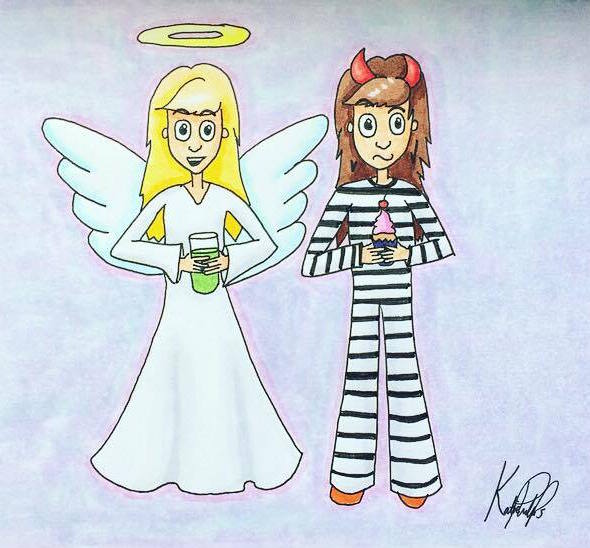
Associating goodness with not eating isn’t even something you just hear from people on diets, it is used in adverts to promote various foods in the media. There is an advert for a “light” cream cheese that shows angels eating the product with halos above their heads, as if their choice of low fat dairy has elevated them to the heavens, and hell is actually a place filled with people who like a full fat cheddar. As someone who did a theology degree and read The Christian Bible in detail several times, I can assure you that decisions around the location in which people will spend the afterlife are not made in such a manner, nor is there a secret eleventh commandment advising on acceptable kinds of cheese to sprinkle over your pasta bake (although from a personal point of view I would always advise on Mozzarella).
Similarly there is an advert for some milk chocolate balls, and in it a woman is reprimanded in her choice of snack by a “friend” (aka rude judgemental lady who should keep her unhealthy opinions to herself) saying “ooh naughty”, to which she replies that she isn’t actually that naughty at all because the balls she is consuming are under 10 calories each. REALLY? Better let whoever decides whether people go to heaven or hell know! Appearance wise her actions make her look worryingly like those of someone who should be shoved down in the burning pits of those who can’t resist a full fat cheddar, but since they are only ten calories I guess she deserves to sit on a cloud with the cream cheese angels for all eternity.

The whole association between moral character and what someone is eating isn’t even simply annoying, it is dangerous. Not only does it condone thoughts people with eating disorders may have (thoughts they are told are abnormal, which is fine yet hard to believe when your Aunt Judith is receiving a free plastic halo every time she buys low fat cheese spread at the supermarket), but it puts the idea into the heads of people who may not have eating disorders or those that then go on to develop them. I understand the need for healthy eating and the need to promote a healthy lifestyle to people, yet I cannot see how it is healthy in terms of mental or physical stability to raise children in a society where someone in an advert doesn’t eat dessert at a restaurant because she is “being good”, unlike her friend who has decided to give in and “be a bit naughty” by digging into a knickerbocker glory. Would it then be a surprise if the child then grew up refusing to ever touch desserts because to do so is something everyone is told they must feel guilty about? Obviously eating disorders are far more complex than all of that, they aren’t about refusing dessert and are caused by a million things that are nothing to do with food. Ok, nobody gets anorexia because they fear that food will send them to the fiery pits of eternal damnation in hell. Nevertheless, thinking that food choices reflect your value as a person is not a good message to be spreading. People with eating disorders need to develop a healthy relationship with food, that is a given, but it seems that everyone needs a bit of a revamp on thoughts around food too.

Now, I will admit that if your idea of a “going food shopping” is breaking into orphanages, tossing the children into the fire and then stealing their muffins, then maybe your food choices are saying something about your moral character and you might be sent to jail for them. Aside from situations like that though, (and if anyone really is food shopping in that way please stop as there are these places called supermarkets that have a wide selection of nice muffins and orphans really don’t need that kind of treatment), eating or not eating cake says nothing about you as a person. To people with eating disorders, without eating disorders, people developing eating disorders, everyone please know that eating any food is not a crime. Food is not a situation to negotiate, it is fundamental to life, it is necessary, and in addition to keeping you alive physically, being free and able to eat a chocolate ball when you fancy one without fear of being reprimanded for bad behaviour, is fundamental to mental health. It is OK to allow yourself to eat and eating is nothing to feel guilty about no matter who you are or what your weight. You do not need written permission from Jesus to allow yourself a a doughnut.
Death row is not lined with convicts who couldn’t resist a piece of a colleague’s birthday cake or daredevils who had the nerve to have full fat milk in their latte, and saints are not simply people who drank a few litres of kale for breakfast. If you want to do something “good” today and are that obsessed with moral purity, then buy a cup of tea for someone who cannot afford to buy one themselves or help someone carry their shopping to the car. Just whatever you do, don’t judge your goodness or self worth on the weight of butter you put on your toast this morning. People who eat cake are good and people who eat cake are bad, just as people who eat kale can be good or bad, but their food choices really have nothing to do with any of it.
goodgirlsdrinkkale

The Great Eating Disorder Bake Off

If you live in England it is likely you are a viewer of, (or are at least aware of), The Great British bake off, a show otherwise known as “The Greatest Program on Television ever”. Seriously, if you don’t watch it you really should give it a go…That is unless you have an allergic reaction to the phrase “soggy bottom” or deep seated hatred of collections of people baking in tents and having their creations critiqued by a bearded man who likes to squash bread into balls and then complain about the consistency of the bread he has just mashed back into a dough…If that is the case maybe give the bake off a miss…
Luckily, none of those things bother me, so I am able to enjoy the bake off in all of its pun filled, icing topped glory. However, every time the annual bake off rolls around, it always reminds me of a certain symptom common to many people with food related mental health problems. The symptom? Many people with eating disorders are obsessed with baking.

Obviously not everyone who has an eating disorder bakes and not everyone who bakes has an eating disorder (if they did Mary Berry would be in need of some treatment immediately). On the whole though, it is a very common problem that many people are unaware of, and that rarely comes up or gets talked about other than by the people whom it affects. To some of you out there, it may sound a bit ridiculous to write a post about the issue that is eating disorder patients finding any excuse to whip out a spatula. After all what is the problem with a bunch of anorexics liking to bake a few sponges now and again? Why worry when someone with bulimia gets out a wooden spoon and starts sieving flour with eyes squinted in concentration? Why complain about someone bringing fresh homemade cookies into work purely because the baker has been diagnosed with EDNOS? Well, the problem is that often people with eating disorders who are obsessed with baking, are obsessed in a very unhealthy way that can be detrimental in recovery and serve the eating disorder rather than the baker.
Seriously, it is such a common and big issue that many of my disordered friends and indeed I myself, have been placed on multiple “baking bans” by mental health services during treatment for anorexia, an experience much like being a smoker on a smoking ban, only I was rocking back and forth cradling a wooden spoon rather than a packet of tobacco.

Like I said, not everyone who bakes has this problem and the problem isn’t within baking itself. Baking is awesome, and there is nothing like the satisfaction you get from people admiring your perfectly risen soufflé, but the issues arise and things get disordered when the baker dedicates an unusual amount of time to their pursuit, yet refuses to try even a lick of icing from the bakes they produce themselves.

For people who haven’t experienced an eating disorder, this probably doesn’t make much sense. Why would someone with a difficult relationship with food surround themselves and actively go about creating the culinary masterpieces that they themselves fear to sample?
Well, as always I can’t speak for everyone suffering from a mental health problem. Though similar on the surface, we are still all so varied inside (much like how chocolate chip cookies and raisin cookies look alike but are actually completely different). Nevertheless, I thought I would at least try to explain here why I personally love to bake, in the hopes that maybe I will provide an explanation and speak for a few others out there.

When I bake, it isn’t just about taking part in a little hobby to pass the time, it is about serving a purpose in terms of my anorexia.
Don’t get me wrong, by involving food it is still a scary activity (for example I often worry about touching fatty ingredients for fear the fat will sink into my skin or I worry that the smell of a cake has calories in it), but overall baking is an outlet, a thing I can do with food that other people can do, and most importantly, a way I can take part in the cultural aspect of food.

Normally in my life with anorexia, when it comes to food/events related to food, I see myself on the outside of things. Whenever someone has a birthday cake, a dinner party or hands round a box of chocolates at Christmas, I watch it all play out like an observer. In the room but not really involved, almost like I am in a theatre watching a scene being played out on stage whilst I am firmly seated in the audience. For over a decade I haven’t been able to join in with many food related things. I haven’t shared a pizza or bucket of popcorn with a friend, I haven’t accepted a bourbon offered over a cup of tea or indeed eaten something at a meal table that was the same as other people eating around me.
Baking then, serves as a way I can get a bit more involved in all of those things, only without the terror I would associate with joining in like a “normal” person.

When I bake a cake it is as if I can stand on the stage with everyone else rather than having to stay firmly seated in the audience, watching from afar through my little pair of binoculars (this may be an analogy but I am unable to afford good theatre seats.)
Instead, I can bring out the cake for the characters to start eating in the next scene, I have a role, a part to play in the action, I am not merely an observer but up there in the spotlight as “The bringer of cake”.
If people talk about food I haven’t tried or made I cannot join in. When people comment on something I have made however, I am involved. They can ask questions about what is in the bake and I will know the answers. Okay I may not have eaten the food myself, but in creating it, I can relate to it in a way that sounds as educated and informed as if I had. If people comment “oooh is there vanilla in this?”, I don’t have to just stand there staring at the confection trying to spot a pod of vanilla, or turning to other people to see if they can taste vanilla too, I can answer for myself that there is indeed vanilla in the cake, and for one second I can actually feel like a human being, part of something “normal”, joining in.
That is why I love baking despite having an eating disorder that prevents me from tasting any of my creations myself, and perhaps that is why a lot of other people with eating disorders like baking too.

In writing this my aims are not to encourage any disordered bakers out there to pack up the pastry or to tell carers of the mentally ill to confiscate their whisks.
If you enjoy baking and it makes you happy, do it more often, but still I have written this because I think it is important to question yourself if you are one of those bakers who would never consider having a nibble on their own Battenberg, and important for people to be aware of the fact that in some cases, a baking obsession can be a symptom of an eating disorder. If you as a reader ever feel compelled to get busy in the kitchen, my only hope is that you bake your cake and eat it too. Sure it may be nice just to partake in the creative process, to play the role of “the bringer of cake” in scenes you would otherwise watch from the wings, but the experience is a hell of a lot sweeter when you are actually able to fully join in with the eating part and share a Victoria sponge with friends. It is scary, but as a Bake Off challenge I would encourage you all to give it a go, and, if ever in doubt, just ask yourself: What would Mary Berry do?
(Answer: she would eat it, and as a British national treasure you should really follow her example).

greatedbakeoff

Why Gyms Need To Be More Aware Of People With Eating Disorders

Recently, I have noticed that gyms have been popping up all over the place, and it is getting to the point where I would not be surprised if I went down to the bottom of my garden one day to find that a new branch had set one up in my shed between the empty plant pots and the lawn mower. Obviously I understand the benefits of the gym, getting a bit of exercise is important to keep healthy, and it is nice to have a place that allows you to look sweaty and tired whilst exercising without the potential judgement one would receive were you to start doing press ups in the cereal aisle at your local supermarket. The problem is that while gyms advocate health and fitness, there is often far too much emphasis on the idea that both are achieved by losing weight, which of course, it isn’t. For some people maybe, but the generalisation that weight loss will improve your health is a dangerous one, especially for people with eating disorders, and in my opinion it needs to be addressed by gyms immediately.

When I first joined my local gym I was 16 years old and in my preliminary session with a member of staff I stated that my goal was to lose weight. This member of staff then took my height, weight, and calculated my BMI to discover a number that I will not post specifically, but let’s just say it was towards the lower end of healthy. Despite this information, the personal trainer happily agreed to set me up with a meal plan and exercise regime to achieve my weight loss goals, without any debate or suggestion that my intention to “shed the pounds” was unnecessary and actually detrimental in terms of fitness.
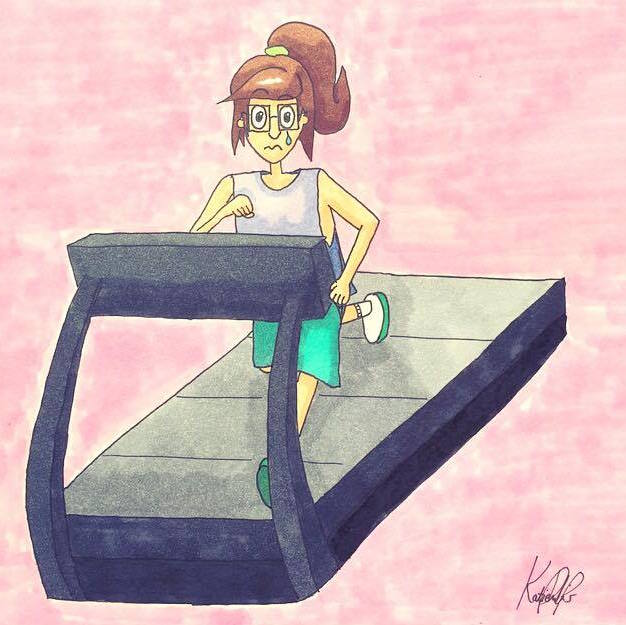
A few months after that preliminary session, I was admitted to hospital on an eating disorders program where I stayed for ten months, gaining back all the weight I had lost on the treadmill.

The day I was healthy and had been discharged, I went back to the gym, not with the intention of losing this time, merely “toning” my new healthy body, but soon enough it became an obsession again and I was there all the time exercising until I was about to pass out. One morning I went to the gym at 6am, the moment they opened. By 9am I had been admitted to hospital again due to my eating disorder and exercise addiction, which combined had made me rather underweight and not “fit” in any sense of the word (unless your sense of the word fit is that it means “to be a weak, dizzy mess on the brink of collapse”, in which case I was REALLY fit). A mere three days before that day, I had been approached by a personal trainer who offered to work with me and help me to lose weight.
Annoyingly, this being a blog post constructed of words rather than expressions displayed on my spectacular visage, you can’t physically see me right now, but as you read that last sentence, please just picture me throwing my hands up in despair and shaking my head at the ridiculousness of that situation.

Now, I understand that personal responsibility for one’s self and one’s actions is important. After all, gyms cannot be asked to dictate the lives of their members, weigh them upon entry, demand they get off the treadmill if they didn’t finish their bran flakes that morning, and cook them a hearty balanced stew for dinner each night (although I would not be adverse to any of these ideas), but when an eating disorder really takes over someone’s mind, that person can have no control, be unable to take responsibility for their own safety, and need people to step in. In part, this is because they may not realise that they are even ill, denial and distorted perceptions being a massive issue in people with eating disorders. The other and in my opinion bigger issue that can result in a lack of control over one’s behaviour however, is the feeling of a lack of permission to look after oneself.

Every time I went to the gym I was terrified and certainly didn’t want to be there at all. I had been told multiple times by doctors, my eating disorder service, nurses in A&E, that I could have a heart attack at any moment, but not going simply wasn’t an option. My head told me I wasn’t allowed to make that decision.
If I pleaded with the eating disorder that I was scared and couldn’t go to the gym, it would scream so relentlessly that I felt I had no choice but to give in, and I would end up on that treadmill whether I wanted to be or not.
Furthermore, the fact that I was continually let into the gym despite being so underweight almost supported the voice of the eating disorder. I had doctors telling me I was physically unwell and looked awful, but when I went to the gym and started rowing on one of those damn machines that is nothing like a real boat experience whatsoever (6 years at that gym and I didn’t see a single duckling), nobody batted an eyelid, so I assumed the doctors were lying and that I must look fine. If I was clearly “so underweight”, then why on earth would a gym let me in and offer me a personal trainer to lose more flab than I had already? Surely this meant they thought I was overweight too? Not saying anything to people who are clearly unwell is one thing, but asking if they want help in making themselves even more unwell in the interest of “fitness” just to make money is a whole new kettle of fish, a very dangerous hot kettle with sharks in it who are able to withstand shockingly high temperatures.
What’s worse is that my experience is by no means unusual or a sign that I clearly had a bad gym, as it is something that happens to loads of people in loads of gyms all across the country.

Now again, I am not asking gyms to approach skinny people in the gym, catch them with a giant net and fling them violently out of the window. Such a code of practice would be futile due to the important fact I have stated in previous posts, that not everyone who is skinny has an eating disorder and not everyone with an eating disorder is skinny. Indeed, someone could be severely unwell, on the brink of death or a heart attack and look a healthy weight or overweight. What I am asking for, is personal trainers and other staff to be made more aware of people with eating disorders, and how to support or help them when they are in a destructive relationship with the gym. They need to be able to spot various symptoms or unusual behaviours, be trained to have a grasp of eating disorders and exercise addictions, or be aware of someone’s motivations in losing weight if there are signs of any underhand eating disorder suspiciousness going on.
At the very least, if they measure someone and know someone is already a healthy weight or underweight, they shouldn’t give them a weight loss meal plan or ask if they want to pay you to help them shed the non existent rolls of fat they are complaining about just to make some cash in the name of “fitness”. When someone has an eating disorder, such suggestions are more like offers to assist in suicide for the price of £20 an hour. BARGAIN.

I know that it is a massive pain to say gyms have to spend extra money on funding training, especially when it may be that such training may be irrelevant for the majority of the time when it comes to healthy members.
Nevertheless, I would still say that it is less of a pain to be aware of sufferers and deal with them whilst having slightly lower profits, than to have to deal with a law suit and a hell of a lot of guilt when someone who clearly shouldn’t be exercising dies on one of the treadmills. I may not be a personal trainer, but that certainly doesn’t sound like fitness to me.

Treadmill

Food Demonising And Eating Disorders

During the month of April 2016, the food company that manufactures “Dolmio” pasta sauce issued a health warning telling people that they should not consume certain varieties of their products more than once a week due to high levels of salt, sugar and fat. The next day, the newspapers were covered in ridiculously dramatic headlines like “The Bolognese sauce in your cupboard is plotting to kill you” and “Research suggests it is safer to drink bleach than creamy tomato pasta bake”. Supermarkets gathered up all remaining stocks of Dolmio sauce and threw them into the ocean where over one million fish were knocked unconscious by the sudden downpour of jarred carbonara, and people fled their homes to set up new lives abroad as the sudden media frenzy had inspired such fear in their hearts that they’d rather safely escape from their kitchens without a backwards glance, than risk having a heart attack trying to dispose of a jar of pesto they had foolishly lurking in the cupboard. Now I will admit that this is perhaps a slight exaggeration on what happened after Dolmio’s announcement, but the message I am basically trying to convey here is that some pasta sauce company said there was some sugar and salt in their sauces and absolute chaos ensued.

This chaos probably doesn’t seem worthy of a blog post, especially on a website that focuses on mental health, but the problem is that this whole Dolmio extravaganza is not an isolated incident when it comes to the fact that the world has suddenly become obsessed with “clean eating” and being healthy. Just the other day I saw a headline on a magazine that asked “Which is more dangerous: Carbs or Fat”, a ridiculous question considering the fact that people need carbohydrates and fat to stay alive. It is far more dangerous to not eat enough of those food groups than to eat over whatever amount of grams the government has said is acceptable or required for every single one of us individually, despite vast differences in age, height, weight and exercise regime across the population. Ok too much of certain food groups can be bad for you, but no individual food group is especially dangerous, they all play a part, are all vital, and this food demonising obsession of recent years is incredibly disordered and unhealthy both in terms of mental and physical wellbeing.

Eating healthily is great, but being obsessed with what you eat and counting every calorie, every fat gram and every grain of sugar is not normal and is something that, prior to recent years, I had only seen in fellow people with eating disorders. Food demonising and counting “macros” is such an issue in the eating disorder community that groups are offered to try and challenge these behaviours, which would be a hell of a lot easier if the rest of the world wasn’t suddenly condoning the thoughts and fears around a potato that you have been told are unwarranted.
During one of my hospital admissions there was a brand of cereal bar that we had as part of the meal plan every day. It came in a variety of flavours but I always went for the blueberry one, because it was the lowest calorie option…However, one fateful day at the hospital, disaster struck. WE HAD RUN OUT OF BLUEBERRY. I suggested we should call the police immediately to deal with this heinous crime of cereal bar deprivation, but for some reason the staff thought this was not the way to respond and told me I would have to have another flavour bar. And they call me crazy? Still, as they were the staff, I had little choice in the matter and ended up having a different flavour that was a mere one calorie more. The next day I gained weight at weigh in and I put all the blame on that different flavoured cereal bar. I did not think of all the meals I was eating in the hospital, the fact I was on a weight gain diet and an eating disorder program designed specifically for weight restoration, no, all I thought about was that cereal bar, and I immediately decided that that flavour was dangerous and never to be eaten again. In my eyes that bar had caused my weight gain and I demonised that bar so extremely that I pictured Satan as that cluster of oats and honey I had consumed, presiding over the underworld with an iron fist and chunks of real fruit (Gosh I shudder at the memory). Hopefully anyone reading this will see that demonising that particular flavour of cereal bar was ridiculous, clearly irrational and that obviously there were many other things influencing the number on the scales at that time. Yet still the message is being spread that we should demonise and run from certain foods (like Dolmio pasta sauce) in the name of “health”, without remembering that health is another thing influenced by hundreds of complex variants and not determined by the macaroni cheese you had for dinner.

In the mental health world, being obsessed with “clean eating” is called Orthorexia, a term coined in 1996 to address the unhealthy fixation on healthy eating suffered by some people with eating disorders and it is a big problem. I myself have been obsessed with government guidelines when it comes to food intake, and due to all the scare stories I have developed a fear of salt. At times I have been so afraid of salt that I have avoided eating a single milligram, because low salt diets are “healthy”, but it has never done me any good. In fact I have ended up in A&E multiple times due to this lack of salt causing low sodium, a key electrolyte that people NEED in order to keep the heart working.

We really need to stop avoiding food groups or labelling them as “dangerous” when it is so much MORE dangerous to become obsessed and potentially develop a fatal eating disorder. Ok if we ever discover crowds of potatoes rallying in secret, plotting to take over the world, then maybe we can see a danger in the carbohydrate department, but until then can we all just sit down and eat some damn pasta like we used to rather than this spiralised courgette nonsense that suddenly seems to be so popular.

I suppose that the message I really want to get across here is that in no circumstance is a food or a food group to be considered a danger in itself, as the real danger here is actually food demonising that condones and can potentially lead people into serious eating disorders. Obviously you should still eat your greens at dinner and whack a banana on your cereal, but you should also be able to eat a bowl of actual spaghetti rather than a courgette that has been cut to ribbons. Take government warnings with a pinch of salt (literally, remember, sodium is important), and stop seeing any food as the ruler of the underworld. It isn’t just an apple a day that keeps the doctor away, sometimes you also need a piece of good old chocolate cake.

Dangerous potatoes

The Problem With Eating Disorders And The Desire To Achieve

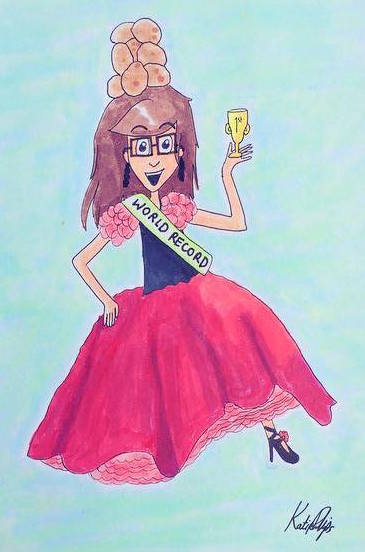
In life I think it is safe to say that most people are born with a desire to achieve, a need for purpose, for something that they feel will make their life worthwhile. If you are an expert in biology as I am, with many qualifications in human body expertise (I did biology GCSE), you will know that this space that craves a sense of achievement comes in the form of a little hole that is located just below the liver, and when humans are born, it is empty. Naturally people want to fill it in order to feel complete, and the way in which to do this is to fill it with achievements, achievements like getting a good grade in an exam or breaking the world record for the number of potatoes you can balance on your head at one time, whilst enthusiastically taking part in a salsa class with a lady who keeps clacking maracas. The difficulty comes in finding what it is that fits in your hole (by which I of course mean your sense of achievement craving space and no other hole in the body), because when that hole is empty it can get awfully draughty, especially if you are wandering around the blustery moors like Cathy searching for Heathcliff in Wuthering Heights.
Unfortunately, a lot of people with eating disorders somehow manage to wedge an almighty bout of anorexia right in their sense of achievement space, and this is in no sense as good an idea as filling it with a world record relating to salsa and potatoes.

When you have an eating disorder, you automatically obtain goals, and purpose (dangerous horrible ones that are no good to achieve, but when you are caught up in the illness they feel as important and legitimate as someone else’s goal to become an astronaut.) There are always rules and things you are striving for or you are trying to beat, a new number of minutes on the treadmill, a lower number of calories than before or a new target weight, and achieving these goals fulfils that need for purpose. Ultimately each goal you set and then achieve can feel like validation that you are doing something with your life, making your existence meaningful and making life worthwhile.

I know that personally I struggle with this a lot, especially as I appear to be friends with a lot of people who all seem to know what they are doing with their lives and are very successful. On countless occasions I have been to parties with these friends and in the general “catch up” chatter I have heard them talk about all of the fantastic universities they have got into to do their masters, all the plans for their PHD dissertations on complicated topics I didn’t know existed, and the fantastic relationships they are all happily involved in, already planning to move out of their family home, elope to New Zealand and get mortgages on houses with their partners.
Meanwhile at these parties I tend to stand there looking a little bewildered and feeling incredibly inferior. I have not been to Oxford university, been to New Zealand (or Old Zealand come to think of it), and the closest I have got to moving into my own house so far is my attempts to build my own pillow fort under my bed, which isn’t going well because planning permission is a nightmare and I am struggling to sort out the plumbing situation. Does anyone have any advice for supplying a pillow fort with running water, when the only materials you have at your disposal are a few cushions, a blankets and giant cuddly penguin who has a surprising lack of DIY skills? Even if that works out, this house is being built under my bed within my parents house, so I wouldn’t really have moved out, even when I do get things up together. I know it is disordered, but in these instances at these parties, my eating disorder is of great comfort to me, because when I am feeling like a hopeless failure, I can comfort myself with all the things I have “achieved” through my anorexia, all the hard work and goals I have reached, even if in the real world things like “only ate X calories for lunch and have a BMI of Y” means very little.

This is but one of the many reasons I find the act of challenging my eating disorder and overall recovery so difficult, because in doing so I am carving out the well crafted plug filling my sense of achievement space and leaving it empty again with the gale whistling through my abdomen.
I know that the key to all of this is simply find another thing to fill that space, but it is a lot harder than I ever anticipated because when it comes to making new goals or setting out on new pursuits that you are not very experienced in, there is a high chance of failure, something that is reassuringly lacking when it comes to the world of having an eating disorder, as I have had it for so long now that I know the rules and I know that when I put my mind to it I can achieve the goals it sets. Setting my hopes and dreams on becoming a lawyer or something is a lot more complicated because it relies on so many outside influences and there are so many places for error. What if I don’t get into law school? What if I fail my exams? What if I manage to make it as a High Court judge and then at the biggest case of my career I lose my big hammer thing that judges use after they have announced their verdict, and the jury and I are left until the end of time unable to put a murderer into prison because I cant bang my hammer on the table? With eating disorder goals, I have to rely on nobody but myself, and I don’t need to be mindful of where I am keeping my hammer.

From speaking to other people with eating disorders I know it is fairly common to use anorexia to serve your sense of achievement, and in a way it is great. The anorexia or whatever else serves the function of filling that sense of achievement and blocking that gale, but it isn’t a particularly healthy filling, because once lodged in there the eating disorder grows bigger, spidering slithery tendrils away from the hole in which is was originally placed to take over and kill the whole body altogether. Therefore when it comes to recovery, it is vital to think about and work on making a new life and set of dreams to pursue and goals to achieve alongside eating a healthy diet and getting to a health body weight.

If you are currently in recovery or contemplating it and are struggling with this issue then I guess my advice is to be brave and rip that eating disorder plug out to feel that abdomen gale for a bit. I know it sucks. It will be chilly, and put you at risk of failing whilst attempting to fill that desire for achievement with things you have never tried before. Maybe things you might be bad at, or heaven forbid, things you may fail in. But maybe that is ok, and nobody can get these kind of things right the first time. Maybe in reality, achieving or failing at anything in life is far better than fooling yourself into thinking you are achieving in an illness that is basically just starving you to death, which is not an achievement at all.

Therefore I want to challenge everyone reading this with an eating disorder to try and find something new or give a random hobby a go to try and replace the one you have that is potentially killing you. Take up chess, or tiddlywinks, collect magnets shaped like penguins in hilarious poses, hell try and beat that world record for dancing the salsa with potatoes on your head. That last one especially is a great one to start with because to let you into a little secret I have learnt from my research, nobody has even set a record for that yet, so you have a pretty good chance of winning (I still cant believe no human has dared to attempt such a feat before.)
Yes it is silly and yes it sounds pointless but I urge you all to give it a go anyway, because in life there is so much more to devote your efforts and attentions to than a silly number on the scales that doesn’t tell you anything anyway. You will never lie on your death bed and reminisce about the greatness you achieved by starving yourself and wasting your life, but by God wouldn’t it be wonderful to lie there in your final moments, and to reminisce about salsa dancing amongst all your trophies and Guinness world book of record certificates, a little pile of winning potatoes gently settled at your feet. That my friends is success. Go and get it.

salsa

Veganism Vs Eating Disorders

I first became vegan in 2012, and at that time I didn’t know anyone else who was a vegan. From my viewpoint, they were pretty rare and sparse, much like some herbivorous creature David Attenborough would have to spend weeks stalking before he could actually get one on film. Recently however, I seem to be seeing a lot of vegans springing up all over the place. As a vegan myself, obviously I think this is great, as it strengthens a movement and cause that I agree with and am passionate about, but the concerning thing is that a lot of people I have seen suddenly start milking almonds are people in the eating disorder community (both online and in real life).
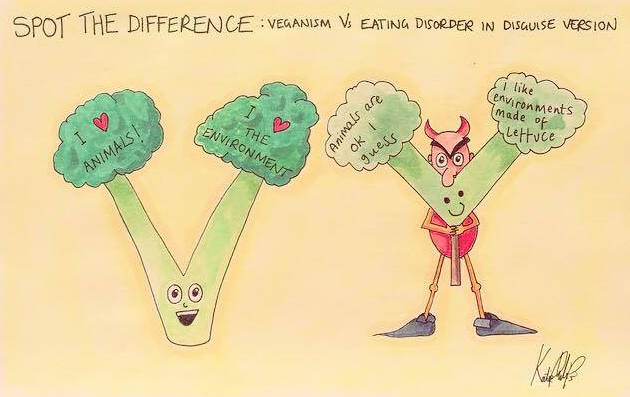
Obviously “veganism” and “anorexia” are two very different things, one is an ethical movement, the other a mental illness, so naturally being vegan does not mean that someone has an eating disorder, just as someone having an eating disorder doesn’t mean they are vegan. Nevertheless there can unfortunately be times when they cross over, and the lines between the two normally very separate labels become a bit blurred, much like the colours of a carrot and a stalk of broccoli do when you put them in a blender and switch it on high speed. It is here that the problems start, problems people need to be more aware of and open to discussing, as it is here people can start using veganism as a mask to cover what is really an eating disorder, a dangerous trick that can leave many people unaware that they have a problem or mean that others do not pick up on what is a potentially fatal illness.
In other words it is hard to work out which bit is broccoli and which bit is carrot, so I feel it is important for people with eating disorders who are vegan to question their lifestyle decision, not because it is wrong, but to make sure it is for the right reasons. Therefore in order to try and help people who are unsure about either themselves or a friends dietary choices, below I am going to list several things to look out for as signs that your veganism is actually something a lot more dangerous…

1. Why are you vegan? What was the initial cause or reason and how did you come to the decision? – When you or your friend became vegan, what was the drive behind it? Was it to benefit the environment? To fight animal cruelty? Or was it to use as an excuse to mask why you are taking things out of your diet? With eating disorders, veganism can sometimes unfortunately be used as a get out of jail free card. If you start refusing all standard cakes or ice cream, family may be concerned or question whether or not there is a problem. Wave the vegan flag however, and you have given yourself a more socially acceptable disguise for your refusal, as I think we can all agree that “I am not eating that because I am vegan” tends to go down a lot better than “I am not eating that because I have an eating disorder that is slowly killing me”.

2. Restriction or alternatives? – An important thing to bare in mind when considering someone’s veganism is how they go about it. For example, veganism is NOT about cutting things out, it is about swapping them. Used to get protein from meat and eggs? You can swap that for chickpeas and beans. Had your fat requirements from full fat dairy? Introduce yourself to Mr avocado and his civil partner Señor peanut butter. Veganism is about still getting all of your daily needs but from plant based sources, it is not about emptying all the cupboards and then living off a bag of lettuce.

3. The “Imagine you accidentally” game – Imagine you (as a vegan), ate something that was not vegan by complete accident and without having any way of knowing about the non-veganness before hand. What do you think? Is it all “oh my God I just ate something with cream in it I am going to get fat! My thighs will be wider than the widest wide thing in the Museum of very wide things”, or is it more along the lines of “Oh Damn! That is annoying, I feel guilty about the animals but I guess it was human error, not my fault and I will just have to check ingredients more thoroughly from now on”?

4. How has veganism impacted your lifestyle overall? – Obviously being vegan involves dietary changes, but changes are not limited to food alone. By deciding not to contribute to the exploitation of animals, you are deciding not to use animals for your own gain, not just deciding to avoid eating them and their produce. For example when I became vegan, my entire make up collection, shampoos, shower gels and toothpaste all changed to animal friendly versions. If the only aspect of veganism you care about is the food side of it then maybe examine why this is, to make sure it isn’t because the food changes are actually about something other than animal ethics. After all it makes little sense to avoid eating a cow whilst wearing a leather jacket, so finding out and questioning your stance and opinions on the non food related parts of veganism can be handy in giving you a clue as to where your head is at.

5. The Vegan bakery test – Imagine a friend wants to support your decision to be vegan and takes you to a vegan bakery. There are vegan brownies, cakes, muffins, the lot. When you look at the display what do you think? Is it a case of “Oh no my excuse to get out of cake is gone! What do I do? I must reach behind the counter, grab a wooden spoon and whack my friend on the head to distract them whilst I run away”, or is it more similar to “Oh my goodness I want that chocolate peanut butter muffin in my face immediately”. This test is a fairly good guide in my opinion as to how much your veganism is impacted by possible animal or disordered eating factors. It is also a good test as a guide to find out how much you like your friends, because if you are that eager to hit them in the face with a wooden spoon you may want to consider socialising with other people.

In an ideal world obviously I would love for everyone to be vegan, so I don’t want this post to be seen as telling people with eating disorders to run off and bite the nearest sheep immediately.
What I am saying is that if you are vegan or have a friend who has recently turned vegan, be sure to question it (especially if they have a history of eating disorders), and be fully aware of why that choice has been made. In my opinion a vegan diet is one of the healthiest diets around, so if you have an eating disorder and your veganism is a separate entity to it, then go ahead and carry on loving your lentils. Hell, have a shower in chickpeas and build a house out of a giant cabbage, just be sure to distinguish whether or not you are dealing with real veganism or a potentially fatal eating disorder wearing a vegan mask. After all, no cow is going to be particularly grateful that you stopped drinking its milk because of a voice in your head that is trying to kill you.

Stay safe all vegans and non vegans and people reading this in general. Cheerio for now.

Vegan

“Who Am I?” – Anorexia And Identity

Have you ever wondered how people refer to you when you are not in the room and they don’t know or have forgotten your name? People refer to others using general but somehow specific terms all the time (my mum and I do this with contestants on Masterchef for example, this series we had “beardy man” and “Jam sandwich lady”), and it makes me think about how people refer to me. Rightly or wrongly I have always assumed that people call me “the anorexic one”, “the one who never went to school dinners”, “the one who disappeared into hospital for 10 months and then came back to sixth form 2 stone heavier” or words to similar effect, and it is one of the reasons that I find the concept of recovery so frightening and difficult to achieve. I feel that the label of being “anorexic” serves as a sort of identity both to me personally and for other people. In my head “anorexia” is my thoughts, it is all I think, it is what I do and who I am, so in my eyes if it disappeared, I would disappear too. I also feel this way about OCD sometimes, as that is also what I do and how I live/what I am, but the identity tie is mainly to the label of “anorexic”. After all, OCD is rarely used as an adjective to describe a person, you never hear the words “they are an OCDic.”

When anorexia first appears in someone’s life, it is sort of viewed as a separate thing, an added extra, an invader that is not part of the real person, or, in metaphorical terms, purple hair. People say that someone “has” anorexia much like they would say someone “has” purple hair due to some dye they have just bought, it is a temporary alteration to their being that will gradually wash out over time, it is not an integral part of who they are. If someone has it for a month, they will perhaps be known for that month as “the one with the purple hair” and then the label will change again as they themselves change style and perhaps career (e.g the brunette professional penguin tamer).
The problem is that the longer someone has purple hair, the more the purple hair becomes tied up with who they are as a person, they stop being a person with purple hair, the purple hair almost becomes them. When I was first diagnosed with anorexia it was an addition to who I was, a bit of purple colouring in my ponytail, but now after all these years I feel it has leaked all over me. The dye as it were hasn’t stayed in my hair, it has dribbled down into my skin so that my entire body is as violet as that girl who turns into that blueberry in Charlie and the Chocolate Factory when she eats the piece of gum Willy Wonka told her wasn’t finished. I no longer have anorexia as one has purple hair, I am anorexic, I am entirely purple from head to toe. If you scrub at my hair or my skin, the colour doesn’t just wash out anymore, it has been too long, it is embedded and to get rid of it you would have to peel away all of my skin completely which would in turn get rid of me too. That is how anorexia feels in terms of my identity, it is a thing that has become me and that now I am so entirely that it is impossible to remove. Without that label who would I be? My therapist is always correcting me when I say things like “I am scared of eating X” by saying “the anorexia is scared of eating X, Katie isn’t” but I don’t feel like that is true. I don’t have a voice telling me to avoid going over a certain number of calories, it is just my thoughts, it is just me.

A few years ago I went to hang out at a friend’s house with various people I had not met before (some may have called it a “party” but there were no balloons and in my eyes a party is not a party without rubber sacks of the host’s breath floating about, so I would call it a “jovial social gathering”). At some point in the evening some cake was brought out and handed around. The plate and thus the cake was offered to every guest individually, except me. Don’t get me wrong, I really appreciated it and was relieved. I hate the awkward moments when people offer me things that I then have to make up excuses to avoid, and knowing this my friend the host (lets call her Bertha for the purpose of this conversation), did not put me in that position. She knew I wasn’t going to have any cake so she didn’t insist on the whole “Cake?”, “Oh, no thank you” palaver that is often so embarrassing. However, this act of what was consideration for me and kindness of a friend aware of my difficulties, really got me thinking. When Bertha went round the circle she saw everyone as a person with the potential to eat cake, but when she got to me she saw someone or something different, she saw one of the “anorexic species”, a creature notorious for avoiding sweet treats. It felt like Bertha saw me as “the anorexic one”, I was different, and I had to wonder what on earth would it have been like if in the five minutes before the offering of the cake, I had been struck by the most wonderful bolt of lightening in the history of weather, and instantly cured of all mental health problems ever. What if I hadn’t had the illness that made me “the anorexic one”, what would be left, if anything, or would there just be a an empty space where the former anorexic had been?

I guess the point I am trying to make here and the point of this post/what I want more people to understand, is that there is a reason that anorexia is so hard to recover from. It is such a complex illness that both destroys and provides in ways that people may not think.
When sufferers are trying to fight but are struggling, it isn’t simply a case of being “scared of food” or ”scared of gaining weight”, often it is also a fear of what they will lose, of throwing away everything that they think they are, the removal of their core identity, leaving a hole they have no idea how else to fill.

Identity

(Apologies for the crease at the top of this image…I actually drew this picture for an appointment with one of my psychologists and the paper got creased on the way to the hospital. It was a good day for therapy but a bad day for my attempts at art.)

Why it is physically impossible to “look anorexic”.

A few weeks ago, the woman whose womb I once inhabited for 9 months (otherwise known as my mother), was chatting to a fellow human, and during the conversation my mother mentioned the fact that her offspring, aka me, has anorexia. The first response to be uttered (after the obligatory “Oh dear that is sad”), was the question “what size is she?”.

Has a more irrelevant question ever been asked? The answer is no. It is a question equivalent to asking someone with a broken leg “what colour is your cast?”, as if that will tell you about whatever funny business the bones are doing inside. Honestly I do not know what size I was before I heard of this incident, but right now I can assure you I am well and truly FURIOUS sized (like fun size chocolate bars only less fun, more rage.)
Unfortunately, this ridiculousness is a common response or question when someone hears that another person has an eating disorder, so I want to clarify one vital piece of information that everyone needs to know:

The weight or size of a person will never tell you how ill or how well someone is with an eating disorder.

Eating disorders (though obviously having implications in the “real world” in terms of behaviour around food/affect on physical composition of the body), are mental illnesses, the severity of which will never be judged by a number on the scales or a size on a pair of jeans. People with eating disorders can be underweight, a healthy weight or they can be overweight, but no matter what size, you will not be able to tell from their appearance what is going on inside their heads. Not only can you not tell the mental strain from appearance, you cannot tell the physical strain and the effect the illness is having on the body either. People with eating disorders die with bones popping out all over the place at a BMI of 2, but they also die whilst looking healthy or overweight because the physical complications caused by these illnesses are so much deeper and more complex than “weight loss”. Heart attacks caused by the body eating heart muscle for energy, electrolyte imbalances caused by purging and insufficient nutrition, and multiple organ failure caused by the general strain of eating disorders on the body are but three of the many ways people lose their lives in the fight and all of these things are invisible on surface level.

It isn’t even as if this misconception that eating disorders can be seen benefits anyone, as it is a dangerous belief for all involved. Sufferers may feel they aren’t really ill because they don’t look like the stereotypical skeletal pictures of people with eating disorders in the media, parents may not take their child’s issues to food seriously because they “look alright”, and medical professionals might deny input or treatment because the weight of the patient isn’t “too low” so they “can’t be that bad”. It is also an idea that even damages people who are trying to recover from an eating disorder, as sometimes help is withdrawn once weight is no longer “low” which is exactly the time that people need to be supported most.

Many people have even been refused treatment at all until the number on the scales is seen as corresponding to being “anorexic”, and until May 2013, there was actually a BMI criteria that had to be met in order to officially be diagnosed. Thankfully, the new DSM (basically a massive book that gives the lists of symptoms one needs to be diagnosed with any mental disorder) has revised this issue and anorexia can now be diagnosed in people of any weight, but despite this, the misconception still remains. It isn’t exactly unusual to hear the word “anorexic” used as an adjective to describe someone’s frail appearance, a casual turn of phase that further perpetuates the issue. Unless you have insanely magical x-ray vision and can see the thoughts and fears someone is harbouring about food (and if you do have such vision please go to a doctor as you are a medical marvel and could potentially help a lot of people with unseen medical conditions…or find buried treasure…but more importantly help people), you will never see a person “looking anorexic”.

The myth that eating disorders can be seen or measured is a dangerous, stigma inducing and potentially fatal story that needs to stop being told. If you really like myths, maybe give Theseus and the minotaur a go (it’s actually rather good, there is a maze with string, monsters and everything), but whatever you do please don’t believe the one I have attempted to debunk in this post.

12903879_10207275967351339_21790916_o