Being Institutionalised After An Inpatient Admission

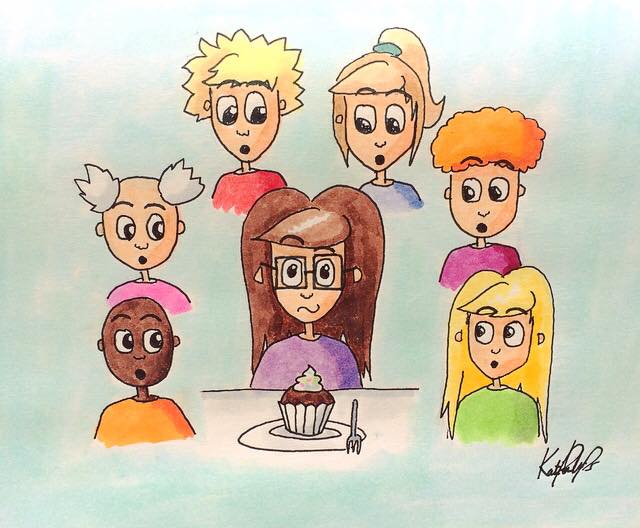
Humans are very much like lions. They have very fluffy manes and they like to stalk antelopes…no wait…that wasn’t my point…what was my point…ah yes, humans are very much like lions: they are not supposed to live in captivity. When you see a lion in a zoo standing behind the glass peering out, longing for freedom, they do not look happy, they do not look free, they look listless and bored and tend to pace around a lot because that is not an environment they are supposed to be in. Similarly, humans are not supposed to live in psychiatric units, it is not their natural environment, it is not where we evolved to be and being in one is an abnormal and temporary experience. Problem is, when you have been staying in a psychiatric unit for almost half a year, you start to get a little bit institutionalised and consequently over these past two weeks I have been struggling with my new found freedom.

Indeed, going back to the lion thing, I feel very much like a lion who has been living in captivity for a long time and then has suddenly been chucked out into the wild without any of the coping skills or natural instincts necessary to survive. I didn’t like living on one small corridor but at the same time it was a contained space that I knew every part of, it was a place I understood, yet now I find myself in this big wide open space of a world and no idea what to do or where to go. Over the past months I spent so much of my time desperate to get out of hospital that I never really thought about what it would be like when I got there and am now finding myself feeling a bizarre sense of “right….now I am out…what the hell do I do now?”. It is like my sense of direction has gone, my goals and my aims were all so focused on getting out and being free that I forgot about what would actually happen and what I would actually do when that freedom was achieved.

What troubles me is that I am not living in a place where I should feel like this, I am not living in an abnormal environment as I was when I was in the hospital, I am living where I am supposed to be, out in the wild, out in the real world, yet it is suddenly a world in which I do not feel I have a place anymore.

To be fair I am quite a homebody, I don’t go out much and the most adventurous trips I have been on since I have been out have been to places like the local supermarket, but every time I go to these places I find myself wandering around watching all these people casually buying food as part of their day, part of their lives that they are living and I wonder how on earth they do it. How do they live in this big scary world? How do they have jobs and families? How do they know what food to buy in a shop and then how do they go back home and make it into something to nourish themselves before maybe going on an evening out to do something similarly alien to me like socialising? I am not a part of that world. I am part of a world where I am used to waking up and being timed to eat a bowl of cereal under the watchful eye of a nurse or other mental health care professional, before gathering in a group room around a box of tissues to talk about my feelings. For five months the biggest deadlines and expectations I have had on my shoulders have been things like making sure I turn up to emotional regulation group with my notebook on time and making sure I am at the clinic to be weighed at 7:30 on a Monday morning. True I didn’t like it, to be honest I hated it, which is why I spent such a long time fighting professionals and trying to get out. I didn’t belong there anymore than a lion belongs in a perspex box, but it feels like so much time has passed and I have become so institutionalised, this admission more than any other even though this has not been my longest, that I don’t belong out here either. I don’t belong anywhere, I am like a ghost wandering around aimlessly haunting old places that I used to know yet now don’t feel a part of.

I think all of these feelings highlight one of the main problems with putting people into hospital for long periods of time, that being the institutionalisation I have mentioned and the fact that people forget how to survive anywhere else. They forget what it is like to be a person with a life and an identity other than a mental patient required to take their medication and have a stab at some therapeutic writing on a Wednesday morning or creative group in the art room on a Tuesday. It probably sounds ridiculous because I wasn’t even in hospital for that long and I have had many admissions before that I survived, some of which were longer than this, but I can’t help it, I just feel so out of place and so confused as to what to do now, A few weeks ago I talked about how living in a psychiatric unit is very much like living in a fish bowl and now I believe in that analogy more than ever. I am a fish out of water, or I suppose to put it more accurately since this is where I am supposed to be, a fish who has been used to a tiny little bowl with a little castle and a turret and is now presented with this great big ocean with giant sharks and other fish busily swimming past as if they are all going some place important and all know a lot of things that I don’t.
If it wasn’t for this blog I wouldn’t know what I was doing at all and to be honest I am even struggling with this. At least my blog gives me structure, my blog gives me a plan to work to, every week I write it, I draw the picture, upload it on the Monday and then pray that people read it and don’t suddenly hate me, but even writing has got harder since I left hospital because I am at a loss as to what to do with myself and my brain doesn’t feel like it is working properly. There is too much stuff out here in the real world, too many people, too much noise, too much responsibility and I am just an unemployed head case living at home (for now). It isn’t as if I am some boss at this high powered company where I am entrusted with the responsibility of managing loads of people and their lives and actions as well as my own.

I guess it is all about what you are used to and that I will settle into the real world and get used to it again eventually, but still I wanted to write today to highlight how institutionalised you can get even if you only stay in a psychiatric unit for a couple of months and how very disorientating it can be once you leave. Don’t get me wrong, I do not want to go back there by any stretch of the imagination and I am doing everything I can every day to keep myself safe enough to stay out. Like I said, it wasn’t that I belonged there at all, I just want to know where the place I belong is now because at the moment I cannot seem to find it. I am supposedly back where I should be right now, yet I am very lost and frightened and really in need of some kind of map to find my way home. I just wish I knew where home was.

Take care everyone x
Lion

The Difficulty Of Eating In Public When You Have An Eating Disorder

To the average person the idea of going out to eat is a pleasant one, and when someone suggests going out for a coffee and a piece of cake in a local cafe or out to dinner at a fancy Italian restaurant, the usual reaction would be “Why yes what a lovely idea”, or “of course! I think I shall order the lasagne”.
To someone with an eating disorder however, it is likely that the idea of eating food out will be a terrifying one, reserved to the realms of nightmares rather than sweet dreams, and if you are anything like me when it comes to life with my eating disorder, it is likely you would rather dance a tango with a giant hairy spider than go out to “grab a bite to eat”. It is for this very reason that when I was in ward round this week and I was told that I had to go out to a local coffee shop for a snack with a member of staff, I started to wish there was a chance to whip out my dancing shoes and go to a ballroom with an enormous arachnid instead.

It is silly really because like I said, as a rule people generally enjoy going out for food (even if, like my mum, that is simply because you don’t have to wash up at the end of the meal), but for me there are so many things to be scared of and I don’t think people realise just how many things there are to worry about when it comes to going out for something to eat when you have an eating disorder rampaging in your frontal lobes.

First off there is the difficult task of looking at a menu and choosing what you are going to eat. Alright you may have to make some food choices in the home or out at the supermarket, so choosing food shouldn’t be a sudden and new experience, but at least with that kind of thing you can plan far in advance and prepare what you are having yourself so you know exactly what the meal comprises of. When you are eating out however, the ability to plan everything and control each stage of the process is whipped out from under you quicker than a slippery yoga mat on a vaseline coated floor. Ok, nowadays most restaurants and cafes tend to have menus online so in a sense you can prepare for what you are going to attempt and do not have to make a choice on the spot, but even if you make a choice from an online menu you can never guarantee that what you decide on will be available in the branch of the restaurant that you visit in particular. What if you have your heart set on the roasted aubergine spaghetti and then get to the table only to be confronted by a waiter breaking the news to you that they are all out of pasta and severely lacking in terms of aubergine supplies? What if you get your head all psyched up to tackle a chocolate muffin with multicoloured sugar strands and then find that the muffin man got caught in a traffic jam on the way to deliver his cocoa rich rainbow sprinkled delights? HOW CAN ONE RELAX AND MAKE A DECISION WHEN THE WHEREABOUTS OF THE MUFFIN MAN AND AUBERGINES ARE ALL UNKNOWN?

Then again, what if the aubergine harvest has been plentiful and the chef can prepare your chosen dish? How are they going to prepare it? How much pasta will they use? Will there be oil? Will there be butter? How will it be arranged? Will the sauce be served on top of or mixed into the spaghetti? Exactly what kind of concoction should you expect? Also what if you can’t even get that far and can’t make a decision as to what to have in the first place, either because there are too many options or not enough safe ones? When it comes to people going to restaurants a little bird told me (a very little bird. about half the size of Tweety Pie to be exact) that people chose what they “fancy,” but again when you have an eating disorder and find most of your decisions controlled by calories and grams of fat, what exactly does it mean to “fancy” something?

Even when food is chosen and aubergines can be found in abundance, the worries don’t end because then you have what I would say is the hardest thing about going out for food and the thing that I worried about most after this news about a snack out had been broken to me: eating in public. Indeed the choosing from a menu worry wasn’t even what made me anxious about the excursion as when I went out for snack with my nurse I actually took the food with me to the coffee shop from the hospital (not that that is technically allowed in terms of coffee shop table taking up without making a purchase regulations, but when you are terrified and have an eating disorder you don’t give a damn about the rules!), so it wasn’t the menu issue but the eating in public part that was troubling me.

Truth is, when I eat I prefer to do it in private because even though I am well aware that other people have too many things on their minds and in their lives to have space to think about what is on my plate, I am always paranoid that everyone around is looking and judging me for every mouthful that I consume. Why do I care what random strangers have to say about my choice of snack of an afternoon? I have no idea. Why do I think that a business woman on her lunch break or a student cramming for an exam over an espresso and a laptop, care about whether or not I eat a hobnob? Who knows, but regardless of the reason, I do care and I care a lot. For other people I do not see the act of eating as something to be ashamed of at all but when it comes to me there is something so guilt and shame filled about it that the idea of eating in public is sort of how I imagine the idea of showering in public would feel to most people, aka self conscious and like you want to throw a sponge and curl up in a ball so nobody can see you.

No matter what you do or what you eat, it feels like everyone is staring at and judging you, even if you can see for a fact that others around you may even be eating more than what you have on your plate and are not actually looking anywhere near your direction. When I was out for snack there were plenty of people busy reading papers over plates far fuller than mine, yet still I thought that they were somehow looking at me with some kind of laser vision and thinking that I was greedy for attempting what I had before me. It was so bad that just to get through the snack I had to close my eyes and play that childhood game where you imagine that because you can’t see other people ,they can’t see you either (side note: it is surprisingly hard to eat a snack when you can’t actually see it…).
Somehow I got through it using my head down, eyes closed, just keep munching method but still it was a horrendous experience and one that I am not planning to repeat in the near future or ever if I can help it.

Overall then, though it would seem that the idea of eating out in public, either for a snack or a meal, is some kind of treat to be looked forward to, when you have an eating disorder, it really isn’t that simple a task nor is it a particularly enjoyable one either. Like I said, I know I for one am not going to be attempting such a thing again voluntarily simply because even without the ordering stress and malarky it is the actual act of eating in public and being judged (however irrational that thought may be), that causes all of the anxiety. A snack out in a coffee shop may be a piece of cake physically, but in practice I can assure you that it certainly isn’t! PLEASE DON’T EVER MAKE ME DO IT AGAIN!

Take care everyone x

EatingPublic

The Pressure To “Get Better” When You Are Struggling With Mental Health Problems

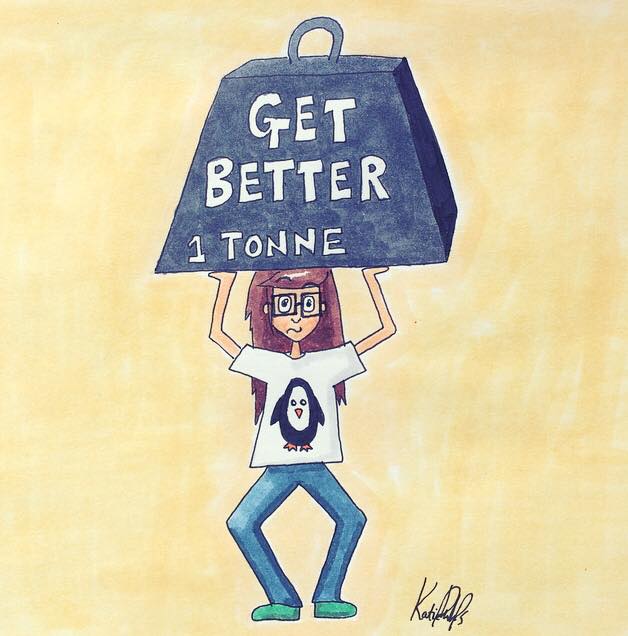
It is official. After five and a half months of being cooped up in hospital with very little interaction with the outside world, I finally have a discharge date and I will be going back home on February the 20th. Considering this hospital admission has been possibly the hardest and most traumatic of my entire life so far (not that I am planning on having another one to top it), I am thrilled, but at the same time I have to admit I am a little scared because the pressure for me to do well when I go back home is overwhelming. Indeed I have had to make a lot of promises in order to get this discharge date agreed, and every day I am starting to doubt a little more whether these are going to be promises that I can keep.

It may be a surprise for some of you reading this to hear that I have a discharge date, considering my posts of late. After all it is only a few weeks since I was writing about the difficulty of being on 1:1 observations and living with a tube up my nose and I will admit this has all moved ahead fairly quickly. To be honest though, I think staff and I have finally come to realise that we have come as far as it is possible for me to go right now and any more time spent in hospital is simply going to be detrimental from now on. As you will know from my post about the body recovering faster than the mind in recovery from an eating disorder (a post you can handily read here…The Difficulty When Mental And Physical Progress Move At Different Speeds In Eating Disorder Recovery), I have been getting rather overwhelmed with the rapid physical progression of my body and weight gain side of things and I really am at a point where I cannot take it anymore. With every ounce of weight I gain my head is screaming louder and louder and the ability to stay alive and simply keep breathing is becoming more and more unbearable to the point where suicidal thoughts and urges to relapse are at an all time high. (God this isn’t a very jolly blog post is it…don’t worry I will try and fit in a knock knock joke or something soon to brighten things up a bit).

On the day that you read this (if you are one of those extremely wonderful keen beans who read my posts on the very day they are uploaded….high five to you and a chocolate chip cookie if you are one of them), my discharge date will still be two weeks and a day away, but in reality I have already checked out of treatment mentally. Then again I suppose you could argue that for the duration of this admission, I never really checked in (it has been five and a half months and I still haven’t fully unpacked and set up my room because I refuse to accept that I am a patient here even now).
I think inpatient admissions for mental health can only ever really be beneficial when both staff and patient are working together to the same end goal, but this time around I have been in such a dark place that I have been finding co-operating impossible and it has very much been an admission of having things done to me, staff feeding me when I was unable to do it for myself and staff keeping me safe because being left alone was too risky even for five minutes. Admittedly, for the past few weeks I have been eating without the tube and keeping myself safe, but that is only with the end goal in sight of going home, and now I am reaching that goal I am not sure if I can carry this good behaviour on. Unfortunately though, like I said there is a lot of pressure for me to carry on because in actual fact, me going home at the end of this admission was never really the plan.

Indeed with the way things have been lately, my parents have been saying that they do not want me back in the family home for the sake of their own mental health. These illnesses may look from my blog that they are only killing me but they are killing them too, so the plan has been for me to move to a more long term hospital. However, though I have been on the waiting list for places you can stay in for over a year, no beds have been coming up (a shortage of mental health beds being available in the NHS?! How shocking and unheard of!) and as I said, since that blog post I linked to earlier, staff and I have realised that I simply cannot wait anymore and that I need to get out of here now.
It may sound harsh to say that my parents have said that they do not want me living at home at the moment but to be fair to them that isn’t exactly what they have said and is only how I have taken it. In actual fact what my parents have said is that they cannot stand having my illness in the house anymore, and after 15 years of dealing with an utter lunatic in their living room (and other rooms of the house of course…I do move around sometimes … I just specifically mentioned the living room for alliteration purposes…) who can blame them? However, as someone who struggles to distinguish between what is “me” and what is “the illness” in my head, them saying that they do not want my illness in the house is very much the same as saying that they do not want me either, seeing as the two in my eyes are so inextricably linked. I know there will be people commenting to say that there is a Katie aside from the mental health stuff and that is very kind of you but really, in the past five months, Katie hasn’t been around much if at all.

Because I was never supposed to be going home then, in order to get my parents to agree to the plan, I have had to agree to live by certain very strict rules to stay in the family home. There are many of these rules but overall they cover general things like agreeing to maintain my new unbearable weight (I don’t even think I will be able to leave the house even when I am “free” because I simply cannot stand the idea of people seeing me with all of these extra kilos I have gained), agreeing to stick to my medication (a medication I hate with a passion due to the side effects) agreeing not to harm myself and agreeing to keep eating. When I made all these promises that I would be able to do these things I honestly meant every word I was saying, but as time has gone on, the doubts have crept in. When I agreed to these conditions initially I was several kilos lighter than I am now, but at this new weight I really don’t know if I can manage and the harder it is getting.

I think there is so much pressure for me to stick to things this time round though because the consequences if I don’t are extremely dramatic. I will be blunt, in my head right now the only thing I want to do is relapse and lose weight, I cannot stand how I feel now in my head or my body and the urges to give up are so strong I might explode, but at the same time I know that if I do, I will quite literally be homeless and back in hospital, neither of which are particularly appealing options. So what do I do? How do I deal with this overwhelming pressure for me to “be well” mentally when it all feels so out of my control. Physically I know what I have to do to be physically well enough to stay out of hospital but how do I manage that when I have pressure to do the opposite piled right alongside the pressure to stay where I am now? Well, if you were looking for answers, I am afraid I don’t have any (and I am afraid I don’t have any knock knock jokes at this point..sorry for that), all I have is pressure, buckets and buckets of it.

I think that for anyone leaving an inpatient admission it is hard because there are so many expectations to be upheld. Will you be able to uphold the changes you have made/carry on with any good behaviour? How? How long for? How long until the million pairs of eyes watching your every move tell you that you haven’t done it well enough and are going to have to be recalled.

What I want to raise the awareness of however is exactly what I have been talking about , the pressure to be well when you leave hospital after a mental health admission which is supposed to have “helped” you, pressure which causes a lot of stress you really don’t need because you are already stressed enough as it is. It is ridiculous really, with physical illnesses you never get this pressure which is why I struggle with this idea in society that mental illnesses are any more in your control. When I left hospital after my appendix there was no pressure to not have another organ explode (although I am rather glad one didn’t and hopefully such organ fireworks never happen again), yet now, leaving a mental hospital, pressure is all I have. I am not sure what will happen when I get home so I guess we will have to see, all I know is that I am going to have to do my best because I cannot afford to not succeed this time. I wish that felt like a manageable task. It just feels very much like a case of knock knock, who’s there? A very scared and messed up in the head person who really wants to stay home but doesn’t know if they can manage (haha see! I told you we would get a knock knock joke in there somewhere…)

Take care everyone x

Pressure

5 Ways To Deal With Weight Gain When You Are In Recovery From An Eating Disorder

If I had a penguin for every time I have heard someone say or have said myself “I want to recover from anorexia but I don’t want to gain weight”, I would have more penguins than exist on this planet and would therefore have to get the existing penguins to rapidly reproduce in order to make up numbers (which is why all the penguins of the world are probably grateful to hear that I don’t have to have a penguin for every time I have heard that sentence or else they would have a lot of egg hatching to do).
Admittedly, there are many sides to the Rubix cube confusing madness that is recovery from anorexia, both mental and physical, and there are a lot of fears revolving around all of them, but I think when it comes to recovery, probably one of the top three things most people worry about is the weight gain side of it all. Personally at least, I know that the fear of weight gain is certainly a big thing for me and is particularly relevant right now as in my current admission to hospital it is the forced and rapid weight gain that has ended up distressing me most of all to the point that I haven’t even been able to focus on any of the more long term mental health sides of the illness as I am too focused on the scales.
I know that to other people, my weight does not define me as a person and that the number that flashes up when I step on a little machine should not dictate the way I live my life but when you have an eating disorder, those thoughts are often automatic and knowing they are irrational doesn’t take them away.

Unfortunately, despite the fact that the weight gain side is incredibly hard, if you really want to recover from your eating disorder, the fear of weight gain is an unavoidable thing that will need to be tackled and that, if neglected, will never truly allow you to get back to a healthy mind and body again.
So how do you manage it? If you want to recover from your eating disorder (or even if you don’t and are in forced treatment at the moment…ahem), how are you supposed to deal with one of the most frightening challenges to face someone struggling with anorexia: weight gain. Well, if that question has been on your mind at all then welcome to a blog post containing some possible answers, because today I am here (wearing a bow tie no less because I am fancy and have dressed smartly for you on this occasion), with 5 thoughts to help you deal with weight gain when you are in recovery from anorexia. So without further ado, lets get into it *straightens bow tie and gets down to serious business*…

1. Weight redistributes – When you start the re-feeding process after depriving yourself of adequate nutrition for a long period of time, your body will have no idea what the hell is going on or what the hell to do (something I explain a little more in this post here: Five Things You Need To know About Re-feeding During Eating Disorder Recovery). Because of this confusion and deprivation, when your body first starts gaining weight, it will want to prioritise on life saving things first (handy that) and for this reason a lot of people find that weight gain in the early days primarily goes to the tummy area so that the body can focus on repairing things like a dodgy liver or an out of whack kidney. This has happened to me multiple times (including right now) and understandably it can be quite distressing as your body can start feeling out of proportion, but what I want to emphasise with this point is that even though weight may initially go to life saving organ places, it WILL redistribute and spread out eventually as long as you hang in there and give it time. Restricting your intake to lose the weight again will only make this process more dramatic, so the key is to stick with it and always remember that redistribution will happen!

2. You are gaining weight you shouldn’t have lost in the first place – Whenever you see or hear an advert for a weight loss diet club, the people will emphasise how good it is to have lost the weight they did with whatever weird low carb eat upside down with a pineapple up your nose (difficult task, would not recommend) diet they have been following and therefore the idea of gaining any weight back is automatically “bad”. Culturally this has then created this false idea that the act of gaining weight is a bad thing in itself however this is not always the case, especially when it comes to recovery. Thing is, when you are regaining weight you have lost through an eating disorder, you are actually not gaining weight but are regaining parts of your body that you should not have lost in the first place, so whenever you see that number go up on the scale remember, it is not weight gain in the negative way that the diet clubs claim it to be, it is just re-finding a little puzzle piece of the wonderful you that may have been lost to this terrible illness.

3. The alternative is worse – I will hold my hands up and admit it: weight gain is scary. Then again, if you think about it, isn’t the alternative, aka death (for anorexia is the mental illness with the highest mortality rate of all), even scarier? “I am not that bad” I hear you cry, “I am not going to die of anorexia”, but hey, that’s what they all say and in a lot of cases, it turns out not to be true. Anyway, even if you are one of the fortunate souls whose body somehow manages to survive the abusive nature of an eating disorder and live, what kind of a “life” is it to spend your days tortured and tormented by a beast in your head? Weighing things up then (no pun intended…actually screw it…with me the pun is ALWAYS intended), although weight gain is scary, when you are going through the process it is important to think of the alternative, and remember that that alternative is a hell of a lot worse.

4. Weight gain is not as visible as you think – If you are like me, when you stand on the scales and see that the number has gone up, you can immediately see where that extra weight has gone to. This however, in the nicest possible way, is utter nonsense because in actual fact changes in body weight are no where near as visible as we might think. I remember one week when I gained one pound and instantly I saw my physical appearance change into something unrecognisable to the person I had been before that pound. Know what everyone else saw? Nothing. I would be lying to say that no weight gain is ever visible (as someone who has just spent 5 months in hospital I can guarantee I do look very different now), but my point here is that weight that you gain every week at weigh ins is not as visible as you might think and if you think you can see that pound or two of extra weight then it is simply proof that your eating disorder is distorting your vision. Don’t listen to its lies I say!

5. Getting bigger doesn’t mean you are big – If I ran a banana farm and after the harvest found that I had 1000 bananas, that would be a lot of bananas (and I would clearly be one hell of a good banana farmer). In that circumstance then, 1000 banana would be the definition of a lot of bananas. If the next year I then had 100 bananas would I think that I had hardly any bananas (trust me I do have a point here and am not just trying to send subliminal messages to you all about my secret dream to become a banana farmer). If however I had 0 bananas one year and then the next had 100, 100 bananas would be my definition of “loads of bananas” and that is what it is like with weight: aka all relative. Just because you are gaining weight and getting “bigger” it does not mean that you are big. You might think “I am huge” because the number on the scales has gone up but what I am saying is that just because the number has got higher it doesn’t mean that number is big. 100 bananas only looks like a lot of bananas if you previously had no bananas, just as a certain number of kilos only seems “huge” because it is bigger than the nothing you had previously and every “high” number you fear only seems high because you are looking at a lower one first. Getting bigger does not mean getting big therefore and if it was the other way round (aka the 1000 banana situation first) then your “high” number would be someone else’s low in a different situation. Whenever you see you have gained weight and feel like your weight is high, remember the bananas and the fact that a high number only seems big because it is bigger than the previous number and it is not that the number is big in itself.

SO there you have it! 5 thoughts to help you manage the fear and stress that is the weight gain side to recovery from an eating disorder! As always I am not saying that this blog post is going to solve the problem, nor will it probably make gaining weight any easier, but these thoughts are at least important and sometimes helpful/comforting things to bear in mind when the voices are getting a bit too loud for comfort and you have no arguments to fight against them. These thoughts are therefore your arguments against all of those bad thoughts, your weapons for the recovery battle, so take them brave soldier and use them wisely to outwit that cunning eating disorder who is trying to fool you into making weight gain seem like a bad thing.
In the meantime, if you are someone struggling with the anxiety ridden process that is gaining weight, please know that I really do feel for you as someone who has gone through the process multiple times myself (and is still going through it today), and I hope that this blog post has perhaps helped a little bit. Remember, recovery and weight gain is hard but losing your life to a cruel demon in your mind is far worse.

Take care everyone x

WeightGainFear

Should The Government Be Teaching Children To Count Calories?

When it comes to the government, they are always coming up with handy suggestions as to how people should live their lives. You know the stuff, “eat at least five portions of fruit and vegetables a day”, “don’t drink more than 14 units of alcohol a week” and “drive on the left hand side of the road” (actually that one might be a rule rather than a suggestion…I wouldn’t know. I failed my driving test and every time I asked my instructor for more driving tips after that, he ran away screaming which really did not help with answering any of my questions…)
Always ready to tell the population what to do then, for 2018, the government in the UK have come up with a new suggestion, complete with its very own catchy advert, where play-dough people morph around the screen and a happy jingle plays advising parents to teach their children to restrict themselves to “100 calorie snacks, two a day max”. Now I am not one to turn down advice from our dear Theresa May who is doing such a wonderful job of running the United Kingdom without any trouble whatsoever (pause for laughter), and even I can admit that it is a catchy slogan with a tune that isn’t bad either, but in my opinion this “handy lifestyle suggestion” is a terrible thing that should cease being taught to children immediately.

Obviously for someone (aka me) who is in hospital trying to recover from anorexia and is following a meal plan where snacks exceed 100 calories and are more frequent than twice a day, this kind of thing is unhelpful and triggering. On one hand I have dieticians and psychiatrists coming out of my ears (I really don’t know how they got in there in the first place), telling me that I need to eat this far higher meal plan than the one Theresa May suggests and on the other hand I have play dough people telling me to restrict my intake, which as I have said is obviously confusing and not particularly useful, but it is not just to people with eating disorders that I think this advert is detrimental, rather it is bad for the entire population (far worse for your health in fact than, dare I say, more than two snacks a day comprised of over 100 calories each).

The problem I think with any lifestyle suggestion or diet tip from any source, is that people hear it and immediately take it as gospel. In the real world however, nutrition isn’t governed by blanket black and white, one size fits all rules like that, and there is no such thing as a “diet expert”, only people who have done a lot of research about food and have opinions about it, a point highlighted to me during my brief stint working in a bookshop.
Unsurprisingly, this job involved various tasks including book shelving, and one day I was in the self help department (insert joke about how I need to spend a lot more of my time in such a section here), which was helpfully next to all the diet books. Therefore whilst shelving, I couldn’t help but get a good look at all the titles and diets being advocated.
Now generally, when it comes to reading about a topic, one would assume the more books you read, the more educated you become. For instance say you read 30 books about penguins, it is then likely that you will be more intelligent on that topic than someone who has only read one and that you would do better on any quiz regarding penguins. Alas, when it comes to nutrition, things are not like that, for as I shelved those diet books (working very hard I might add just incase my former boss is reading this…), I realised something ridiculous. Turned out if I were to read all of the diet books, take all of the information, all the “no carb”, “no protein”, “no fat” nonsense and I were to mush it together to make one overall diet plan (which you would think would be the best and most informed having been the culmination of so many books’ worth of information), I wouldn’t be able to eat anything. All the health advice added up together in the world and the conclusion from it? No food is safe, which I think is fairly unhealthy considering such a thing would lead to death, and, were we all to follow that advice, the extinction of all human life on earth. Marvellous. Therefore when it comes to rules like this “twice daily 100 calorie snacks” thing dolled out by nutritionists, taking them as gospel is never a good idea as they are merely opinions rather than facts.

“But for some people limiting snacks to twice daily amounts of 100 calories might be a good, healthier idea than their current lifestyle choices” I hear you cry and I am not going to disagree with you on that, but another thing I want to point out when it comes to guidelines is that they are not universal and are actually only helpful or beneficial to SOME people, which is why it is not helpful to have them rolled out as rules for the general population. As I have already said, this advert is obviously not applicable to people who are in recovery from eating disorders, but neither is it applicable to a large number of the population who all vary in height, weight, activity levels and nutritional needs. What about athletes for example. Is this rule supposed to apply to them too because I am pretty sure that that Mo Farah and Usain Bolt wouldn’t get very far nor would they get any more gold medals were they to restrict themselves to two 100 calorie snacks a day…
Okay I get it, there does need to be some kind of suggestion out there as to how to live a healthy lifestyle and it is important to teach children about food and nutrition but whatever happened to “general education” and suggestions like “eat your vegetables”, “everything in moderation” and try to have a “balanced diet” as opposed to these rigid rules and guidelines ridden with fixed numbers. Where pray did these numbers come from because last time I checked people don’t eat numbers, they eat food (and for good reason too. I once tried to eat a number nine and it was terrible. Tasted purely of pepper.)

It is just somewhat ironic that the whole focus of this campaign is to encourage health but encouraging children to see food in terms of calories and numbers really is a disordered habit struggled with by many people with eating disorders. If healthy snacking is the priority then advising healthy snack foods and providing possible examples would be a far better way to go about it because this focus on calories isn’t healthy at all. When numbers are brought up things start to get obsessive and this is where I think the problem lies. By specifying 100 calorie snacks they are labelling a strict limit to adhere to, but how ridiculously close are people supposed to stick to it? Is a 101 calorie snack ok? What if it is a really healthy snack that is slightly over? Should an “unhealthier” food be chosen instead simply because it fits the amount? Should we weigh already healthy fruit to check that they are “safe” in this new government scheme? Should children be taught how to count calories from the moment they exit the womb? Is that a normal healthy attitude to food? Seriously, think about it, does all of this sound healthy and worth advocating or more akin to rigid disordered behaviour seen in people with eating disorders aka a mental health condition needing treatment?

Overall then, if I had any say or control in any of this government malarky, I would say the whole “100 calorie snacks” with “two a day max” idea needs to be binned and for calculating numbers to be kept in children’s maths lessons in schools rather than in their lunch boxes or at the dining table at home. If you want to educate and give healthy food guidelines from the government then fine, go ahead, but when this advice is given it should be just that, GUIDELINES like the old “eat more fruit and veg” rather than strict, prescribed, rigid calorie counted rules that must be followed exactly and are carved in stone and sung over the breakfast table like some terrible national anthem.

If you have or even if you don’t have an eating disorder but are finding these adverts unhelpful, as hard as it is, my advice would be to do your very best to ignore them. Remember, just because it is prescribed by the government it doesn’t mean it is automatically healthy and it doesn’t mean that its obsession with numbers is not disordered. Nobody is the authority on rules regarding food and diet, it is all opinion, and strict rules, hell even general guidelines, are not applicable to everyone.

Take care everyone x

GovernmentFood

The Difficulty Of Talking About Anything Other Than Mental Health When You Are An Inpatient In A Psychiatric Ward

I have an amazing family and, since being in hospital, my mum has visited me nearly every day. During visits there are a variety of activities we try to do to distract me from my current situation, sometimes we watch TV programs mum has downloaded to her tablet, we have been known to dabble in a little scrabble and once a week my mum will help me edit these blog posts that you love so much, to let me know if there are any glaring grammatical errors (that’s right. If you ever see a grammatical error on this blog feel free to blame my mother…only kidding…thanks for the help mum). When it comes to conversation however, there is little to no variety in topic and usually, if not every visit, we will end up talking about something mental health related which understandably can get rather tiresome.
It is therefore no wonder that the other afternoon my mum asked if we could possibly “talk about anything else” and lord knows I can see where she is coming from. Anyone would get fed up talking about depressing brain nonsense all the time and I do not blame her at all for asking for a different topic once in a while but at the same time I don’t think people realise how difficult it is to talk about things other than mental health problems when you have mental health problems, even if you are trying really really hard.

I hate admitting that because it makes me sound incredibly boring and self obsessed to say that I am frequently caught up in conversations regarding my head demons but the thing is, when your head demons are in your head 24/7, it is practically impossible to think about the “anything else” that other people wish to be discussing. Which part of your brain is supposed to be free to think about this supposed “anything else”?
When you are lost in your mental health problems, asking such a question is pretty much the same as asking someone who is being repeatedly smacked on the head with a wooden pumpkin to say anything other than “Oww”, “please stop hitting me with that”, “that hurts” or, if the person is a particularly articulate fellow “My frontal lobes are in a state of great pain so please desist with your actions and then tell me where on earth you were able to find a root vegetable carved out of the finest mahogany”.

I think this is especially the case when someone is in hospital because not only are your mental health problems all you can think about but they are all around you and you are in a location in which forgetting them is impossible, like trying to forget the smell of fresh bread in a bakery. I know people are always telling me that I am “more than” my mental illness and that it isn’t my entire identity which should mean I do have other things to talk about, but I think when in hospital you are often treated as an illness rather than an individual, and psychiatric units, though helpful, can make you start to feel like you are not a person at all.

It is like the problem I am currently facing being on 1:1 Observations.
Now, considering I write a blog on the internet all about how I am a flipping lunatic (or “Marbleless Marvel of mysterious Marblelessness when being addressed formally), you could say that I am perhaps not the world’s most private person. I talk about my mental health problems publicly every week and whenever I go into hospital for treatment I no longer ask friends to make up excuses to explain my disappearance in day to day life (my favourite of which was when I was 16 and to cover up my detainment in a psychiatric unit a rumour was spread at school that I was working on voicing a rat in the Disney Pixar sequel to “Ratatouille”, a rumour that was regrettably untrue in that I have never voiced a rat for Disney, nor has a sequel to Ratatouille ever materialised). However, as open and honest as I am, like any regular person, I still do like a reasonable amount of privacy in my life and unfortunately, for the past few months, privacy is something that I have been severely lacking due to the nightmare that is 1:1 and 2:1 observations.

The terms 1:1/2:1 observations in hospital are probably self explanatory and in explaining it I apologise for offending your intelligence, but basically it means that wherever you go, there will be at least one member of staff staring at you (aka 1 or two staff to your 1 patient ratio). It doesn’t matter whether you are going to the toilet, having a shower or having a snooze, the staff member will be with you (possibly within arm’s reach if that is stated in your care plan), and they will be watching every move, almost like a real life version of that song “Every breath you take” by The Police with those creepy lyrics (seriously if you haven’t heard that song look it up. It is weird and is a perfect summary of the 1:1 inpatient experience.) That song and indeed that experience has been my life for the past two months and to be blunt, it is incredibly humiliating. More than humiliating though, it is dehumanising and that is one of the things that takes me back to the question as to how you can talk about anything else other than mental health problems when you are being treated as a new species of disorder that is able to walk and talk. You are not a person, you are a thing that needs to be watched and observed. I am constantly hearing staff in the corridor ask each other “who is watching Katie?” or “who is with Katie for the next hour?” as if I am a ticking time bomb that people are just waiting to go off.

I suppose in fairness everyone loses a certain level of privacy when they are admitted anywhere. Even if you aren’t on 1:1 obs in hospital, you will be on some kind of observations, just as I was initially on 10 minute observations meaning that every ten minutes a staff member would appear at my door to see what I was up to. Therefore staff knew what I was doing all of the time but still in that ten minutes of unobserved time there was an element of privacy that I am sorely missing today, and I think that having just that ten minutes again would make me feel more human and less like a living issue in need of being managed. In those ten minutes I could hum a jolly ditty if I wanted and nobody would know, but now I can’t even convert oxygen to carbon dioxide without a beady eye watching to make sure I do it appropriately.

It is just so humiliating to be watched all of the time, even in the “private moments” that people take for themselves just to respect their own decency. Take urinating for example. Sure I have learnt over time to manage it and can now pee with staff even if I don’t have music playing on my phone (although in the early days such an activity was practically impossible and it is safe to say that I have publicly urinated to every song in the current top 40 charts…have fun getting that image out of your head when you next listen to Ed Sheeran on the radio), but it is still something that I want to do on my own. Worst of all though is showers and I think that is where my main issue lies with this whole 1:1 thing.

Imagine absolutely hating your body, despising every ounce and seeing it as nothing but a source of shame and then having to parade it around naked in front of a different stranger every day whilst you wash yourself. Surely that would be a challenge for even the most body confident person out there but for the person whose body is a constant source of torment and torture? How can anyone feel human or respected then? How can you feel anything other than dehumanised, humiliated and not respected as a proper person with their right to their own privacy whilst they have a good lather? How can you see yourself as, let alone discuss, “anything else” other than mental health problems?

I suppose I know on paper that if I were to print this blog post out and give it to any of the members of staff looking after me right now they would say that they do 1:1 Observations to look after people and keep them safe rather than humiliate but it is a lot harder to believe that when you are the one standing naked in front of a complete stranger whilst you frantically look for a pair of pants (hypothetically of course…this has never actually happened to me… Trust me, when you are on 1:1 you always have your clean pants prepared for after a shower!)

So, when you have mental health problems how easy is it to talk about “anything else”? Well, not very, when you don’t have the brain space or power to think about these “anything else’s”. Sometimes though, the biggest challenge isn’t thinking about anything else, but, when you are on 1:1 observations and have no say in your treatment, it is about trying to see yourself as anything other than a dehumanised circus freak in a constant humiliating parade.
Take care everyone x

TalkAnythingElse


The Difficulty When Mental And Physical Progress Move At Different Speeds In Eating Disorder Recovery

In a few days time, I will have been in hospital for 16 weeks aka a grand total of 4 months, and because of this, I am often being asked questions like “How are you getting on?” or “are you feeling better?” which are both very complicated and difficult questions to answer when you are in treatment for an eating disorder. You see, on one set of paper work, things are going rather swimmingly and I am indeed doing much better, yet on the other set of paper work in my opinion, I am actually feeling and am “doing” worse than I ever have done in my life.

Oddly enough, this discrepancy between paper works is not because I have two very different doctors with opposing ideas writing sets of notes about my progress, but because when it comes to recovery from an eating disorder, there are two very distinct and different sides to it, the mental and the physical, and unfortunately these two sides do not work as sleeping otters do (aka hand in hand – yes, fun otter fact for you, otters hold hands when they sleep to make sure that they don’t drift away from each other. Apparently they also make waterslides and play with pebbles. Conclusion: Otters are cool).

Indeed the two sides to eating disorder recovery are so separate that I think that asking someone in treatment for an eating disorder how they are, is a question that needs to be asked twice, once for each side of recovery, because otherwise getting one coherent answer is impossible.

To be fair, towards the beginning of my admission, the physical and mental sides of how I was doing were fairly in sync. Mentally things were a bit all over the place and physically things were too. This then continued as I struggled to work with the program at the eating disorder hospital, until the introduction of my NG tube and since that most unwelcome introduction, everything has changed, in my eyes, for the worse.

Before, when I was mentally struggling and didn’t feel able to manage food, I was able to avoid it which obviously didn’t help my body very much but it prevented my anxiety levels from getting worse. Now though, since the NG tube, I have a constant and unavoidable source of nutrition and it doesn’t matter how I feel, food cannot be avoided. If I don’t eat, the food still goes in, and consequently my mind is in utter turmoil. My body on the other hand is as they say “loving life” and ironically, it is killing me.

Seeing as food is unavoidable now, I have been following my meal plan in one way or another for weeks and the affect this has had on my body is dramatic. I am gaining weight faster than I have ever gained weight before (perhaps because I have never had such an unavoidable source of nutrition stuck up my nostril before), so health wise, I am “improving”. I am no longer at a weight where I require a wheel chair, I am now able to stand in the shower for long periods of time, even on one leg (I am a fantastic flamingo impersonator these days), and when I get out of bed in the morning, the world doesn’t swim before my eyes and go black. Objectively these all sound like good things and for the medical professionals and my friends and family, these are good things but to me, these are terrible things.

I really don’t know how to explain this idea to people who may not have eating disorders as I know that to most people it sounds absolutely ludicrous. Physical health, the ability to stand in the shower and walk down the corridor are abilities to be appreciated not feared, but when you have an eating disorder, these abilities mean entirely different things.
To me, not being able to stand up without things all going fuzzy was a sign that I was “behaving” myself, a sign that I was doing a good job at punishing myself so the guilt I felt at being alive was lessened. Now though, I am unable to “behave myself” by not eating because even if I don’t eat the food will go in without my permission, so with things not going fuzzy, it is like a sign that I am doing something “bad” (even if it isn’t always me who is doing the eating), and I guess I am feeling all the guilt and shame as anyone else would were they to do something they thought was bad, like stealing or punching someone in the face.

Now I take up too much space in the world and with the weight going on as it is I take up more and more space each day, which is something I have always struggled with. When you hate something you want to make it as small as possible (or you want it to disappear altogether), you want it to take up as little of the world’s space as possible so as there is more room for the good things. In gaining weight I feel like a weed taking up too much space in the flower bed and stealing all the sunlight from the marigolds.

It is incredibly hard to watch this body you hate, morph in front of your eyes into this thing that is getting bigger everyday, getting “better” everyday whilst inside you are all the more depressed and tormented.
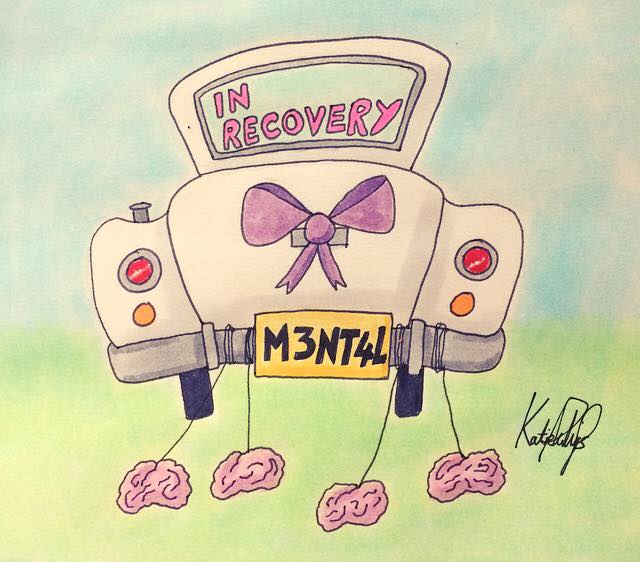
I don’t have any idea if I am making sense here because to be honest I am on so many medications right now that my brain is not functioning but if I had to resort to the good old Born Without Marbles way of explaining things, aka an analogy, it feels like my body and brain are one of those cars people drive off in after a wedding with tin cans on the back and “just married” scrawled across the rear windscreen.

My body is the car and as it gains weight it is zooming off full speed. Meanwhile my brain is the collection of tin cans tied to the back, being dragged along and through all of this road that it is not ready for, each can bouncing and denting, bruising and breaking a little more with every mile that passes. My body gains weight, my brain cracks a little more, I feel more broken, depressed and bruised and the faster my body goes the further it is from my brain which is actually all the way back at the starting line. I guess this analogy isn’t perfect because you could say “but your brain is moving in the right direction like your body if it is tied to the car” but that is where the analogy fails because that is not happening at all, like I said, as the car moves the brain just gets battered and even staff have admitted that in the past few weeks things have mentally become worse and worse as time has passed and weight has gone on.
Christmas day is a perfect example of this. When I woke up on Christmas day I was weighed (NOT something I asked Santa for and if I ever wake up to a set of scales in my stocking on Christmas morning again I swear to God I am marching to Santa’s grotto to give that beardy man a piece of my mind…and his scales back), and I had gained a lot of weight. On paper then and to the doctors, my body had got “better” but mentally the shock of it all had such a strain on my mind that I totally lost it. Within minutes I was having to take medication to calm down from the anxiety and agony and when my family came to see me for our two hour visit, the visit wasn’t better for the weight gain, it was worse. It should have been better logically, my body was healthier than the last time they had seen it but in becoming that way I became so upset, distressed and anxious that I had what we shall simply call “ a little incident” and I had to ask my family to leave early.

It is that which I think illustrates my point best as to how impossible it is to answer the question as to “how are things going” when you are in recovery for an eating disorder. Am I better? In a way, yes and I am getting “better everyday”, but in the other more important mental side am I better? Am I progressing? Not at all. I hate myself more than ever, I am more unhappy than ever and I feel more trapped than ever in a body that I no longer relate to. The distance between my body and mind is so great now that I have asked staff if there is any chance we can slow down on the weight gain so that my mind has got a chance to catch up but they are refusing and it all feels like I am being dragged and pushed too far out of my comfort zone. I am in hospital being treated for an eating disorder and the physical problem is being taken care of by a tube, but the mental aspect is being torn apart and I really don’t know how much longer I can handle it.

It is so frustrating trying to explain all of this and I guess in the end the main thing I want to do at the end of this blog post is apologise because I feel like I haven’t made any sense and that I have wasted your time with my incoherent waffle. Like I said though, I am on all sorts of crazy meds at the moment (to calm me down because I am in so much distress due to this whole struggling mentally with the physical progress my body is making right now when I am not ready for it), so please blame those meds and not my inabilities as a writer. I don’t understand half the things that are going on at the moment so explaining them coherently is somewhat difficult. I really am sorry. I am just so battered. I hope this makes some sense at least or that I have got the point across in some way that physical recovery and mental recovery for an eating disorder do not go hand in hand and can sometimes be literally travelling in opposite directions. “How are you doing?” is such a simple question but good lord when you have mental health problems is it a difficult one to answer.

Take care everyone x

RecoveryCar

Mental Health New Year’s Resolutions

Quick everyone! Get your noses out…Do you smell that? Just there?
That whiff of hope, new goals, exciting plans and new calendar pages all waiting for you like fresh, crisp bed sheets from the washing machine with just a slight undertone of possible regret for your behaviour last night and the sharp tang of cheap gin? That my friend is the smell of New Year’s Day, aka a day that is only a few hours later in time than the previous one, but a day in which we are supposed to be reborn and regenerated like Doctor Who (yes I am also thrilled that the next Doctor Who is going to be a woman but I have to admit that I’m still disappointed that the BBC didn’t go with casting a penguin in the role…Admittedly it would be hard for a penguin to hold a sonic screwdriver or operate a Tardis with flippy flappy wings but the waddling away from Daleks chase scenes would have been unbeatable).

As lovely as this whole “New year new me” idea is however, like I said in last year’s “new year” post (Oh my goodness, look a handy link to that very post:Why Baby Steps Are More Important Than New Year’s Resolutions In Mental Health Recovery), it does put rather a weight of pressure onto one’s back to make sudden drastic changes, which is why I said last year about the fact that I am very much in favour of setting smalls goals and making small gradual changes over a long period, especially when it comes to goals relating to recovery from mental health problems.
Indeed, last year I made a big point of talking about making small mental health New Year’s Resolutions, but this year I realised that as helpful as that is as a piece of advice, I did not provide any examples or suggestions to help figure out what these goals could be…Shame on you Born Without Marbles of 2017!
Thankfully though, it is, as of today, 2018 and therefore, now being a completely new and different person since midnight (please note the use of extreme sarcasm), I am here to solve that mistake from last year with this post where I am going to try and sprinkle a few ideas out there for you on the internet as to mental health New Year’s resolutions should you so wish to make any this January.

I think that coming up with mental health goals is often a tricky one because mental health is such a broad spectrum that cannot be pinned down or confined (much like a cloud, a wave upon the sand or a certain curtain sewing, puppet operating, singing nun called Maria) so to help make this whole thing a bit easier, I have divided my set of suggestions into four main categories of ways that you can make small and manageable changes over the course of 2018. Let’s go!

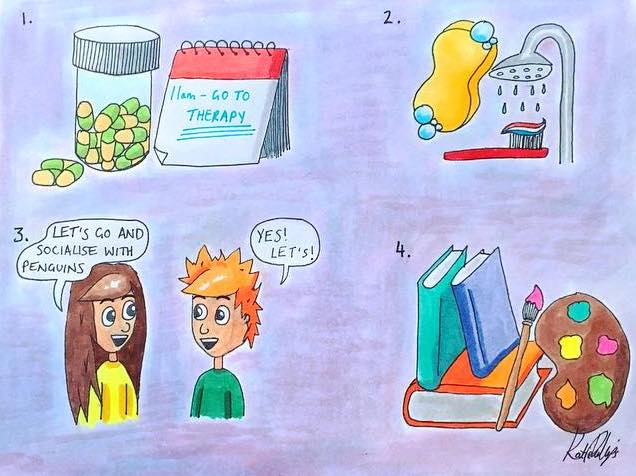
1. Goals about treatment – This is probably the easiest category to make mental health goals for because these are basically just goals relating to whatever mental health treatment plan you have going on. Say for example you take medication but struggle to do so, one idea could be to set yourself the goal of taking your medication every time a dose is required, with a calendar or chart to help you keep track and aid as an extra reminder or motivator. Maybe you have an eating disorder and have a meal plan set by a dietician or are working towards building a meal plan up, maybe make a goal to follow what that dietician has said or to gradually keep up with increases in your meal plan until you reach the amount that is right for you and is going to help you best in your recovery. Hate turning up to appointments with your therapist either because you find them awkward or because your local psychologist’s waiting room smells like cauliflower cheese? Make a resolution to attend all appointments or at least increase attendance over a period of time (and maybe invest in an air freshener for your nearby surgery…I recommend something with a hint of lemon if like me you are partial to a citrus tang).
If you already turn up to appointments regularly, then there are still loads of appointment related goals that are possible like doing any therapy homework on time (I think I might need to make that one of my resolutions for 2018…the ”my penguin ate my homework” excuse has not been going down well for some time now), making more use of therapy sessions by being more honest or maybe taking notes of important things that are said to take away so that they don’t get lost in the “post appointment mental blank abyss”.
Even if you have a mental health problem and are not in specific mental health treatment you can still make goals in this category especially if for example pursuing professional support is something you are interested in. Booking yourself an appointment at your local GP surgery to discuss possible treatment options, filling a form in to get your name down on one of those pesky waiting lists, making a phone call about a first appointment or setting up an assessment or perhaps doing some research into nearby therapy groups you could attend, are all awesome mental health treatment related New Year’s resolutions to get 2018 started off with a bang (and by bang I mean therapeutically supportive environment…ahem…Kapow!)

2. Goals about physical self care –  In any toothpaste or shower gel advert they always make acts of self care like brushing your teeth or showering, look like such an easy, pleasant task (to be honest some toothpaste adverts I have seen go way past pleasant to the point where someone will look so eager and thrilled about brushing their teeth in the morning that they have the deranged look of a serial killer in a horror film with minty fresh breath), but in real life those things aren’t as simple as they seem. Sometimes when you have mental health problems just getting out of bed is a task to be proud of, let alone things like brushing your hair, showering, cleaning your teeth, eating or putting something on that isn’t pyjamas…However, as hard as all of those things are to do, they are important and taking care of your physical health and physical needs, though exhausting, often helps take care of the mental side of things too. Trust me I know, I have the days where I stay under a duvet and refuse to move but as hard as it is to drag myself out of my cocoon and into the shower, I have to admit I always feel a bit better when it is done.

Similarly getting fresh air is important for your physical health as is eating which, even if you don’t have an eating disorder, can be difficult when you can barely muster the motivation to blow your nose. That said, it is bad enough being mentally ill without your body becoming physically ill and deprived of care, which will only make you feel more hopeless, so goals around self care physically are also important. Again they don’t have to be big and can start out as small as you like from “get out of bed for at least X amount of time every day” or every other day if that is too big a step. Setting yourself a goal to shower a certain number of times a week, brush your teeth every day, spend five minutes outside for a short walk and fresh air, or maybe make goals regarding eating enough proper food meals to take care of yourself properly. Whatever it is, in this category just make goals that are about taking care of your outer physical needs and hopefully they will have some effect on making your internal mental health nonsense a little better too.

3. Goals about socialising scientific Studies show that humans are social animals and that we feel better when we aren’t lonely. My brain studies however, show that socialising with humans is nevertheless very difficult sometimes, often terrifying and mentally exhausting. Again though, like showering and all that fresh air our lungs crave, it is important so some New Year’s resolutions for your mental health could be to do with your social life and, dare I say it, talking to other people and actually going out to make friends and have “fun” (Oh God I shudder at the thought!). I know that a lot of years my goals in this category include things like “Text a friend at least once a day”, or “meet up with so and so (trusty friend so and so, she really is good to me), X times a month.” When you are getting ready to actually carry out the action part to those goals and are getting ready to see good old so and so, you might be so anxious that the meeting doesn’t feel like it will be of any benefit to your mental health, but at the same time, doing what I usually want to do and isolating myself doesn’t benefit much either. Of course alone time is important but a bit of conversation can be a nice distraction and it can be a great motivator to see and hang around with the people you care about and who care about you. Who knows, despite all the anxieties, maybe you will end up having a bit of a laugh by accident and what a happy accident that would be!

4. Goals about interests I think this category is the hardest category to make goals up for as in this one to help your mental health it is about investing time in things that are nothing to do with mental health. That may sound like trying to improve your swimming without going anywhere near water, but mental health problems tend to be all consuming and it is important to make goals to try and get a bit of space away. I know that for me, days when I have multiple therapy appointments and spend the entire time talking about all the madness in my brain are exhausting and as important as it is to pay attention to the mental health things, it is also important to take space away from them too. Again this is incredibly difficult because i know that for me it can feel like you can’t take space away from your mental health problems because they are not a separate thing to you, they simply are you, glued into your internal brain make up but the key thing to remember is that though you might have mental health problems, you are not entirely your mental health problems (even if they try to convince you that you are). Whether you see it or not, you are a person too and a person who deserves to be treated like one. You would never tell someone with a broken leg that they were their broken leg so don’t let anxiety convince you that you are just one bundle of neuroses either. The best way to make goals here is to think about your interests which once again is difficult because when you are consumed by mental health problems, you don’t really have interests and might not get pleasure or enjoyment from doing anything. In that case I set goals to do things like “try a new hobby” or “try something that I used to enjoy” to at least make an attempt at getting in contact with even the tiniest bit of you that isn’t broken. Like I said you may not feel it, but trust me it is there and making goals that pay that little part attention might make it stronger in the long run.

So there you have it! Four categories in which you can make possible mental health New Year’s resolutions and goals to try and improve your mental health and wellbeing in 2018! Maybe you will love this idea and pick several goals for each category, maybe you will just make one tiny goal in one category or maybe you just want me to shut up so that you can go and put the kettle on to make a coffee (if that third one is the case please make me a tea whilst you are at it). Either way I hope this post has been of some use or benefit to you on this fresh, January New Year’s day or has at least given you something to ponder over whilst you enjoy that coffee you are going to make now (AND A TEA DON’T FORGET THE TEA.)
Maybe if you do make mental health goals, write them down to serve as a daily reminder/keep yourself accountable but unless you know tick boxes are helpful for you to see progress, try to avoid them in the interests of the days when you don’t manage to tick any of the boxes and feel like you have failed. Mental health New Year’s resolutions are NOT something you can fail at, they are just casual things you are trying to do as best you can when you can and any progress is so flipping awesome that if you achieve so much as part of one of your goals once this year I highly encourage you to run to the nearest person and insist they reward you with a well earned pat on the back (unless that nearest person is that serial killer like actor in the toothpaste advert…avoid her at all costs).

Overall, do whatever you can to try and maybe end 2018 in a slightly better place than you were at the end of 2017, even if that slightly better place is only a little to the left or just around the corner from where you were. Any mental health progress is progress and whatever happens, I will be forever proud of you (yes even you person who isn’t making goals and just wants coffee. You just read a whole blog! That is very pride worthy…now go and make that tea!).

Take care everyone x

New Year Marbles

Is It Ok To Give Food Related Christmas Presents To People With Eating Disorders?

As soon as winter rolls around, there are certain questions that suddenly pop up every time you interact with another human. These questions vary but include things like:
“Are you doing anything nice for Christmas?”
“What do you want for Christmas?”
“Do you really need to buy more penguin themed decorations this year?” (Yes. Yes I do)…
And of course the ever sigh inducing “Have you started your Christmas shopping yet?”

Due to the birth of commercialisation and consumerism (two things that, although very much involved in Christmas, were not actually born in Bethlehem and laid in a manger), Christmas shopping is a big stress over the festive season both for money reasons and of course wondering what the hell to buy for everyone. Mental health wise however, there are further complications because sometimes there is a question not just to what you should buy a friend or relative, but whether there is anything that you should definitely not be buying…

As you may know, I have a lot of friends with eating disorders and several of these friends have come to me in the past exasperated and fed up, poised with a story to tell me about a distant relative who sent them food as a birthday or Christmas present. I know a lot of people with eating disorders might get frustrated, find the gift insensitive, rude, or even cruel, like taunting an alcoholic with a bottle of gin, and the majority of people I know have stated that “people should not give food related presents to people with eating disorders”.

I think that one of the difficulties in this issue, is trying to decide whose responsibility it is for someone to manage the whole gift giving/receiving situation. Is it the responsibility of the person who is choosing the gift to give (maybe an unfair burden considering not everyone will know every personal detail of whoever they are buying for this December and surely if it is “the thought that counts” any present is incredibly kind and generous), or is it the responsibility of the person receiving the gift, to manage what it is appropriately for them?
If you give a Dolly Parton hater (for-shame! Come on now, you have to at least like Jolene? 9-5? IT IS A SONG ABOUT THE MONOTONY OF WORK LIFE! DOLLY GETS US!), a copy of Dolly Parton’s Greatest hits, whose responsibility is it to deal with the CD? The gift giver for not knowing about a person’s hatred of the world’s greatest country singer and for not being too careful, or is it the responsibility of the gift receiver to simply donate the generous present to a charity shop where it can be enjoyed by someone else who is able to appreciate a bit of “I will always love you” blasting from the speakers? However, what if a gift is medically inappropriate? Whose responsibility is it to manage then?

For example what about Horris who is deathly allergic to peanuts? Maybe Horris didn’t write a Christmas list this year (always a risky move), and maybe his third cousin twice removed’s husband’s goldfish wants to send Horris a gift (for he is a very generous goldfish), but is unaware of Horris’ unfortunate peanut condition.
If this lovely Christmas loving goldfish sends Horris three tonnes of peanut butter, a t-shirt made from knitted peanuts and a trip to the “World of Peanut” theme park with the “Ultimate Peanut Experience Peanut roller coaster” (you ride around the track within the shell of a giant genetically modified peanut and then at the end enter a flume tube filled with peanut butter that will leave you utterly soaked upon plunging into it). If Horris uses this ticket to the theme park, surely it is partly his fault for not taking proper care of his health requirements (aka the requirement to not plunge into a pool of peanut butter at 100mph in the shell of a giant peanut). Then again, what if Horris is so allergic that the mere sight of the ticket and the tonne of peanut butter sends him off in an allergic reaction without him having any warning of the deadly gift? Who do we blame? Goldfish or Horris? Surely this is a very different kettle of ethics than the previous Dolly Parton debate? So what about people with eating disorders?

On one hand, as a person with an Eating disorder myself, I can see the point of those who say that giving food as a present to someone with an eating disorder is inappropriate or something they don’t like happening. It can indeed be frustrating to be given food presents that you fear every year and are possibly unable to enjoy due to your illness. I have heard people with anorexia say that it makes them feel more isolated from the rest of the Christmas festivities because being given, say a Christmas present that is a box of merry smiling gingerbread men with chocolate buttons, a freshly cut yule log or a batch of homemade mince pies is like being shown something “normal” about Christmas that others can enjoy and that they may want to take part in like other people, but due to their illness, feel they can’t. Some could say that getting food presents makes them feel misunderstood or like their problems/disorders have not been taken seriously, belittled and assumed to be “a mild difficulty with food” that can easily be solved if you put a nice bow on a box of chocolate penguins, rather than a fully fledged eating disorder ruining their lives no matter how many bows you stick on top of that box of rich 70% cocoa waddlers.
As well as food presents for disordered eaters being problematic in the sense the present receiver may be too scared to enjoy them, there is also the risk that food presents could trigger someone in other ways, for example someone who feels the compulsion to binge and maybe purge afterwards. Some sufferers keep certain foods that they are likely to binge on out of the house to make them feel more in control, so when that food is suddenly handed to them wrapped in glittery ribbon tied paper, they struggle to deal with it in the way they might like to when fighting their disorder.

That said, though what I am about to say is something most Eating Disorder sufferers would disagree with, I don’t think that people should put a full-on ban on food presents for people with eating disorders and I think that getting a food present once in a while is more likely to help rather than hinder your recovery.
What if one Christmas as the countdown to the 25th was underway, you went into some form of new treatment that you started to find more beneficial than any you had tried before. What if an image of what life could be like without your eating disorder started to give you hope in a positive future and what if, like a Christmas miracle, your eating disorder backed off a bit and you felt strong and determined enough to kick some ass. What if in this Christmas miracle you became so inspired to fight your demons that you made a promise to join in on all the scary Christmas food things this year, finally buy that advent calendar, make that gingerbread house with the candy cane decorations, try one of Aunt Enid’s famous mince pies and join in on all the party canapé platters at the work Christmas buffet (I hear the brie and cranberry filo tarts and chocolate penguin profiteroles are a delight). What if all of these goals arise, all this determination to fight and join in with everyone else…and then nobody gives you the opportunity to do any of it because they are all too scared to offer you that filo tart or wrap up that tub of Celebrations. To me, that would be incredibly triggering, if I were to be there ready to fight, ready to eat and join in and everyone just left me out anyway because they assumed I wouldn’t do it. This year, considering i am in hospital and not particularly well right now, that assumption might be right but in my head, never being given food presents at Christmas or any other time of year like Easter or a birthday, is simply a way of other people confirming the idea you already have in your head that you don’t deserve or need food and therefore shouldn’t eat it. People treat you like an eating disorder and you will find it hard to see another identity for yourself. Furthermore, when would the food ban stop and would it ever? How would that be decided and wouldn’t that be more triggering in itself to have food presents suddenly reintroduced? If you have an eating disorder at one point, are families to avoid food gifts even if you are recovered “just incase” which again isolates you from certain celebrations. Yes food can be triggering as a gift but wouldn’t it be more triggering to be very unwell for years and then one year to be maybe doing a little better mentally and physically, so much so that people notice, give you food and then you freak out thinking that they are insinuating that you “aren’t ill anymore” or that they think you have put on weight so are clearly fine with eating again.
Personally to avoid all of these issues, when it comes to food presents, I would rather be treated as normal, like everyone else, receiving the odd box of Quality Street and being offered the iced mince pies. Even if I can’t accept the mince pies or have to give the Quality Street to my mum, I would rather they were there to make other people treat me “normally” until I am in a place to play that role of “normal person who eats food presents at Christmas and gets two candy canes stuck in their gums by getting a bit too enthusiastic when impersonating a walrus”.

Overall though, I guess that with this topic, it is impossible to make any conclusion because whether or not you give food to someone with an eating disorder is going to be a tricky thing to gauge and will vary from person to person. As I said, even I and my group of friends who share the diagnosis feel very differently about the topic so to be on the safe side, if you are wondering whether or not to give someone with an eating disorder a food related gift, you might want to check with the individual or maybe a relative of that individual first to see how they might react to it. There are many types of eating disorder and even people with the same one will experience them differently at different times, such as when they are going through periods of relapse or recovery, so as much as I would like to have given you a black and white simple answer (and we all know how much I love things that are black and white ahem penguins ahem), I am afraid I will have to conclude in a rather hazy grey as the answer will vary from person to person.
All I would say is, if you are the gift giver, try not to get too anxious or caught up in overthinking it because ultimately you have a 50/50 shot of getting it right and if you get it wrong, it isn’t your fault, nor does it make you a bad person. Similarly, if you are the receiver I am sorry if food present wise, things don’t go your way this year, but equally remember that other people may not be thinking as deeply into the meaning or significance of a box of chocolates as you might be and maybe it is just their way of trying to show they think you are pretty awesome. A Christmas present is a Christmas present, it isn’t a holy significant statement laden with meaning as to how someone views you or your body, it is a sign of appreciation, a sign someone cares, and at the end of the day, it is always the thought that counts.

Take care everyone x

Pudding blog

Is It Possible To Be Too Open About Your Mental Health?

TRIGGER WARNING: This blog post contains reference to certain medical treatments that can be used with people with eating disorders, so if that is something you would find unhelpful then please do not read it for your own safety. If you are like the witch in the Wizard of Oz who melts when coming in contact to water, THIS is your warning to STEP AWAY FROM THE FLUME.

In both the mental and physical health worlds, confidentiality is a BIG thing. When it comes to your wellbeing, there are a lot of rules between professionals, your medical notes and what can or can’t be said in front of friends and family.
Want to keep that random extra hand sprouting from your lower back a secret from Aunt Enid so that she doesn’t start knitting you an extra mitten every winter? No problem, medical confidentiality has got you covered (unlike your third hand which is now not going to have a mitten for Christmas).
Don’t want people at work to know that you have a condition that causes you to temporarily morph into a teapot whenever stressed? That’s fine. Tell the doctor and they will keep that tidily hidden away on a computer protected with lots of codes and National Health numbers that would make your deepest medical secrets hard to find, even if people were looking for them.
You see, when you are dealing with hospitals, everything is kind of like some kind of James Bond spy film, it is all very hush hush, very top secret, very “who can we talk about your bunions in front of” (which, coincidentally was the alternative title for the 1964 classic “Goldfinger” but Shirley Bassey didn’t want to sing about Bunions).
Not only is medical confidentiality important though, it is also fragile, and like all fragile things, this unfortunately means that it can very easily, even accidentally, get broken.

My question however, is if it is YOUR personal medical confidentiality, is it ok/are you allowed, to break it yourself? Are you allowed to be “too open” about matters that other people would usually keep private, in the interests of raising awareness of those issues?
Not to talk about any single person or specific situation in particular or anything (THIS ENTIRE BLOG IS ABOUT ME AND MY VERY CURRENT AND SPECIFIC SITUATION), but is it possible I ponder, for one to be too open say, about a mental health condition and the treatment that may be involved as a consequence?

Like I said, we are not talking about anyone in particular (THIS IS ALL ABOUT ME), but as a very rough, vague and unspecific example, lets go back to Monday the 27th of November 2017 at 10:01am when a link to a post on this fabulous mental health blog you might have heard of, was uploaded to try and give a rough update to readers of said blog regarding the situation (or rather, the colossal mess of a situation) of the writer.
Oh screw it, I cant keep the secret anymore. Ok yes! You are right! I am talking about my blog aka this blog and my situation last Monday when I tried to write a post to tell everyone the latest news and was incredibly vague about everything, which is unusual for someone who usually speaks honestly and openly about everything personal and mental health related. Why was I incredibly vague? Well, because I was scared after staff had raised concerns about me sharing certain things on my blog, which really freaked me out and had me very worried and confused.

Thing is, when it comes to medical confidentiality, I kind of see it like you see a piggy bank, it belongs to you, you can look after and protect it, but at the same time, you and you alone are allowed to break it.
Were you to go over to someone else’s house, find and destroy their piggy bank and run off with all the money inside (or say medical details), that would be wrong on many levels. It would be theft, it would be a breach of someone’s privacy, destruction of their property and the murder of a perfectly good ceramic piggy. If however you have your own piggy bank and, after several years of amassing various coins of experience, decide that you don’t mind sharing those experiences and spending those coins out in the world in the hopes of making a difference, and consequently smash your own ceramic oinker to smithereens with a mallet…I think that is ok, because it is your property, your information to share, your little piggy to destroy (and then mourn over appropriately of course).

It is still important to be responsible for your information of course, and I don’t believe people should, as it were, shove their information coins into other peoples faces whether they like it or not.
There should always be warnings to alert people when someone is talking about a sensitive issue that could be triggering or harmful to others, so that they as a reader can use their own personal responsibility to choose to remove themselves from potential harm. Nobody should be forced on a flume and plunged into a bath of emotions without the opportunity to get their rubber duck out but similarly, if you know you melt when you come in contact with water, maybe don’t go on a flume.

Admittedly this is more complicated with things like mental health problems which can sometimes cause you to do things, read things and get involved in things you might know deep down are harmful, but we can’t all be silent about everything, and if Donald Trump is allowed his own twitter account then I like to think I can spout my nonsense freely and use my free speech on my blog in my little corner of the internet.
That is how I see all this, all the drama that I have been caught up in over the past week about what it is and what it is not ok to share, whether there are some things that should be kept confidential and whether you can or can’t be “too honest” about personal matters, and it is that opinion that has led me to just throw caution to the wind and write this post being honest about things anyway.
This is of course merely my opinion, and I am sure there are many people out there who will disagree, but there we go, we can’t all like mashed potatoes made by the same recipe, opinions vary, some people don’t like lumps, some people don’t like pepper and others don’t like to read blogs about people who talk about mental health (weirdos). End of.

So what is going on? What has been happening? What have I been skirting oh so daintily around for the past fortnight? Well I will tell you because like I said, this is my piggy bank and if I want to take a mallet to it then I damn well will.
Basically, as you know, I have been in a psychiatric unit being treated for my eating disorder for the past 10/11 weeks, but things were not going well and I was not managing mentally or physically with any of this recovery business. It was then decided that we had reached a point where it wasn’t safe to keep me where I was anymore (which feels so weird and confusing to write as I still adamantly believe that I am perfectly fine and do not need any of the things going on around me, but that is a topic for another time). Anyway, as a consequence of various decisions regarding my mental and physical health last week, I had a week or so away over to a medical ward, and, if this post is going up in time and all the professionals stick to the current plan, I will hopefully have been transferred back to the mental health place on the Friday before you are reading this.

When you have an eating disorder there are a lot of physical complications that can happen as a result and there are sometimes a lot of things that may need to be medically treated as well as mentally, but the main reason for this transfer was so that I could be fitted with an Nasogastric tube (aka a tube that goes up your nose and then down into your tummy so that you can be given nutrition without having to eat it yourself if needed).
Some eating disorder units can do this procedure on site themselves and many do, but the one I am in has been unable to until now (hence why a few weeks ago I was talking about maybe being sent to Glasgow or somewhere else across the country). With no beds becoming available in time though, I had to just pop off to get it done on the medical ward and have some treatment over there. Like I said though, if all goes to plan, by the time you are reading this, I will be back on the mental health ward, still with my tube for a bit now it is safely up and running, but working to have it out as soon as possible which would be nice, as I am not thrilled about this new accessory (I would have preferred a bowtie but alas you cannot give someone nutrition through a bow tie. Not even a sparkly one). It was this whole tube thing that caused the staff to get a bit over excited with the “shushing” (picture a librarian after several hundred cups of espresso).

If I am trying to see from their point of view, I guess I can kind of sort of understand on some level. For example, I know there are some people who might find talk of NG tubes triggering, and unfortunately there are occasions and certain sufferers/people who see them as something to take pride in, something that proves they are “really ill”. This is of course ridiculous as every eating disorder is equally severe and serious and everyone is “really ill” regardless of whether they have been through certain treatment options or not. Even if you have never received any treatment for an eating disorder you are as ill as someone who may have been in therapy for years, and the last thing I would ever want is to give a message on my blog contradicting that.
However at the same time, whilst a tube is something I do not think one should be proud of, I do not think it is something to be ashamed of either and that was what stressed me out so much last week. I was all there ready to go ahead and write as per usual, and suddenly everyone was telling me that what I wanted to talk about was inappropriate, which had me paranoid that I should be ashamed of what was going on or that this happening meant that I had let everybody down by “failing” to get better, and thus not say anything at all just to be on the safe side. To be honest I don’t think a tube is anything to feel particularly anything about. It just is. Sometimes they just happen to get fitted to people who have eating disorders to help them try and get out of being rather stuck in a highly sticky syrup/velcro/superglue bound/sellotape/plaster situation.

If you are reading this and think that me admitting any of this is to be too open about mental health/confidentiality breaching then I am honestly sorry, but like I said, talking about mental health and my experiences within the realm of mental health treatment is something I am passionate about both in terms of reaching out to others, raising awareness, breaking stigma and misunderstandings about various illnesses and overall making people feel less alone and not as weird and isolated as I did when I kept all of my problems bottled up and never had anyone to relate to. Maybe I am breaking a piggy bank, but it is my piggy bank to break and it has been my decision to be honest about it.

I won’t go on about it any more now because writing this much is scary enough as it is, but I hope in the future I will be able to write about how this experience and tube feeding in general has affected me and how it can be used in treating people with eating disorders. It isn’t a nice topic, nor is it a nice experience, but it happens.
Now if you don’t mind, I am off to hide under my bed as I do when I post all scary blog posts that could potentially make someone angry with me/get me into trouble (I also need to hide from the cleaner…that is one thing nobody warns you about when you get a tube…when you have one in there is a genuine risk of being mistaken for a Henry hoover and dragged across a carpet snorting crumbs for three hours…) I hope this has been ok, I hope having this tube doesn’t mean you feel that I have let you down and if not I really am very sorry. I promise I am still trying.

Take care everyone x

PiggyConfidentiality