The Frustratingly Illogical Existence Of Life With An Eating Disorder

A few days ago, I met up with a friend who I have not seen for 15 years. It was a friend I have known since the tender age of zero after we stumbled across each other at an antenatal class our parents had been attending in the hopes of learning what the hell to do with the new humans they were about to produce and were expected to raise without any prior knowledge of how to do such a thing.
We may have only been newborns but our connection was instant, we bonded over Thomas the Tank Engine and have been friends ever since (although like I said, we haven’t seen each other for fifteen years because when you get to senior school and puberty a lot of nonsense gets thrown at you and there isn’t any time left to discuss the wonderful intricacies of your favourite blue tank engine…senior school is cruel.)

Recently however, after reconnecting over the 21st century miracle that is “social media”, we decided to meet up, and thus it was that I found myself sitting opposite my oldest friend in a coffee shop several days ago.
I think when you meet up with anyone, either new to you or as old a friend as your life itself, there is always a tendency to compare yourself to that other person in some way. Frustratingly, even though I know that appearance and weight are the least important of all things, my eating disorder automatically compares my body to those around me and without fail will always manage to convince me that I am an inferior disgrace who should go home and hang their head in shame. Like I said, I know weight doesn’t mean anything and I quite frankly don’t care what other people weigh. The number of pounds shown up on someone’s bathroom scales does not matter to me in the slightest, nor does it affect my opinion of them, yet for some reason when it comes to me specifically and my body, weight is of the highest significance and summarises my self worth as a person.

When I saw my friend standing there then, I felt really embarrassed and had it not been for the desperation to see her after such a long time, I probably would have run out of the coffee shop and would still be hiding in a bin somewhere.
Eloise Unicorn McGlitterface (I may have added the “Unicorn McGlitterface” myself just for fun…she really likes unicorns…and glitter…), looked fabulous, and I wished I could look like her.
Immediately my eating disorder was triggered and the thoughts telling me to lose weight struck up their familiar bellowing.
I didn’t want to be thinking about these things at all, as I left I wanted to be thinking about how lovely it had been to see my friend, but as I got in the car to go home, my head was screaming at me to lose weight, and here is where I get confused.

I know for a fact, that my friend Eloise Unicorn McGlitterface, on paper, is a healthy weight, and even though I don’t believe the “facts” my psychologists tell me about me being “underweight”, I understand them, sort of like someone understanding the theory behind someone’s religion without believing in that religion themselves. Logically then, according to doctors and science, most people would conclude that in order for me to look as fabulous as my friend, I would need to gain weight. On paper and if talking to anyone else, I would easily be able to agree with this argument yet somehow, when it comes to me, even though I cannot explain the science behind it myself, I am convinced that the only way for me to look like someone who weighs more than me…is that I need to lose weight. WHAT KIND OF LOGIC IS THAT.
When I tried to explain this to my mum I couldn’t. Naturally she thought that I sounded irrational and like a lunatic (she would have a point), yet despite my inability to explain the science behind my thoughts, I remain utterly convinced of their truth without really understanding them…
I even thought that if I tried to write this blog post and tried to explain my theory I would realise how ridiculous I sound, how my thoughts make no sense and therefore cannot be true, yet still here I sit, unable to explain how my body defies science and needs to lose weight to look like someone who weighs more than me, yet utterly convinced that this is the case.

There are a lot of things I believe that make no sense to other people when it comes to my eating disorder, but at least I can see the logic behind them. I know it doesn’t make rational sense that I cannot eat unless my hair is tied up in a very specific way at a very specific angle, but I understand where that belief/behaviour comes from and the rationale behind it according to previous experiences. I know it doesn’t make sense that I cannot eat with forks, knives or plates and am only able to use spoons and bowls, but again I understand the reason I feel this way. There is no science behind it, but it makes sense to me and I could explain it to people.

This however, I do not understand, yet like I said, this doesn’t make it any less compelling. I guess going back to the religious comparison, it is like being a devoutly religious person who can hear all the arguments against their beliefs but believes nonetheless and is convinced in their heart by pure faith. I don’t want to insinuate that my eating disorder is at all some kind of religious movement, it is a murdering mental illness that destroys lives, but I think this example goes to show that when you have an eating disorder your belief in your thoughts are held and driven mainly by a faith that you cannot explain the logic behind. In my experience at university studying theology and when talking to religious friends, if you ask them to explain “why” they hold their beliefs, any explanation will be secondary to the feeling they hold inside them. They can say “why” but when it comes down to it the thing that convinces them is a faith, an indescribable feeling that they have which means that they “know” what they believe to be true even though they can hear people arguing about why they might be wrong.

I don’t wholeheartedly believe my eating disordered thoughts because I am stupid and don’t understand science, somehow I believe them in spite of that understanding. This whole “to look like my healthy friend I need to lose more weight” thing is exactly like my obsession with green tea. I hate the stuff and over the years hundreds of people have told me that it makes no difference to your weight, I have read the studies and I know they are true and more scientific/rational than any thoughts I get from my eating disorder…yet somehow I am still convinced that if I don’t drink a certain number of millilitres of green tea I will gain several stone overnight. Consequently I drink that green nasty fluid that I am horrified is held in the same category as all other teas. WHERE IS THE LOGIC HERE EATING DISORDER? HMM?

I think what this really proves is the fact that eating disorders make no sense and that even if their thoughts don’t have a reason behind them, they are nevertheless believable. People with eating disorders aren’t stupid people who don’t understand how bodies work, they understand all of those things, often better than most, yet still the disordered thoughts are so strong and so compelling that they are convinced to follow them without being able to say why. Eating disorders have the power to make science sound ridiculous and nonsense sound like fact. I guess this example also proves the fact that eating disorders are flipping stupid and will always manage to convince you and tell you that you need to lose weight no matter what the facts of any situation.
Usually when I write blogs about eating disorders I do it to try and explain the reasoning behind
them to people who don’t understand, but clearly, sometimes life with an eating disorder is about not understanding a damn thing about your thoughts yourself and just basking in a frustrating confusion.

Take care everyone x

NonsenseBin

“I Wish I Had The Self Control To Be Anorexic”

Several times in my life I have heard the phrase “I wish I had the self control to be anorexic” and, considering I am now writing this blog post about this phrase, you can safely assume that I have a lot to say about it.
You may be thinking “Katie, you already wrote a post about people wanting anorexia and how silly that is, why are you repeating yourself?” (a post you can find at the link here: A Message To All The People Out There Who Are “Pro-Ana”), but please hold that thought as I actually think that the problem with this phrase is not about people wanting eating disorders.
Indeed, unlike people who are “pro-Ana”, in my experience, people who say this are not actually craving the bulging rib cage and hip bone images promoted on “pro-Ana” websites. The mistake these people make is not that of idolising a mental illness, rather it is of completely misunderstanding what an eating disorder actually is and what it is like to suffer from one.

I think when it comes to illnesses such as anorexia, there is a misconception that when people with the illness don’t eat, it is because of their will power or an extreme superhuman ability for self-control. They assume that sufferers feel hungry and want to eat but powerfully override the primal urge to seek food because they are strong, yet in my experience, it is the total opposite, and it is in the times that I am unable to follow this primal urge that I feel the weakest that I have ever felt in my entire life (even weaker than the time I was beaten in an arm wrestle by an rather arrogant and ambitious sloth I met drinking tequila in a bar a few years ago…that was a BAD evening.)

Whenever I miss a meal or don’t eat a free sample handed to me in a supermarket, it isn’t because I implement my ability to make decisions/affect my actions as the word “control” implies. Instead, it is because I am not in control at all, a point I think is easier to explain if we take a trip down memory lane and travel back in time to any birthday I have had over the course of the last decade.

Most years, when it gets near to my birthday, if I am out shopping in a supermarket with my mum, when we walk past the birthday cake section, she will look at the birthday cakes and sigh. Following this signal, we may have a wander over to look at all the intricately decorated creations topped with thick white icing and pictures of various Disney characters (I don’t look at the plain old boring cakes for “adults” that simply say “Happy Birthday”. Seriously who wants one of those when you can have an sponge shaped like a minion or a giant chocolate caterpillar with a cheeky grin?!), and then after five minutes of eye wandering my mum will turn to me and ask the question “can I get you a birthday cake this year?”.
Now, if I had any degree of “self-control” when it comes to food and my ability to nourish myself, I can honestly say I would turn to my mother in these moments and say something along the lines of:

“Can you buy me a birthday cake? Why of course! There is no question regarding such a matter! It is my birthday in two weeks and I simply cannot celebrate the occasion without a cake! Quick! Let’s go around all the supermarkets and bakeries in the area to try and find the biggest penguin shaped chocolate cake available. I want nothing more than to share such a delight with all of my nearest and dearest friends! Ooh can I please reserve the chocolate beak for me because it is my birthday? I do love a chocolate beak! Hurry mother, let us away to the automobile and get started on this quest immediately!”.
I would probably then insist we head to the candle area to pick the most garish, brightly coloured candles on offer to adorn my perfect penguin centrepiece, poised and ready for the moment when I am ready to blow out the flames and make a wish that Helena Bonham Carter hurries up and marries me already.

That is the response of a Katie who is in control. Unfortunately though, we haven’t seen “In Control Katie” around much lately. That Katie popped out for bread about ten years ago leaving an out of control mess in place, and since then we haven’t heard anything (better be picking up some damn good bread is all I can say…I’m talking a good quality ciabatta or we are going to have issues).
Therefore, with “In Control Katie” otherwise engaged on a mission to find a tasty source of carbohydrates, it is the “out of control” one that turns to Mum year on year with a dejected look and says: “I wish. Maybe next time”, at which point we agree to try again next year before repeating the annual routine in roughly 365 days time.
I know it would mean the world to my mum to buy me a giant penguin birthday cake to share with her/the family, and I desperately want to accept her offer each time mainly because I want to see her reaction. I want to see her face light up with the brightness of a birthday cake candle, filled with hope that for once she can do something that normal mothers do rather than having to come up with some kind of eating disorder friendly replacement for her neurotic offspring (e.g. the act of sticking a candle in a pink lady…the kind of apple I mean…not an unsuspecting blushing female who doesn’t know what’s coming).
When I do not accept the offer of a proper birthday cake then, it is not because I don’t want to, it is because my mind throws up barriers that make me feel that I physically can’t.
It is like a “normal” person standing in front of a bonfire and wanting to put their hand in it to retrieve a particularly nice log. They can look into those flames and want to put their hand in to get the log (this person really likes logs), but no matter what, they can’t. Of course they are physically capable of moving their arm into the vicinity of the fire, but the fear of pain stops them (no matter how much they like logs).
Saying “I wish I had the self-control to be anorexic” then, is basically like saying “I wish I had the self-control not to put my hand on a bonfire”. Of course eating and setting yourself aflame aren’t the same thing, one is vital for life whilst the other is downright ridiculous and not something I advise anyone to try at home or anywhere else for that matter, but the similarity exists in the sense that both the person who doesn’t put their hand in the fire and the person with the eating disorder do not carry out their actions because of self-control, rather it is because they are both scared and fear the pain that could result from their actions.

Whenever you hear yourself or anyone wishing they had the “self-control” and “will power” to eat like someone with an eating disorder then, please know that when it comes to eating disorders, self-control has absolutely nothing to do with any of it. When someone is unable to keep themselves healthy by eating enough, it is because they are not in control, and because the reins of decision are actually being held hostage by an evil dictator in their head who is trying to kill them.
If I had self-control and willpower over my life I could write a list of about a million things I would use it for. The ability to fill my mother’s eyes with disappointment, to refuse sharing a dessert with a friend or turn down the offer of a birthday cake would not be on there.

Take care everyone x

ControllingPea

The Problem With Before And After Photos In Eating Disorder Recovery

A few months ago, towards the end of February, it was Eating Disorders awareness week, so naturally I did as I always do on this occasion and buried my head in the sand for the duration of the week (I also allowed children to use the remaining sand to build sand castles atop my hiding place because I am such a lovely person). This may sound like odd behaviour for someone who is constantly talking about mental health problems like eating disorders in order to raise awareness and for someone who has a strong disliking of sand, but then again odd behaviour is what I am known for. Literally.

The reason that I avoided the internet during that week, and indeed avoid it every year, is that it is a week in which social media is filled with “before and after” pictures, aka photos of someone taken during the depths of their illness, compared to a later photo taken post/during recovery. Don’t get me wrong, these photos certainly have their place and I would be lying if I were to say that I have never been inspired by any of them. Often these pictures will come with an empowering and motivating story of someone’s journey in recovery and triumph over anorexia, and that is brilliant. That is something that should be celebrated, and those stories  are shared throughout the Eating Disorder community to encourage others to fight their illnesses and to give hope to those who doubt recovery is truly possible. I love these stories but it is not the stories of recovery that I have a problem with, rather I have a problem with the “before and after” photos that are often involved in telling the triumphant tale.

Firstly, these images will usually show the person in the depths of their illness as an incredibly underweight individual, with ribs popping out so far all over the place that you could easily use them as a xylophone. Regardless of the inspirational intention with which they were posted, there is always the risk of these pictures going on to be triggers for other sufferers or, dare I say it, “thinspiration” for all those misguided souls who think that anorexia is something to aspire to. They can also make sufferers who are perhaps not as underweight (or who are unable to see themselves as that underweight) consequently see these images and feel that they cannot seek help because they aren’t “thin enough” or “bad enough”, when encouraging people to seek treatment is supposed to be the whole point of a week dedicated to educating and raising awareness of eating disorders. Similarly, in their representation of someone with an eating disorder and someone without, they encourage the myth that eating disorders are about being thin and that eating disorders can be seen, (a myth I have tried to tackle here: Why it is physically impossible to “look anorexic”.)
For people who do not know much about eating disorders and who do not have the time or interest in reading full accounts of recovery journeys, these snapshots may be the only experience they get of someone with an eating disorder, so the risk is that the stigma and lesson of “ill is underweight”, “well is a healthy weight” will be perpetuated without taking into account the far more complex and important internal and mental struggle that is having an eating disorder.

Similarly, as an image to summarise recovery, I feel it is problematic in that the main difference that is visible between the two pictures is weight, which implies that the main difference one goes through is the difference of the number on the scales. It suggests that in recovery, the biggest thing you “gain” is weight, when really weight is probably the smallest of all the things I have seen people gain in recovery. I may not be able to speak as a recovered person myself, but of all the friends I have watched beat their eating disorders into a soggy pulp on the ground that is no longer able to control their lives, the change in their weight has been the least significant change of all. Okay there is a change in weight and perhaps clothes size, but when I see my recovered friends, I do not see the change in their BMI, what strikes me most is the change in their lifestyle and their overall presentation as a person. To me they have not gained weight as much as they have gained themselves. When you are in the depths of your eating disorder, as much as you fool yourself, you cannot maintain a normal life. Your ability to have a job, have normal relationships with people, be happy or even function are seriously compromised, and these things are all aspects of life that can be improved on with recovery. I have seen friends go on to study medicine at university, have romantic relationships, give birth to children, climb mountains (I am talking proper big mountains like Kilimanjaro), and travel the world. They have regained their ability to properly smile, to laugh without having to fake it, and to me seeing all those photos of them skydiving in Australia or getting married and having babies have been far more significant and noticeable changes than what size jeans they wear. It is these aspects of recovery that are the really important reasons that people need to fight and it is these changes in lifestyle that are the really inspiring stories. Yes weight gain is a part of the journey, but what is more important is the places that weight can take you, for example to medical school or up a flipping huge mountain.

On a similar note, my other issue is that I feel before and after photos simplify the process of recovery. In one picture you probably have someone who is underweight and either looking miserable or faking a smile out of dead eyes, and in the other you have someone who has gained weight and perhaps, is beaming at you with genuine joy. This then makes recovery very straight forward, “Being underweight make you unhappy and thus gaining weight will make you happy”. It automatically assumes that the happiness comes as the weight increases, without highlighting the far more complicated journey in getting that weight to be there.

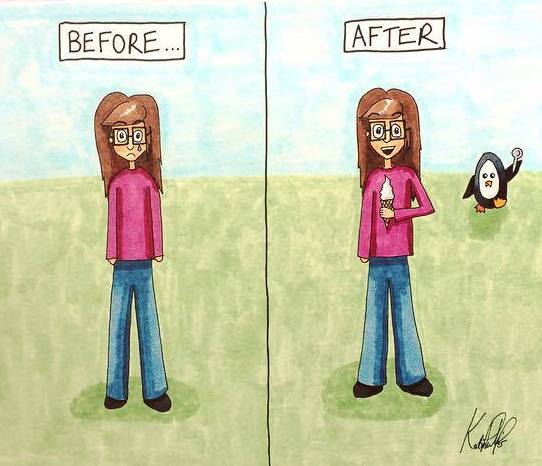
It is hard to explain exactly what I mean, but it is like looking at a picture of someone standing in a field looking miserable, and then another photo of them smiling in the same field but with the addition of an ice cream. At face value then, you can look at these pictures and think “well a person was sad because they didn’t have an ice cream but then they got an ice cream and they were happy” , simple. What the picture will not tell you however, is how that ice cream got there. Little would you know that the person had not simply walked up to the nearest ice cream van, asked for a 99p Mr Whippy and walked away smiling, just as the person in recovery had not simply gained some weight, and in turn, a smile (side note did you know that they don’t even do 99p Mr Whippys anymore? They are now at least £1.50! How do those ice cream men still have the nerve to play jolly tunes as they patrol the streets for customers now that they are basically performing daylight robbery rather than offering a merry treat. You can play Greensleeves all you want but that doesn’t change the fact you are making me re-mortgage the house to buy myself an ice cream. SHAME ON YOU ICE CREAM MEN. SHAME ON YOU.)

Anyway, what the picture doesn’t show is that to acquire their ice cream they were forced to go on a perilous test of their endurance, that pushed them to the limits of mental and physical strength. To get that ice cream in the picture, that person had in fact had to walk across continents and cross oceans to America, the largest producer of almonds in 2014 I will have you know, and then had to hand pick hundreds of almonds ready to blend into a creamy milk worthy of a tasty frozen dessert (this person was lactose intolerant so almond milk was the milk required for the job.)
Then, exhausted from months of trekking, nut picking and milk making, that person had to swim across even more oceans into the freezing cold pole of the Arctic where they stirred their almond milk with a wooden spoon atop a large glacier that acted as a natural freezer for their ice cream churning process. Even when the ice cream was made it didn’t get any easier as they had to then wrestle with a penguin who had cheekily tried to steal the ice cream (I don’t blame him to be honest. I would steal ice cream if all I had ever eaten was raw fish), and then they had to get the ice cream all the way back to that field in their country of origin, back through the hot climate of almond fields in America, without the creation melting. Clearly that is a far more character building excursion to get to that point of “person with ice cream in a field” than the picture initially suggests, and I didn’t even tell you the 5 month side trip it took to make the cone in which the ice cream was to rest (it would take too long to tell you fully but as a brief summary it involved a very angry rhino and a lot of waffles).
The person worked hard to get to the point where they were standing in that field with that ice cream, and all that hard work is eradicated, as it is in recovery journeys, when all you see is a simple before and after shot.

Obviously I am not saying we should stop people from sharing their recovery stories and indeed, if you have recovered from an eating disorder, then I am OVERWHELMINGLY proud and impressed by your determination and strength. If you were here with me now rather than wherever you are reading this, I would give you so many rounds of applause that my hands would fall off and I would be left clapping stumpy wrists to show appreciation of your achievement. What I am saying is that maybe, more often we should be celebrating and telling these stories without the underweight photos that go with them. A story is still a great story without pictures. Hell, look at Harry Potter, that story changed and continues to change generations of people, it has grown theme parks and movie franchises, careers and other astonishing things, all from a pile of words cobbled together with no images at all (For the purpose of this post can we please just pretend that the illustrated versions that are currently in production don’t exist.) Still, even when pictures are added to the Harry Potter books, it will still be the words that are doing all the talking.

So that is why I have a problem with before and after photos when it comes to eating disorder recovery, not because I don’t like inspirational stories or don’t want people to celebrate their achievements, but because those pictures don’t really do anything but diminish and reduce the value and greatness of what has been achieved. As a snapshot ok, a picture may say a thousand words, but a recovery journey is made up of millions of them.

Take care everyone x

BeforeAndAfter