Why Familiar Surroundings Are Important When You Suffer With OCD

The original title of the blog I was planning to write today was “Tips on staying away from home when you have mental health problems”. You see, my parents were jetting off to Malaysia and seeing as I am not well enough to manage by myself at the moment, the plan was for me to go and stay with their friends in this lovely little house out in the countryside.
We have been planning it for months, I had visited the house and felt OK about it seeing how nice my bedroom, personal office AND personal bathroom were going to be. There was even a cat called Pingu. A cat. Named after my favourite childhood penguin. Ideal right?

Well I thought so, but was still worried about managing my mental health with new carers who do not know me as well as my parents, so I came up with a list of coping strategies and ways to manage it. Consequently I decided to write a blog sharing my oh so helpful tips incase anyone else out there was in a similar situation, but then…well…I went to the house where I was due to stay for two weeks, lasted approximately four hours and then was driven home in hysterics at midnight with my parents due to fly the next day despite having still not packed so much as a flip flop, because we have been spending weeks packing for me to go away (if you want to imagine how many things and bags it was, think of the average stuffed car that people often drive off to uni in, double it and chuck a penguin on top for good measure. Oh and a Christmas elf. One must never travel without one’s cuddly Christmas elf. Oh there we go! I did give a travel tip! YAY ME.)

Clearly then, I am in no place to be giving tips about staying away from home right now BUT over the course of this traumatic experience, I have been reminded of a valuable lesson about mental health problems, so I thought I would share that with you today instead.

Having been mentally ill and having been in therapy for over a decade, I would say I understand my conditions and myself rather well, which is why I felt that I could make a plan about an approaching situation in advance without running into any unforeseen issues.
Trying to do my same rituals in a different place however, really reminded me of something a lot of people might not realise: that being that sometimes with OCD, it is not just about carrying out a specific behaviour like a shower routine, it is about carrying out a very specific shower routine in a very specific shower.

I always knew that because of OCD and anorexia, I have a LOT of routines, rituals and specific ways of doing things. I eat out of certain bowls with a certain spoon, I drink tea out of a certain mug at certain times of the day and I wash my hands, shower and get dressed in very specific ways. As rigid as these and a number of different actions in my day are, logically you could assume that I could carry them out in a different place so long as I had the correct equipment. There was a shower where I was going to stay so of course I could do my shower routine, there was a sink so of course I could wash my hands and I was taking all of my cutlery/crockery so obviously I would be able to eat all in my usual ways.

Even I can admit that years ago, though still having OCD, I was able to do these fixed ritual things in other places with other sinks and showers. I have been on holiday since my diagnoses, have stayed in a hospital and went to university (kind of…), always carrying out the same actions just in different locations. Therefore I tried to do that this time going to a strange house but, with things how they are at the moment, as hard as I tried and as good as my intentions were at the time I attempted it, it isn’t possible (at least to a manageable realistic degree that doesn’t involve hysterics 24/7 for a fortnight which is less “a good challenge” and more cruel torture. I am all for accepting challenges and trying things out of my comfort zone but sometimes you need to eat a few mini muffins before you are up to demolishing an entire five tier wedding cake by yourself).

I was truly shocked as I sort of hadn’t realised how bad things have got again.
The descent has been a gradual process, little slips that in the end add up to a sky diver height of a fall. It is like what they say about if you put a frog in boiling hot water it will hop out but if you put it in warm water and gradually turn the heat up it will boil to death before it realises (that is what they say isn’t it? Who are these people? Please dear readers, do not go putting frogs in boiling water. If you really want to see some green bubbling in a pan just whack in a bag of frozen peas, far more humane AND one of your five a day).

When we pulled up at the house I fully intended on staying for the next two weeks (obviously I did, I had my penguin and my cuddly Christmas elf, I was committed to this trip). Even though I was anxious, by using multiple packets of anti bacterial wipes and with support from my parents, I got through the unpacking and after two hours my room, bathroom and office all looked really nice, filled with familiar things, a comfortable home from home.

It was when I tried to shower that things went so horribly wrong. First there was the issue that the shower was a stand in shower cubicle with a door. At my house our shower head is hanging above the bath, so when I am getting all lathered I can stand out of the flow of water to reach the required bubbliness (I know that this is not the most environmentally friendly way to live my life and that I could just turn the shower off but just know that I am unable to do that at the moment and to be honest when you are focusing on just keeping yourself alive your carbon footprint is not a top priority. At least I am not flying across the globe in an aeroplane to Malaysia like SOME people…).
With this stand in shower however, I was unable to reach the desired bubbliness needed to get through all of my thought routines because before I had time to count to the required numbers the suds had all been washed away.
Then there was a problem that I had to put my soaps in a basket so my lemon shower gel for feet was too close to my banana shower gel for body and far too close to a wall that I couldn’t touch, and the way you turned on the shower made my usual vitally important life saving way impossible.

I took so long to shower that all the hot water ran out and after a while of forcing myself to stand under the cold ice like hail pelting me in the face, I got out though I still didn’t feel clean. I was in a bit of a state but I didn’t want to give up so I persevered and tried to get on regardless but it was one thing after another. I couldn’t wash my hands in the sink because the tap distance to the back of the sink meant holding my arm at 135 degrees rather than 90, I couldn’t step off the towel I had laid on the floor because my bare feet couldn’t touch the tiles and I couldn’t put on the socks that I had brought into the bathroom with me without direct access to trousers and slippers. “You should have taken slippers in and trousers too” I hear you cry but I had thought of that already and couldn’t because there was nowhere safe in the bathroom to put those things at an acceptable distance away from each other. I found myself standing stranded on this towel shivering and blue with cold, so I naturally did what any other person would do in that situation. I cried uncontrollably and screamed in terror for my mother.

Luckily my parents were still there because the unpacking had taken such a long time that they had ended up staying for dinner whilst I showered.
Seafood rice was cooked and eaten and a homemade rhubarb crumble was just being served when the screaming happened and mum came running. She tried to help by offering solutions, one being the ideal “I can go and get the trousers and not let them touch anything”, but I didn’t want to do that. Yes it would have been safe, but I wanted to solve the problem by myself somehow with support.
Mum could have easily gotten my trousers and I could have left the bathroom but what the hell would I do the next day when she was on a beach somewhere in Malaysia? Around this point my “in a bit of a state” descended into full on “out of control don’t know what I am doing dangerous risky chaotic hysterics and panic” and from there things are a bit of a blur. All I know is that I cried for several hours (I tried to talk too but was at that hiccuping crying point so “I don’t know how to manage I want to disappear” came out more like “Hic gasp gulp hic scream”), and my parents and friends frantically tried to decide what to do.
When I was able to talk and sob at the same time I made it clear that I felt it was a challenge too many and that rather than tackling the “parents away and totally different location for all rituals for two weeks” I wanted to attempt the “parents aka usual carers away, in a familiar place” challenge. Losing both was like losing both of my homes, a tortoise rudely ripped from his semi detached terrace house and his shell in the same day leaving a cold naked slug unable to survive in its place.

There were then more hours of discussion before we realised that this really was not a feasible option and then after two hours of packing all of my things back into the bags we had unpacked them from (we didn’t have to pack my elf. He went and got himself back in the car the second he heard the first bout of screaming. He knows me well), we were back in the car driving home in the dark, leaving the abandoned now cold homemade crumble on the dining table. It is a big shame. My parents love rhubarb crumble.

So it was that I ended up back home after my much shorter than planned and somewhat failed “stay away from home with mental health problems”. On the plus side I did manage to get to the house and unpack…I just left two weeks too early.

Clearly then, I think I have proved my point and raised awareness to all the people who might not understand OCD, that when it comes to OCD and other mental health problems with ritualistic behaviours, it isn’t just the rituals that are important to a sufferer but the specific location and circumstances under which those rituals are carried out.

Take care everyone x

Bubbly

The Frustratingly Illogical Existence Of Life With An Eating Disorder

A few days ago, I met up with a friend who I have not seen for 15 years. It was a friend I have known since the tender age of zero after we stumbled across each other at an antenatal class our parents had been attending in the hopes of learning what the hell to do with the new humans they were about to produce and were expected to raise without any prior knowledge of how to do such a thing.
We may have only been newborns but our connection was instant, we bonded over Thomas the Tank Engine and have been friends ever since (although like I said, we haven’t seen each other for fifteen years because when you get to senior school and puberty a lot of nonsense gets thrown at you and there isn’t any time left to discuss the wonderful intricacies of your favourite blue tank engine…senior school is cruel.)

Recently however, after reconnecting over the 21st century miracle that is “social media”, we decided to meet up, and thus it was that I found myself sitting opposite my oldest friend in a coffee shop several days ago.
I think when you meet up with anyone, either new to you or as old a friend as your life itself, there is always a tendency to compare yourself to that other person in some way. Frustratingly, even though I know that appearance and weight are the least important of all things, my eating disorder automatically compares my body to those around me and without fail will always manage to convince me that I am an inferior disgrace who should go home and hang their head in shame. Like I said, I know weight doesn’t mean anything and I quite frankly don’t care what other people weigh. The number of pounds shown up on someone’s bathroom scales does not matter to me in the slightest, nor does it affect my opinion of them, yet for some reason when it comes to me specifically and my body, weight is of the highest significance and summarises my self worth as a person.

When I saw my friend standing there then, I felt really embarrassed and had it not been for the desperation to see her after such a long time, I probably would have run out of the coffee shop and would still be hiding in a bin somewhere.
Eloise Unicorn McGlitterface (I may have added the “Unicorn McGlitterface” myself just for fun…she really likes unicorns…and glitter…), looked fabulous, and I wished I could look like her.
Immediately my eating disorder was triggered and the thoughts telling me to lose weight struck up their familiar bellowing.
I didn’t want to be thinking about these things at all, as I left I wanted to be thinking about how lovely it had been to see my friend, but as I got in the car to go home, my head was screaming at me to lose weight, and here is where I get confused.

I know for a fact, that my friend Eloise Unicorn McGlitterface, on paper, is a healthy weight, and even though I don’t believe the “facts” my psychologists tell me about me being “underweight”, I understand them, sort of like someone understanding the theory behind someone’s religion without believing in that religion themselves. Logically then, according to doctors and science, most people would conclude that in order for me to look as fabulous as my friend, I would need to gain weight. On paper and if talking to anyone else, I would easily be able to agree with this argument yet somehow, when it comes to me, even though I cannot explain the science behind it myself, I am convinced that the only way for me to look like someone who weighs more than me…is that I need to lose weight. WHAT KIND OF LOGIC IS THAT.
When I tried to explain this to my mum I couldn’t. Naturally she thought that I sounded irrational and like a lunatic (she would have a point), yet despite my inability to explain the science behind my thoughts, I remain utterly convinced of their truth without really understanding them…
I even thought that if I tried to write this blog post and tried to explain my theory I would realise how ridiculous I sound, how my thoughts make no sense and therefore cannot be true, yet still here I sit, unable to explain how my body defies science and needs to lose weight to look like someone who weighs more than me, yet utterly convinced that this is the case.

There are a lot of things I believe that make no sense to other people when it comes to my eating disorder, but at least I can see the logic behind them. I know it doesn’t make rational sense that I cannot eat unless my hair is tied up in a very specific way at a very specific angle, but I understand where that belief/behaviour comes from and the rationale behind it according to previous experiences. I know it doesn’t make sense that I cannot eat with forks, knives or plates and am only able to use spoons and bowls, but again I understand the reason I feel this way. There is no science behind it, but it makes sense to me and I could explain it to people.

This however, I do not understand, yet like I said, this doesn’t make it any less compelling. I guess going back to the religious comparison, it is like being a devoutly religious person who can hear all the arguments against their beliefs but believes nonetheless and is convinced in their heart by pure faith. I don’t want to insinuate that my eating disorder is at all some kind of religious movement, it is a murdering mental illness that destroys lives, but I think this example goes to show that when you have an eating disorder your belief in your thoughts are held and driven mainly by a faith that you cannot explain the logic behind. In my experience at university studying theology and when talking to religious friends, if you ask them to explain “why” they hold their beliefs, any explanation will be secondary to the feeling they hold inside them. They can say “why” but when it comes down to it the thing that convinces them is a faith, an indescribable feeling that they have which means that they “know” what they believe to be true even though they can hear people arguing about why they might be wrong.

I don’t wholeheartedly believe my eating disordered thoughts because I am stupid and don’t understand science, somehow I believe them in spite of that understanding. This whole “to look like my healthy friend I need to lose more weight” thing is exactly like my obsession with green tea. I hate the stuff and over the years hundreds of people have told me that it makes no difference to your weight, I have read the studies and I know they are true and more scientific/rational than any thoughts I get from my eating disorder…yet somehow I am still convinced that if I don’t drink a certain number of millilitres of green tea I will gain several stone overnight. Consequently I drink that green nasty fluid that I am horrified is held in the same category as all other teas. WHERE IS THE LOGIC HERE EATING DISORDER? HMM?

I think what this really proves is the fact that eating disorders make no sense and that even if their thoughts don’t have a reason behind them, they are nevertheless believable. People with eating disorders aren’t stupid people who don’t understand how bodies work, they understand all of those things, often better than most, yet still the disordered thoughts are so strong and so compelling that they are convinced to follow them without being able to say why. Eating disorders have the power to make science sound ridiculous and nonsense sound like fact. I guess this example also proves the fact that eating disorders are flipping stupid and will always manage to convince you and tell you that you need to lose weight no matter what the facts of any situation.
Usually when I write blogs about eating disorders I do it to try and explain the reasoning behind
them to people who don’t understand, but clearly, sometimes life with an eating disorder is about not understanding a damn thing about your thoughts yourself and just basking in a frustrating confusion.

Take care everyone x

NonsenseBin

“I Wish I Had The Self Control To Be Anorexic”

Several times in my life I have heard the phrase “I wish I had the self control to be anorexic” and, considering I am now writing this blog post about this phrase, you can safely assume that I have a lot to say about it.
You may be thinking “Katie, you already wrote a post about people wanting anorexia and how silly that is, why are you repeating yourself?” (a post you can find at the link here: A Message To All The People Out There Who Are “Pro-Ana”), but please hold that thought as I actually think that the problem with this phrase is not about people wanting eating disorders.
Indeed, unlike people who are “pro-Ana”, in my experience, people who say this are not actually craving the bulging rib cage and hip bone images promoted on “pro-Ana” websites. The mistake these people make is not that of idolising a mental illness, rather it is of completely misunderstanding what an eating disorder actually is and what it is like to suffer from one.

I think when it comes to illnesses such as anorexia, there is a misconception that when people with the illness don’t eat, it is because of their will power or an extreme superhuman ability for self-control. They assume that sufferers feel hungry and want to eat but powerfully override the primal urge to seek food because they are strong, yet in my experience, it is the total opposite, and it is in the times that I am unable to follow this primal urge that I feel the weakest that I have ever felt in my entire life (even weaker than the time I was beaten in an arm wrestle by an rather arrogant and ambitious sloth I met drinking tequila in a bar a few years ago…that was a BAD evening.)

Whenever I miss a meal or don’t eat a free sample handed to me in a supermarket, it isn’t because I implement my ability to make decisions/affect my actions as the word “control” implies. Instead, it is because I am not in control at all, a point I think is easier to explain if we take a trip down memory lane and travel back in time to any birthday I have had over the course of the last decade.

Most years, when it gets near to my birthday, if I am out shopping in a supermarket with my mum, when we walk past the birthday cake section, she will look at the birthday cakes and sigh. Following this signal, we may have a wander over to look at all the intricately decorated creations topped with thick white icing and pictures of various Disney characters (I don’t look at the plain old boring cakes for “adults” that simply say “Happy Birthday”. Seriously who wants one of those when you can have an sponge shaped like a minion or a giant chocolate caterpillar with a cheeky grin?!), and then after five minutes of eye wandering my mum will turn to me and ask the question “can I get you a birthday cake this year?”.
Now, if I had any degree of “self-control” when it comes to food and my ability to nourish myself, I can honestly say I would turn to my mother in these moments and say something along the lines of:

“Can you buy me a birthday cake? Why of course! There is no question regarding such a matter! It is my birthday in two weeks and I simply cannot celebrate the occasion without a cake! Quick! Let’s go around all the supermarkets and bakeries in the area to try and find the biggest penguin shaped chocolate cake available. I want nothing more than to share such a delight with all of my nearest and dearest friends! Ooh can I please reserve the chocolate beak for me because it is my birthday? I do love a chocolate beak! Hurry mother, let us away to the automobile and get started on this quest immediately!”.
I would probably then insist we head to the candle area to pick the most garish, brightly coloured candles on offer to adorn my perfect penguin centrepiece, poised and ready for the moment when I am ready to blow out the flames and make a wish that Helena Bonham Carter hurries up and marries me already.

That is the response of a Katie who is in control. Unfortunately though, we haven’t seen “In Control Katie” around much lately. That Katie popped out for bread about ten years ago leaving an out of control mess in place, and since then we haven’t heard anything (better be picking up some damn good bread is all I can say…I’m talking a good quality ciabatta or we are going to have issues).
Therefore, with “In Control Katie” otherwise engaged on a mission to find a tasty source of carbohydrates, it is the “out of control” one that turns to Mum year on year with a dejected look and says: “I wish. Maybe next time”, at which point we agree to try again next year before repeating the annual routine in roughly 365 days time.
I know it would mean the world to my mum to buy me a giant penguin birthday cake to share with her/the family, and I desperately want to accept her offer each time mainly because I want to see her reaction. I want to see her face light up with the brightness of a birthday cake candle, filled with hope that for once she can do something that normal mothers do rather than having to come up with some kind of eating disorder friendly replacement for her neurotic offspring (e.g. the act of sticking a candle in a pink lady…the kind of apple I mean…not an unsuspecting blushing female who doesn’t know what’s coming).
When I do not accept the offer of a proper birthday cake then, it is not because I don’t want to, it is because my mind throws up barriers that make me feel that I physically can’t.
It is like a “normal” person standing in front of a bonfire and wanting to put their hand in it to retrieve a particularly nice log. They can look into those flames and want to put their hand in to get the log (this person really likes logs), but no matter what, they can’t. Of course they are physically capable of moving their arm into the vicinity of the fire, but the fear of pain stops them (no matter how much they like logs).
Saying “I wish I had the self-control to be anorexic” then, is basically like saying “I wish I had the self-control not to put my hand on a bonfire”. Of course eating and setting yourself aflame aren’t the same thing, one is vital for life whilst the other is downright ridiculous and not something I advise anyone to try at home or anywhere else for that matter, but the similarity exists in the sense that both the person who doesn’t put their hand in the fire and the person with the eating disorder do not carry out their actions because of self-control, rather it is because they are both scared and fear the pain that could result from their actions.

Whenever you hear yourself or anyone wishing they had the “self-control” and “will power” to eat like someone with an eating disorder then, please know that when it comes to eating disorders, self-control has absolutely nothing to do with any of it. When someone is unable to keep themselves healthy by eating enough, it is because they are not in control, and because the reins of decision are actually being held hostage by an evil dictator in their head who is trying to kill them.
If I had self-control and willpower over my life I could write a list of about a million things I would use it for. The ability to fill my mother’s eyes with disappointment, to refuse sharing a dessert with a friend or turn down the offer of a birthday cake would not be on there.

Take care everyone x

ControllingPea

How Summer Can Affect People With Eating Disorders

When you live with an eating disorder, there are a lot of things that can affect it. For example my eating disorder rules are often impacted by things like my location, what time it is, who I am with, what is going on for the rest of that day, and, as I have learnt very recently, what season it is.

I have always known that things like the season can affect my eating disorder, but never have I realised this more than this summer, especially the past few weeks of June. If you do not live in England you may not be aware of what has been going on, so to clue you in, you should know that for the majority of June, England has been doing its very best impersonation of a Sauna. IT WAS 34 DEGREES.
For those of you who are used to living in hot countries this may not sound particularly hot, but for people who have always lived in England, 34 degrees feels like you are wearing three hundred woollen jumpers and have been thrust into a furnace with a hot potato shoved down your trousers, a feeling that is not helped by our inability to go for more than 24 hours without a good cup of hot tea (seriously we can’t do it. This isn’t a joke. Tea withdrawal disease is a very serious problem in the UK and 90% of hospital admissions are poor folk who cannot find their favourite teapot).

Now when the weather is hot, people like to take off their clothes or at least wear as few clothes as possible. Gone are the winter coats and snow boots and out come the shorts and crop tops, items that I find rather terrifying due to my eating disorder and body confidence issues. Throughout the year I live in large baggy jumpers so as to cover my body up and out of sight, so that people cannot see all of the disgustingness I see when I look in the mirror, which is a slightly problematic practice when the weather is hot. In summer when you have an eating disorder or body dysmorphic issues, you basically have two choices, stick to your normal wardrobe and roast to death or wear sensible clothes that allow a little bit of breeze here and there but that simultaneously leave you incredibly uncomfortable/stuck in the high street rigid with anxiety because you are wearing a pair of shorts.

I don’t know about anyone else, but I also find summer and warm weather extremely triggering to my eating disorder because I am so used to being cold and being cold is a symptom of being “unwell”. Indeed being cold is a feeling so synonymous and such a documented symptom for people with eating disorders that thermometers were shoved in our ears multiple times a day in hospital to see if we were at risk of hypothermia (an unpleasant experience though I suppose better than that of having a thermometer shoved anywhere else…).
Every time I say or am told by someone that I feel cold, doctors will say things like “it is because you are underweight” or “it is because you don’t eat enough”, so when I am not cold, I panic.
Due to the association with being cold to not eating enough, if I feel warm or heaven forfend “hot” at any time, my head will immediately convince me that it is because I must have accidentally eaten ten buckets of lard and have gained one thousand kilograms. If I feel warm, my eating disorder states that I also must be fat.
It is completely nonsensical but I cannot help it. As much as I try to apply logic to the situation, my brain will always convince me that being warm has absolutely nothing to do with the giant ball of fire burning in the sky (aka the sun…calm down this is not the apocalypse), and has everything to do with what I have eaten and how much I weigh. For me then, eating becomes a lot harder in the summer time because it is easier for my eating disorder to convince me that I don’t really need the food seeing as I am already abundantly covered in enough flesh to keep me toasty warm.

Another problem I have faced this year more than ever, is that of the longer daylight hours we have in summer. I know a lot of people find that sunlight is beneficial to their mood and can actually help them with mental health problems like depression, but for me it is the opposite. I hate sunshine (which is why I live in the UK).
In the sunshine everything feels too bright, too loud, too intense, and I feel calmer in the quiet winter months when people are tucked up inside rather than running around out doors with no clothes on.
I have also always struggled to eat when the sun is up, a problem that has somehow got worse this year. You see, I am currently sectioned under a CTO, a part of the mental health act that means I am allowed to live at home as long as I adhere to certain conditions like staying above a certain weight and going to appointments. I want to say that my main motivation to eat is to be healthy but as true as that is, I am ashamed to say that if I am completely honest, the main push that gets me eating is the fear of going back into hospital and having to eat more food and gain more weight. In the day time however, that fear is not as strong. When the sun is up my brain thinks “hey it is fine, you will stay above your CTO weight, if you don’t need to eat now, you can do it later”.
When the sun is down, there is no later though, and I realise that if I want to maintain my weight and with it my freedom, I am going to need to get some munchies out. The problem is that I know my weight will be acceptable as long as I eat and does not depend on when that eating happens, so naturally as with most things you fear/dread in life, I avoid it as long as possible.
In the winter, this was not such a problem because it was dark by 4pm, but in the summer with all this daylight savings malarky, it isn’t dark until around 10pm and as the months have gone on I have found my eating getting later and later in the day until the point I am at as I write this, a point where I am basically carrying out a year long, eating disorder motivated version of Ramadan. This would make sense if I was a particularly devout follower of the Muslim faith, but my adherence to such rules is not driven by a special spiritual meaning or importance, it is is because I have an eating disorder in my ear who is a total idiot.

In summer as well as taking their clothes off, people tend to change their way of life in the sense of what food they eat and the roast dinners and steamed syrup puddings of the winter time are replaced by cold salads and ice cream.
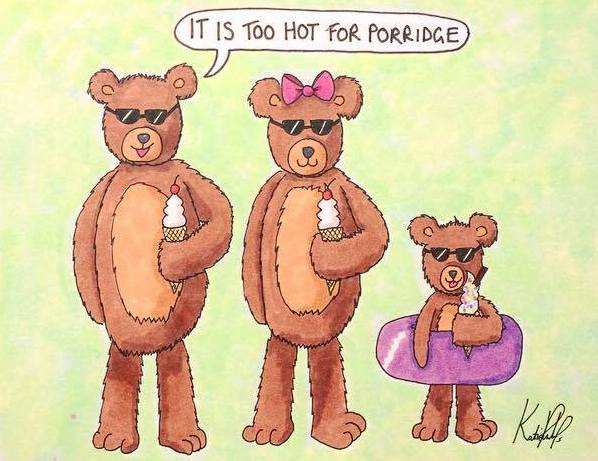
Again however, this is another seasonal transition that my eating disorder leaves me struggling with, because I eat exactly the same foods in the exact same proportions every day and one of these foods is porridge, aka that boiling hot bowl of oats that most people don’t whip a pan out for until there is a significant chill in the air.
When it is 34 degrees outside, nobody in their right mind would start getting oats out of the cupboard to perform their daily Goldilocks’ impression, but I am not in my right mind, so that is exactly what I do (the slight difference in my impersonation being that I am a brunette version of Goldilocks…Oh yeah and I don’t break into people’s houses to get my oats, especially if those people are bears).

In June then, during the hottest week England has seen in my lifetime, I was stuck in the predicament of being boiling hot and thus convinced that I didn’t need to eat because I was clearly obese. Then by 10pm when the CTO fear would hit me, I would force myself to eat despite being so warm, only I would trigger myself even more and make it even harder by making the food I was consuming a steaming bowl of porridge.
“Eat cold porridge” I hear you cry, “try overnight oats which is the exact same thing but you don’t cook it”, yet even that couldn’t solve my problem as OCD has rules about how porridge is prepared and naturally has me convinced that unless my porridge has been cooked for exactly 4 minutes and 40 seconds with stirring at the appropriate intervals, I will kill everyone on the planet. What logic!

As you can see then, summer/the season and weather in general is one of the many things that people may not think about affecting people with an eating disorder, another thing that complicates the simplified idea that people with eating disorders “just don’t eat”.
They are complex creatures, mysterious as the dark side of the moon (10 points to anyone who got that reference), and the control they hold over a person’s life creates anxieties and difficulties most people might not think about. I am of course happy for everyone out there who loves summer and if you are one of those people living in England, I really hope you are having a lovely time in the June sunshine and are feeling as sunny as…well…the sun…
In the meantime I guess I will just have to suck it up and count down until the winter months when jumpers, porridge and 24 hour darkness are socially acceptable again. My God I am a jolly soul!

Take care everyone x

SummerBear

Birthdays And Mental Health Problems

When I was younger and heard adults saying things like “I just want to forget about my birthday this year”, I thought that adults were crazy and needed to seriously reconsider the way in which they were living their lives. Why on earth would anyone ever want to forget about their birthday?

For me, birthdays were something to look forward to and something I couldn’t forget about if I tried. Birthdays were about choosing which soft play area you were going to take all of your friends to for the party, buying rainbow coloured bouncy balls to fill party bags with and deciding whether you wanted a Thomas the tank engine or Spice Girls birthday cake ready to decorate with a flaming beacon of candles. Birthdays were about unwrapping incredibly exciting and complicated plastic contraptions that you would then spend the rest of your day watching your mum struggle to assemble amidst an encyclopedia of instructions in every language but English, before finally making it look like the thing on the box, only to realise that batteries were not included, causing your mother to curse the creators of Toys R Us and howl at the moon until the early hours of the morning, Barbie’s camper van standing motionless and taunting you from the corner. Birthdays were about wearing a badge with your age on it to school so that everyone would know how very mature you were and how much respect they should bestow upon you, and no birthday was complete without a trip to TGI Fridays where you would stand on your chair like a king whilst a chorus of red and white striped waiters belted out “Happy Birthday”, the performance concluding with rapturous applause from all around and, if you were lucky, an extra gummy worm in your Mississippi mud pie. With all that to look forward to, how could anyone dread a birthday?

I was sure that I would always look forward to my birthday and would never be one of these fools who looked upon the occasion with anything other than spine tingling excitement. I was wrong.
For the past few years, despite little Katie’s best intentions, I have become one of those people who wants to forget about their birthday, and I think it is because as you get older, birthdays don’t mean the same things as they used to. They become less about gummy worms and birthday cakes and more about time passing you by, life passing you by, which isn’t something you really care about when you are younger and your main focus is getting the bit of icing on the cake that has your favourite cartoon character on it. On top of that however, when you are mentally ill, I think they are especially hard because for me at least, a birthday can feel like a reminder that you have wasted another year drowning in anxiety and the older you get, the longer you have been stuck with this mental illness bothering you all the time.

That said, I guess you can sort of see birthdays and that marker of time passing as a positive thing. This year for example, I turned 25 (I did it last Thursday as a matter of fact and luckily, despite all the dreading and worrying about it talked about in this post, I really did have a lovely birthday, so if you sent me a birthday message or said hello to me at all on the 22nd June then thank you for being someone who made it special. I really appreciate you all so much). Alas! I must get back to the point!
So, turning 25 means I will have been unwell for 14 years. On the plus side, whilst a depressingly long time, it is an improvement in the sense that I can say the number 14 because it is a safe number, unlike the number I used to have to say, (the one that comes between 12 and 14), which is a somewhat difficult number for me to handle in terms of OCD (YAY SILVER LININGS).
Also there is something rather motivating about birthdays in that they often inspire you to make goals of things you are unhappy about and want to change before the next one.
Indeed, I think that as the number of years I have been ill has gone up, the more motivated I have become to fight my illnesses and push as hard as I can for recovery even when it involves doing something scary.

During the first years of my illness when I had to go back a year in school and take time out of education to go into hospital, I was motivated to fight purely because my illnesses were making me unhappy, but not so much because I realised what I was missing out on whilst stuck in my head. Ok I often couldn’t leave the house and I missed out on a few sleepovers with friends, a couple of school trips and several opportunities to share a pizza and watch a movie on a Saturday night, but to begin with, missing the odd pizza isn’t that big a deal. Obviously I would have liked to have done all the things like going bowling with friends and eating popcorn at the cinema, but for me being safe at home not having to touch or eat anything, felt a lot more comfortable. I would have rather stayed in my little bubble avoiding as much anxiety as I could, even if that meant being a little bit lonely, than go out of my bubble and cause myself a lot of distress trying to wear a pair of bowling shoes or eating a mouthful of popcorn. Staying safe was my priority, and if that meant missing out on a few sleepovers/meant less terror, that was a necessary sacrifice I would take. Why terrify yourself for weeks and weeks just trying to get the courage to see a friend for an hour? Better just to avoid it.

However the longer you live with mental illness, the more those little things add up over the years, and suddenly you find you have not just missed the odd sleepover, you have missed hundreds of sleepovers, hundreds of moments in which people took photos and made memories that they reminisce about and fondly recall with sentences beginning “Oh my goodness do you remember when…”. After several years, you haven’t missed one bucket of popcorn, you have missed an entire swimming pool worth of popcorn (not that I advise you put popcorn into a swimming pool…just trying to get the image of how much popcorn we are talking about across), and that amount of popcorn can’t be caught up on as easily as the one bucket you missed in the first place. As the days become months and the months become years, you realise just how much of your life you have missed out on because you were too scared to take part in it, and suddenly the motivation to work even harder to stop the years passing by without you noticing increases, because you finally understand how rubbish it feels to be left so far behind everyone else.

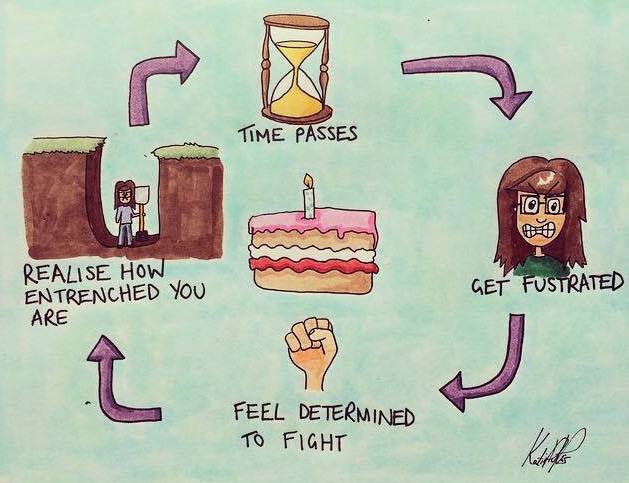
However at the same time, whilst the longer you live with a mental illness the more anger and frustration you have at it to motivate your recovery, the further entrenched you are in that illness and thus the harder it feels to get better. It is a catch 22 situation, the most vicious of all the vicious circles.

Time passes, you get angrier at all the time wasted, you become more motivated to fight but then find it is harder to fight than the first day you tried to challenge yourself because the illness has used the time wasted to dig its claws into you even further. Odd things that started out as little quirks to keep yourself safe become engrained habits and habits are a lot harder to break than things you only did a few times. I have smoked only one cigarette in my life and I will be honest, I hated it. It was like swallowing a smelly smokey fire. Therefore deciding to “give up” on the idea of smoking after that cigarette was not a challenge at all. I had spent longer as someone who didn’t smoke than I had spent as someone who did, it wasn’t a habit and I was not addicted or used to the comfort or feeling of a cigarette in my hand. Now however, I have officially been mentally ill for longer than I have ever been not mentally ill and I have dug myself into a hole so deep that it is far harder to get out of. Years ago I didn’t go to a meal out with friends because it made me uncomfortable, but that uncomfortable feeling has built over the years, and now I don’t go because I am terrified. Eating out doesn’t make me anxious, it makes me feel like I am dying on the inside. The longer you are ill, the more set in your ways you are and the harder it is to get better.

This year then, as always, though I dreaded my birthday as it scares me to think how long I have been trapped in my own mind, I am trying to see it as a positive motivation for change, an opportunity to say “this past 14 years has been hell and I am determined to fight as hard as I can to make sure that number doesn’t go up by one every time my age does”. I am fed up, truly angry every year as I see the growing list of all the opportunities I have missed out on and I really do want things to be different. It is just difficult, ageing with mental illness. As the years pass you may feel more motivated, but at the same time, you just feel more trapped.

Take care everyone x

BirthdayBlog

The Numbness Of Depression

Trigger warning: This blog post does include a reference to self harm (a very casual one with no details), but if that would trigger you please go and read something more relaxing like a manual telling you how to grow vegetables. I hear it is the perfect time to plant courgettes…

Depression is, technically, one illness named after one emotion. For me however, what depression feels like is different every day. Sometimes having depression is the experience I imagine most people picture depression to feel like, aka some days I am depressed/agonisingly sad. Over the course of any average week though, it is likely that depression will throw up some different negative emotions picked out of its sinister collection. One day the main emotion might be guilt, the next hopelessness, anxiety, anger or even intense pain to the point that I go a bit delirious and start laughing for no reason because I don’t know what else to do. For me, depression is not simply about being depressed, it is about being and feeling many different things and sometimes, in my experience, living with depression is about feeling nothing at all. Today is one of those days.

I think trying to explain what it feels like to be numb is one of the harder aspects of depression to express because…well…it doesn’t FEEL like anything…that is the point…
If I had to try to describe it I would say it’s like you turn into a robot or someone who is sleepwalking. I can walk, talk and carry out mechanical actions when instructed, but I am not really there, sort of the classic the lights are on but no-one’s home because the occupants have decided to go on a Mediterranean cruise for a few weeks (they went waterskiing and had ice-cream on the beach. It really was a wonderful holiday).

When I feel numb I am technically alive in that I am breathing, but there is no real life there, it is just a body on autopilot, a tin man who hasn’t yet been given a heart.
There is no passion, no want or desires. There aren’t even preferences, because when you don’t feel anything, everything in this world is the same so there isn’t anything to choose from.
For example, if you have taste buds, buying a tub of ice cream involves making a choice because all the flavours taste different and will therefore be experienced differently. The tub of vanilla will taste of vanilla, the chocolate of chocolate and the strawberry ice cream will taste of pistachios (there was a mix up at the factory).
If however, all the ice creams were to taste the same, there would be no choice to make, you cannot choose one thing over another when everything tastes of cardboard.
On these numb days, days like today, you could honestly walk up to me and give me the options of either a hug or a punch in the face and I would be indifferent to both of them. Logically I can see that it is nicer to have a hug than a punch in the face, so rationally I can understand that the hug should be my choice, but that choice has no feeling. I don’t want the hug nor do I dread the punch in the face, I just know the one to go for through the same logical process you might use to tick a box in an exam paper of non-verbal comprehension.

On the one hand you would think it might be nice to not feel anything, and you could say that it is better to feel nothing than to feel heart aching sadness. I do not agree.
When you are angry or sad, you get through that emotion by feeling it and living out the experience.
When you are angry you can ride that wave by shouting into a pillow to get the frustration out (be sure to apologise to the pillow later), and when you are sad you can cry until you run out of tears. I actually think that the feeling you get after a really good cry is almost worth all the crying it takes to get there.
When you are numb however, you can’t scream or cry it out because there is nothing there to get out. You can’t whip out some techniques you have used in therapy to calm down, there is no proactive action you can take, you just have to stand there staring into space (you can stare at a TV screen or a tree instead but it won’t make any difference because everything looks the same, like all of the ice cream tasted of cardboard). You just have to sit with it.

If I am feeling numb I often try to motivate some kind of feeling or life back into myself by looking at one of my lists of reasons to stay alive. Sounds a bit dramatic but these days suicidal thoughts are so frequent and loud that I have to have at least one list on me at all times to provide an answer to the question of “Why not just end it now?”.
I have lists on my phone, lists in my diary, on my wardrobe, lists of the people that I love and any possible goals or aspirations for the future.
For example I know that one day I want to be a writer, I want to go to Disneyland, I want to have a cat and a dog, I want to read all of the books I can get my hands on and I want to have a house with one of those bookshelves that has a ladder attached so that I can swing between F.Scott Fitzgerald, Harry Potter and the Bronte sisters like Belle from Beauty and the Beast.

When I am numb however, the lack of desires, want or interest in anything makes these reasons that I hold as fundamental to my survival, redundant. They don’t mean anything. They are just empty words. It makes me sound like a terrible person and there are probably people out there who think I am a terrible person for what I am about to say but the truth is that on days like today, I even look at reasons like “You need to keep fighting for your Mum and Dad” and I feel nothing towards it or my parents.
I know logically that I love them more than anything and I know they are the most wonderful, caring and supportive parents in the world, but I don’t feel that love, I don’t feel that “I love you”, it is merely a factual statement. I can read the words “You need to keep fighting for your mum and dad who you love very much” but that’s all they are. Letters. Words. A variety of marks and symbols made out of ink on a page, words with no more weight, depth, significance or profound importance than a casual offhand comment someone might make about how much milk they like in their tea. “I love my family” should have far more passion in it than “just a splash of milk please” but again, I am numb, the feelings are on mute, everything is the same. Everything is cardboard.

Similarly, there are many reasons as to why I struggle with self harm. Sometimes I do it because I feel that I need to be punished, need to release some built up anxiety rushing through my veins, need to make an invisible pain visible so that I can understand it, and sometimes on numb days, I do it to try and get myself to feel something. ANYTHING, even if that feeling is unpleasant.
Today I self harmed to try and inspire the life back into me, shock the system from robot mode to human just as you might pinch someone to wake them from a dream. I thought that if I caused the body pain, my mind would come back to feel it and then maybe I could cry and feel better, but even though I could see the damage on my body I couldn’t feel a thing. It was like harming a very lifelike mannequin.

Today then, that is what depression feels like for me. It feels like nothing. I feel numb. Everything is cardboard. Today, I have no passion. All I have are these words, so that is what I am giving to you. I hope you find some meaning in them.

Take care everyone x

RobotKatie

Is Donald Trump Mentally Ill?

Since his inauguration in January 2017, there have been a lot of articles written about Donald Trump and considering he is now President of the United States (feel free to cry uncontrollably about this), that is not a surprise. The job of President of the United States is not exactly one you apply for if your goal in life is to keep a low profile and avoid people noticing you. Of all the articles I have seen there have been serious statements about his political endeavours as well as more lighthearted comments about how his hair always looks like it is trying to escape (and who can blame it), or a more recent movement talking about how much his chin looks like a frog. Lately though, more than people comparing the lower part of his face to a tadpole laying amphibian, people have been writing about the fact that Donald Trump is so outrageous in his running of the country that he must be mentally ill.

Now, I am not denying the possibility that this is the case and that Donald Trump is indeed suffering from a mental health condition. I am not a psychologist who can make a statement either way on the matter and funnily enough I have never met old frog face (sorry, “President Trump”), as he lives in America and he doesn’t tend to hang out in the places that I am frequently found (aka my nearest Eating Disorder support service and my local Co-op.) For this reason I cannot meaningfully make accusations either way with regard to the accuracy of these claims. Maybe he is mentally ill, maybe he is not, but my issue with the whole thing is the fact that Donald Trump is only one in a long line of outrageous unpopular characters who has their persona explained away by the idea that they must be mentally ill. You hear it all the time from the newspapers to day to day conversation. If anyone ever says something ridiculous or if you ever hear about some murderer on the loose, people make comments like “they are clearly mad”, “they ought to be committed” or, as my Dad says, “their mind’s addled and they ought to have their bumps read”.

Of course, I understand that in some cases criminals are mentally ill and are therefore sent to psychiatric hospitals rather than prison, so I am not denying that diagnosable madness is never the cause of a crime or a foolish opinion. That said, this is not the case for EVERY crime or every stupid statement made and stating this idea over and over again, always explaining a murder or Donald Trump with the label “the person is mentally ill”, does nothing but perpetuate the mental health stigma that already exists and that damages the general “crazy” common folk like myself. I am always saying that nobody should ever be ashamed of being mentally ill and a lot of charities and celebrities have lately been supporting this message, coming out with their stories to encourage others to speak out and seek help. Is it any wonder people are afraid to say that they have a problem though, when the word “crazy” has become synonymous with actions or opinions that people think make someone a bad person.

Every time I read a headline that says “Donald Trump is like someone who is mentally ill” it feels like someone is instead saying “Donald Trump is like Katie Simon Phillips”. Obviously I realise it isn’t personal to me specifically but the comparison of Donald Trump to someone with a diagnosed mental health problem does lead to a large group of people who are unwell and who have no similarities to our floppy haired President, being lumped in the same category of some horrible Venn diagram. It just doesn’t feel fair. Why do I have to be shoved into the same category as Donald Trump? I have never threatened to build a wall (much to my Dad’s disappointment, he really needs help building our new conservatory), I have never stolen anyone’s health insurance and though I admit to having insecurities and am not the biggest fan of my appearance, I don’t think that my chin is particularly reminiscent of a toad. Admittedly I walk like and have similarities to a penguin, but a toad? Seems a bit harsh if you ask me.

Like I said, I know that whenever anyone makes statements like these they are not meaning to speak negatively of the mentally ill people of our world, but I think that it is because it is so unintentional and “unmeant” that it is such a problem. Mental health problems are so synonymous with criminal acts or outrageous opinions that you don’t even have to make an effort to draw a connection, it is automatic. I have personally found it particularly frustrating with Donald Trump especially, because one of the main things people accuse him of is having some kind of personality disorder, a diagnosis I have myself. This specific correlation seems even more personal than “he is mentally ill like you” because it lists a specific condition I am familiar with and I am sure it feels personal to many people out there.
“He needs serious therapy”, “he needs medication”, “he needs to be hospitalised” the people cry, and I find myself wanting to wave my arms about and cry back “yeah. a lot of us do, but that doesn’t mean that we are bad people or power hungry tyrants who discriminate against a variety of genders, sexualities and races that don’t fit into his perfect ideal of the “straight white male”. Not everyone who needs medication wants to build a wall, not everyone who needs intense therapy has got to that point because they have committed a crime and not everyone in hospital is roaming the corridors with ridiculous hair (although to be fair to people I do at least fit into that one.)

In a sense I suppose it is good that there is more of an awareness as to the things that could influence a person’s behaviour. These days people are seen less in the black and white “heaven or eternal damnation” terms than they were in the middle ages. People don’t see others as simply “good” or “bad”, even villains in movies tend to get backstories these days and are rarely the two dimensional moustache twirling creatures of pointless evil, with no more desires or motivation than those who used to tie people to train tracks in silent movies. They say every Saint has a past and every sinner has a future and I fully agree with that as well as the ideas that human actions and behaviours are often far more complex than they appear on the surface. Nevertheless, why can’t we accept at the same time that as complex and intricate as minds and motivations are, sometimes there are still things that are random, things that don’t make sense and that how things look on the surface may occasionally be a good representation of what is underneath. Why do people have to see the morally questionable things Donald Trump says and does and explain them as a sign of a diagnosed mental illness that needs therapy and emergency hospitalisation. Why can’t we see things he says or does that we perceive as idiotic and explain them simply as due to the fact that he is indeed a bit of an idiot. Maybe this sounds incredibly politically incorrect, but to be honest as someone who is frequently likened to and lumped in the same pile as Donald Trump, I am bored of being politically correct. I just think that people we decide are bad people and moustache twirling villains, did not all disappear the day we discovered the explanation of mental illness. Mentally ill people exist, but so can complete and utter plonkers who have nothing to do with mental health problems.

So back to my original question and the title of this blog. Is Donald Trump mentally ill? I DON’T KNOW (bet you are glad you read all those words to get to that groundbreaking conclusion). Maybe he is perfectly fine in the head and maybe he is totally off his rocker, but either way can we please stop with this need to compare anyone who commits a crime or has a political stance that many regard as offensive, to people who are mentally ill. I am mentally ill but I am not Donald Trump and neither are a lot of people out there who I have met in psychiatric units, passed in the therapy waiting room or stood behind when queuing up for their latest prescription of anti depressants. Like I said mentally ill people exist, idiots with mental health problems exist, but sometimes, if someone is behaving like an idiot, maybe they are just an idiot.

Take care everyone x

Trump

Eating Disorders Away From The Table

If I were to hand you a pencil and ask you to draw a person who, in the moment depicted, was struggling wth their eating disorder, you would probably draw an image of a person sitting at a meal table with a plate of food in front of them (Unless you are anything like my mother who instead, when given a pencil and asked to create a picture, will throw that pencil back in your face and run for the hills screaming “I can’t draw – leave me alone!”)
On one hand, drawing someone at a table would be right as it is likely that if someone has an eating disorder, meal times are going to be difficult for them. However I think there is an idea that when you have an eating disorder your struggles come into action at the dinner table and depart once the meal is over, a nice idea, though one that is unfortunately far from the truth.

For me at least, my eating disordered thoughts are there from the second I wake up and my first thoughts of the day will be about food and how much/what I am planning on eating during that day. It is silly really, because everyday I eat the exact same foods in the exact same amounts, so there is no decision to be made and any dithering is futile. There is no point in wondering whether or not I want Coco Pops or toast, I can ponder and postulate pancakes and Pop Tarts all I like but no matter what, the first thing I will eat that day remains the same as every other, in the same amounts and even on the very same plate. It is also pointless to think about this from the second I wake up as currently I am struggling with this rule that I cannot eat when the sun is up so, being summer, the first meal is usually hours away and shouldn’t be an immediate concern.
Nevertheless, every morning the thoughts and worries about what I am going to eat are immediately there, thinking about infinite options, things that might be healthier, lower calories/lower fat, before inevitably settling with the usual. It is like this for every meal no matter how far away that meal is, be it hours, days, even years.
There are several reasons why I have the same foods every day. For one thing I know what my weight does/how my body reacts to this meal plan, but mainly I stick to the same thing because it removes the need to debate the decision for hours each day.
Everything is planned down to the smallest most specific detail, I don’t just eat an apple a day, I eat a Pink Lady apple specifically to avoid the chance of spending three hours debating between a Golden Delicious or a Granny Smith, yet even if I know the debate is heading nowhere, it still arrives before every meal. I will spend the hours leading up to it debating the options and calculating various calorie amounts without ever getting an acceptable result.

Then, even when the inevitable decision has been made, the eating disorder is still there for the food preparation extravaganza, controlling every movement and weighing out ingredients to the exact gram, no matter how long it takes. I often weigh things multiple times on different scales to check that one set isn’t lying to me (I once saw a set of kitchen scales on Jeremy Kyle who failed the lie detector test. Turned out he WAS the child’s father and I have never trusted a pair of scales since). As always, the weight will be the same on every set of scales, but still I will spend time worrying that the food I was weighing was “different to usual” and that I randomly managed to pick up an incredibly dense courgette with twice the calories of a normal one.
Food prepared, there is then the obvious struggle people know about, the bit we all picture when we imagine someone with an eating disorder, the eating that takes place at the dining table. However even when I leave that table, the battle is still going on, and rather than sitting at the table politely waiting for the next meal, anorexia follows me rabbiting on about what went on at the table and the meal that, for everyone else, was over hours ago.
Did I eat too quickly? Did I eat too much? Do I feel fuller than usual, aka a sign that the scales were lying earlier and I was dealing with a magically calorie dense genetically engineered superhuman courgette? Have I gained weight that I can see? All of these questions swirl around in my brain amidst the thick soup of guilt and I replay the meal in my head over and over again incase I missed some key piece of evidence of something that I should be worrying about. I said in the part about worrying about meals before they occur that the meal can be hours or weeks away, and similarly the worrying afterwards can carry on for years after I put my knife and fork down on a plate.

Eight or nine years ago, during one of my admissions to hospital, I had a meal involving mashed potato. I had been eating the hospital mash for months and months before so I knew exactly what to expect, yet there was one particular day that the mash tasted different. They say variety is the spice of life, but as I ate that mash the difference frightened me and as someone with an eating disorder I wished that variety would keep its peppery little paws off my food thank you very much.
At first I wasn’t sure what the difference in the meal was but then it hit me that the mash tasted sweeter than usual. Immediately I became convinced that someone had mashed a doughnut into it and hoped I wouldn’t notice. Other than the slightly sweeter taste I had no evidence to support this theory, hospitals were not struggling with an epidemic of caterers with an uncontrollable urge to shove an iced ring into every dish, but that sweet taste was enough to have me convinced. It has been 9 years and yet I still think and worry about the doughnut that I am convinced was in my mashed potato nearly a decade ago.

Every waking hour between meals is consumed with food fears and often every sleeping hour is too. Not only does anorexia not live at the dinner table, it doesn’t live in the land of conscious thought either, and is well known to infiltrate and get its claws into the snoozetastic unconscious place known as “The land of nod”.
I have nightmares most nights, all of them with varying storylines, characters and background music, yet a lot of them have similar themes, one of these themes being food. I will dream that I have been held up at gun point and forced to eat an entire chocolate cake, before waking up and fearing that I did it for real and that I therefore have to go for X amount of time without food to make up for my behaviour. On many occasions I have woken up so convinced that I have eaten something that was actually part of a dream, that I have had to search the kitchen for evidence to prove to myself it wasn’t real. One specifically memorable dream involved me cooking and eating a gigantic spaghetti bolognese and the fear upon waking made me feel so sick that I had to go downstairs and check cupboards to see that all the pans were clean, the pasta wasn’t open and the bin was bolognese free, so I couldn’t have cooked and made it for real (apparently my brain believes I might unconsciously cook and eat a meal but draws the line at the idea that I would have washed up afterwards.)
I also dream about exercise and whilst some people have unconscious thoughts that lead them to sleepwalk, mine sometimes drive me to do sleep sit ups on autopilot so that I will wake up halfway through a set, stomach muscles aching, out of breath, wondering what the hell is going on.

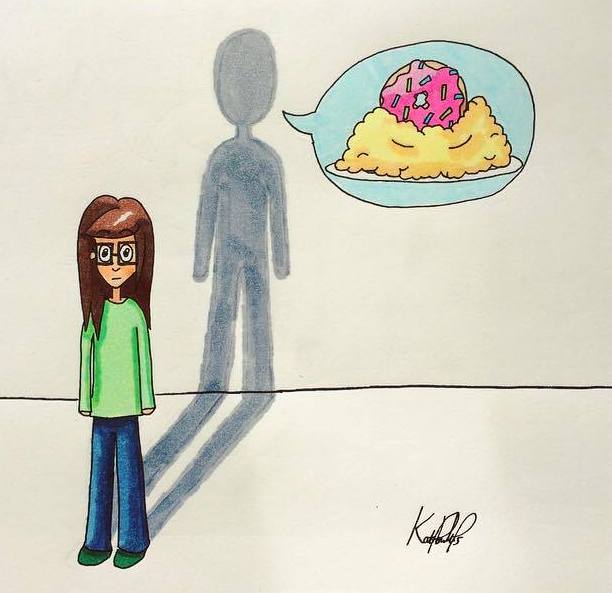
For me then, having an eating disorder isn’t just about struggling at meals, it is about being constantly controlled and dictated to 24 hours a day 7 days a week, a voice that follows me no matter where I go or how unconscious I am, interfering with thoughts and my ability to function even when food is nowhere nearby. It is a nice idea to assume that eating disorders do just live at the table and that meal times are the only difficult times for sufferers, but to tell you the truth, when you have an eating disorder, that devil will stick to you like an unrelenting shadow.

Take care everyone x

EatingDisorderTable

The Problem With Before And After Photos In Eating Disorder Recovery

A few months ago, towards the end of February, it was Eating Disorders awareness week, so naturally I did as I always do on this occasion and buried my head in the sand for the duration of the week (I also allowed children to use the remaining sand to build sand castles atop my hiding place because I am such a lovely person). This may sound like odd behaviour for someone who is constantly talking about mental health problems like eating disorders in order to raise awareness and for someone who has a strong disliking of sand, but then again odd behaviour is what I am known for. Literally.

The reason that I avoided the internet during that week, and indeed avoid it every year, is that it is a week in which social media is filled with “before and after” pictures, aka photos of someone taken during the depths of their illness, compared to a later photo taken post/during recovery. Don’t get me wrong, these photos certainly have their place and I would be lying if I were to say that I have never been inspired by any of them. Often these pictures will come with an empowering and motivating story of someone’s journey in recovery and triumph over anorexia, and that is brilliant. That is something that should be celebrated, and those stories  are shared throughout the Eating Disorder community to encourage others to fight their illnesses and to give hope to those who doubt recovery is truly possible. I love these stories but it is not the stories of recovery that I have a problem with, rather I have a problem with the “before and after” photos that are often involved in telling the triumphant tale.

Firstly, these images will usually show the person in the depths of their illness as an incredibly underweight individual, with ribs popping out so far all over the place that you could easily use them as a xylophone. Regardless of the inspirational intention with which they were posted, there is always the risk of these pictures going on to be triggers for other sufferers or, dare I say it, “thinspiration” for all those misguided souls who think that anorexia is something to aspire to. They can also make sufferers who are perhaps not as underweight (or who are unable to see themselves as that underweight) consequently see these images and feel that they cannot seek help because they aren’t “thin enough” or “bad enough”, when encouraging people to seek treatment is supposed to be the whole point of a week dedicated to educating and raising awareness of eating disorders. Similarly, in their representation of someone with an eating disorder and someone without, they encourage the myth that eating disorders are about being thin and that eating disorders can be seen, (a myth I have tried to tackle here: Why it is physically impossible to “look anorexic”.)
For people who do not know much about eating disorders and who do not have the time or interest in reading full accounts of recovery journeys, these snapshots may be the only experience they get of someone with an eating disorder, so the risk is that the stigma and lesson of “ill is underweight”, “well is a healthy weight” will be perpetuated without taking into account the far more complex and important internal and mental struggle that is having an eating disorder.

Similarly, as an image to summarise recovery, I feel it is problematic in that the main difference that is visible between the two pictures is weight, which implies that the main difference one goes through is the difference of the number on the scales. It suggests that in recovery, the biggest thing you “gain” is weight, when really weight is probably the smallest of all the things I have seen people gain in recovery. I may not be able to speak as a recovered person myself, but of all the friends I have watched beat their eating disorders into a soggy pulp on the ground that is no longer able to control their lives, the change in their weight has been the least significant change of all. Okay there is a change in weight and perhaps clothes size, but when I see my recovered friends, I do not see the change in their BMI, what strikes me most is the change in their lifestyle and their overall presentation as a person. To me they have not gained weight as much as they have gained themselves. When you are in the depths of your eating disorder, as much as you fool yourself, you cannot maintain a normal life. Your ability to have a job, have normal relationships with people, be happy or even function are seriously compromised, and these things are all aspects of life that can be improved on with recovery. I have seen friends go on to study medicine at university, have romantic relationships, give birth to children, climb mountains (I am talking proper big mountains like Kilimanjaro), and travel the world. They have regained their ability to properly smile, to laugh without having to fake it, and to me seeing all those photos of them skydiving in Australia or getting married and having babies have been far more significant and noticeable changes than what size jeans they wear. It is these aspects of recovery that are the really important reasons that people need to fight and it is these changes in lifestyle that are the really inspiring stories. Yes weight gain is a part of the journey, but what is more important is the places that weight can take you, for example to medical school or up a flipping huge mountain.

On a similar note, my other issue is that I feel before and after photos simplify the process of recovery. In one picture you probably have someone who is underweight and either looking miserable or faking a smile out of dead eyes, and in the other you have someone who has gained weight and perhaps, is beaming at you with genuine joy. This then makes recovery very straight forward, “Being underweight make you unhappy and thus gaining weight will make you happy”. It automatically assumes that the happiness comes as the weight increases, without highlighting the far more complicated journey in getting that weight to be there.

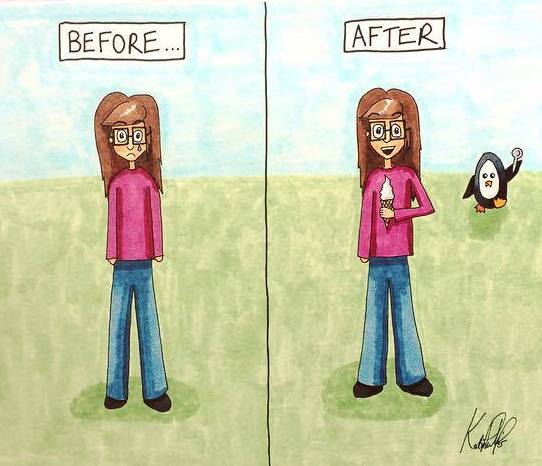
It is hard to explain exactly what I mean, but it is like looking at a picture of someone standing in a field looking miserable, and then another photo of them smiling in the same field but with the addition of an ice cream. At face value then, you can look at these pictures and think “well a person was sad because they didn’t have an ice cream but then they got an ice cream and they were happy” , simple. What the picture will not tell you however, is how that ice cream got there. Little would you know that the person had not simply walked up to the nearest ice cream van, asked for a 99p Mr Whippy and walked away smiling, just as the person in recovery had not simply gained some weight, and in turn, a smile (side note did you know that they don’t even do 99p Mr Whippys anymore? They are now at least £1.50! How do those ice cream men still have the nerve to play jolly tunes as they patrol the streets for customers now that they are basically performing daylight robbery rather than offering a merry treat. You can play Greensleeves all you want but that doesn’t change the fact you are making me re-mortgage the house to buy myself an ice cream. SHAME ON YOU ICE CREAM MEN. SHAME ON YOU.)

Anyway, what the picture doesn’t show is that to acquire their ice cream they were forced to go on a perilous test of their endurance, that pushed them to the limits of mental and physical strength. To get that ice cream in the picture, that person had in fact had to walk across continents and cross oceans to America, the largest producer of almonds in 2014 I will have you know, and then had to hand pick hundreds of almonds ready to blend into a creamy milk worthy of a tasty frozen dessert (this person was lactose intolerant so almond milk was the milk required for the job.)
Then, exhausted from months of trekking, nut picking and milk making, that person had to swim across even more oceans into the freezing cold pole of the Arctic where they stirred their almond milk with a wooden spoon atop a large glacier that acted as a natural freezer for their ice cream churning process. Even when the ice cream was made it didn’t get any easier as they had to then wrestle with a penguin who had cheekily tried to steal the ice cream (I don’t blame him to be honest. I would steal ice cream if all I had ever eaten was raw fish), and then they had to get the ice cream all the way back to that field in their country of origin, back through the hot climate of almond fields in America, without the creation melting. Clearly that is a far more character building excursion to get to that point of “person with ice cream in a field” than the picture initially suggests, and I didn’t even tell you the 5 month side trip it took to make the cone in which the ice cream was to rest (it would take too long to tell you fully but as a brief summary it involved a very angry rhino and a lot of waffles).
The person worked hard to get to the point where they were standing in that field with that ice cream, and all that hard work is eradicated, as it is in recovery journeys, when all you see is a simple before and after shot.

Obviously I am not saying we should stop people from sharing their recovery stories and indeed, if you have recovered from an eating disorder, then I am OVERWHELMINGLY proud and impressed by your determination and strength. If you were here with me now rather than wherever you are reading this, I would give you so many rounds of applause that my hands would fall off and I would be left clapping stumpy wrists to show appreciation of your achievement. What I am saying is that maybe, more often we should be celebrating and telling these stories without the underweight photos that go with them. A story is still a great story without pictures. Hell, look at Harry Potter, that story changed and continues to change generations of people, it has grown theme parks and movie franchises, careers and other astonishing things, all from a pile of words cobbled together with no images at all (For the purpose of this post can we please just pretend that the illustrated versions that are currently in production don’t exist.) Still, even when pictures are added to the Harry Potter books, it will still be the words that are doing all the talking.

So that is why I have a problem with before and after photos when it comes to eating disorder recovery, not because I don’t like inspirational stories or don’t want people to celebrate their achievements, but because those pictures don’t really do anything but diminish and reduce the value and greatness of what has been achieved. As a snapshot ok, a picture may say a thousand words, but a recovery journey is made up of millions of them.

Take care everyone x

BeforeAndAfter

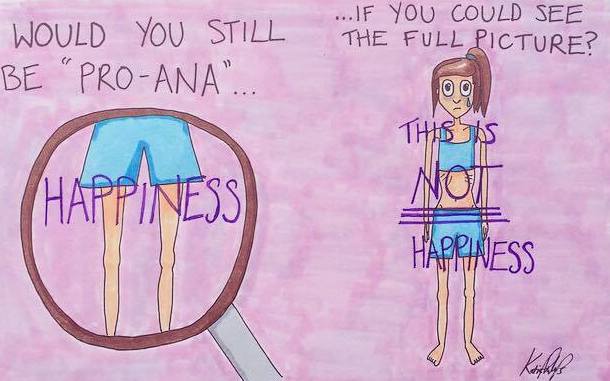
A Message To All The People Out There Who Are “Pro-Ana”

Before I get on with the main bulk of this post I just want to preface it by clearly stating the fact that eating disorders are not a choice and are horrible illnesses that barge into and take people’s lives without those people having a chance to stop the aforementioned barging. However, as involuntary as eating disorders are, there are some people out there who for some reason see them as a glamorous and desirable life choice/thing to aspire to. It is to THESE people and not all involuntary sufferers out there, to whom I address this post. All clear? Cool, let’s get on with it…

In life, there are many types of people that I do not understand. For example, I do not understand people who eat a piece of Christmas cake and leave the icing/marzipan behind (THAT IS THE BEST PART WITHOUT THAT IT IS JUST RAISINS), neither do I understand the people planning to vote for Donald Trump in the upcoming election. Possibly the most confusing people to me however, are those who frequent “pro anorexia” websites online (yeah. That’s right. They confuse me even more than Donald Trump supporters. At least Donald Trump has floppy hair you can laugh at when he is spouting bile. Anorexia has no floppy hair and therefore no room for visual comedy). If you didn’t know already, pro-anorexia websites are basically as horrendously sick and disturbing as they sound. Having avoided them like the plague myself, I cannot provide an in depth image as to what they show, but from what I gather it is pretty much a lot of pictures of skeletal bodies that people stare at in order to inspire them to achieve the beauty of collarbones that make you look like you have swallowed a coat hanger. There also may be forums where people can discuss diet tips, encourage each other not to eat and who generally see anorexia as something that is desirable, that they want to have (hence the ‘pro’ in the name).

Now I am not one to tell people what to do. When I do not understand someone’s life choices I am not going to stand in their way and insist they change their deepest desires. Though I do not understand people who leave the icing and marzipan from the top of Christmas cakes (or indeed people who choose to eat Christmas cake when the other option is chocolate log…there is no decision there…obviously it is chocolate log every time), I have never spied an icing abandoner, approached them in outrage and chased them down the street waving the forgotten almond paste and fondant. This is because although I do not understand this behaviour, I trust that they have tried icing before and following the full experience and all the knowledge available, they know that cake without icing is really what they want.
When it comes to people who want eating disorders however, I simply cannot allow myself to sit back and let them make these life “choices”, as in my eyes the only person who would ever make such a decision as to get an eating disorder would be a poor uninformed soul who doesn’t really know what they are getting into. For this reason then, today I thought I would just write a little post to all those people who want eating disorders, in order for them to realise what life with an eating disorder really is like. Basically I am enlarging the font of the little set of “terms and conditions” that accompany the joy of being thin and not eating, so that people can be sure it is what they want. So to all people who want to have an eating disorder, that is cool, but before you go ahead and seek one out, here are a few things that I want you all to know:

1. Eating Disorders are not great for your physical health: Not eating is great and all but it is important to be aware that not eating is potentially fatal and is the reason that eating disorders are the number one killers in terms of mental health problems. Even if you don’t die they will definitely wreck your body, so before investing in an eating disorder you may want to say goodbye to your health first, as lord knows you wont be seeing it for a while. For one thing your hair is going to fall out in clumps, your skin is going to become dry and pale and you will probably have bags under your eyes so big that you can fit a week’s food shop in them (no more paying 5p for a carrier from Tesco for you! Bargain!). You are also going to be freezing cold all the time no matter what the weather, so in preparation you may want to purchase forty to fifty hot water bottles, blankets and thick thermal fleecy undergarments (sexy). This does have the benefit of making you a good pastry chef (as all bake off fans will know, cold hands are essential to a good apple pie), but on the down side you won’t be able to eat that pastry without agonising guilt afterwards… Also you may want to buy a wheel chair or walking stick as eating disorders love to screw with your bones (picture anorexia as a dog having a good old gnaw on your elbow until most of the bone has chipped away, leaving an osteoporosis filled powder). Oh yeah, and if you want kids anorexia will probably render you infertile too, but hey, who cares! You will save a tonne on child care and you get to be thin right? Wrong…

2. Eating Disorders do not make you thin: This disclaimer is a tricky one but allow me to explain. Basically there seems to be this idea that when you have an eating disorder attacking your mind, this will be physically evident in a lot of weight loss. For one thing, not all eating disorders involve weight loss, and for another thing even if they do, you will not be able to appreciate it. Sure you will be able to get on the scales and see the numbers go down but when you look at the reflection in the mirror it is likely you will not see that weight loss at all. Interestingly, when you don’t eat enough and become underweight, self perception becomes more and more distorted, so you may even see yourself as having gained when really the opposite is true. Its just a fun little game eating disorders like to play (the jokers!), so if wanting an eating disorder to “look thin” then maybe look elsewhere in terms of life goals and ambitions as looking thin is not a package deal with an eating disorder. The physical complications mentioned above are a package deal no matter what though, so no worries there.

3. Eating Disorders do not make you happy: Much like the myth that eating disorders make you thin, there is the idea that they will make you happy (probably because there is the association that being thin makes you happy but the happiness idea remains nonetheless). Yeah, if you want an eating disorder because you think it will make you happier, once again I would advise you to reconsider, as being undernourished is actually a way to encourage our good friend depression to join the party rather than the desired eternal bliss. Often anxiety will pop round too, so again be aware that those two delights are part of the package deal. You will often note that in these pictures on ‘thinspiration’ websites there will often be “models” without a face (primarily the images show thigh gaps and rib cages), and the reason for this is because were consumers to see the full image, the whole thing wouldn’t look so appealing. After all it is a lot more difficult to sell the idea of how beautiful a hipbone is when the owner of said bone is crying and waiting for the pain inside to end.

4. Eating disorders will mess up your social life: Aside from the effects eating disorders will have on your body and mood, it is also important to note that they affect your social life, and by “affect” I mean utterly destroy it until you are left all alone. You can have the best friends in the world but ultimately with all the “catch ups over drinks” and “dinner reservations” you will constantly find yourself avoiding them as you cannot join in with any activity whatsoever. You may be thinking “Ok I will ruin pizza night but I can still go out to play mini golf with friends”. That is a really nice thought, yet alas this will get ruined as well. Even if an activity is not revolving around food, you will still not want to go either because you have exercises to do or because you are too miserable, anxious/hate yourself and are too self conscious to socialise.

5. Eating disorders will/are likely to cause some issues in the workplace: Much like socialising with friends, working or holding down a job will also become impossible with an eating disorder, even if your job is not food related. Again we have the classics of depression and anxiety making it hard to leave the house, as well as the required sick days for your battered physique (you may pick up virus’ and illnesses a lot easier than most people due to damaged immune system, so stock up on the cough syrup). Bigger than that however will be the issue of concentration. Yeah…with an eating disorder your ability to function mentally will spiral away faster than water down a plug hole (especially water down the plug hole in your bath remember as all your hair will have fallen out and blocked the pipes with soggy wodges of entangled strands). Ahh, nothing says “living the life” like a Saturday night spent in the house pulling hair bundles the size of kittens from your drain (top tip: if you put goggly eyes on those bundles they look even more like kittens. They are adorable. Great Christmas presents too and December is coming! Get malting!). With mental functioning at an all time low then, it is likely you will lose any job you do have and money problems will likely follow as well as our old pals who love to join money problems for a party, depression and anxiety!

So that is only five of the terms and conditions important to be aware of when wanting an eating disorder (there are millions, trust me), but I think that for now I have made my point/ helped potential eating disorder investors to be a little more aware of what they are desiring/encouraging when scrolling through those pro anorexia websites. Like I said, I am not one to tell anyone what to do so if these points don’t diminish the glamour of the thigh gap photos, then go ahead and have fun. I just want you to know what you are getting yourself into so you can make an informed decision. There are people out there who want eating disorders, but I doubt they would find the unwelcome surprises that come with them as appealing.

Take care everyone x

pro-anorexia