Why Baby Steps Are More Important Than New Year’s Resolutions In Mental Health Recovery

There are two kinds of people in this world, those who like and make New Year’s resolutions, and those who think that New Year’s resolutions are pointless and should actually be renamed as “things you try to do all year but give up on by February”. I myself however, am somewhat in the middle of these two kinds of people (much like I am on the whole Marmite debate. I don’t love it, nor do I hate it. I am truly indifferent…WHAT DOES THIS MEAN).
I actually like the idea behind New Year’s resolutions. I think it is good to see the new year as a chance to improve on whatever happened in the previous one, see it as a fresh start and a clean slate without all the baggage you have dragged around for the past twelve months. That said, I have not made a New Year’s resolution myself since 2010, and that is because I feel that when people make these promises to change, they are far too ambitious and unattainable. They set themselves tasks like “fly to the moon” or “play tennis at Wimbledon” when they haven’t yet thought to apply to astronaut school or pick up a racket. Back in 2010 I made three new years resolutions, those being:

  1. Be happy all the time
  2. No anorexia
  3. No OCD

As midnight approached I felt a surge of excitement. The moment that clock chimed (lets pretend we still live in a time where it is common to have a grandfather clock that chimes..it is a nicer image than me staring at the digital numbers on my phone waiting for 23:59 to become 00:00), my life was going to change, I was determined, and I had made a promise to myself that 2011 was going to be better. Then it happened. The clock struck midnight, and suddenly my carriage that had brought me to the party turned into a pumpkin and I lost a glass slipper!…Wait..no sorry…got mixed up in the life of someone else a little…no, what actually happened was the clock struck midnight and I felt a weight fall from my shoulders (much like a glass slipper was slipping from the sole of a future princess…)

Finally 2011 was here and I was recovered, I never had to do an OCD ritual again, I could eat and I would be smiling for the rest of my life. Looking back I can’t believe I was so deluded, but the first thing I did in 2011 was to run to the bathroom to wash my hands once, just to prove that I was in control again and could stop easily after one squirt of soap. But I didn’t stop. After the squirt had been collected in to my hands my thoughts immediately burst in and I found myself rubbing my hands together vigorously with the same urgency as I had done in 2010. I became incredibly stuck, thoughts flying so rapidly that before I knew it a significant amount of time had passed, over 100 squirts of soap had been used and the only thing I could see through the tears of despair and frustration was a basin full of bubbles. As I went back downstairs to join the others still milling around drinking champagne and watching the odd late firework banging about in the distance, I felt totally defeated. I had failed. I hadn’t even kept my resolution for 24 hours before engaging in the behaviours I told myself I was finished with, and my hopes for change fizzled out like an old sparkler. Granted I was being a bit dramatic by seeing the whole year as ruined and giving up because of one ritual, but logically because of the strict boundaries of “No” OCD, I had in essence failed, so what was the point carrying on? Clearly recovery was impossible.
It is only now looking back that I realise that the problem with my resolution and the reason I had “failed” was entirely the wording and dramatic nature of the resolution I had made. I didn’t set myself a manageable goal of trying to reduce the amount of time in the shower over the course of the year or anything reasonable, a goal that would focus on steady progress with potential slip ups yet still a continuous effort to push forward. Instead I had set myself the impossible task of transforming from a person who had been dominated by mental health problems for the last 7 years to a “normal person” in less than 7 seconds, which is pretty much like someone setting the goal of “flying to the moon” without realising all the steps it takes to get to that point.

Admittedly, I have always struggled with people telling me to “take things steady” and “take baby steps” when it comes to recovery. I am a very black and white person, either I am better or I am not, “baby steps” and little goals like “exercise for five minutes less per day” do not help me. I want total freedom from this mental health cage, not just the same cage with an ocean view.
However, my attitude to all this recently underwent a bit of refurbishment when I was glancing through pictures on Facebook and stumbled across a photograph that I posted online in 2014 to commemorate the fact that I had graduated from university, and for the first time, as I looked at the picture, taking “baby steps” made some sense.

babysteps
As you can see this picture is a comparison shot between little 4 year old me on my first day of school, and 22 year old me graduating from university after a rocky 18 years bumbling through the education system (I look pretty happy in that picture but that was because my mum took it before I found out I wasn’t allowed to keep the funny hat and gown. That was a major disappointment. The only thing I got out of that day was a piece of paper saying I had a theology degree. Who the hell wants that? I didn’t go to university to be educated, I went for the damn hat!)

Looking at these pictures it is very black and white. In one I have a degree (and a marvellous hat), and in the other, I have no degree (and no hat. 4 year old Katie had a hard life). That said, though there is a stark difference in achievement between those two pictures, it isn’t because I made a grand resolution at the age of 4 that changed my life in a second. When I was 4, the thought of getting a degree one day had not entered my mind.
Imagine if someone went back in time now, found little 4 year old me and said “go and get a degree in theology this year”. I would probably have cried (and asked what the hell theology was). When I was 4 there was no way I could just go off and get a degree. I had birthday parties to plan for my teddy bears, letters to write to Santa and hopscotch competitions to attend! I couldn’t tie my shoes yet let alone write essays on Saint Thomas Aquinas or Augustine of Hippo (genuine name…Hippo…it has been years but I am still amused), so setting that goal for me at age four would have been overly ambitious and basically would have set me up to fail.
Had this time travelling person told me to go to school that day however instead of getting a degree right then and there, I would have probably looked at them, nodded and then got on with it. When doing so I wouldn’t have realised that me turning up for a morning of finger painting was actually the first part of my journey to that oh so lovely yet tragically temporary hat (and a degree I am now stuck with forever), but it was. Without achieving all those little steps in-between, the sports days, the story books and the words of wisdom over the years, I would never have got that degree (actually maybe cancel the sports day bit..I don’t think they were particularly important…).

My 2010 new years resolutions to totally recover in the blink of an eye then, were basically the equivalent of me telling 4 year old Katie to go and get a degree before the little tike had learned to read, and it is in realising this that I can see the value in making new years resolutions, as long as they are the baby steps to get you to your goal rather than a leap to success that no Olympic long jumper could make even with a springboard.
If you want to set yourself a resolution for 2017, make a resolution that you can do over time, that allows for mistakes and gradual progress rather than instantaneous results. If you want to recover completely from OCD, make your goal to try and reduced the number of times you get caught in rituals over the course of the year. If you want to recover from depression don’t set the goal of being happy all the time, simply think about the things that could one day make you happy and go out trying to achieve them, even if that goal is just phoning up to enquire about a course. It is the same with progress in eating disorder behaviours as well as any other mental health condition, and though admittedly it takes a lot longer than the midnight miracle method I wished for in 2010, I think it is the only way to make it through this journey.

My hope in life is that one day I will be able to take a picture as someone who is no longer struggling with mental illness and to see it alongside that 4 year old me as a sign of how far I have come in ways other than education, and working towards that is my goal for the next twelve months. 2017 is not going to be “my year”, the year I change, recover totally and get a brand new life, but it is another year in which I will continue my 2016 resolution of doing all I can, listening to professionals, talking and attending all appointments, to one day make that massive goal of recovery. Taking my medication this morning has not made me better, but hopefully it is a baby step along the way.

Happy New Year everyone x

newyear

An Explanation Of Invisible OCD Rituals

When most people imagine someone with OCD carrying out a ritual, they probably picture them visually carrying the ritual out in the “real world”. Maybe some will picture a person repeatedly tapping a light switch, arranging books or washing their hands, but it is unlikely that the person pictured will simply be standing there with no obvious signs of ritualistic activity.
However, many people with OCD actually have rituals that can be carried out invisibly, and this is a side to OCD that I feel needs more discussion/awareness raised, partly to help others understand the condition better, but partly to help sufferers who do not realise that what they are experiencing is actually a form of OCD that can be treated.

Now I have started to write this blog post I have realised just how hard trying to explain a mental ritual is to people who may not have had them themselves (damn it past Katie why did you have this as an idea for a blog).
If trying to give a rough idea in terms of my OCD though, my personal thought rituals generally involve things like compulsively picturing certain events or people, thinking the same words a certain number of times, having to remember something in exact detail or ritualistic blinking (which I suppose isn’t really a thought ritual as if you know what I am doing you can physically see it, but in most circumstances people don’t notice and thus I count it as one of the lesser known invisible sides to the illness. Even when people do notice I am fairly good at covering it up anyway. You would not believe the number of times people have asked if I am ok because I am flapping my eyelids like the wings of a hummingbird and I have had to pretend I had an eyelash. I used to feel very bad saying this as I don’t like lying, but recently the guilt has gone as I realised that it isn’t actually a lie. It is indeed a true fact that I have eyelashes…just not in the specific eye location implied by my blinking…God this is a long set of brackets…sorry about that…I will close them now…actually wait…no it is ok that was all I had to say about blinking…today at least).

Some of these thought rituals mentioned above are fairly straightforward, as in the “repeating a certain thought over and over”. Okay it can take a long time but it is easy to understand and explain to professionals as a symptom. This is not however the case with all thought rituals, and in order to give some impression of just how complex they can become, I thought I would explain a specifically long and complicated one of mine (if you are able to follow this next bit and gain any sense from it then congratulations, you are a genius, please apply to Mensa immediately).

So, probably the most complex of my rituals is one that I carry out every night before I go to sleep in order to “keep my friends and family safe” (though I am of course aware that rationally there is no way that my thoughts prior to the land of nod are capable of such safeguarding. Nevertheless I still carry them out every evening without fail…GAH!)

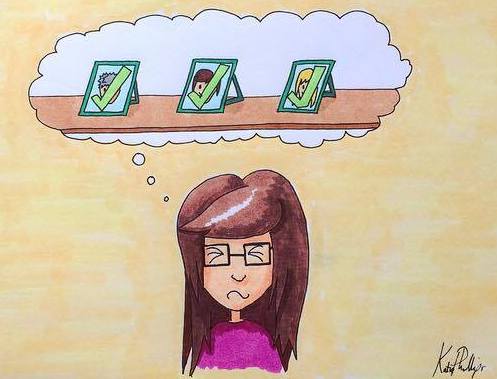
The start of the ritual involves picturing a long mantlepiece (it is made of high quality mahogany in case you are interested), and it is lined with photo frames, each one containing the face of a loved one that I wish to protect. Over the years the photos of the people in these frames have changed as people have come and gone from my life, but it is rare that a picture is removed and more common for an extra one to randomly appear when someone becomes particularly special to me (bear in mind this is a very long mantlepiece that can hold an infinite number of frames. It is a nightmare to dust.)
Once all the pictures are imagined in their neat little line, the next step is to imagine a paintbrush with green paint on the end drawing a tick over the face of each person to confirm them as safe, much like an attendance sheet register thing that you have in school. What must not happen is that I picture a red cross being painted over each face. It sounds easy enough, after all they are my thoughts so surely I can think what I want (ha!), but it is very much like that trick when people ask you to imagine a scenario and not to imagine a white elephant, a statement after which you can think of little other than a trunked creature looming in the forefront of your mind. Once the green tick is imagined on the person’s face I then have to move on to the next picture and so on until all of the faces are adorned with a flourish of bright jade acrylic. However, if during this process one of the pictures goes wrong (aka they get a red cross), then I have to start the entire thing again from photo one. Even if I finally manage a line of perfect ticks though, the ritual is not over, as then I have to imagine staring at all these approved photographs for 100 counts without imagining a gust of wind blowing any of the pictures over which is incredibly stressful as if such a wind occurs I have to whip out the paint brush and start all over again. That little explanation from the painting of the green ticks is step ONE of this thought ritual.
There are ten steps overall. TEN.

Rest assured, I will not elaborate on the next nine steps as I fear I would be here all day. No matter what step I get to however, if there are any mistakes I am sent back to step one and hopefully this explains somewhat the difficulty, complexity and time consuming nature of rituals that may not be visible like those in which I wash my hands multiple times. I realise it probably sounds a bit weird to say that I get stressed and upset over imaginary breezes blowing imaginary photo frames off an imaginary mantlepiece, but if those breezes come and if those pictures fall then I fear I will put everyone I have ever loved in danger due to my negligence, an understandably scary thought for anyone.

You are probably wondering how on earth I concocted such ridiculously long mental routines, yet if you were to ask me how they appeared I honestly couldn’t tell you. They didn’t exactly appear overnight, rather they developed over time in a gradual process I cannot remember the beginning of. That said, if I had to pin the origin of my mental rituals it would probably be my first hospital admission to a psychiatric unit over ten years ago. With most people, OCD tends to evolve and morph over time as the person’s life and situation changes and it is often a dramatic change in environment or situation (like suddenly being inpatient in hospital), that can cause rituals to flick on stealth mode and turn invisible. Before my first hospital admission, all of my rituals were visible and involved things like showering for hours on end or repeatedly washing my hands. In hospital however, none of these rituals were possible as I was physically locked out of my bathroom and had to ask for permission each time I needed to use it, at which point I would be supervised and stopped from engaging in any behaviours. Now, on the surface, you would think this cured the problem. True, I was no longer showering for hours every day, but that wasn’t because I didn’t have OCD anymore, it was because I was physically incapable of getting to the shower despite best efforts (turns out I am rubbish at picking locks/kicking down doors of psychiatric unit shower rooms. I would make a poor criminal.)
By being physically locked away from the equipment needed to do my usual rituals then, my rituals changed and adapted. The OCD was too strong to just disappear at the first hurdle in the road and instead my compulsive behaviours became located in areas nobody could lock me out of, areas nobody could bar my access too, those areas being found in my own head (just left of imagination next to the frontal lobe to be specific).

The reason this invisible kind of thought ritual OCD is less talked about than its more apparent variants is probably because of how difficult it is to explain (let alone understand…seriously if you are following this get on that Mensa thing). Nevertheless, difficult or not I think it is a really important topic to raise awareness of as like I said near the start, some people may be suffering from OCD in this way and not really aware of it. I have been in treatment for years so when aspects of my OCD became internal I knew immediately what it was, yet I am sure there will be people out there struggling who never knew that this was a thing. Perhaps there are people out there silently suffering, in distress as they find themselves having to paint ticks and avoid imaginary gales without having any idea of why or how to stop it. Had I no knowledge of OCD and were I experiencing such things there is a good chance I wouldn’t tell anyone because even I can admit that thought rituals sound a bit “crazy” and are not something you would want to bring up voluntarily or admit to, especially if you didn’t know anyone else felt the same. Maybe people with thought rituals don’t even realise it is OCD because they think OCD is washing, and it is for those people (as well as any other lovely people reading this of course) that I have written this post.

If you are struggling with compulsively carrying out intricate thought patterns that cause distress if not performed correctly, you certainly are not alone and it doesn’t mean you are crazy. Obviously I cannot diagnose anyone online, but if you relate to this post there is a good chance that what you are struggling with is an invisible form of OCD. That probably sounds scary if you haven’t ever considered yourself as a person with mental illness in need of therapy, but hopefully it will provide some comfort knowing that your struggles are part of an illness that can be treated. It is not something to be suffered in silence even if your routines are performed in such a manner and I would urge anyone out there relating to this to go to the GP and ask for help. If they have any awareness of mental health issues they will NOT think you are “weird”, they will understand that this is a common issue for OCD sufferers and hopefully by speaking out you will be able to get the help you need. Also if there are any GPs out there or students training in medicine, maybe this post could help you identify these symptoms and help someone in the future. Either way I really think invisible thought OCD rituals need more discussion. The more we are aware of OCD, the more we can understand and most importantly of all, defeat it.

Take care everyone x

mantlepiece

Why I Wish Mental Health Problems Came In Boxes

Whenever a doctor or health care professional looks at my notes for a brief overview of my mental health, they will see three separate words:

Depression
OCD
Anorexia

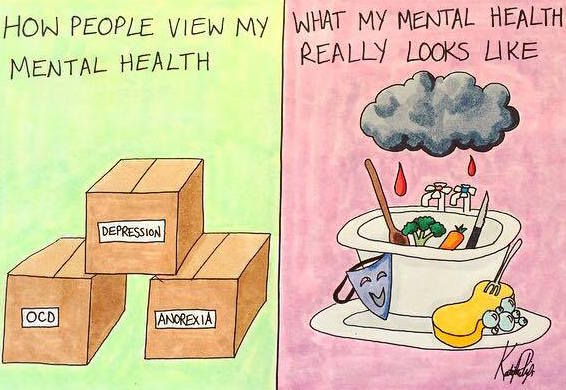
The words may not be on separate lines as I have illustrated above, but there is always some kind of gap between them, even if that gap is only in the form of a comma or perhaps a space bar. As a brief summary of my mental health, I suppose those three words can give you a reasonable idea of my struggles. Nevertheless, the idea gathered from those three words is only a reasonable idea, as my illnesses are far more intertwined than many people realise. If I were to write the three diagnoses in a more accurate form, they would look like this:

boxes1
Now granted, that wouldn’t be as easy to decipher as the former example (although doctors are used to examining messy handwriting…), but it would be a lot closer to the truth and what mental illnesses feel like.
I think that some professionals, even those working in mental health, have a a problematic view of the illnesses that they treat by thinking that they can be separated into neat tidy boxes as easily as I can separate these words just by hitting the space bar. Don’t get me wrong, I would LOVE it if they were right and that mental illnesses really did come in boxes, much as the title of this blog post suggests. For one thing, if mental illnesses came wrapped and caged within physical cubed objects it might be possible to operate on a person and physically remove the cause of any problems with the ease with which they remove a tonsil (or tonsils…I think people have more than one tonsil…I really need to get round to counting mine one of these days. It has been on my to-do list for years). More importantly though, were mental illnesses to be so easily distinguished from each other, it would make treatment far more straight forward.

In terms of treatment I get for my mental health, I have several very separate teams of people in several very separate buildings. There is the hospital for my eating disorder which always smells of cauliflower cheese, there is the general mental health centre for my depression (which doesn’t smell much of cauliflower or cheese), and if I get accepted to the new service I was assessed for two weeks ago, I will have another building to attend appointments in regarding OCD (I haven’t been in that building yet so I am afraid I cannot document how much this place smells of either cauliflower or cheese but I will be sure to inform you the moment I know).
When I walk into each building every week, I am expected to talk about and deal with the illness that has been designated to that service. It’s as if they think I can leave my other mental illnesses by the door still packaged in their neat little boxes, without realising that the three are inextricably linked in a complex mesh even I cannot understand, so if one comes into the room with me, the other two cannot help but tag along.

For example, because of my mental health problems I have a lot of behaviours. One of these is that I tie my hair up repeatedly before a meal in a routine that can take as short as five minutes or as long as several hours. Now, if asked, I would say that this behaviour is an eating disorder behaviour as I only carry it out prior to a meal. If I wasn’t about to eat something, I could tie my hair up in seconds so I would say that as the anxiety is more about preparing for the impending meal, the hair tying is a part of anorexia. That said, there are many professionals who have argued with me that it is in fact an OCD behaviour, an obsessive ritual of repetitive compulsions that make no sense in rational terms. Who is to say which one of us is right in our conclusion? Both have fair points and it is easy to argue either way. What about the fact that I cut the majority of foods into four separate pieces? It is related to food so it could be my eating disorder, yet the numbers and rigidity with which I handle a knife is far more akin to the OCD. So what is the answer? Who is the culprit in causing each of these rituals? Who can solve this mystery? Someone find Poirot immediately! (Finding Miss Marple or Sherlock would also be helpful but they are second choices because they don’t have fancy moustaches.)

It isn’t that I particularly care which of my diagnoses is causing the problem, I just want them to go away, yet without knowing the specific name of the villain in this situation it is hard to find a professional able to help me. When I talk to the eating disorder services they tell me to talk about the ritualistic eating behaviours with the OCD team yet the OCD team tell me that is a job for the eating disorder hospital and as a result, treatment for these behaviours tends to slip through the cracks without ever getting a chance to materialise because they don’t fit into the neat boxes everybody wants them to. In this example it isn’t really that big of an issue as in spite of not fitting into the neat boxes all the time, I still receive treatment for both OCD and anorexia even if is is unable to solve the issues where behaviours are a combination of the two. The biggest issue however, is when this lack of mental health diagnoses tidiness doesn’t just get in the way of someone’s treatment, but gets in the way of them being accepted for treatment at all.

All over the world people including myself who are seriously struggling with mental health problems are referred to services that turn them down not because treatment is not needed, but because the case doesn’t exactly fit into a specific list of criteria. So why not broaden the criteria? Obviously I realise that the issue causing all of these problems is a lack of funding for mental health services and thus the need to have specific criteria to narrow the case load down (don’t worry, when I become prime minister I am going to be chucking so much funding at mental health services that this problem will be solved. I am also going to chuck in a lot of funding to investigating the invention of a mug that keeps a cup of tea at exactly the right temperature for hours on end, but that is a story for another time).
Still, issues with funding or not, it makes absolutely no sense to me seeing the complex soup that is mental health being separated into neat little blocks. I myself have been turned away from services for being “too complex”, which is basically like saying “yes you are crazy and in need of help but you do not fit into our definition of crazy so we are going to have to send you elsewhere only to be told the same thing and referred somewhere new all over again”.

Labelling a mental health problem with a diagnosis like “OCD” or “anorexia” is of course incredibly useful in terms of narrowing down a problem, but even then every person with OCD will experience the illness differently and that needs to be taken into account with the way they are treated as each experience is equally valid. If you go to the supermarket there will be a whole aisle of baked beans, tin upon tin all labelled “baked beans” and sure, they are all “baked beans”, but each one is slightly different just as each person with a diagnosis is slightly different. Nobody should be refused treatment for being the “wrong kind” of crazy, the fact that there is any kind of crazy should be enough.

That is why I wish mental health problems came in boxes, but alas I fear that is one wish that won’t ever come true (much like the wish I made on my 4th birthday to become a penguin. It has been 20 years and I am still waiting. Haven’t even got a sign of a flipper yet.) However, if it is a wish that won’t come true then we need to change the way we see mental disorders and indeed treat them rather than acting as if things are far simpler than they are in reality. It is time we realised that mental illnesses don’t come in boxes and the people who suffer from them don’t either. Rather than refusing to help those of us with a bit of a confusing mess going on, we need to roll our sleeves up and dive in anyway. Everyone is different, yet all are equally worthy of support.

Take care peeps.

box2

Why It Can Be Scary Having People In The House When You Have OCD

In two days time, on the 5th of October 2016, I am having an assessment with a new OCD service that I have been referred to (just clarifying the exact date incase you have invented a time machine and are reading this somewhere in1912 which would make “two days time” a lie. I don’t want to ever lie to any of you. Also if you are in 1912 maybe warn the Titanic to look out for icebergs). I have been waiting for an assessment date for several months now so it should be a relief that the day is finally near and more intense support on the horizon, but my God I am terrified.
Funnily enough, none of that terror comes from the fact it is an assessment where I will be meeting two strangers and having to talk to them openly about my mental health. Over the years I have had hundreds of assessments, I have even had assessments to see if I am suitable for other assessments (seriously, mental health services LOVE assessments. They even sprinkle them on their cereal in the morning), but there is something slightly different about the assessment that is only a few days away. Normally an assessment involves going to a new building, getting lost for several hours down some poorly labeled corridors, and then turning up in a stark room with chairs, a psychologist and a table topped with a box of tissues which I think is supposed to look friendly and welcoming but to me it is intimidating, more a threat of “I WILL MAKE YOU CRY”.
With Wednesday’s assessment however, I don’t have to go anywhere, the two assessors are coming to my house, and THAT is the reason for my currently heightened levels of anxiety.

Like many people who suffer from OCD, I really struggle with people coming to “my” house. I am sure for each individual, the reasons for this vary, but for me it is because my house is my “safe” place. Leaving the house is difficult because I am entering an environment that I have no control over. I do not know who has touched the door handle to whatever building I am in, or when the chair I may be required to sit in was last occupied. Maybe the floor was mopped with antibacterial industrial cleaner minutes before my arrival, maybe it has never seen the bristles of a broom, either way I don’t know, hence why for me, touching things out of the house is more difficult than in my own home. I can’t actually remember the last time I opened a pull door in a public place and I have lost count of the hours I must have spent standing on the side of a road, waiting to cross yet unable to press the little button to alert the traffic light of my presence and inspire an appearance from the little green man. We need more Zebra crossings in this country!

In my house then, it is easier, because I know when everything was last cleaned, who has last used it and I also know that cleaning products are mere moments away should I challenge myself too far and need to whip out the bleach. When other people come into my house however, an element of that control slips from my grasp. For the duration of their visit I cannot control what is touched, moved or anything else people may do with items in my home.

These OCD people (I am sure they have names but for now that is what I shall call them) have said that they want to do the assessment in my house because they need to see me in “my natural habitat”. To be fair that makes sense (although it does make me sound a bit like a tortoise on a nature program being visited in its personal hovel), and as a lot of my rituals take place in my household it will help for them to see the “scene of the crime”, yet in anticipation of their arrival all I can think about is what they will touch during their stay and where they will sit. I have honestly been having nightmares that one of them will have been drinking a lot of tea that morning and need to use the bathroom, aka the holiest of holies, “my tap” (please God let the OCD people be dehydrated just for October 5th).
Of all the people I should be able to be honest with about these kind of difficulties, people from an OCD service would logically be high on the list. If anyone is going to understand my fears it is them, and they are the least likely to come back at me with a dagger of stigma that leaves me feeling like a total freak. Nevertheless I feel I can’t say anything out of the fear that it will be inhospitable.

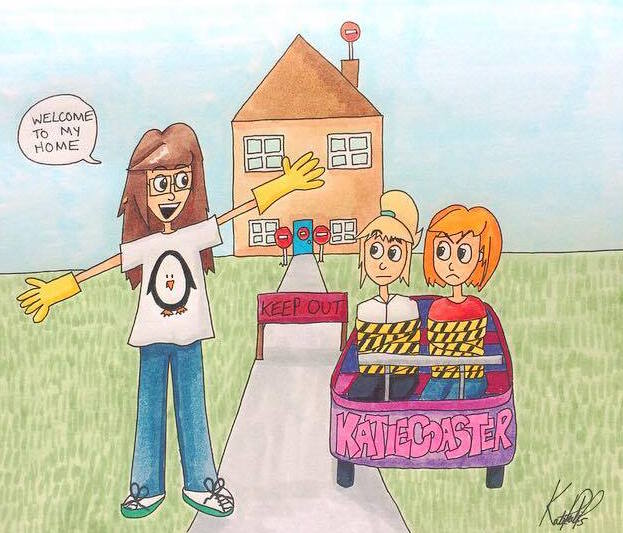
If it was up to me, whenever anyone comes to my house I would like to put them in one of those little carts you get on a roller coaster, where the bar comes down and you hear that voice asking you to “please keep all arms and legs inside the vehicle at all times”!…I wonder if you can get those installed within less than 48 hours…or maybe I could just tie their arms to their sides with tape…is that legal?…I feel like that would be illegal…or at least frowned upon…
Even if it wasn’t frowned upon though I couldn’t do it because like I said it seems too rude. I want to greet these people with the gratitude they deserve for coming all the way to see me for the afternoon, but how can you do that or appear hospitable when you are terrified of the people you are supposed to be greeting? What am I supposed to say? “Hello lovely OCD people, welcome to my humble abode, please make yourself at home but for the love of all that is holy in this world please don’t touch anything because I don’t know where you have been”. Oh dear God what if they want to shake hands. AHHH.

I find it stressful even when friends come over to the house too, but at least my friends know “the rules” prior to their visit. I really hate having to issue guests with a list of requirements alongside their cup of tea, yet I know that if I were not to do so I would be crying hysterically within five minutes which would be even more embarrassing.
Thankfully I am incredibly lucky to have friends who accept my difficulties and respect my level of anxiety. It is a tough balance, as obviously people can’t give into everything when it comes to my OCD. That would be inconvenient for them and would arguably perpetuate my beliefs that their germs are a genuine risk. Nevertheless, there is a distinct difference between following the dictations of my illness, and challenging me whilst not pushing me past my breaking point. My friends know not to take their socks off in the house, not to sit in “my” safe chair, and they know that I will probably take a ridiculously long time if I go to the bathroom due to the necessary washing routines that entails (picture a surgeon preparing to remove someones kidney, soap up to the elbows etc.)
They know that none of my requests are personal, that I don’t think they are dirty people who are infected with a contagious disease, because they know me. Some friends have been in my life since the day of my diagnosis so they grew up with a knowledge and acceptance of my conditions that few would comprehend. One friend was even on holiday in Greece last week and she literally texted me from across the Atlantic (is that right…is Greece across the Atlantic…screw it lets keep it this way, it sounds dramatic), to tell me at 10pm to stop fiddling with my hair as she knew that I was home alone and probably stuck in a hair routine that often takes place during that time (which I was). With friends then, it is ok to tell them not to touch anything, but with strangers no matter how kindly you say it there will always be (in my eyes at least), a little resentment on their part. I know if I went to somebody’s house and they told me to keep out of the lounge for fear of contamination I would probably feel a little offended myself.

It really is a tricky balance trying to be a friendly host whilst trying to manage my anxiety and for this reason I know many people with OCD refuse to allow people into their houses at all, just one reason as to how this illness can be incredibly isolating. If my friends weren’t aware of my mental health I know wouldn’t be able to manage them in the house either.

I guess what I am trying to say is that when it comes to OCD, it isn’t always the behaviour of the sufferer that causes the anxiety, but also the behaviour and actions of those around them. It isn’t just my hands I worry about when it comes to germs, it is everyone nearby. Most importantly though, in feeling this way about others, it is in no way a suggestion that a certain individual is dirty and no personal judgement on a bystander’s levels of hygiene.
Equally then, if you struggle having people in the house, you are not a bad person or rude, just as I am trying to convince myself now that I am not a horrible person for wondering if it is socially acceptable to tie my assessors up with tape in order to restrict movement. Obviously I am not going to do that, I am as always just going to deal with it and hopefully get the courage to speak out so that they are aware of my anxieties rather than suffering in silence, which would consequently make them worse.

If for some reason my assessors are actually reading this prior to our appointment, please know that if I appear inhospitable at any point in your visit I truly am sorry and trying my best. I really do appreciate you making the effort to come to my house and hope you feel welcome and relaxed in my home…JUST PLEASE DON’T TOUCH ANYTHING OR I WILL HAVE TO TIE YOUR ARMS TOGETHER AND WRITE THE NOTES ON MY MENTAL STATE FOR YOU.

Cheers… See you Wednesday!

ocdhouse

Six Tips For Going Home After A Hospital Admission For Mental Health Problems

You know that feeling when you go to the cinema, watch a film, then leave the pitch black room of the movie theatre and step out into the light? Usually, if you have been seeing a film in the day time, the sunlight outside will be such a contrast to the dimmer environment you inhabited previously, that you end up blindly staggering around in a daze wondering where you are, how to deal with the situation, and why on earth that small bucket of popcorn you purchased cost £50.
That overwhelming sudden change in environment and resulting confusion is pretty much what it is like when you leave inpatient treatment in a mental health hospital for the real world after several months (though I admit, in that situation, you are a little less concerned about the price of popcorn in cinemas than the analogical version suggests), and this is one of the reasons so many people relapse the moment they leave 24 hour care.
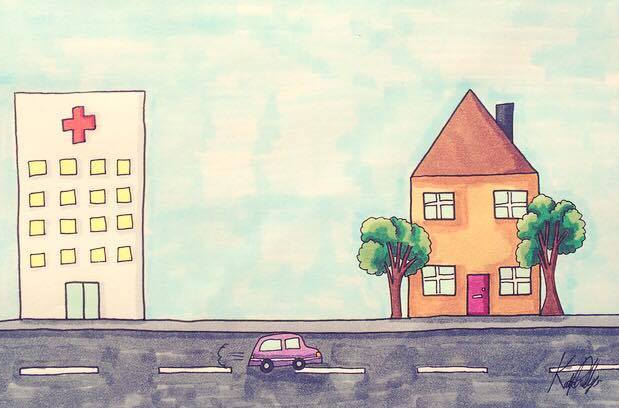
In hospital, you are helped to manage your mental health problem in a very specific environment which, once changed, can make someone feel like they are mentally back at square one, home in the house with the same ghosts that haunted them prior to admission. Everyone knows that going into hospital is hard, but at the same time, there are moments when leaving and going back home doesn’t feel any easier. There is a lot of support out there for people who are due to be admitted, but not a lot of help for those on the brink of freedom, and when on the brink of anything (e.g a cliff or freedom), it is vital to have a parachute, a safety net, a plan, and that is what I hope to help you lovely people with in this post. So as someone who left hospital a mere six days ago themselves (it is a very long story that I won’t bore you with here, but in summary I kicked up a right fuss about being in hospital and have been allowed home on a Community Treatment Order, a full explanation of which can be found via this link to my post about the Mental Health Act…https://bornwithoutmarbles.com/2016/07/11/demystifying-the-mental-health-act-with-penguins/) here are a few nuggets of advice for how to deal with leaving inpatient treatment after a lengthly admission:

1. Make a plan and stick to it: When you are in hospital, there are usually a lot of rules and staff who enforce them. Your days are structured, and going from this very regulated, controlled environment to total freedom where you can do as you please, can be a frightening shift in responsibility. Therefore it is vital to make a plan and rules to stick to at home so that the change is less dramatic and you still have boundaries, rather than the secure bars of safety falling down around you and allowing your mental illness to run wild. Create a basic timetable to follow (not religiously, just to give you a sense of how to structure the days you are suddenly free to spend as you choose), and implement any non-negotiable rules from the ward at home. Follow the plan of recovery that you have been working on in hospital and don’t let your days be filled up by the to-do lists scribbled on the walls of your mind by your anxieties.

2. Take it one day at a time: Before going home it is important to acknowledge that making the transition is never going to be perfect. There are new challenges to face, and with that it is likely there will be little slip ups along the way (If you watched hurdles at the Olympics this year you will know exactly what I mean. Seriously those people were professional hurdlers and they still kept falling over and sending hurdles flying all over the place). The key however is to not see every set back as permission to revert to relapse or give up the race. If you mess up one day, start afresh the next morning and don’t let a bad hour spiral into another bad year. Treat mistakes like sand castles, make them, acknowledge them, whack a shell on top, and then watch the tides of time wash them away.

3. Keep Moving forward: Whenever I leave hospital I often find myself feeling that the geographical move signals a mental move in terms of recovery. When inpatient you are constantly being pushed to move forward, but when you go home it is easy to halt all progress and remain static because your head tells you that you are “not in treatment anymore”. The truth is, wherever you are, you are in treatment and progress in recovery is possible, so to avoid getting stuck, make a list of goals or challenges for each month to keep progress going.

4. Ask for help: Bottling up thoughts and keeping how you feel a secret is a lot harder in hospital than at home because in hospital there are people constantly following you around and shining a torch in your face at night to check if you are sleeping, which, funnily enough you were until someone rudely shone a torch in your face (if you have someone doing that at home then you should probably bring it up with your landlord). Asking for help when inpatient then is not really necessary, because help is often following you around even when you don’t want it. At home however, it is easy to isolate yourself, pretend you are ok to please others, and fall down a slippery slope greased with eels and vaseline because you fear letting others know that you need a little assistance in scrambling back up aforementioned eel ridden slope. Admitting you are struggling is tough, but it is tougher to fight your battles alone. If you can call the hospital to speak to staff from the unit you were in, do that. If not, call a friend. Either way, reach out, be honest and don’t be ashamed of needing people to hold onto.

5. Use your imagination: Whenever I have been in hospital, then go home and struggle, I often find it helpful to imagine I am back in hospital. It doesn’t sound like particularly great advice to help someone in their journey to mental stability by telling them to imagine they are in a psychiatric unit (in terms of signs of insanity that one sounds pretty high up the list), but I like to remind myself of the fact that though things feel so different and so much harder at home, really the only difference is location. If you have managed to eat your meal plan/not self harm/resist compulsive behaviours within hospital walls then going home and doing the same is, in practical terms, no different. The hurdles as it were have not got higher, they are on a different track, so if you can leap them in one place you can leap them in another. Don’t let your head spiral out of control and make you believe that doing what you have been doing for months is as drastic as it feels.

6. Acknowledge that you are still unwell: One of the biggest mistakes when leaving inpatient treatment is to see yourself as “better” and able to thrust yourself back into hard core “normal life”. Just being at home will take a lot of energy and mental effort, so don’t force or pressure yourself to going straight back to a stressful job full time when you have been out of action for a while. Allow yourself to still see the journey to recovery as your full time occupation and ease yourself back into things gradually. If you have a job, maybe go back part time at first so that you still have time to look after yourself, and find your feet back home. Then when you have found your feet (and we all know how much easier life is when one is aware as to the location of all body parts), you can try full time again, but take it steady and prioritise mental health.

So there you have it! Six delightful tips to help keep you on track when making the difficult transition from hospital to home. Maybe calling them delightful is a bit of a stretch, but they are at least what I am trying to use to help me as I find myself suddenly back in reality after several months of being locked away behind a very high and unscalable green fence.
On a more personal and honest note, I know that discharging myself from inpatient treatment six days ago was probably not the best idea, and I know I did it for the wrong reasons, but hopefully it will work out OK in the end. Whether or not these tips are any good of course will be determined by how things go over the next few months of me carrying them out myself back at home.

I guess that is something we will find out together…

Leaving inpatient tips

Unveiling The Secrets Of Life As A Mental Health Nurse

As you are probably all aware, this blog is a blog about mental health.
If you weren’t aware and thought this was actually a blog offering gardening tips, then I am sorry to disappoint you, but I really have no advice to offer in that department so you may want to look elsewhere for tips. All I know is that you should water your plants…but not too much…and plants need sunlight…but then some like to be in cool dark cupboards…yeah like I said I really am not qualified or experienced as a gardener…ANYWAY, browsing the titles of my current collection of posts I have noticed that most of them are aimed at people with mental health problems, but what about a post centred around the people who spend their lives trying to treat those without marbles? How do they feel about working with the mentally ill? What do they like about the job and which parts make them wish they had steered clear of the anxious and the depressed inhabitants of this godforsaken planet, to pursue a career in fish mongering instead? What makes them dream of swapping therapy for cod and medication side effects for a nice piece of haddock? What advice do they have for people thinking about becoming a mental health professional and how does one go about following that dream? If the mentally ill are plants, who are the gardeners providing enough warmth for seed germination and growth? (Please note I just used the word germination…that is a gardening term…maybe I am more qualified in that department than I realised). Well, if you have wanted to know the answers to any of these questions and even if you haven’t, I am here today to give them to you anyway in a hard hitting interview with a real, qualified mental health nurse working on the ward in which I currently reside. Prepare yourself for the secrets of the mental health professionals, the story behind the shift work and a very confused nurse wondering what on earth I am talking about…

LIGHTS GO UP.

[The nurse and I are seated in blue chairs in a place known as “the quiet room”. The conversation begins whilst the sound of the cleaner mopping slops rhythmically in the background]

Me: Hello Nurse Gertrude Potatobucket, thank you so much for joining me today for this interview.

Gertrude Potatobucket: What interview? Who is Gertrude Potatobucket?

Me: This interview. I want to know about the life of a mental health nurse for an article on my blog. Also you are Gertrude Potatobucket for the duration of this interaction because I am hiding your real name in the interest of confidentiality, so you can be brutally honest as nobody will know your true identity.

GP: I will agree to the interview but can’t I pick another name? Why does it have to be Gertrude Potatobucket? That sounds ridiculous.

Me: I will have you know it is not at all ridiculous but is an underused name that deserves more recognition, so no, you cannot pick an alternative. Anyway, I’m supposed to be the one asking questions here so please just accept your new identity and lets get to the good stuff.

GP: Katie I really think…

Me: [In a loud and interrupting manner] QUESTION ONE. WHAT DOES BEING A MENTAL HEALTH NURSE ENTAIL?

GP: [Sighs…there is a long pause during which the sound of mopping appears to increase in volume until Nurse Potatobucket realises that she is going to take part in an interview whether she likes it or not and gets on with answering the question at hand]. The role of a mental health nurse is different depending on what kind of service you are working for but in terms of my responsibilities on this Eating Disorder Unit, I am in charge of co-ordinating health care assistants on shift, running support groups, working with patients in 1:1 sessions, supporting them at meal times and I am in charge of handing out any medication prescribed by Doctors or psychiatrists.

Me: What a busy bee you are! I can almost hear you buzzing, your face is practically aglow with black and yellow stripes. So tell me Gertrude, how did you earn such responsibility? How does one go about becoming a mental health nurse? What training is required?

GP: To be a mental health nurse you need to have at least 5 GCSE’s including maths, English and Science and then go to university for three years to study mental health nursing. You don’t have to go to university to work in mental health though. If someone wanted to be a Health Care Assistant they would need to have something called a care certificate, but it is possible to get a job as an HCA without any official training. If someone has experience in mental health and does a good interview for a job, they may be offered a position and then have the opportunity to do the care certificate whilst working.

Me: Well to qualify alone sounds like a lot of fun but how about the job itself? What would you say is the best thing about being a mental health nurse?

GP: Supporting people and helping them to make positive changes in their lives.

Me: How nice. I don’t want to paint a misleadingly fluffy picture about the job though so tell me, what is the worst thing about being a mental health nurse?

GP: You see some really sad and upsetting stuff. Also shift work can be difficult as you never have a fixed schedule or routine and can be working at day or night depending on your rota. That said I know that “Bertha Potatonose” likes shift work as it enables her to be flexible when looking after her children, so it is different for everyone. Oh God I have just used her real name, can you cut that bit out?

Me: No need, I will simply hide her identity by replacing her real name with Bertha Potatonose.

GP: What is it with you using the word potato in fake surnames?…

Me: [Even louder and more interrupting than the first time the interviewee started to question the interviewer] QUESTION FIVE: HOW DOES BEING A MENTAL HEALTH NURSE AFFECT YOUR DAILY LIFE AND WHAT ADVICE WOULD YOU GIVE TO SOMEONE WHO WANTED TO BE A MENTAL HEALTH NURSE?

GP: [Sighs. Despair at the situation is visible. The cleaner is still mopping in background]. First off I would advise someone to get some life experience or experience as an HCA. Secondly I would say that in terms of daily life you really need to learn to leave work at work and look out for your own wellbeing at home. You can’t look after someone else unless you have first looked after yourself.

Me: Does this mean there any people then that you would advise to avoid looking into being a mental health nurse? Are there any people you feel would be particularly unsuited to the role?

GP: No. It can be a difficult job but anyone can be a mental health nurse. Different people bring different life experiences, skills and character to the job and I think that is important. Mental illnesses don’t all fit into a neat box and neither do the people who are able to be great Mental Health Nurses.

Me: Inspiring. Truly inspiring.
Now Ms Potatobucket, I know that the people at home often worry when speaking to a mental health professional in candid honesty about their condition that they will be thought of as “crazy” or “weird”. Answer me honestly, do mental health nurses ever judge patients regarding what they say in a session?

GP: No, there is never any judgement. All I feel towards people talking about their difficulties is empathy and I want to show compassion towards the difficult time they are having in life.

Me: Well that is a relief. I am sure we will all rest easier in our beds tonight knowing that we can spill our inner most thoughts without fear of being thought to be “weird”. In addition to worries like that, a lot of people in treatment out there may also be struggling at the moment and feeling like things will never get better. Do you think recovery from a mental illness is ever really possible?

GP: Definitely. All mental health nurses hold the hope and belief that the people they are treating can get to a better place. I think everyone is capable of building the strength and determination not to let their mental health problem rule them forever, and in learning skills they can gain confidence they may not have had initially in fighting their issues.

Me: Fascinating stuff Gertrude. Truly fascinating. Now finally. The question everyone at home has been waiting for and the most important piece of information in all of this. Tell me, has being a mental health nurse in any way altered the opinion you hold with regard to penguins?

GP: What does that have to do with working in mental health?

Me: [Incandescent with rage at being asked a third question during the interview] MS POTATOBUCKET

GP: Oh for goodness sake ok, yes, being a mental health nurse has given me a new found appreciation for penguins.

Me: Aha! Just as I expected! Gosh! Looking at my watch it appears we are all out of time! Thank you so much for answering these questions Nurse Potatobucket. Your honesty and words will touch millions. On behalf of all my readers please know that we are eternally grateful.

GP: Can I go now?

Me: Absolutely

[Interview ends. The sound of mopping in the background has stopped. Upon leaving the room the cleaner is nowhere to be found and only a mop lies in the corridor. The cleaner has not been seen since…]

FADE TO BLACK

Well there you have it! The hard nitty gritty truth about what it is like to work as a Mental Health nurse, how to become one, and how such a career can affect one’s opinion on monochrome birds who refuse to comply with society’s expectations and use their wings to fly. I really hope that this helped people out there either if they are thinking about becoming a Mental Health Professional or those in treatment worrying about what carers in an inpatient setting may be thinking. It appears there is no judgement when it comes to working with the marble-less hoards and no matter how it feels at the time, it seems there is always hope and the potential to recover.
Now if you don’t mind me I am going to abandon my job as journalist for the day and turn to a little detective work. I really am getting worried about the case of the mysteriously disappearing cleaner that took place during this interview…any witness statements would be appreciated in the comments.

I will speak to you all next Monday, take care x


Gertrude Edited

Why Friendship Is Important When Battling A Mental Health Problem

A few months ago I read a quote stating that when “I” became “we”, mental illness became mental wellness. Now at the time I will admit I thought that statement was a nice thing to write on the wall of a psychiatric unit (as in properly artistically written as a message, purposely placed there by the authorities rather than some crazed crayon scrawl of a patient with too much time and too many crayons), but other than that I didn’t believe the statement very much. It felt like one of those things that is all well and good to say like “the sun will come out tomorrow” and other similarly cheesy phrases sung by red headed orphans who have no experience, knowledge or authority in weather forecasting to make any such predictions, but I have to say that over the past few weeks, I have realised that this quote is actually pretty accurate. Okay, it is not flawless, but there is a lot more truth in it than the words of a deluded 10 year old who thinks no outfit is complete without a smile, a very inappropriate thing to wear to a relative’s funeral.

I think I can say on behalf of many, that having a mental health problem is very lonely.
For one thing there is the actual physical distance created by mental illness. Maybe your difficulties restrict your ability to take part in life so you lose touch with friends leading “normal” lives and end up pretty isolated. Maybe you have to take time off work to go into hospital or to have treatment which separates you from the community in which you may have played a part. Maybe you fall out with acquaintances who cannot understand why you can’t “just be normal” when “it’s all in your head” and there is “nothing physically wrong with you”, but the biggest distance is the unseen emotional distance that nobody really talks about. When you are so trapped in thoughts spiralling around in your head, you feel as if you are a million miles away from people who may be sat right beside you, simply because you can’t relate to them in anyway. You watch them laugh, eat or open a door without washing their hands afterwards, you wonder how they do it, and you feel like a lesser underdeveloped species. Furthermore there are the thoughts that come with mental health problems, the low self esteem, feelings that everyone must hate you, the shame and inability to be honest with people incase they think you are crazy, and general emotional detachment from reality.

Both these physical and emotional distances can make you feel like you are the only person in the world who thinks the way you do, and this in turn contributes to the overwhelming sensation of being alone. Don’t get me wrong, being alone is nice sometimes, but when you are feeling alone and trying to battle a mental illness that is hitting you on the head with a mallet every five minutes, it can make your individual feeble attempts to fight against it weak and futile in comparison to its all controlling power. What you need is an army to help you, people on your side to support you in battle, in short, you need to call in the troops to face your demons with you, troops who will preferably bring a large number of rather large mallets with them. For this reason, friendship, community and kindness should never be ignored as ways of treating any disorder, for they are pretty much as important as all the therapy and psychiatric drugs in the world.

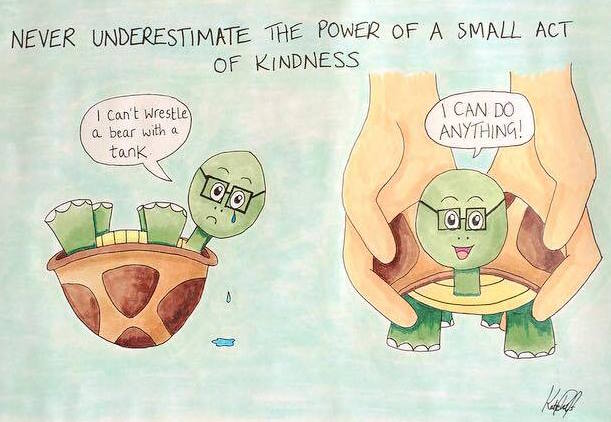
I guess my attitude to all this has changed fairly recently and has been during my time in hospital. When you are stuck in unfamiliar surroundings with unfamiliar people, anyone is going to feel alone, and that in turn made me feel pretty alone with my problems. Fighting them felt futile and every second pointless. It was like I was a tortoise lying upside down on my back waving my legs around, unable to roll back over, yet being asked to wrestle with a lion, a crocodile, three tigers, and a bear who had somehow developed the use of opposable thumbs and managed to get his hands on an armoured tank complete with canon. As I lay there flailing pathetically, I couldn’t help but think “why bother trying to fight this? I can’t stand on my feet let alone battle a pack of vicious animals with the use of military style transport and machinery”. However, I then received a sudden onslaught of kindness both from friends, family and strangers, and it made me wonder whether or not there might actually be a point in giving it my best shot.
When people feel emotions caused by kindness shown by other people, they tend to say things like that they were “touched” and “moved”, but to say that is to vastly underestimate what I felt. Indeed I was so touched I was practically black and blue all over with the force of it, and so moved that one morning I actually found myself several thousand miles away in the sahara desert, where it took staff on the ward a very long time to find me again (they say they the reason for the delay in locating me was a dodgy sat nav but I am suspicious that they got distracted by the abundance of sand and started building castles…nurses love sand castles). I felt like a gigantic boob with the worlds strongest wonderbra supporting me, and though I never imagined anything positive ever coming from feeling like a boob, here I was proved wrong.

Knowing I had all these people supporting me made me feel empowered and suddenly trying to wrestle all those animals seemed a lot less daunting. I had back-up, and if I joined forces with them then my beasts could be overcome. Furthermore, actually engaging in the battle suddenly seemed worthwhile. When flailing on my back (remember the analogy, I am a tortoise here), not only did I see the fight as impossible, but I saw it as something that didn’t matter because I didn’t care what happened to me. I didn’t care if the lion ripped off my head or the bear flattened me to a pancake in his armoured vehicle. To be honest, when I was admitted, I just wanted for it all to be over. With the support I received though, I realised that it wasn’t just my vote that counted in all of this, it wasn’t just a case of me not wanting to fight and that being the end of it. For some bizarre reason, a lot of other people did think it mattered. They did care, and they did want me to win the fight. There were people who didn’t want to see me torn to pieces, there were people rooting for me, people who wanted me around, so when it came to facing a challenge, lunch for example, I couldn’t help but think “Even if I don’t care and don’t want to do this right now, there are a lot of people who do care, and I am not going to let them down, so for now I will do it for them”.

The confirmation in the quote that when “I” becomes “we”, illness becomes wellness and the important message I want to get across here then, is that when it comes to fighting mental health issues, knowing you are not alone in your recovery can be as important as any other aspect of treatment. If you don’t have mental health problems yourself but know someone who does and you want to help but don’t know what to do, helping them doesn’t have to be as hard as you may think. You don’t need to study all the psychology books in the library to try and understand what they are going through. You don’t have to move in with them, rally them each morning with an inspirational speech and skip encouragingly beside them throughout the day. Trust me, just letting a friend know that you are there for them if they need, that you care about their battle and other simple acts of kindness will do more for them than you will ever know.
Alternatively, if you yourself are sitting there reading this and you have mental health problems, feel that nobody understands, are unable to talk to friends and family in real life about your struggles and feel completely alone, know that this is not the case. I may not know you personally, but I can assure you that I care about your battle and I am more than happy to support you in it. When you know you are not alone you gain power, and that is what I want to give to you. I want you all to know that I am one your side, and that I have three tanks with canons so big that those bears and lions don’t stand a chance. If simply knowing that is enough then great, but if you still feel alone and ever want someone who understands, email or message me. I may not give the best advice and hearing from a stranger may not be what you want right now, but if you need a hand to hold in this darkness, I am more than happy to lend you all mine.

Take care everyone.

Tortoise

Demystifying The Mental Health Act…With Penguins

If there is ever a widely reported act of violence on the news orchestrated by a single individual, the majority of the time it will be equally widely reported that said person was mentally ill and most likely “detained under the Mental Health Act”. Understandably then, when people hear of people being detained under the Mental Health Act, they associate the Act with danger. To be fair I can understand why people may jump to this conclusion.
If every time I heard about some violent crime I simultaneously heard that the perpetrator was addicted to coco pops, I may naturally make a connection between violent knife attacks in the street and coco pops. When the coco pops are simply mentioned as a “thing” and there is no explanation to tell me that coco pops are actually little puffs of cocoa sugar covered wheat based cereal with the key ability to turn the milk chocolatey, how am I to know any different?
Therefore, seeing as I am currently “detained” and have recently been given a load of forms explaining the official legal terms of it all, I thought I would do a post to clear up any confusion and to give a purely factual explanation of what the Mental Health Act is, what it does and what it means.
I don’t however want this to turn into some boring school lesson, so to liven it up I am going to provide my explanation via little examples involving “Patricia the penguin”. You know what they say: “When life gives you lemons you make lemonade”, so when life sections you under the Mental Health Act, you use the lump of paperwork dumped on you to make a post explaining what it means, with pictures of penguins to help clear up confusion and reduce mental health stigma. I think that’s the saying anyway…so here goes…

What is the Mental Health Act?: It is a law that enables professionals to admit and detain patients for a compulsory admission to hospital. It doesn’t have to have involved any incidents of violence, much like the consumption of coco pops does not have to be involved with criminal activity. Alas, unlike coco pops, the Mental Health Act does not turn the milk chocolatey, for there is rarely any milk involved.

How does one come to be sectioned under the Mental Health Act?: This is a question that will vary between the sections of the Act and individual circumstances, but as a basic principle a Mental Health Act Assessment will be called by professional people (I am not sure what they are professionally qualified in exactly, but they are usually people holding clipboards, stroking their chins, squinting/looking thoughtful), and they will interview you and ask questions in order to assess your health.

Are there different sections of the Mental Health Act?: What a marvellous question dear reader and one I can respond to with the knowledge that indeed there are several, the differences between which I will explain below with the help of Patricia…

Section Two: Recently, Patricia the penguin has been acting unsafely (skating on thin ice as it were), and is suspected to have a mental illness without the capacity to see that she is putting herself in danger. She is not however diagnosed with one, nor has she been in hospital before, so a group of professional penguin Doctors with specific training may place her under a section two, aka a legal detention to hospital for an assessment of her mental health, in order to establish whether or not she needs treatment. It can last up to 28 days and in that time they aim to discover if she has a mental disorder. Under this law she can be treated against her will if it is deemed in her best interests, and discharge or transfer to another section can happen during, or at the end of the 28 days.

Section Three: A section three is a detention in hospital for treatment, so if Patricia were to be put under this section it would mean that she were well known to hospital services, would have a diagnosis and not require assessment. In the section two admission, the focus would have been more about finding out why Patricia was found skating on thin ice in the middle of nowhere and deciding whether or not her reasons were rational, but for the section three they already know why she was skating in such a reckless way, for she has a diagnosis of “Skating on thin ice syndrome”, a common mental health problem in penguins that requires treatment when severe. On this section Patricia can be held for up to 6 months, but may be discharged sooner, or later if the section is renewed for further treatment. Again under this section it is possible for Patricia to be treated against her will (e.g. in her case, forced to skate on thicker blocks of ice even if she doesn’t want to).

Section Four: Section four is pretty much like a section two in that again it is a detention for a short period of time (72 hours) for an assessment of one’s mental health. This is more commonly used in emergency situations as you only need one special doctor to enact it, unlike a section two which requires two. For example, if Patricia is skating on thin ice at 5am in the middle of the arctic and two doctors with the ability to enact the Mental Health Act have been sent for, but one got lost by turning left at the second igloo (use your imagination kids), the doctor with superior navigation skills could potentially hold Patricia under a section four for 72 hours until the other Doctor hurries up to give his second opinion, which then may result in her being placed on a section two.

Section Five: In this circumstance Patricia has realised she may have skating on thin ice syndrome and has voluntarily admitted herself to hospital. However, twenty minutes into her admission she is overwhelmed with the desire to skate on thin ice and asks to discharge herself. The Doctor does not think this would be a good idea in terms of Patricia’s safety though, so he can put her on a Section 5(2), aka use his “Doctor’s holding power” for up to 72 hours. If there are no doctors available at the time Patricia is asking to leave however, a nurse can enact a section 5(4) which lasts for 6 hours or until a doctor arrives. This section will be used if there aren’t specially qualified doctor/doctors around to enact a section two/four available and can take place in general as well as mental hospitals.

CTO: This isn’t technically another section it is tied up in it all, as a CTO is a community treatment order that it’s possible for someone who has been detained under a section 3 to be discharged on to. Basically, it’s a legally binding order of conditions someone has to meet in order to be allowed to remain in the community (e.g. Patricia must attend weekly appointments/hand in her ice skates, cancel her membership to the local ice rink and take her antifreeze medication.)

And there we have it! Now of course this is a very brief explanation as to what the Mental Health Act is and there are far more details and legal jargon/complexities that go into each section, but hopefully I have demystified The Mental Health Act somewhat, albeit with a very basic, penguin centred outline. Hopefully if you are reading this you will never have to have anything to do with the Mental Health Act personally, but at least you will know what it actually is that is being referred to when an article brings it up in relation to something unpleasant that doesn’t put any effort into explaining the Act itself.

Finally, I just want to let everyone know that if anyone is concerned, I can confirm that Patricia the penguin is merely a fictional character created for the purpose of educating and reducing stigma, so please do not go away and worry about how she is doing after having been through all these sections. As a product of my imagination, I can assure you that Patricia is just fine, and I hope you all are too. Cheerio.

Patricia
(I hope the above picture serves as enough evidence that Patricia is safe and sound/not in any danger. As you can see she is merely enjoying a bowl of coco pops in her safe ice igloo and has not been ice skating, nor will she be doing so in the near future.)

Life Lesson: Running Away From Your Problems Is Not A Good Idea

Last Wednesday (the 22nd of June if you want to put it in your diaries for next year), was my 24th birthday. I anticipated a day of being at home with my family and playing on my new games console, but things did not go exactly to plan, much like the rest of this week. So, for today I wanted to use this post to provide a brief personal update on my current situation, as I feel it will be necessary for you all to know for the next few weeks of blogging delights, and the whole thing has taught me a little lesson I wish to share with you, the lesson being that you cannot run away from your problems. Actually that is a lie, you can run away from your problems very easily, but they will chase after you, and those little buggers can run fairly fast (so fast that I am convinced that they are on steroids and am hereby requesting that “Problems” are not allowed to race at this years olympics).

But I am getting ahead of myself, spouting lessons before I have explained how I learnt them, so let us go back to the beginning, by which I mean my 24th birthday rather than the dawn of time and the dinosaurs.

So, on the 24th of June at 10:30am my dad picked me up from my house to attend my appointment at the hospital and there I sat in the waiting room until my Psychologist arrived. I was taken to be weighed as per usual (a fairly disappointing experience, as the scales were just as they always were, no balloons/ribbons on the scales to celebrate my birthday or anything), and then we went through to talk. Had barely been chatting for five minutes however, before my psychologist presented me with an unexpected birthday present, this year, the very unwelcome surprise of an inpatient bed in hospital due to recent deterioration in my mental health, the bed being for Friday, less than 48 hours away. Now I know that people say that it is the thought that counts, and if anyone offers you a gift for your birthday you should be grateful and say thank you, but suffice it to say that I was not at all impressed with this suggestion, and couldn’t help thinking that my therapist should do any future present shopping for friends and family on amazon. I would rather she had given me a moustache maintenance kit for a gift, and I don’t even have a moustache…yet.

It was all pretty unwanted and sudden in my eyes, not the birthday party I wanted at all, so I left feeling rather deflated, much like the non existent balloon my therapist had failed to put on the scales to add a bit of merriment to weigh day proceedings. Luckily my mum later cheered me up by taking me to the park I used to frequent as a child to play on the swings, a far jollier birthday activity. I then played my new games console all evening, so I managed to have a nice birthday in the end by generally ignoring all worries about hospitals and anything other than which character I wanted to be in Mario Kart. (Incase you are interested I picked Toad because he looks like a mushroom and if you don’t find pleasure in watching a man who looks like a piece of spotted fungi zoom around a racing track throwing bananas, then quite frankly there is no hope for you). Basically, I ran away from my problems and pursued my dreams of winning the grand prix instead.

The next day however I was rudely awaken by my problems (quite literally, my therapist phoned me whilst I was still in bed dreaming of penguins), and she told me once again that I should go into hospital the next day. Again, I refused and got on with my day, but a little later I got another phone call that suggested the problems I was avoiding were rapidly gaining on me, this time the notification of a Mental Health Act assessment later that afternoon. My parents have since told me many a time, that it would have been the best idea to just remain calm and attend, but as a natural born problem avoider without marbles, I decided to do the next best thing, aka run away on bus and then a train to Exeter. Do I have family or friends in Exeter you ask? No. Did I have a place to stay or plan in Exeter at all you cry? No. I quite simply had no idea what I was doing other than getting away from the situation and possible hospitalisation to be re-fed back in Bristol. Unfortunately things got a little messy around this point, and though I caught the train and found myself hurtling across the English countryside at 65mph, the mess I had got myself in was hurtling right alongside (not even on a train, the mess was literally running alongside the track that fast. Steroids I tell you. STEROIDS). I won’t bore you all with the details, but in summary, my problems burst on the train to seize me no matter how hard I tried to deny any of it was happening, and a few hours later they had rudely dragged me back to Bristol where I was sectioned under section three of the Mental Health Act and admitted to an eating disorders hospital right away with none of the things I would have needed to pack. All I had in my bag was my wallet and my train tickets to Exeter, which I had well and truly learnt were of no use in my current predicament.

So, that pretty much brings me to my present situation, legally detained in hospital, unsure of how long I will be here and frightened in relation to every aspect of my life. Worst of all, the hospital in which I am detained doesn’t even have wifi (I am officially back in the stone age), and I will admit that one of my worries when I woke up the next day was you, my dear little internet blog readers. Though a small crowd I admit, you are in all honesty a key motivation for me to keep kicking ass as much as I can. I have no control of my personal life at the moment, but I still have my blog and writing to escape to so that is what I am focusing on for now to get me through. That said, without wifi posting this is going to be an almighty challenge, so if it is Monday and you are reading this then another lesson we will have learnt from this week is that I am a technological genius who is more educated in the ways of computer than Bill Gates.
Thankfully, as one positive to brighten up this rather bleak post, I do at least have some of my things in my hospital room now, as my mother was kind enough to bring the basics in, and it is always nice to have your own toothbrush and teddies when trapped under stressful circumstances. I guess that is yet another lesson right there: never underestimate the power and importance of clean teeth and something to cuddle.

I really hope you can all forgive me for this slightly indulgent post that is all about my personal mental health and situation, rather than stigma reducing information or any advice I can offer, but to be fair this is my birthday week, and if you can’t be a bit indulgent and have a ramble about yourself on your birthday then when can you? I promise normal/more interesting blogging will resume next week when I have settled in and know what is going on in my life, but for now I hope you can all at least take away the main lesson I have learnt and point of this post that in some ways we can all benefit from it, that being that when it comes to mental health issues and things generally in life, you cannot run away from your problems as they will always catch up with you eventually, (even if you are on a train to Exeter).

Orange.jpg

(For the purpose of this picture I have envisaged my problems as a giant orange with a satsuma for a nose. This is not because of any symbolic significance related to oranges or their complex segmented form, it is simply because I really do not like oranges and never miss an opportunity to draw them in a bad light).