Why Friendship Is Important When Battling A Mental Health Problem

A few months ago I read a quote stating that when “I” became “we”, mental illness became mental wellness. Now at the time I will admit I thought that statement was a nice thing to write on the wall of a psychiatric unit (as in properly artistically written as a message, purposely placed there by the authorities rather than some crazed crayon scrawl of a patient with too much time and too many crayons), but other than that I didn’t believe the statement very much. It felt like one of those things that is all well and good to say like “the sun will come out tomorrow” and other similarly cheesy phrases sung by red headed orphans who have no experience, knowledge or authority in weather forecasting to make any such predictions, but I have to say that over the past few weeks, I have realised that this quote is actually pretty accurate. Okay, it is not flawless, but there is a lot more truth in it than the words of a deluded 10 year old who thinks no outfit is complete without a smile, a very inappropriate thing to wear to a relative’s funeral.

I think I can say on behalf of many, that having a mental health problem is very lonely.
For one thing there is the actual physical distance created by mental illness. Maybe your difficulties restrict your ability to take part in life so you lose touch with friends leading “normal” lives and end up pretty isolated. Maybe you have to take time off work to go into hospital or to have treatment which separates you from the community in which you may have played a part. Maybe you fall out with acquaintances who cannot understand why you can’t “just be normal” when “it’s all in your head” and there is “nothing physically wrong with you”, but the biggest distance is the unseen emotional distance that nobody really talks about. When you are so trapped in thoughts spiralling around in your head, you feel as if you are a million miles away from people who may be sat right beside you, simply because you can’t relate to them in anyway. You watch them laugh, eat or open a door without washing their hands afterwards, you wonder how they do it, and you feel like a lesser underdeveloped species. Furthermore there are the thoughts that come with mental health problems, the low self esteem, feelings that everyone must hate you, the shame and inability to be honest with people incase they think you are crazy, and general emotional detachment from reality.

Both these physical and emotional distances can make you feel like you are the only person in the world who thinks the way you do, and this in turn contributes to the overwhelming sensation of being alone. Don’t get me wrong, being alone is nice sometimes, but when you are feeling alone and trying to battle a mental illness that is hitting you on the head with a mallet every five minutes, it can make your individual feeble attempts to fight against it weak and futile in comparison to its all controlling power. What you need is an army to help you, people on your side to support you in battle, in short, you need to call in the troops to face your demons with you, troops who will preferably bring a large number of rather large mallets with them. For this reason, friendship, community and kindness should never be ignored as ways of treating any disorder, for they are pretty much as important as all the therapy and psychiatric drugs in the world.

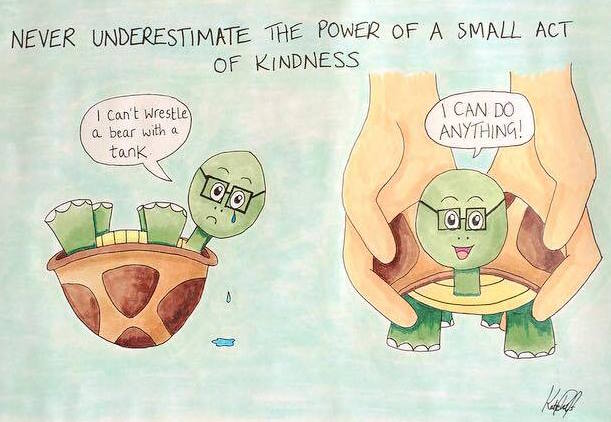
I guess my attitude to all this has changed fairly recently and has been during my time in hospital. When you are stuck in unfamiliar surroundings with unfamiliar people, anyone is going to feel alone, and that in turn made me feel pretty alone with my problems. Fighting them felt futile and every second pointless. It was like I was a tortoise lying upside down on my back waving my legs around, unable to roll back over, yet being asked to wrestle with a lion, a crocodile, three tigers, and a bear who had somehow developed the use of opposable thumbs and managed to get his hands on an armoured tank complete with canon. As I lay there flailing pathetically, I couldn’t help but think “why bother trying to fight this? I can’t stand on my feet let alone battle a pack of vicious animals with the use of military style transport and machinery”. However, I then received a sudden onslaught of kindness both from friends, family and strangers, and it made me wonder whether or not there might actually be a point in giving it my best shot.
When people feel emotions caused by kindness shown by other people, they tend to say things like that they were “touched” and “moved”, but to say that is to vastly underestimate what I felt. Indeed I was so touched I was practically black and blue all over with the force of it, and so moved that one morning I actually found myself several thousand miles away in the sahara desert, where it took staff on the ward a very long time to find me again (they say they the reason for the delay in locating me was a dodgy sat nav but I am suspicious that they got distracted by the abundance of sand and started building castles…nurses love sand castles). I felt like a gigantic boob with the worlds strongest wonderbra supporting me, and though I never imagined anything positive ever coming from feeling like a boob, here I was proved wrong.

Knowing I had all these people supporting me made me feel empowered and suddenly trying to wrestle all those animals seemed a lot less daunting. I had back-up, and if I joined forces with them then my beasts could be overcome. Furthermore, actually engaging in the battle suddenly seemed worthwhile. When flailing on my back (remember the analogy, I am a tortoise here), not only did I see the fight as impossible, but I saw it as something that didn’t matter because I didn’t care what happened to me. I didn’t care if the lion ripped off my head or the bear flattened me to a pancake in his armoured vehicle. To be honest, when I was admitted, I just wanted for it all to be over. With the support I received though, I realised that it wasn’t just my vote that counted in all of this, it wasn’t just a case of me not wanting to fight and that being the end of it. For some bizarre reason, a lot of other people did think it mattered. They did care, and they did want me to win the fight. There were people who didn’t want to see me torn to pieces, there were people rooting for me, people who wanted me around, so when it came to facing a challenge, lunch for example, I couldn’t help but think “Even if I don’t care and don’t want to do this right now, there are a lot of people who do care, and I am not going to let them down, so for now I will do it for them”.

The confirmation in the quote that when “I” becomes “we”, illness becomes wellness and the important message I want to get across here then, is that when it comes to fighting mental health issues, knowing you are not alone in your recovery can be as important as any other aspect of treatment. If you don’t have mental health problems yourself but know someone who does and you want to help but don’t know what to do, helping them doesn’t have to be as hard as you may think. You don’t need to study all the psychology books in the library to try and understand what they are going through. You don’t have to move in with them, rally them each morning with an inspirational speech and skip encouragingly beside them throughout the day. Trust me, just letting a friend know that you are there for them if they need, that you care about their battle and other simple acts of kindness will do more for them than you will ever know.
Alternatively, if you yourself are sitting there reading this and you have mental health problems, feel that nobody understands, are unable to talk to friends and family in real life about your struggles and feel completely alone, know that this is not the case. I may not know you personally, but I can assure you that I care about your battle and I am more than happy to support you in it. When you know you are not alone you gain power, and that is what I want to give to you. I want you all to know that I am one your side, and that I have three tanks with canons so big that those bears and lions don’t stand a chance. If simply knowing that is enough then great, but if you still feel alone and ever want someone who understands, email or message me. I may not give the best advice and hearing from a stranger may not be what you want right now, but if you need a hand to hold in this darkness, I am more than happy to lend you all mine.

Take care everyone.
Tortoise

Demystifying The Mental Health Act…With Penguins

If there is ever a widely reported act of violence on the news orchestrated by a single individual, the majority of the time it will be equally widely reported that said person was mentally ill and most likely “detained under the Mental Health Act”. Understandably then, when people hear of people being detained under the Mental Health Act, they associate the Act with danger. To be fair I can understand why people may jump to this conclusion.
If every time I heard about some violent crime I simultaneously heard that the perpetrator was addicted to coco pops, I may naturally make a connection between violent knife attacks in the street and coco pops. When the coco pops are simply mentioned as a “thing” and there is no explanation to tell me that coco pops are actually little puffs of cocoa sugar covered wheat based cereal with the key ability to turn the milk chocolatey, how am I to know any different?
Therefore, seeing as I am currently “detained” and have recently been given a load of forms explaining the official legal terms of it all, I thought I would do a post to clear up any confusion and to give a purely factual explanation of what the Mental Health Act is, what it does and what it means.
I don’t however want this to turn into some boring school lesson, so to liven it up I am going to provide my explanation via little examples involving “Patricia the penguin”. You know what they say: “When life gives you lemons you make lemonade”, so when life sections you under the Mental Health Act, you use the lump of paperwork dumped on you to make a post explaining what it means, with pictures of penguins to help clear up confusion and reduce mental health stigma. I think that’s the saying anyway…so here goes…

What is the Mental Health Act?: It is a law that enables professionals to admit and detain patients for a compulsory admission to hospital. It doesn’t have to have involved any incidents of violence, much like the consumption of coco pops does not have to be involved with criminal activity. Alas, unlike coco pops, the Mental Health Act does not turn the milk chocolatey, for there is rarely any milk involved.

How does one come to be sectioned under the Mental Health Act?: This is a question that will vary between the sections of the Act and individual circumstances, but as a basic principle a Mental Health Act Assessment will be called by professional people (I am not sure what they are professionally qualified in exactly, but they are usually people holding clipboards, stroking their chins, squinting/looking thoughtful), and they will interview you and ask questions in order to assess your health.

Are there different sections of the Mental Health Act?: What a marvellous question dear reader and one I can respond to with the knowledge that indeed there are several, the differences between which I will explain below with the help of Patricia…

Section Two: Recently, Patricia the penguin has been acting unsafely (skating on thin ice as it were), and is suspected to have a mental illness without the capacity to see that she is putting herself in danger. She is not however diagnosed with one, nor has she been in hospital before, so a group of professional penguin Doctors with specific training may place her under a section two, aka a legal detention to hospital for an assessment of her mental health, in order to establish whether or not she needs treatment. It can last up to 28 days and in that time they aim to discover if she has a mental disorder. Under this law she can be treated against her will if it is deemed in her best interests, and discharge or transfer to another section can happen during, or at the end of the 28 days.

Section Three: A section three is a detention in hospital for treatment, so if Patricia were to be put under this section it would mean that she were well known to hospital services, would have a diagnosis and not require assessment. In the section two admission, the focus would have been more about finding out why Patricia was found skating on thin ice in the middle of nowhere and deciding whether or not her reasons were rational, but for the section three they already know why she was skating in such a reckless way, for she has a diagnosis of “Skating on thin ice syndrome”, a common mental health problem in penguins that requires treatment when severe. On this section Patricia can be held for up to 6 months, but may be discharged sooner, or later if the section is renewed for further treatment. Again under this section it is possible for Patricia to be treated against her will (e.g. in her case, forced to skate on thicker blocks of ice even if she doesn’t want to).

Section Four: Section four is pretty much like a section two in that again it is a detention for a short period of time (72 hours) for an assessment of one’s mental health. This is more commonly used in emergency situations as you only need one special doctor to enact it, unlike a section two which requires two. For example, if Patricia is skating on thin ice at 5am in the middle of the arctic and two doctors with the ability to enact the Mental Health Act have been sent for, but one got lost by turning left at the second igloo (use your imagination kids), the doctor with superior navigation skills could potentially hold Patricia under a section four for 72 hours until the other Doctor hurries up to give his second opinion, which then may result in her being placed on a section two.

Section Five: In this circumstance Patricia has realised she may have skating on thin ice syndrome and has voluntarily admitted herself to hospital. However, twenty minutes into her admission she is overwhelmed with the desire to skate on thin ice and asks to discharge herself. The Doctor does not think this would be a good idea in terms of Patricia’s safety though, so he can put her on a Section 5(2), aka use his “Doctor’s holding power” for up to 72 hours. If there are no doctors available at the time Patricia is asking to leave however, a nurse can enact a section 5(4) which lasts for 6 hours or until a doctor arrives. This section will be used if there aren’t specially qualified doctor/doctors around to enact a section two/four available and can take place in general as well as mental hospitals.

CTO: This isn’t technically another section it is tied up in it all, as a CTO is a community treatment order that it’s possible for someone who has been detained under a section 3 to be discharged on to. Basically, it’s a legally binding order of conditions someone has to meet in order to be allowed to remain in the community (e.g. Patricia must attend weekly appointments/hand in her ice skates, cancel her membership to the local ice rink and take her antifreeze medication.)

And there we have it! Now of course this is a very brief explanation as to what the Mental Health Act is and there are far more details and legal jargon/complexities that go into each section, but hopefully I have demystified The Mental Health Act somewhat, albeit with a very basic, penguin centred outline. Hopefully if you are reading this you will never have to have anything to do with the Mental Health Act personally, but at least you will know what it actually is that is being referred to when an article brings it up in relation to something unpleasant that doesn’t put any effort into explaining the Act itself.

Finally, I just want to let everyone know that if anyone is concerned, I can confirm that Patricia the penguin is merely a fictional character created for the purpose of educating and reducing stigma, so please do not go away and worry about how she is doing after having been through all these sections. As a product of my imagination, I can assure you that Patricia is just fine, and I hope you all are too. Cheerio.

Patricia
(I hope the above picture serves as enough evidence that Patricia is safe and sound/not in any danger. As you can see she is merely enjoying a bowl of coco pops in her safe ice igloo and has not been ice skating, nor will she be doing so in the near future.)

The Problem With Eating Disorders And The Desire To Achieve

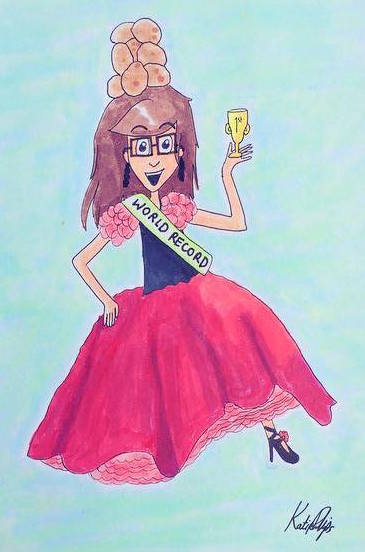
In life I think it is safe to say that most people are born with a desire to achieve, a need for purpose, for something that they feel will make their life worthwhile. If you are an expert in biology as I am, with many qualifications in human body expertise (I did biology GCSE), you will know that this space that craves a sense of achievement comes in the form of a little hole that is located just below the liver, and when humans are born, it is empty. Naturally people want to fill it in order to feel complete, and the way in which to do this is to fill it with achievements, achievements like getting a good grade in an exam or breaking the world record for the number of potatoes you can balance on your head at one time, whilst enthusiastically taking part in a salsa class with a lady who keeps clacking maracas. The difficulty comes in finding what it is that fits in your hole (by which I of course mean your sense of achievement craving space and no other hole in the body), because when that hole is empty it can get awfully draughty, especially if you are wandering around the blustery moors like Cathy searching for Heathcliff in Wuthering Heights.
Unfortunately, a lot of people with eating disorders somehow manage to wedge an almighty bout of anorexia right in their sense of achievement space, and this is in no sense as good an idea as filling it with a world record relating to salsa and potatoes.

When you have an eating disorder, you automatically obtain goals, and purpose (dangerous horrible ones that are no good to achieve, but when you are caught up in the illness they feel as important and legitimate as someone else’s goal to become an astronaut.) There are always rules and things you are striving for or you are trying to beat, a new number of minutes on the treadmill, a lower number of calories than before or a new target weight, and achieving these goals fulfils that need for purpose. Ultimately each goal you set and then achieve can feel like validation that you are doing something with your life, making your existence meaningful and making life worthwhile.

I know that personally I struggle with this a lot, especially as I appear to be friends with a lot of people who all seem to know what they are doing with their lives and are very successful. On countless occasions I have been to parties with these friends and in the general “catch up” chatter I have heard them talk about all of the fantastic universities they have got into to do their masters, all the plans for their PHD dissertations on complicated topics I didn’t know existed, and the fantastic relationships they are all happily involved in, already planning to move out of their family home, elope to New Zealand and get mortgages on houses with their partners.
Meanwhile at these parties I tend to stand there looking a little bewildered and feeling incredibly inferior. I have not been to Oxford university, been to New Zealand (or Old Zealand come to think of it), and the closest I have got to moving into my own house so far is my attempts to build my own pillow fort under my bed, which isn’t going well because planning permission is a nightmare and I am struggling to sort out the plumbing situation. Does anyone have any advice for supplying a pillow fort with running water, when the only materials you have at your disposal are a few cushions, a blankets and giant cuddly penguin who has a surprising lack of DIY skills? Even if that works out, this house is being built under my bed within my parents house, so I wouldn’t really have moved out, even when I do get things up together. I know it is disordered, but in these instances at these parties, my eating disorder is of great comfort to me, because when I am feeling like a hopeless failure, I can comfort myself with all the things I have “achieved” through my anorexia, all the hard work and goals I have reached, even if in the real world things like “only ate X calories for lunch and have a BMI of Y” means very little.

This is but one of the many reasons I find the act of challenging my eating disorder and overall recovery so difficult, because in doing so I am carving out the well crafted plug filling my sense of achievement space and leaving it empty again with the gale whistling through my abdomen.
I know that the key to all of this is simply find another thing to fill that space, but it is a lot harder than I ever anticipated because when it comes to making new goals or setting out on new pursuits that you are not very experienced in, there is a high chance of failure, something that is reassuringly lacking when it comes to the world of having an eating disorder, as I have had it for so long now that I know the rules and I know that when I put my mind to it I can achieve the goals it sets. Setting my hopes and dreams on becoming a lawyer or something is a lot more complicated because it relies on so many outside influences and there are so many places for error. What if I don’t get into law school? What if I fail my exams? What if I manage to make it as a High Court judge and then at the biggest case of my career I lose my big hammer thing that judges use after they have announced their verdict, and the jury and I are left until the end of time unable to put a murderer into prison because I cant bang my hammer on the table? With eating disorder goals, I have to rely on nobody but myself, and I don’t need to be mindful of where I am keeping my hammer.

From speaking to other people with eating disorders I know it is fairly common to use anorexia to serve your sense of achievement, and in a way it is great. The anorexia or whatever else serves the function of filling that sense of achievement and blocking that gale, but it isn’t a particularly healthy filling, because once lodged in there the eating disorder grows bigger, spidering slithery tendrils away from the hole in which is was originally placed to take over and kill the whole body altogether. Therefore when it comes to recovery, it is vital to think about and work on making a new life and set of dreams to pursue and goals to achieve alongside eating a healthy diet and getting to a health body weight.

If you are currently in recovery or contemplating it and are struggling with this issue then I guess my advice is to be brave and rip that eating disorder plug out to feel that abdomen gale for a bit. I know it sucks. It will be chilly, and put you at risk of failing whilst attempting to fill that desire for achievement with things you have never tried before. Maybe things you might be bad at, or heaven forbid, things you may fail in. But maybe that is ok, and nobody can get these kind of things right the first time. Maybe in reality, achieving or failing at anything in life is far better than fooling yourself into thinking you are achieving in an illness that is basically just starving you to death, which is not an achievement at all.

Therefore I want to challenge everyone reading this with an eating disorder to try and find something new or give a random hobby a go to try and replace the one you have that is potentially killing you. Take up chess, or tiddlywinks, collect magnets shaped like penguins in hilarious poses, hell try and beat that world record for dancing the salsa with potatoes on your head. That last one especially is a great one to start with because to let you into a little secret I have learnt from my research, nobody has even set a record for that yet, so you have a pretty good chance of winning (I still cant believe no human has dared to attempt such a feat before.)
Yes it is silly and yes it sounds pointless but I urge you all to give it a go anyway, because in life there is so much more to devote your efforts and attentions to than a silly number on the scales that doesn’t tell you anything anyway. You will never lie on your death bed and reminisce about the greatness you achieved by starving yourself and wasting your life, but by God wouldn’t it be wonderful to lie there in your final moments, and to reminisce about salsa dancing amongst all your trophies and Guinness world book of record certificates, a little pile of winning potatoes gently settled at your feet. That my friends is success. Go and get it.

salsa

“Who Am I?” – Anorexia And Identity

Have you ever wondered how people refer to you when you are not in the room and they don’t know or have forgotten your name? People refer to others using general but somehow specific terms all the time (my mum and I do this with contestants on Masterchef for example, this series we had “beardy man” and “Jam sandwich lady”), and it makes me think about how people refer to me. Rightly or wrongly I have always assumed that people call me “the anorexic one”, “the one who never went to school dinners”, “the one who disappeared into hospital for 10 months and then came back to sixth form 2 stone heavier” or words to similar effect, and it is one of the reasons that I find the concept of recovery so frightening and difficult to achieve. I feel that the label of being “anorexic” serves as a sort of identity both to me personally and for other people. In my head “anorexia” is my thoughts, it is all I think, it is what I do and who I am, so in my eyes if it disappeared, I would disappear too. I also feel this way about OCD sometimes, as that is also what I do and how I live/what I am, but the identity tie is mainly to the label of “anorexic”. After all, OCD is rarely used as an adjective to describe a person, you never hear the words “they are an OCDic.”

When anorexia first appears in someone’s life, it is sort of viewed as a separate thing, an added extra, an invader that is not part of the real person, or, in metaphorical terms, purple hair. People say that someone “has” anorexia much like they would say someone “has” purple hair due to some dye they have just bought, it is a temporary alteration to their being that will gradually wash out over time, it is not an integral part of who they are. If someone has it for a month, they will perhaps be known for that month as “the one with the purple hair” and then the label will change again as they themselves change style and perhaps career (e.g the brunette professional penguin tamer).
The problem is that the longer someone has purple hair, the more the purple hair becomes tied up with who they are as a person, they stop being a person with purple hair, the purple hair almost becomes them. When I was first diagnosed with anorexia it was an addition to who I was, a bit of purple colouring in my ponytail, but now after all these years I feel it has leaked all over me. The dye as it were hasn’t stayed in my hair, it has dribbled down into my skin so that my entire body is as violet as that girl who turns into that blueberry in Charlie and the Chocolate Factory when she eats the piece of gum Willy Wonka told her wasn’t finished. I no longer have anorexia as one has purple hair, I am anorexic, I am entirely purple from head to toe. If you scrub at my hair or my skin, the colour doesn’t just wash out anymore, it has been too long, it is embedded and to get rid of it you would have to peel away all of my skin completely which would in turn get rid of me too. That is how anorexia feels in terms of my identity, it is a thing that has become me and that now I am so entirely that it is impossible to remove. Without that label who would I be? My therapist is always correcting me when I say things like “I am scared of eating X” by saying “the anorexia is scared of eating X, Katie isn’t” but I don’t feel like that is true. I don’t have a voice telling me to avoid going over a certain number of calories, it is just my thoughts, it is just me.

A few years ago I went to hang out at a friend’s house with various people I had not met before (some may have called it a “party” but there were no balloons and in my eyes a party is not a party without rubber sacks of the host’s breath floating about, so I would call it a “jovial social gathering”). At some point in the evening some cake was brought out and handed around. The plate and thus the cake was offered to every guest individually, except me. Don’t get me wrong, I really appreciated it and was relieved. I hate the awkward moments when people offer me things that I then have to make up excuses to avoid, and knowing this my friend the host (lets call her Bertha for the purpose of this conversation), did not put me in that position. She knew I wasn’t going to have any cake so she didn’t insist on the whole “Cake?”, “Oh, no thank you” palaver that is often so embarrassing. However, this act of what was consideration for me and kindness of a friend aware of my difficulties, really got me thinking. When Bertha went round the circle she saw everyone as a person with the potential to eat cake, but when she got to me she saw someone or something different, she saw one of the “anorexic species”, a creature notorious for avoiding sweet treats. It felt like Bertha saw me as “the anorexic one”, I was different, and I had to wonder what on earth would it have been like if in the five minutes before the offering of the cake, I had been struck by the most wonderful bolt of lightening in the history of weather, and instantly cured of all mental health problems ever. What if I hadn’t had the illness that made me “the anorexic one”, what would be left, if anything, or would there just be a an empty space where the former anorexic had been?

I guess the point I am trying to make here and the point of this post/what I want more people to understand, is that there is a reason that anorexia is so hard to recover from. It is such a complex illness that both destroys and provides in ways that people may not think.
When sufferers are trying to fight but are struggling, it isn’t simply a case of being “scared of food” or ”scared of gaining weight”, often it is also a fear of what they will lose, of throwing away everything that they think they are, the removal of their core identity, leaving a hole they have no idea how else to fill.

Identity

(Apologies for the crease at the top of this image…I actually drew this picture for an appointment with one of my psychologists and the paper got creased on the way to the hospital. It was a good day for therapy but a bad day for my attempts at art.)

What are they doing about the fact that you are insane?

Every time my parents pick me up from a psychiatric appointment, they ask me the same questions:

  1. “So what did they do to you today?”
  2. “What are they doing about the anorexia/OCD/depression?”

They are only trying to be nice and just want to understand more about what is going on with the crazy person living in their house, but I often wonder what exactly my parents expect me to answer when they ask me these kind of questions.
What did they do to me? Well first I was strapped to a table and then they hit me on the head with a mallet to smash the crazy out. What are they doing about the anorexia/OCD/depression? They are cornering it with a sleuth of angry bears (that is actually what a group of bears is called, “a sleuth”, trust me I looked it up on google), so that it runs off of a cliff into a flange of angry baboons (I may or may not have just discovered a website that tells you what the collective names for various kinds of animals hence the uses of ‘sleuth’ and ‘flange” in this post).

The truth is, the psychologists and psychiatrists and support workers I see don’t “do” anything, but at the same time that does not mean they don’t do anything. Sometimes I may do pieces of “work” or try courses of various therapies, discuss changing my medication or upping the dose, but on the whole the majority of my appointments are taken up by simply talking about things. If I say that to my parents, they worry that because nothing is being “done”, I am not receiving any treatment, but what many people don’t realise is that simply talking as a treatment, is seriously underrated.

By telling someone how you feel, you can release some of the emotions you are bottling up; by explaining a problem you are having to someone who doesn’t understand, you may understand things that even you didn’t know you were feeling; and by sharing a secret or a burden/pain, you share the weight of it and are allowed a little brain space to breathe. Like they say, “a problem shared is a problem halved”, not that I know who they are but they seem pretty smart to me. I know it all sounds very wishy washy, which is probably why the idea of “just talking” is sometimes not viewed as “treatment”, but mental health issues are far more complex and confusing than people can really comprehend, and you only learn about them through exploring. I have been in treatment for over a decade yet still I often realise things about my illnesses and my relationship to them that I didn’t know before, just by talking things through.

I suppose the message I want to get across in this post is that when it comes to recovery from mental health problems, it isn’t straight forward, there isn’t a set thing to “do” or fixed course you follow. As cheesy as it sounds, recovery really is a journey of self exploration, and everyone/everyone’s journey is different. People are individual and unique, so their experiences of their illnesses are individual and unique, different and relative to them alone, so “just” talking about things is really important. Only when you really understand what is going on with you and how your life is affected personally, can you really tackle the problem. If you are just starting to receive therapy or are supporting a loved one in therapy and are worried that nothing is really “happening”, please do not feel despair. It may not feel like it, but things really are being “done” and you are working towards recovery even if you don’t realise it right now. Words are power. Use them.

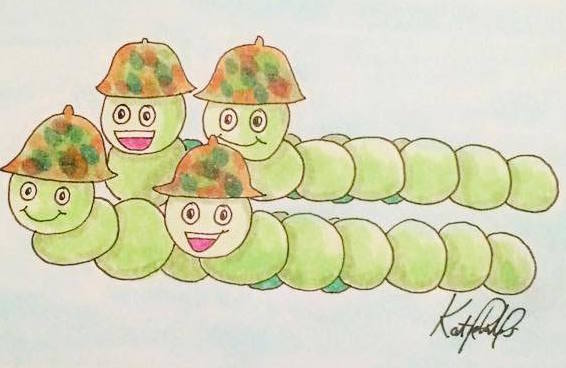
Just going to end this post here by letting you know that a group of is caterpillars is called an army. How hilarious is that? The answer is very. Caterpillars are literally the most non-threatening looking animals in the history of the world, yet still if a lot of them came into your house you would have to say that you had been invaded by an army. Now if you don’t mind, I am off to gather my own caterpillar army to help in my quest to destroy mental health stigma. Cheers.

12922297_10207348201637151_15230091_o