The Dangers Of Drinking Too Much Water When You Have An Eating Disorder

So in last week’s blog, I talked about a recent lesson I had learnt about the importance of familiar surroundings when you struggle with OCD, and funnily enough I have learnt something else in the past week too.
I am learning a lot of things lately. It is like being back in pre-school only Daniel Jones hasn’t stolen my green crayon (if you are reading this Daniel then yes I know it was you and I still want it back), and the topics of these recent lessons have been far more focused on mental health and less on how messy one can get whilst finger painting/what noise a cow makes (hint: it is moo).

In life, we are constantly being told to drink more water. If you have ever sat in a doctors’ waiting room you will have no doubt seen several posters about how drinking a lot of water is very important, how kidneys love the stuff, how dangerous it is to get dehydrated, and from all of these posters and health warnings you may assume that the more water you drink the healthier you are, which…well… isn’t exactly true, especially if you are someone who is struggling with an eating disorder.

Drinking too much fluid is by no means something common to all people with eating disorders however, and in my years of experience getting to know fellow sufferers, there seem to be three camps of people and how their disorders manage fluids.
In one camp we have the people with eating disorders who struggle to drink enough water and end up extremely dehydrated, then there is a second camp of people who could drink a whole swimming pool if they had a big enough straw, and then finally in the third camp there are the people with eating disorders who do not have a problem with maintaining safe fluid levels and would therefore like to leave the camp I have just put them in and go back home to a habitat that is slightly less tent like.

As it happens, I am in the second aforementioned camp (ours has a lovely log fire and on Saturdays we roast marshmallows), and I struggle with drinking too much water even if I am not at all thirsty.
It is odd because I have always known that drinking too much liquid isn’t good for you, but when it comes down to it, me gulping down glass after glass of water is like some uncontrollable compulsion, a kind of outer body experience.
Many a time I have been pouring myself another litre and in my head have been thinking “NO. STOP! THIS IS DANGEROUS NOW” but my body won’t listen and carries on filling up my glass anyway. It doesn’t matter how ill I feel, drinking the water feels like an urgent and necessary task as if I need to dowse a fireball that is burning somewhere in my stomach, no matter how much water it takes.

Even in the camp of people with eating disorders who struggle with drinking too much water, it is likely that everyone will do so for a variety of reasons and it is rare for two sufferers with the same disordered behaviours to have the same reasons for carrying them out.
When it comes to me though, my compulsion to drink a lot of fluid is partly because of posters I used to see at my local gym telling me that if I didn’t drink enough my body would hold onto water (leading me to fear that the number on the scales would go higher), but mainly it is because no matter how many doctors or dieticians talk to me about the science of the intestine, I am convinced that if I do not drink ridiculous amounts, any food I eat will get stuck in me forever.

Technically I know all about stomach acids and the body’s ability to break down solid foods via various muscle contractions and other clever things that go on behind one’s belly button, but in my head, eating anything solid conjures up an image of that solid thing getting stuck in a tube. Say for example I eat an apple, it doesn’t matter how much I chew it, when it is in my stomach I still picture it as a big red cartoon like shiny apple with the stalk attached, a lump that will stay there unless I am able to create enough waves to erode and wash it away.

For this reason, to try and keep my drinking under some form of control, I have been on a fluid chart for years where I write down everything I drink to try and keep an eye on things so that it doesn’t get out of hand. If I don’t write my fluids down my brain tends to trick me and convince me that I haven’t had a mouthful of water in days (even if I am surrounded by empty bottles of Evian and have been peeing every five seconds), so it is safer for me to keep a record of it so that when the compulsion to drink a lot comes, I can remind myself that I have already drunk more than enough and need to distract myself elsewhere. Last week however, this fluid chart thing went a little bit off plan with the disappearance of my parents on holiday.

I have had several people message me asking what on earth happened after the mass break down described last week, whether my parents ended up cancelling the holiday or whether we gave it a go despite plan A being a rather sizeable fail.

Well, after people had realised that I couldn’t stay at my parents’ friends’ house for the duration of the holiday, the immediate conclusion was that the holiday would be cancelled, but eventually we managed to come up with an alternative plan wherein mum and dad would go off to Malaysia as planned and I would stay at home with my sister and my most legendary friend of all time alternating sleeping over to try and help me stay safe.

It was going rather well for the first few days (or at least better than the disaster that had been plan A), but as time went on I started to get more and more anxious about my parents being away and consequently the urge to drink increased in order to wash all of that anxiety and stress away. I know it sounds pathetic but without my mum there to verify how much I was drinking and suddenly in total control of my fluid intake myself, things started to get out of hand. People who stayed over would be able to support me in the day time but when up late at night I couldn’t help but manically gulp glass after glass of water over the sink. All the people who write those “yay kidneys like water, stay hydrated” posters would probably be thinking that is great but as with most things in life, moderation is key and you can have too much of a “good thing”.
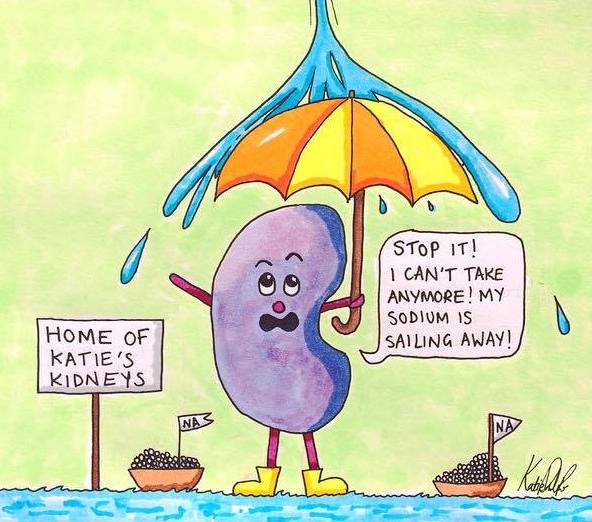
Drinking too much water can cause problems for anyone who has been hitting it hard on the old H20 because your kidneys cannot process it and consequently the water stays in you where it can dilute the salt/sodium level in your blood and cause a condition called hyponatremia, which doesn’t sound particularly exciting but in general language this is known as water intoxication, and I am pretty sure that phrases containing the word “toxic” are never good phrases to hear describe someones physical health.

In healthy adults eating and maintaining a healthy diet, a few extra glasses of water will not cause this kind of thing, but the risks when it comes to people with eating disorders is often greater purely because they may not have been consuming enough salt/sodium in the first place, and essentially there is a risk of drowning your cells on the inside. This then leads to things like heart problems, fainting, water on the brain, seizures, psychotic episodes, death, and basically a lot of things that mean you “aren’t very well” which is exactly what happened to me a few days after my parents flew off to Malaysia and is exactly why my poor sleepy friend had to call an ambulance at 2am on a Saturday morning having been woken by me banging around, generally delirious and spouting nonsense (and a little bit of water. I was like a living water feature. Delightful).

The reason I stayed in hospital for so long however is a slightly more complicated story which I will have to get around to next week, just so that we are all up to date and clear as to why I was so rude as miss a blog post two Mondays ago (Oh the shame. And I was raised in a house with such good manners!), but as an initial explanation, the problem was that I was hospitalised for drinking too much water, and it is now after some severe tellings off from several health professionals that I feel the need to write this post about it so that people realise just how dangerous drinking too much water can be when you have an eating disorder, in case it is something other people struggle with themselves and seriously need to seek support for. If you are one of those people who struggles with drinking too much water I know you are probably doing what I used to do upon hearing these kind of things, the whole “surely it can’t be that bad” and “it would never happen to me” but trust me when I say that water intoxication is extremely dangerous and potentially fatal so if you struggle with it, even if your head tells you “you will be fine”, it is vital you get regular blood tests to check your sodium balance.

Luckily after a few days of being on a water restriction in hospital (good lord was I thirsty), my sodium levels returned to a more acceptable level…it is just that other things started to go wrong after that but again, patience dear friends! All in good time!

Now what I don’t want is for someone who already struggles with drinking enough to read this blog and suddenly panic and start restricting their fluids more than they already were because that is NOT what I am saying you should do and that is dangerous for a different bunch of reasons all on their own. I am just saying it is dangerous to go ridiculously overboard when it comes to fluid consumption even if your eating disorder tries to force you in that direction, and that instead of not drinking anything, just do it all in moderation. Water isn’t dangerous, everyone loves a good paddle or dip in the swimming pool, you just have to keep it at a safe level and be careful not to drown.

Take care everyone x
Kidney

P.s I am sorry if this blog is a little bit all over the place. Physically I am still not in the best place right now and my ability to write is somewhat affected but please bear with me! I am sure recovery will hurry up soon!

The Frustratingly Illogical Existence Of Life With An Eating Disorder

A few days ago, I met up with a friend who I have not seen for 15 years. It was a friend I have known since the tender age of zero after we stumbled across each other at an antenatal class our parents had been attending in the hopes of learning what the hell to do with the new humans they were about to produce and were expected to raise without any prior knowledge of how to do such a thing.
We may have only been newborns but our connection was instant, we bonded over Thomas the Tank Engine and have been friends ever since (although like I said, we haven’t seen each other for fifteen years because when you get to senior school and puberty a lot of nonsense gets thrown at you and there isn’t any time left to discuss the wonderful intricacies of your favourite blue tank engine…senior school is cruel.)

Recently however, after reconnecting over the 21st century miracle that is “social media”, we decided to meet up, and thus it was that I found myself sitting opposite my oldest friend in a coffee shop several days ago.
I think when you meet up with anyone, either new to you or as old a friend as your life itself, there is always a tendency to compare yourself to that other person in some way. Frustratingly, even though I know that appearance and weight are the least important of all things, my eating disorder automatically compares my body to those around me and without fail will always manage to convince me that I am an inferior disgrace who should go home and hang their head in shame. Like I said, I know weight doesn’t mean anything and I quite frankly don’t care what other people weigh. The number of pounds shown up on someone’s bathroom scales does not matter to me in the slightest, nor does it affect my opinion of them, yet for some reason when it comes to me specifically and my body, weight is of the highest significance and summarises my self worth as a person.

When I saw my friend standing there then, I felt really embarrassed and had it not been for the desperation to see her after such a long time, I probably would have run out of the coffee shop and would still be hiding in a bin somewhere.
Eloise Unicorn McGlitterface (I may have added the “Unicorn McGlitterface” myself just for fun…she really likes unicorns…and glitter…), looked fabulous, and I wished I could look like her.
Immediately my eating disorder was triggered and the thoughts telling me to lose weight struck up their familiar bellowing.
I didn’t want to be thinking about these things at all, as I left I wanted to be thinking about how lovely it had been to see my friend, but as I got in the car to go home, my head was screaming at me to lose weight, and here is where I get confused.

I know for a fact, that my friend Eloise Unicorn McGlitterface, on paper, is a healthy weight, and even though I don’t believe the “facts” my psychologists tell me about me being “underweight”, I understand them, sort of like someone understanding the theory behind someone’s religion without believing in that religion themselves. Logically then, according to doctors and science, most people would conclude that in order for me to look as fabulous as my friend, I would need to gain weight. On paper and if talking to anyone else, I would easily be able to agree with this argument yet somehow, when it comes to me, even though I cannot explain the science behind it myself, I am convinced that the only way for me to look like someone who weighs more than me…is that I need to lose weight. WHAT KIND OF LOGIC IS THAT.
When I tried to explain this to my mum I couldn’t. Naturally she thought that I sounded irrational and like a lunatic (she would have a point), yet despite my inability to explain the science behind my thoughts, I remain utterly convinced of their truth without really understanding them…
I even thought that if I tried to write this blog post and tried to explain my theory I would realise how ridiculous I sound, how my thoughts make no sense and therefore cannot be true, yet still here I sit, unable to explain how my body defies science and needs to lose weight to look like someone who weighs more than me, yet utterly convinced that this is the case.

There are a lot of things I believe that make no sense to other people when it comes to my eating disorder, but at least I can see the logic behind them. I know it doesn’t make rational sense that I cannot eat unless my hair is tied up in a very specific way at a very specific angle, but I understand where that belief/behaviour comes from and the rationale behind it according to previous experiences. I know it doesn’t make sense that I cannot eat with forks, knives or plates and am only able to use spoons and bowls, but again I understand the reason I feel this way. There is no science behind it, but it makes sense to me and I could explain it to people.

This however, I do not understand, yet like I said, this doesn’t make it any less compelling. I guess going back to the religious comparison, it is like being a devoutly religious person who can hear all the arguments against their beliefs but believes nonetheless and is convinced in their heart by pure faith. I don’t want to insinuate that my eating disorder is at all some kind of religious movement, it is a murdering mental illness that destroys lives, but I think this example goes to show that when you have an eating disorder your belief in your thoughts are held and driven mainly by a faith that you cannot explain the logic behind. In my experience at university studying theology and when talking to religious friends, if you ask them to explain “why” they hold their beliefs, any explanation will be secondary to the feeling they hold inside them. They can say “why” but when it comes down to it the thing that convinces them is a faith, an indescribable feeling that they have which means that they “know” what they believe to be true even though they can hear people arguing about why they might be wrong.

I don’t wholeheartedly believe my eating disordered thoughts because I am stupid and don’t understand science, somehow I believe them in spite of that understanding. This whole “to look like my healthy friend I need to lose more weight” thing is exactly like my obsession with green tea. I hate the stuff and over the years hundreds of people have told me that it makes no difference to your weight, I have read the studies and I know they are true and more scientific/rational than any thoughts I get from my eating disorder…yet somehow I am still convinced that if I don’t drink a certain number of millilitres of green tea I will gain several stone overnight. Consequently I drink that green nasty fluid that I am horrified is held in the same category as all other teas. WHERE IS THE LOGIC HERE EATING DISORDER? HMM?

I think what this really proves is the fact that eating disorders make no sense and that even if their thoughts don’t have a reason behind them, they are nevertheless believable. People with eating disorders aren’t stupid people who don’t understand how bodies work, they understand all of those things, often better than most, yet still the disordered thoughts are so strong and so compelling that they are convinced to follow them without being able to say why. Eating disorders have the power to make science sound ridiculous and nonsense sound like fact. I guess this example also proves the fact that eating disorders are flipping stupid and will always manage to convince you and tell you that you need to lose weight no matter what the facts of any situation.
Usually when I write blogs about eating disorders I do it to try and explain the reasoning behind
them to people who don’t understand, but clearly, sometimes life with an eating disorder is about not understanding a damn thing about your thoughts yourself and just basking in a frustrating confusion.

Take care everyone x

NonsenseBin

The Difficulty Of Losing A Therapist

Over the past few weeks, I feel that I have been going through what is commonly referred to as “a break up”, one of those horrible experiences that, in popular culture, is often portrayed as a situation that can only be remedied by much crying into tissues and several tubs of ice cream. Now I know what you are thinking, “but Katie, how can you be going through a break up when you yourself admitted the day before Valentine’s Day that you haven’t been in any kind of romantic relationship for over two years” (alright don’t rub it in guys…Jeez).
Well if you thought that, you would be right, no, I haven’t been in a romantic relationship for a very long time (aside from the one I am in wth Helena Bonham Carter that she isn’t aware of…yet), but in the world of mental health there is a common experience that is very like a break up, that being the loss of a therapist.

Now, before I go on I would like to preface this by saying that I do not mean for this to imply that I am caught up in any romantic entanglements with the therapist I am referring to and who is currently in the process of “leaving me” for a new job.
Indeed our relationship is very much the standard “patient/psychologist” affair (perhaps affair wasn’t the best choice of word there…). However, what I don’t think a lot of people understand is just how attached one can get to a person who only hangs out with you every week because they are paid to do so.
It a very odd situation, and whenever a therapist leaves I feel I should deal with it easily, without being particularly bothered. This is after all not a new experience for me, as I have literally lost count of the number of therapists that have left me over the years, (seriously if you rounded them all up you would have more than enough of a cast to put on a performance of Les Miserables and trust me, from someone with a theatre background, you need a lot of people to perform that show). That said I know a lot of people find this a very difficult thing to go through, and rather than it mean we are clingy or weird, I think it makes a lot of sense.

Yes, a relationship with a therapist is strictly professional and should, on paper, be the equivalent relationship to someone you have hired to be your private chef (who is paid for by the NHS because you are mentally unable to sustain yourself alone….I need to work on my analogies…)
The chef turns up at your house because it is their job just like my therapist turns up for our appointments, but when you are talking about your deepest darkest secrets and fears rather than how you like your eggs cooked, it can’t help but become more personal whether you intend it to or not.
In every other professional relationship you have with someone who is being paid to spend time with you, like a chef or a plasterer in your house, the reason for their being there is in reference to something separate, aka food or dodgy walls. With a therapist though, unsurprisingly, a lot of it is about talking about your life. How can that not be personal?
Ok other professional relationships have personal aspects to them as well, a private chef for example may eventually grow to know how much milk you like in your cup of tea without asking every time, yet with a therapist there grows a level of intuition that is less about knowing how you like your tea and more about being able to simply look at your face and know automatically that it is time to put the kettle on (although I would like to clarify that my therapist has never actually made me a cup of tea at all…if you are reading this dear therapist, maybe work on that in your new job). It is that deep connection of being understood as a person, and for that reason of course it can be like a relationship break up when a therapist retires or leaves to get a new job.

Again, of course I am not saying that it is in any way romantic and unlike romantic relationship endings we are not going to be left wondering who gets custody of the kids (we already decided in our first session that I get them Monday to Friday and then she has them over the weekend). Nevertheless I am left wondering what I will do without this person who is currently a big part of my life.
When you see a therapist for a long period of time, discussing your mental health problems/building a therapeutic relationship is sort of like building a house. In the beginning you have an empty plot of land and the patient has a hell of a lot of bricks (bricks that in terms of this analogy represent secrets/thoughts/things that make you as a person). The patient is standing in the middle of this messy pile of bricks without any idea of how to deal with it, so the therapist is there as a sort of builder/tidier to help sort it all out. Every week you both turn up at this plot of land and gradually, the patient hands the bricks individually to the builder. Together you try to construct something that is a little less of a mess, and a little more something you can work in. The more you talk, the more bricks that come out, and eventually the house is finished at which point you can go inside and start trying to make the place liveable. You try things out, experiment with fuchsia walls, checkered wall paper or new therapies and you see what works for you.
Then finally you get to the point where you can both walk into the house (aka brain), and know the insides and outs of it so well that one of you can reference something within the house and the other will know exactly what they are talking about. Refer to the “plant thing in the bathroom” and they know what that plant thing is as well as when in your life you bought it and why it is in the house, just as a therapist will eventually grow to know all about the way your mind works as well as any life events you simply reference to as “that time with the giant squid”. If anyone else comes in the house and you reference the plant thing, they don’t understand exactly what you are talking about. Even if you take them to the room to point it out they cannot have the same level of understanding as the person who helped you build the bathroom in that particular way and find that particular plant at the gardening centre. You can tell a new therapist about what happened during “that time with the giant squid”, but to them it will just be a story rather than an experience you have lived through together.
Getting a new therapist then is not as simple as the professional transition involved when you get a new plasterer for example (I have just realised there are a hell of a lot of interior design analogies in here which I think is in reference to my love of 90’s TV show Changing Rooms. I miss Carol Smiley. Where did she go. She was so Smiley). No, instead of a new therapist coming in to help you in the house you had made earlier, it is like having to smash all of that “brain internal understanding relationship” stuff to the ground and having to start again. Once again you need to start passing them all the individual bricks they have never seen before, so you actually have a long time of simply building up enough of a rapport/understanding before you can get on with any of the serious stuff.

Like the end of any romantic relationship you find yourself wondering if you will ever find someone you will get on as well with or who will understand the way you work in the same way, and the first sessions with a new therapist are very much like all the first dates you have to go on to try and find a new partner. Conversations go from deep personal investigations into the meaning of life to the cookie cutter “so what is your job”, “where do you live” standard statements that you have to go through before you can get to anything of real interest or value.
Unlike a first date of course, a new therapist will probably have all of your notes from the previous one and thus a rough knowledge of your history, but nevertheless, with or without these notes they will always say that they want to hear about your history “from you”. Admittedly this is a good idea. Obviously I can explain something that happened to me when I was eleven better than a therapist was able to jot down in a word document, but having to go through all that stuff is exhausting. Maybe if you don’t have a huge mental health history this “tell me about you” question can be answered relatively quickly, yet for me it is a question that is incredibly daunting. Tell me about your experiences with mental health services?! How can I do that? We have nearly 14 years of appointments to catch up on! I can’t get through all that in one hour!? DO YOU HAVE ANY IDEA HOW EXPENSIVE HOSPITAL PARKING IS?

This entire blog is probably just one long incoherent ramble so half of you reading will be probably wondering what the hell I am talking about and who the hell Carol Smiley is. I guess I just wanted to raise some awareness of how difficult it is when a member of your therapy team has to change and why it feels so much more impactful than a change in any other strictly professional relationship. If I was ruler of the world I think I would probably make it law that therapists are unable to ever get new jobs, retire, change jobs or go on maternity leave (sounds ridiculous I know but in terms of fair/rational leadership I would still be doing a better job than Donald Trump.)
Luckily as you will know if you have been around my blog for a while, I do have a whole team of therapists so it isn’t a total break down of my psychological support and only one person is changing. I also know and like the replacement very much so it is as “good” and manageable a “break up” as it can be. Nevertheless I can’t help but feel as though in a few weeks when it is time for our last session (on the 21st of March, put that in your diary folks), I will be losing someone very important, someone who I can trust and rely on, so naturally, this isn’t going to be easy.

Take care everyone x

therapistchange