Mental Health Problems In The LGBTQ+ Community

This is just a little note to say that this post mentions incidents involving self harm so if that would trigger you, I thank you very much for joining us today but maybe go and treat yourself to a good cup of tea and biscuits instead. Safety first pals!

I once had a psychologist who, during a talk about my mental health and how broken my brain is, asked me if I thought any of my issues “were because of being gay”. I was appalled.

“How dare you!” I replied. “What homophobic nonsense is this? I am deeply offended! You think people who are gay must also be mad because nobody with common sense would be queer? For-shame! A plague unto you and your ancestors! Watch me flounce out of this room waving my rainbow flag in a fury! Watch me flounce I say!” (please note that this was what I replied in my head…in reality I think I just squinted my eyes a bit and formed a quizzical expression).

At the time I didn’t see what being a member of the LGBTQ+ club, had to do with my mental health at all, but after a little bit of discussion, research, and no actual flouncing, I realised that this psychologist was on to something.
Turns out, rainbow folk in general show higher levels of anxiety, depression and suicidal thoughts than heterosexuals, so seeing as it is Pride month in the UK this month, I thought I would use this post to think about why that might be. It’s like that old saying, “if you are gay and you have mental health problems, it is your duty to mush those experiences together and write a blog about it.”

In my experience,I wouldn’t say that for me personally, being a member of the LGBTQ+ community has been THE trigger that led to all of my personal mental health problems, although I know that for some people, it can be.
Often I think it can be things like homophobic bullying and external discrimination that are the reason people who are LGBTQ+ might go on to suffer problems, and in that respect, I have been very lucky.
I have never been bullied for my sexuality, my family have always been very accepting (my mum to the point where she is basically a walking gay pride parade all year round and always gets very excited/becomes a fan every time any celebrity comes out as a homosexual), and I live in a country/time period where it is safe for me to be “out” without fearing arrest.
The only discrimination I have ever had has been the odd homophobic slur shouted out of a car window at me as I was walking down the street, but this has never really bothered me as I don’t have that much respect for the opinions of people who shout abuse out of car windows… I might admire their ability to project with their vocal chords out of a moving vehicle, but when it comes to their judgements on who I fall in love with, frankly, I don’t give a damn.

However being LGBTQ+ has certainly affected me because of discrimination, it is just that all of that discrimination came from my own head and in the early days of my queerness, led me to feeling very ashamed.
Nobody in my external surroundings was telling me I was weird or shouldn’t be gay, but my head was, and consequently I was scared to tell anyone about it incase they felt the same. Indeed I decided that rather than tell anyone, I would start a grand “make Katie straight” mission so that nobody would ever have to find out. You may wonder how on earth one goes about “de-gaying themselves” as surely to do so is impossible, and in that assumption, you would be right. Little old me however, was convinced otherwise.

The idea came to me whilst watching a television program which funnily enough, was about a straight woman seeing if she could undergo treatment to turn her gay…Good lord they show some weird things on TV these days…
Anyway, in the program, this woman was told by some mad scientist to use this machine that would give her electric shocks every time she thought something heterosexual in an attempt to recondition the brain to stop thinking those things. The theory was that if your brain experiences an electric shock every time you think about something, it will stop thinking about that thing (either that or your hair will stick out all over the place forevermore and you will run up one hell of an electricity bill).
Unfortunately, I did not have an electric shock machine. I did however, have access to a lot of sharp things around my household, and I think you can guess how things went from there without me providing any more detail. As part of my “make Katie straight” plan, I set about trying to literally cut the gay part away from me, a futile pursuit considering “gayness” is not an extra body part or a long fingernail you can clip away at until it is gone. Unsurprisingly, that plan didn’t work, but it did get me into a cycle of self harm that I couldn’t get away from and still struggle with to this day.

Admittedly, my struggle with self harm is not about being gay anymore, but the whole situation introduced the idea of self harm as a punishment, a coping mechanism to try and remove guilt or shame I was feeling about anything in life.
Rather than being a punishment for being gay, it has become a punishment for things like bad marks on a test at school, or saying something mean in an argument, and I actually used to keep a little notebook in my pocket throughout the day to keep track of my “crimes” so I knew how many “punishments” I deserved later.
At first I was only doing a few things “wrong” a day, but because I was scared to talk to any of my psychologists about it as that would involve telling them how self harm started, and though I was ok with being gay, I didn’t expect everyone else to be. Consequently the notebook of punishments escalated and got so out of hand that after a few months, every action was considered a crime deserving of punishment, from using a “large blob of toothpaste” (which would use up the family tube sooner and lead to money needing to be spent on a new one), to “not smiling well enough at my friend in the corridor at school”.

It wasn’t until my mum found some blood soaked clothing in my bag which I had been trying to smuggle into school to wash in the school sink before she could see it in the laundry, that the whole self harm as punishment thing came out, and even then I wouldn’t tell people how it had started.
By the time I did tell people that I was gay, I had already been in therapy for 8 years or so and had been through two admissions to psychiatric hospitals, always keeping that part of my identity hidden. Like I said, being gay has never been a cornerstone in the almighty Jenga tower of my insanity so I don’t think that keeping that part of me a secret severely hindered my treatment. I was still able to talk openly and honestly about the depression, OCD, BPD related problems and anorexia in therapy, yet although it isn’t the source of my mental health problems, when I finally came out to professionals it did serve as some kind of relief. Whether it had been important to OCD or not, I always had to watch what I said in sessions incase I accidentally let a possible clue slip like “I LOVE HELENA BONHAM CARTER AND I WANT TO MARRY HER IN A BIG GAY WEDDING WITH A BIG RAINBOW CAKE BECAUSE I AM A BIG GAY MYSELF”. Being able to talk openly without worrying about that certainly made a difference and made me feel more connected to my therapists, because I think if you are ever keeping a secret from anyone, you are automatically reserved around people even when that secret isn’t being discussed.

As you can see then, compared to some members of the LGBTQ+ community with mental health problems, being queer hasn’t had anywhere near the impact on me that it has on other people. In essence, being gay is the vanilla extract in my giant cake of insanity rather than the flour of which the majority of the cake comprises.
That said there are a lot of LGBTQ+ folk out there who struggle so much with their identity either due to judgement from outside sources or internal judgement on themselves, that being LGBTQ+ can be a direct cause of certain conditions like depression or anxiety and it is for these people that we need to talk more about this kind of thing in the hopes that they will be able to seek help themselves. If shame about your identity leads you to having mental health problems, it is likely that shame will prevent you from seeking help for them, and as we all know that is just going to make things worse.

In this post I do not want to do a shoutout to all the LGBTQ+ people out there who are hiding in the bushes and tell them to run about telling everyone about their identity, because I understand that for some people in certain families or countries, that might not be safe for them.
All I want to say is that if you are struggling and feeling like there is nobody to turn to, you are not alone and I can promise you that there are people out there who understand (I am one of them. Hello, it is nice to meet you. My name is Katie and if you bring me penguins we can be best friends). If being LGBTQ+ is causing mental health problems and it is not safe for you to speak to people around you, there are hundreds of LGBTQ+ mental health charities out there for every country (I will link a page recommending some existing in the UK below), and if you can, I would encourage you to reach out to them for support.
I am not going to demand you just get a rainbow flag and feel proud because it is pride month, as I understand it is not as easy as that, but I do hope to offer some sense of reassurance that being LGBTQ+ is NOT something anyone needs to to be ashamed of or punished for, no matter what that voice in your head tells you.

Take care everyone x
RainbowBlog

https://www.mind.org.uk/information-support/guides-to-support-and-services/lgbtq-mental-health/useful-contacts/#.WV0XKlKZPVo


Embarrassing Incidents Caused By Mental Health Problems

I talk a lot on this blog about what it is like to live with various mental health problems, often waffling on about how exhausting, traumatic, frustrating and upsetting it is to have a brain that doesn’t want to co-operate with your goals in life. What I rarely talk about though, is that sometimes, as well as being all those serious things, living with mental health problems can just simply be damn embarrassing and leave you in awkward situations that you later look back on and feel like a fool.
Indeed, every time I have played one of those truth or dare games and the question has been “what has been your most embarrassing moment?” the first answer that has sprung to mind has been something related to mental health. It is also a question that often comes up when playing getting to know you games in any team building exercise you have found yourself roped into, yet every time I am asked such a question I never feel able to be honest because admitting to some of the nonsense you can get into when battling a mental illness, to a bunch of people who don’t understand such things, can sometimes be more embarrassing than the situation you are meaning to describe.

When it comes to picking an embarrassing mental health situation I have a bag full of examples to chose from (the one with the fireman or the “box of soggy kale in the cinema” incident are particular gems), but for today I think I am going to go with one of my more recent exploits that occurred during what I thought would be an innocent little trip to the supermarket.
As always mum and I were doing the food shop together and I was, as always, sticking right by her side, the childhood lesson that you should never run off on your own in a supermarket still burned into my brain as well as the fear of such a thing happening (when I was younger I lived in terror of the idea that one day I would have to have my name read out by some lady on a tannoy as the idiot who got lost and was found sobbing in an aisle of loo rolls. The shame of it!)
There is, however, one aisle in the supermarket that I am not a fan of, that being the meat aisle, so when my mum wheels her trolley down there I often hang out in the adjacent aisle and wait very patiently without panicking about my name being read to the entire shop over any tannoys. As I was waiting in the next aisle during this particular expedition, I noticed a woman enter from the other end, her arms extended out wide to carry a large pile of groceries.
To be honest, this woman (lets call her Bertha), really should have had a basket, but I think she was doing one of those whip rounds where you only plan on popping in to get a pint of milk and end up leaving with some Bombay mix, three jars of pickled onions, and a birthday cake in the shape of a caterpillar. I ignored dear Bertha in the beginning, and each of us continued along our merry ways without taking much notice of each other…

Then it happened.

Disaster struck.

Bertha, dropped her yoghurt. *Clashes cymbals for dramatic effect*

It was like watching a car crash in slow motion only with fewer screeching tyres and more rapidly descending low fat dairy products. Now, Bertha, aka dropper of the yoghurt, would have probably liked to have reached down to retrieve her shopping herself, but as I mentioned, Bertha was carrying a lot of groceries and in her defence was rather incapacitated (again, this woman really needed a basket). Had she bent down to retrieve the yoghurt herself, she would have risked an overflow of all of the other food items she had clasped to her chest, smashed jars, broken Bombay mix, wonky caterpillars, aka, total disaster.
As I looked at her carrying those groceries and saw the yoghurt fall to the floor, I instantly knew what was going to happen next. I was the only other person in the aisle. Bertha was going to ask me to pick up the yoghurt. *Clashes cymbals again as a blood curdling scream is heard over some hidden speaker system*

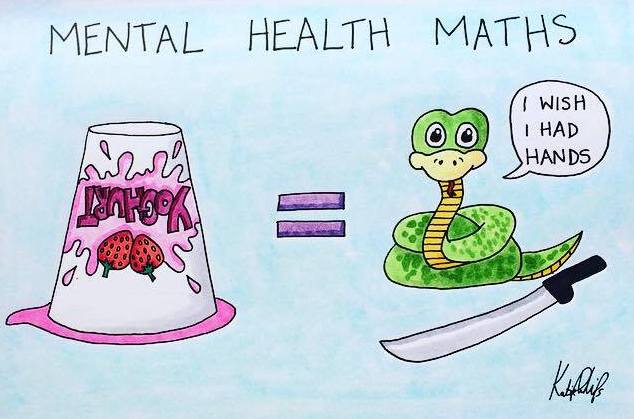
To most “normal” people/sane people, the idea of being asked to pick up a yoghurt is probably not that terrifying, but to someone with OCD who fears touching anything that has been on or near the floor, it was a nightmare. If I had to explain it, someone asking me to pick something off the floor gives me the anxiety someone would feel were they asked to pick up a rattlesnake carrying a machete…in its non existent hand…(note to self, next time when trying to think up an analogy, think of an animal with hands…)

The second that yoghurt hit the floor, I immediately set about looking like the busiest person ever to exist, in the hopes that Bertha would not ask me for assistance out of awareness that I was on a very important mission of my own. I snapped my head away from the yoghurt to the shelves and feigned a deep interest in a bottle of olive oil (rookie error, nobody is ever interested in olive oil. I should have gone for pasta but alas, retrospect is a wonderful thing). I stared at this bottle of olive oil and peered at it so closely you would have thought the meaning of life was inscribed in tiny letters along the side of the label, as if this olive oil was the most fascinating and wonderful thing I had ever seen. My acting was impeccable, several people from the frozen section even applauded despite their distance from my performance, and sent fan mail which I received a few days later. Bertha however, did not take the hint. Despite my acting performance, Bertha saw me and my bottle of olive oil and said in a voice that sent shivers down my very spine “excuse me can you please pick up my yoghurt?” *clashes cymbals so violently that they break into a million pieces and the very centre of the earth explodes*

Looking back, you may ask me why I didn’t just say that I had OCD and couldn’t help, before venturing off to find someone better suited to the needs of someone who needs their yoghurt risen from the ground like some 21st century Lazarus. If I had had a leg disease or something, I would have had no problem in saying “sorry I am currently disabled because of my leg disease” yet for some reason it seemed unacceptable to say “I am currently disabled because my brain is broken”. It doesn’t make any sense, both are a disability and both physical and mental illnesses impact and interfere with your life, but still I couldn’t be honest because saying I had OCD felt a million times more embarrassing than saying I had a leg disease. This sounds especially weird for someone who is able to speak openly about their mental health problems online without shame, but then again I think that is because I don’t really believe that anyone is reading my blog and if they are (hello you), I know they can’t see me hiding behind a cushion in the corner as they do so. For some reason I found that I couldn’t tell Bertha the truth, provide her with an explanation as to why I was scared to pick up her yoghurt, so instead I did the next best thing. I ran away. As I sprinted off into the distance I didn’t look back, but in my mind I can still see the imagined image of Bertha standing there over her yoghurt, Bombay mix tucked under her chin, staring after me and wondering what on earth was going on.

I grabbed my mum and dashed us out of the shop before we could buy anything (we were all very hungry that week), and by the time we got home I felt terrible. Ok I was embarrassed but I also felt incredibly guilty. Here was this poor woman asking me for yoghurt help, and I ran away.
It just makes me wish that there was less shame and less embarrassment over disabilities caused by mental illness, so that people could be honest in that kind of situation. I truly dream to live in a world where one day it will be possible to say “I am scared to pick up your yoghurt because I have OCD” without looking like a lunatic and whilst being taken as seriously as anyone with a physical and more visible impairment. Maybe I am underestimating Bertha and maybe she would have been understanding, but still you have to admit it is more likely she would have raised an eyebrow at the mental illness excuse as oppose to the leg disease thing.

If any of you out there have found yourselves in similar embarrassing situations in which your mental health problem made you feel like a fool, I hope you see this post as a comfort. Remember you are not alone in feeling like a bit of an idiot because there is someone out there who left a woman with her yoghurt on the floor, but more importantly, remember that when in the supermarket, one should always remember to pick up a basket before heading for the yoghurt.

Take care everyone x

Yoghurt

The Difficulty Of Losing A Therapist

Over the past few weeks, I feel that I have been going through what is commonly referred to as “a break up”, one of those horrible experiences that, in popular culture, is often portrayed as a situation that can only be remedied by much crying into tissues and several tubs of ice cream. Now I know what you are thinking, “but Katie, how can you be going through a break up when you yourself admitted the day before Valentine’s Day that you haven’t been in any kind of romantic relationship for over two years” (alright don’t rub it in guys…Jeez).
Well if you thought that, you would be right, no, I haven’t been in a romantic relationship for a very long time (aside from the one I am in wth Helena Bonham Carter that she isn’t aware of…yet), but in the world of mental health there is a common experience that is very like a break up, that being the loss of a therapist.

Now, before I go on I would like to preface this by saying that I do not mean for this to imply that I am caught up in any romantic entanglements with the therapist I am referring to and who is currently in the process of “leaving me” for a new job.
Indeed our relationship is very much the standard “patient/psychologist” affair (perhaps affair wasn’t the best choice of word there…). However, what I don’t think a lot of people understand is just how attached one can get to a person who only hangs out with you every week because they are paid to do so.
It a very odd situation, and whenever a therapist leaves I feel I should deal with it easily, without being particularly bothered. This is after all not a new experience for me, as I have literally lost count of the number of therapists that have left me over the years, (seriously if you rounded them all up you would have more than enough of a cast to put on a performance of Les Miserables and trust me, from someone with a theatre background, you need a lot of people to perform that show). That said I know a lot of people find this a very difficult thing to go through, and rather than it mean we are clingy or weird, I think it makes a lot of sense.

Yes, a relationship with a therapist is strictly professional and should, on paper, be the equivalent relationship to someone you have hired to be your private chef (who is paid for by the NHS because you are mentally unable to sustain yourself alone….I need to work on my analogies…)
The chef turns up at your house because it is their job just like my therapist turns up for our appointments, but when you are talking about your deepest darkest secrets and fears rather than how you like your eggs cooked, it can’t help but become more personal whether you intend it to or not.
In every other professional relationship you have with someone who is being paid to spend time with you, like a chef or a plasterer in your house, the reason for their being there is in reference to something separate, aka food or dodgy walls. With a therapist though, unsurprisingly, a lot of it is about talking about your life. How can that not be personal?
Ok other professional relationships have personal aspects to them as well, a private chef for example may eventually grow to know how much milk you like in your cup of tea without asking every time, yet with a therapist there grows a level of intuition that is less about knowing how you like your tea and more about being able to simply look at your face and know automatically that it is time to put the kettle on (although I would like to clarify that my therapist has never actually made me a cup of tea at all…if you are reading this dear therapist, maybe work on that in your new job). It is that deep connection of being understood as a person, and for that reason of course it can be like a relationship break up when a therapist retires or leaves to get a new job.

Again, of course I am not saying that it is in any way romantic and unlike romantic relationship endings we are not going to be left wondering who gets custody of the kids (we already decided in our first session that I get them Monday to Friday and then she has them over the weekend). Nevertheless I am left wondering what I will do without this person who is currently a big part of my life.
When you see a therapist for a long period of time, discussing your mental health problems/building a therapeutic relationship is sort of like building a house. In the beginning you have an empty plot of land and the patient has a hell of a lot of bricks (bricks that in terms of this analogy represent secrets/thoughts/things that make you as a person). The patient is standing in the middle of this messy pile of bricks without any idea of how to deal with it, so the therapist is there as a sort of builder/tidier to help sort it all out. Every week you both turn up at this plot of land and gradually, the patient hands the bricks individually to the builder. Together you try to construct something that is a little less of a mess, and a little more something you can work in. The more you talk, the more bricks that come out, and eventually the house is finished at which point you can go inside and start trying to make the place liveable. You try things out, experiment with fuchsia walls, checkered wall paper or new therapies and you see what works for you.
Then finally you get to the point where you can both walk into the house (aka brain), and know the insides and outs of it so well that one of you can reference something within the house and the other will know exactly what they are talking about. Refer to the “plant thing in the bathroom” and they know what that plant thing is as well as when in your life you bought it and why it is in the house, just as a therapist will eventually grow to know all about the way your mind works as well as any life events you simply reference to as “that time with the giant squid”. If anyone else comes in the house and you reference the plant thing, they don’t understand exactly what you are talking about. Even if you take them to the room to point it out they cannot have the same level of understanding as the person who helped you build the bathroom in that particular way and find that particular plant at the gardening centre. You can tell a new therapist about what happened during “that time with the giant squid”, but to them it will just be a story rather than an experience you have lived through together.
Getting a new therapist then is not as simple as the professional transition involved when you get a new plasterer for example (I have just realised there are a hell of a lot of interior design analogies in here which I think is in reference to my love of 90’s TV show Changing Rooms. I miss Carol Smiley. Where did she go. She was so Smiley). No, instead of a new therapist coming in to help you in the house you had made earlier, it is like having to smash all of that “brain internal understanding relationship” stuff to the ground and having to start again. Once again you need to start passing them all the individual bricks they have never seen before, so you actually have a long time of simply building up enough of a rapport/understanding before you can get on with any of the serious stuff.

Like the end of any romantic relationship you find yourself wondering if you will ever find someone you will get on as well with or who will understand the way you work in the same way, and the first sessions with a new therapist are very much like all the first dates you have to go on to try and find a new partner. Conversations go from deep personal investigations into the meaning of life to the cookie cutter “so what is your job”, “where do you live” standard statements that you have to go through before you can get to anything of real interest or value.
Unlike a first date of course, a new therapist will probably have all of your notes from the previous one and thus a rough knowledge of your history, but nevertheless, with or without these notes they will always say that they want to hear about your history “from you”. Admittedly this is a good idea. Obviously I can explain something that happened to me when I was eleven better than a therapist was able to jot down in a word document, but having to go through all that stuff is exhausting. Maybe if you don’t have a huge mental health history this “tell me about you” question can be answered relatively quickly, yet for me it is a question that is incredibly daunting. Tell me about your experiences with mental health services?! How can I do that? We have nearly 14 years of appointments to catch up on! I can’t get through all that in one hour!? DO YOU HAVE ANY IDEA HOW EXPENSIVE HOSPITAL PARKING IS?

This entire blog is probably just one long incoherent ramble so half of you reading will be probably wondering what the hell I am talking about and who the hell Carol Smiley is. I guess I just wanted to raise some awareness of how difficult it is when a member of your therapy team has to change and why it feels so much more impactful than a change in any other strictly professional relationship. If I was ruler of the world I think I would probably make it law that therapists are unable to ever get new jobs, retire, change jobs or go on maternity leave (sounds ridiculous I know but in terms of fair/rational leadership I would still be doing a better job than Donald Trump.)
Luckily as you will know if you have been around my blog for a while, I do have a whole team of therapists so it isn’t a total break down of my psychological support and only one person is changing. I also know and like the replacement very much so it is as “good” and manageable a “break up” as it can be. Nevertheless I can’t help but feel as though in a few weeks when it is time for our last session (on the 21st of March, put that in your diary folks), I will be losing someone very important, someone who I can trust and rely on, so naturally, this isn’t going to be easy.

Take care everyone x

therapistchange