The Dangers Of Drinking Too Much Water When You Have An Eating Disorder

So in last week’s blog, I talked about a recent lesson I had learnt about the importance of familiar surroundings when you struggle with OCD, and funnily enough I have learnt something else in the past week too.
I am learning a lot of things lately. It is like being back in pre-school only Daniel Jones hasn’t stolen my green crayon (if you are reading this Daniel then yes I know it was you and I still want it back), and the topics of these recent lessons have been far more focused on mental health and less on how messy one can get whilst finger painting/what noise a cow makes (hint: it is moo).

In life, we are constantly being told to drink more water. If you have ever sat in a doctors’ waiting room you will have no doubt seen several posters about how drinking a lot of water is very important, how kidneys love the stuff, how dangerous it is to get dehydrated, and from all of these posters and health warnings you may assume that the more water you drink the healthier you are, which…well… isn’t exactly true, especially if you are someone who is struggling with an eating disorder.

Drinking too much fluid is by no means something common to all people with eating disorders however, and in my years of experience getting to know fellow sufferers, there seem to be three camps of people and how their disorders manage fluids.
In one camp we have the people with eating disorders who struggle to drink enough water and end up extremely dehydrated, then there is a second camp of people who could drink a whole swimming pool if they had a big enough straw, and then finally in the third camp there are the people with eating disorders who do not have a problem with maintaining safe fluid levels and would therefore like to leave the camp I have just put them in and go back home to a habitat that is slightly less tent like.

As it happens, I am in the second aforementioned camp (ours has a lovely log fire and on Saturdays we roast marshmallows), and I struggle with drinking too much water even if I am not at all thirsty.
It is odd because I have always known that drinking too much liquid isn’t good for you, but when it comes down to it, me gulping down glass after glass of water is like some uncontrollable compulsion, a kind of outer body experience.
Many a time I have been pouring myself another litre and in my head have been thinking “NO. STOP! THIS IS DANGEROUS NOW” but my body won’t listen and carries on filling up my glass anyway. It doesn’t matter how ill I feel, drinking the water feels like an urgent and necessary task as if I need to dowse a fireball that is burning somewhere in my stomach, no matter how much water it takes.

Even in the camp of people with eating disorders who struggle with drinking too much water, it is likely that everyone will do so for a variety of reasons and it is rare for two sufferers with the same disordered behaviours to have the same reasons for carrying them out.
When it comes to me though, my compulsion to drink a lot of fluid is partly because of posters I used to see at my local gym telling me that if I didn’t drink enough my body would hold onto water (leading me to fear that the number on the scales would go higher), but mainly it is because no matter how many doctors or dieticians talk to me about the science of the intestine, I am convinced that if I do not drink ridiculous amounts, any food I eat will get stuck in me forever.

Technically I know all about stomach acids and the body’s ability to break down solid foods via various muscle contractions and other clever things that go on behind one’s belly button, but in my head, eating anything solid conjures up an image of that solid thing getting stuck in a tube. Say for example I eat an apple, it doesn’t matter how much I chew it, when it is in my stomach I still picture it as a big red cartoon like shiny apple with the stalk attached, a lump that will stay there unless I am able to create enough waves to erode and wash it away.

For this reason, to try and keep my drinking under some form of control, I have been on a fluid chart for years where I write down everything I drink to try and keep an eye on things so that it doesn’t get out of hand. If I don’t write my fluids down my brain tends to trick me and convince me that I haven’t had a mouthful of water in days (even if I am surrounded by empty bottles of Evian and have been peeing every five seconds), so it is safer for me to keep a record of it so that when the compulsion to drink a lot comes, I can remind myself that I have already drunk more than enough and need to distract myself elsewhere. Last week however, this fluid chart thing went a little bit off plan with the disappearance of my parents on holiday.

I have had several people message me asking what on earth happened after the mass break down described last week, whether my parents ended up cancelling the holiday or whether we gave it a go despite plan A being a rather sizeable fail.

Well, after people had realised that I couldn’t stay at my parents’ friends’ house for the duration of the holiday, the immediate conclusion was that the holiday would be cancelled, but eventually we managed to come up with an alternative plan wherein mum and dad would go off to Malaysia as planned and I would stay at home with my sister and my most legendary friend of all time alternating sleeping over to try and help me stay safe.

It was going rather well for the first few days (or at least better than the disaster that had been plan A), but as time went on I started to get more and more anxious about my parents being away and consequently the urge to drink increased in order to wash all of that anxiety and stress away. I know it sounds pathetic but without my mum there to verify how much I was drinking and suddenly in total control of my fluid intake myself, things started to get out of hand. People who stayed over would be able to support me in the day time but when up late at night I couldn’t help but manically gulp glass after glass of water over the sink. All the people who write those “yay kidneys like water, stay hydrated” posters would probably be thinking that is great but as with most things in life, moderation is key and you can have too much of a “good thing”.
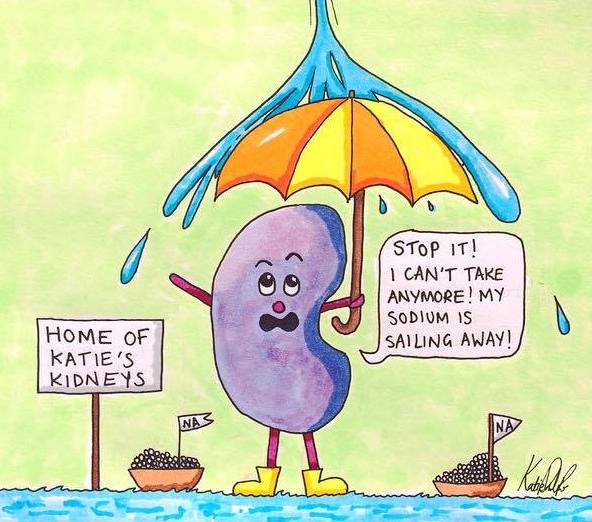
Drinking too much water can cause problems for anyone who has been hitting it hard on the old H20 because your kidneys cannot process it and consequently the water stays in you where it can dilute the salt/sodium level in your blood and cause a condition called hyponatremia, which doesn’t sound particularly exciting but in general language this is known as water intoxication, and I am pretty sure that phrases containing the word “toxic” are never good phrases to hear describe someones physical health.

In healthy adults eating and maintaining a healthy diet, a few extra glasses of water will not cause this kind of thing, but the risks when it comes to people with eating disorders is often greater purely because they may not have been consuming enough salt/sodium in the first place, and essentially there is a risk of drowning your cells on the inside. This then leads to things like heart problems, fainting, water on the brain, seizures, psychotic episodes, death, and basically a lot of things that mean you “aren’t very well” which is exactly what happened to me a few days after my parents flew off to Malaysia and is exactly why my poor sleepy friend had to call an ambulance at 2am on a Saturday morning having been woken by me banging around, generally delirious and spouting nonsense (and a little bit of water. I was like a living water feature. Delightful).

The reason I stayed in hospital for so long however is a slightly more complicated story which I will have to get around to next week, just so that we are all up to date and clear as to why I was so rude as miss a blog post two Mondays ago (Oh the shame. And I was raised in a house with such good manners!), but as an initial explanation, the problem was that I was hospitalised for drinking too much water, and it is now after some severe tellings off from several health professionals that I feel the need to write this post about it so that people realise just how dangerous drinking too much water can be when you have an eating disorder, in case it is something other people struggle with themselves and seriously need to seek support for. If you are one of those people who struggles with drinking too much water I know you are probably doing what I used to do upon hearing these kind of things, the whole “surely it can’t be that bad” and “it would never happen to me” but trust me when I say that water intoxication is extremely dangerous and potentially fatal so if you struggle with it, even if your head tells you “you will be fine”, it is vital you get regular blood tests to check your sodium balance.

Luckily after a few days of being on a water restriction in hospital (good lord was I thirsty), my sodium levels returned to a more acceptable level…it is just that other things started to go wrong after that but again, patience dear friends! All in good time!

Now what I don’t want is for someone who already struggles with drinking enough to read this blog and suddenly panic and start restricting their fluids more than they already were because that is NOT what I am saying you should do and that is dangerous for a different bunch of reasons all on their own. I am just saying it is dangerous to go ridiculously overboard when it comes to fluid consumption even if your eating disorder tries to force you in that direction, and that instead of not drinking anything, just do it all in moderation. Water isn’t dangerous, everyone loves a good paddle or dip in the swimming pool, you just have to keep it at a safe level and be careful not to drown.

Take care everyone x
Kidney

P.s I am sorry if this blog is a little bit all over the place. Physically I am still not in the best place right now and my ability to write is somewhat affected but please bear with me! I am sure recovery will hurry up soon!
How To Dress Up As A Mental Patient For Halloween

Personally, this Halloween I am dressing up as a penguin shaped pumpkin and would advise anyone out there to do the same. However, if there is anyone out there determined to dress as someone with mental health problems, I thought I would help you out a bit with this handy video…

https://www.youtube.com/watch?v=iOXxbN3MWl4

Six Tips For Going Home After A Hospital Admission For Mental Health Problems

You know that feeling when you go to the cinema, watch a film, then leave the pitch black room of the movie theatre and step out into the light? Usually, if you have been seeing a film in the day time, the sunlight outside will be such a contrast to the dimmer environment you inhabited previously, that you end up blindly staggering around in a daze wondering where you are, how to deal with the situation, and why on earth that small bucket of popcorn you purchased cost £50.
That overwhelming sudden change in environment and resulting confusion is pretty much what it is like when you leave inpatient treatment in a mental health hospital for the real world after several months (though I admit, in that situation, you are a little less concerned about the price of popcorn in cinemas than the analogical version suggests), and this is one of the reasons so many people relapse the moment they leave 24 hour care.
In hospital, you are helped to manage your mental health problem in a very specific environment which, once changed, can make someone feel like they are mentally back at square one, home in the house with the same ghosts that haunted them prior to admission. Everyone knows that going into hospital is hard, but at the same time, there are moments when leaving and going back home doesn’t feel any easier. There is a lot of support out there for people who are due to be admitted, but not a lot of help for those on the brink of freedom, and when on the brink of anything (e.g a cliff or freedom), it is vital to have a parachute, a safety net, a plan, and that is what I hope to help you lovely people with in this post. So as someone who left hospital a mere six days ago themselves (it is a very long story that I won’t bore you with here, but in summary I kicked up a right fuss about being in hospital and have been allowed home on a Community Treatment Order, a full explanation of which can be found via this link to my post about the Mental Health Act…https://bornwithoutmarbles.com/2016/07/11/demystifying-the-mental-health-act-with-penguins/) here are a few nuggets of advice for how to deal with leaving inpatient treatment after a lengthly admission:

1. Make a plan and stick to it: When you are in hospital, there are usually a lot of rules and staff who enforce them. Your days are structured, and going from this very regulated, controlled environment to total freedom where you can do as you please, can be a frightening shift in responsibility. Therefore it is vital to make a plan and rules to stick to at home so that the change is less dramatic and you still have boundaries, rather than the secure bars of safety falling down around you and allowing your mental illness to run wild. Create a basic timetable to follow (not religiously, just to give you a sense of how to structure the days you are suddenly free to spend as you choose), and implement any non-negotiable rules from the ward at home. Follow the plan of recovery that you have been working on in hospital and don’t let your days be filled up by the to-do lists scribbled on the walls of your mind by your anxieties.

2. Take it one day at a time: Before going home it is important to acknowledge that making the transition is never going to be perfect. There are new challenges to face, and with that it is likely there will be little slip ups along the way (If you watched hurdles at the Olympics this year you will know exactly what I mean. Seriously those people were professional hurdlers and they still kept falling over and sending hurdles flying all over the place). The key however is to not see every set back as permission to revert to relapse or give up the race. If you mess up one day, start afresh the next morning and don’t let a bad hour spiral into another bad year. Treat mistakes like sand castles, make them, acknowledge them, whack a shell on top, and then watch the tides of time wash them away.

3. Keep Moving forward: Whenever I leave hospital I often find myself feeling that the geographical move signals a mental move in terms of recovery. When inpatient you are constantly being pushed to move forward, but when you go home it is easy to halt all progress and remain static because your head tells you that you are “not in treatment anymore”. The truth is, wherever you are, you are in treatment and progress in recovery is possible, so to avoid getting stuck, make a list of goals or challenges for each month to keep progress going.

4. Ask for help: Bottling up thoughts and keeping how you feel a secret is a lot harder in hospital than at home because in hospital there are people constantly following you around and shining a torch in your face at night to check if you are sleeping, which, funnily enough you were until someone rudely shone a torch in your face (if you have someone doing that at home then you should probably bring it up with your landlord). Asking for help when inpatient then is not really necessary, because help is often following you around even when you don’t want it. At home however, it is easy to isolate yourself, pretend you are ok to please others, and fall down a slippery slope greased with eels and vaseline because you fear letting others know that you need a little assistance in scrambling back up aforementioned eel ridden slope. Admitting you are struggling is tough, but it is tougher to fight your battles alone. If you can call the hospital to speak to staff from the unit you were in, do that. If not, call a friend. Either way, reach out, be honest and don’t be ashamed of needing people to hold onto.

5. Use your imagination: Whenever I have been in hospital, then go home and struggle, I often find it helpful to imagine I am back in hospital. It doesn’t sound like particularly great advice to help someone in their journey to mental stability by telling them to imagine they are in a psychiatric unit (in terms of signs of insanity that one sounds pretty high up the list), but I like to remind myself of the fact that though things feel so different and so much harder at home, really the only difference is location. If you have managed to eat your meal plan/not self harm/resist compulsive behaviours within hospital walls then going home and doing the same is, in practical terms, no different. The hurdles as it were have not got higher, they are on a different track, so if you can leap them in one place you can leap them in another. Don’t let your head spiral out of control and make you believe that doing what you have been doing for months is as drastic as it feels.

6. Acknowledge that you are still unwell: One of the biggest mistakes when leaving inpatient treatment is to see yourself as “better” and able to thrust yourself back into hard core “normal life”. Just being at home will take a lot of energy and mental effort, so don’t force or pressure yourself to going straight back to a stressful job full time when you have been out of action for a while. Allow yourself to still see the journey to recovery as your full time occupation and ease yourself back into things gradually. If you have a job, maybe go back part time at first so that you still have time to look after yourself, and find your feet back home. Then when you have found your feet (and we all know how much easier life is when one is aware as to the location of all body parts), you can try full time again, but take it steady and prioritise mental health.

So there you have it! Six delightful tips to help keep you on track when making the difficult transition from hospital to home. Maybe calling them delightful is a bit of a stretch, but they are at least what I am trying to use to help me as I find myself suddenly back in reality after several months of being locked away behind a very high and unscalable green fence.
On a more personal and honest note, I know that discharging myself from inpatient treatment six days ago was probably not the best idea, and I know I did it for the wrong reasons, but hopefully it will work out OK in the end. Whether or not these tips are any good of course will be determined by how things go over the next few months of me carrying them out myself back at home.

I guess that is something we will find out together…

Leaving inpatient tips

Life Lesson: Running Away From Your Problems Is Not A Good Idea

Last Wednesday (the 22nd of June if you want to put it in your diaries for next year), was my 24th birthday. I anticipated a day of being at home with my family and playing on my new games console, but things did not go exactly to plan, much like the rest of this week. So, for today I wanted to use this post to provide a brief personal update on my current situation, as I feel it will be necessary for you all to know for the next few weeks of blogging delights, and the whole thing has taught me a little lesson I wish to share with you, the lesson being that you cannot run away from your problems. Actually that is a lie, you can run away from your problems very easily, but they will chase after you, and those little buggers can run fairly fast (so fast that I am convinced that they are on steroids and am hereby requesting that “Problems” are not allowed to race at this years olympics).

But I am getting ahead of myself, spouting lessons before I have explained how I learnt them, so let us go back to the beginning, by which I mean my 24th birthday rather than the dawn of time and the dinosaurs.

So, on the 24th of June at 10:30am my dad picked me up from my house to attend my appointment at the hospital and there I sat in the waiting room until my Psychologist arrived. I was taken to be weighed as per usual (a fairly disappointing experience, as the scales were just as they always were, no balloons/ribbons on the scales to celebrate my birthday or anything), and then we went through to talk. Had barely been chatting for five minutes however, before my psychologist presented me with an unexpected birthday present, this year, the very unwelcome surprise of an inpatient bed in hospital due to recent deterioration in my mental health, the bed being for Friday, less than 48 hours away. Now I know that people say that it is the thought that counts, and if anyone offers you a gift for your birthday you should be grateful and say thank you, but suffice it to say that I was not at all impressed with this suggestion, and couldn’t help thinking that my therapist should do any future present shopping for friends and family on amazon. I would rather she had given me a moustache maintenance kit for a gift, and I don’t even have a moustache…yet.

It was all pretty unwanted and sudden in my eyes, not the birthday party I wanted at all, so I left feeling rather deflated, much like the non existent balloon my therapist had failed to put on the scales to add a bit of merriment to weigh day proceedings. Luckily my mum later cheered me up by taking me to the park I used to frequent as a child to play on the swings, a far jollier birthday activity. I then played my new games console all evening, so I managed to have a nice birthday in the end by generally ignoring all worries about hospitals and anything other than which character I wanted to be in Mario Kart. (Incase you are interested I picked Toad because he looks like a mushroom and if you don’t find pleasure in watching a man who looks like a piece of spotted fungi zoom around a racing track throwing bananas, then quite frankly there is no hope for you). Basically, I ran away from my problems and pursued my dreams of winning the grand prix instead.

The next day however I was rudely awaken by my problems (quite literally, my therapist phoned me whilst I was still in bed dreaming of penguins), and she told me once again that I should go into hospital the next day. Again, I refused and got on with my day, but a little later I got another phone call that suggested the problems I was avoiding were rapidly gaining on me, this time the notification of a Mental Health Act assessment later that afternoon. My parents have since told me many a time, that it would have been the best idea to just remain calm and attend, but as a natural born problem avoider without marbles, I decided to do the next best thing, aka run away on bus and then a train to Exeter. Do I have family or friends in Exeter you ask? No. Did I have a place to stay or plan in Exeter at all you cry? No. I quite simply had no idea what I was doing other than getting away from the situation and possible hospitalisation to be re-fed back in Bristol. Unfortunately things got a little messy around this point, and though I caught the train and found myself hurtling across the English countryside at 65mph, the mess I had got myself in was hurtling right alongside (not even on a train, the mess was literally running alongside the track that fast. Steroids I tell you. STEROIDS). I won’t bore you all with the details, but in summary, my problems burst on the train to seize me no matter how hard I tried to deny any of it was happening, and a few hours later they had rudely dragged me back to Bristol where I was sectioned under section three of the Mental Health Act and admitted to an eating disorders hospital right away with none of the things I would have needed to pack. All I had in my bag was my wallet and my train tickets to Exeter, which I had well and truly learnt were of no use in my current predicament.

So, that pretty much brings me to my present situation, legally detained in hospital, unsure of how long I will be here and frightened in relation to every aspect of my life. Worst of all, the hospital in which I am detained doesn’t even have wifi (I am officially back in the stone age), and I will admit that one of my worries when I woke up the next day was you, my dear little internet blog readers. Though a small crowd I admit, you are in all honesty a key motivation for me to keep kicking ass as much as I can. I have no control of my personal life at the moment, but I still have my blog and writing to escape to so that is what I am focusing on for now to get me through. That said, without wifi posting this is going to be an almighty challenge, so if it is Monday and you are reading this then another lesson we will have learnt from this week is that I am a technological genius who is more educated in the ways of computer than Bill Gates.
Thankfully, as one positive to brighten up this rather bleak post, I do at least have some of my things in my hospital room now, as my mother was kind enough to bring the basics in, and it is always nice to have your own toothbrush and teddies when trapped under stressful circumstances. I guess that is yet another lesson right there: never underestimate the power and importance of clean teeth and something to cuddle.

I really hope you can all forgive me for this slightly indulgent post that is all about my personal mental health and situation, rather than stigma reducing information or any advice I can offer, but to be fair this is my birthday week, and if you can’t be a bit indulgent and have a ramble about yourself on your birthday then when can you? I promise normal/more interesting blogging will resume next week when I have settled in and know what is going on in my life, but for now I hope you can all at least take away the main lesson I have learnt and point of this post that in some ways we can all benefit from it, that being that when it comes to mental health issues and things generally in life, you cannot run away from your problems as they will always catch up with you eventually, (even if you are on a train to Exeter).

Orange.jpg

(For the purpose of this picture I have envisaged my problems as a giant orange with a satsuma for a nose. This is not because of any symbolic significance related to oranges or their complex segmented form, it is simply because I really do not like oranges and never miss an opportunity to draw them in a bad light).