Why We Need To Keep Talking About Mental Health

Tomorrow is a very special day for this blog that you are oh so kindly reading in this moment (cheers for that), for tomorrow will mark the one year anniversary of Born Without Marbles being “a thing” on the internet as opposed to an idea in my head that I was too scared to carry out.
That means that I have been harping on about mental health, whether you have liked it or not, for an entire year, and I wouldn’t be surprised if there were people out there wondering why on earth I am still waffling on about illnesses that the majority of the population are well aware of by now.
Ok the general public may have misconceived ideas and perceptions as to what an illness may really be like, but everyone has a rough idea these days as to what things like OCD and Anorexia actually are, so why am I still talking about these things and why do I plan on continuing to talk about these things for the foreseeable future? Newton isn’t still harping on about the time that apple fell on his head (partly because Gravity is old news that doesn’t own the headlines these days and partly because he died in 1726 which somewhat limits his abilities to “harp on”), so why do I keep talking about what it is like to be mentally ill when the existence of mental illnesses is no longer breaking news. Well friends, whether you have been here from the beginning or whether this is your first experience of Born Without Marbles (Welcome. Please excuse the penguins I have left lying around in each post. They are kind of important), today I am going to answer that question and tell you why, even after a year of weekly waffling, I still feel that we all need to keep talking about mental health.

Of course there are all the obvious things like the fact that the more we talk about mental illness, the more research there will be and in turn the more likely we are to find a cure. To explain why I personally have such a passion for the subject however, I need to take you back to 2003, and, more specifically, eleven year old Katie (to set the scene I looked exactly the same as I do now only shorter).
As the name of this blog suggests, I can see that I have shown signs of mental illness from the moment I was born, but it was in 2003 that things really began to become a problem, that I became afraid and ashamed for the first time of the thoughts going on in my head. It was the first time that I didn’t feel normal, and feared that I was different from everyone else.

Every day at school I would watch other pupils in awe. I would see them eating school dinners, opening doors and shaking hands with each other as if it was the easiest thing in the world, and I would wonder how on earth they did it all. For some reason when I tried to open a door, I would find myself frozen in fear, unable to touch the handle as if someone was holding my arms behind my back. When I was in the queue for school dinners, my head was screaming at me to run away because I wasn’t allowed to eat, and no matter how hard I tried to concentrate in lessons about ox bow lakes, all I could see in my mind were images of terrible things happening to all the people I loved, and hear threats that the only way to stop those things happening was to repeat some kind of ritual. This would have been rubbish enough, but the worst bit was that I had no idea what this meant or why this was happening. I thought long and hard, trying to come up with an explanation but the whole thing made very little sense to me. What was so scary about the germs on a door handle when I had evidence all around me showing that nothing bad was happening to people “contaminated” with them? Why couldn’t I go to lunch, even on pasta days? Logically I knew that I loved pasta (pasta is flipping awesome), so why did the idea of eating a steaming bowlful topped with as much cheese as I could get away with before a disapproving dinner lady grasped my cheddar filled palm, scare me so much?
These things went on for months, and I said nothing to anyone because I was too afraid. Maybe mental health wasn’t as widely discussed in 2003 or maybe I was just unaware of what mental illnesses were, but I had never heard of anyone experiencing these things so I kept silent and hoped they would go away. Spoiler alert: they didn’t. Of all the awkward situations I found myself in however, there is one in particular that sticks in my mind and one that continues to motivate me and my dedication to this blog today.

“It” happened at the end of a music lesson. Now, in my school, music was taught in a separate building to all others, ditto art, drama, and DT who all had their own individual buildings (something tells me the staff members of the more creative subjects did not get on well…this explanation of the separate buildings certainly correlates with the time I saw the head of drama pelting the art teacher’s studio with water balloons anyway…)

On the day in which our story occurred, our class had been taken to a room on the top floor of the music building where there were a lot of computers and keyboards set up for us to spend a few hours learning how to play the theme tune from Titanic (a vital part to any eleven year old’s education). Then, the lesson ended and we were dismissed, a fact that meant we were going to have to leave the room and therefore, someone was going to have to open the door. Usually I was very good at avoiding such a responsibility, and at the end of every lesson I would fumble around with my bag until someone else had done the job so that I could scoot on after them without touching anything. This technique worked perfectly for every lesson, but today, for some reason, the teacher wanted us to lead out in single file from the nearest computer to the door. I think maybe someone had been messing about with a keyboard, playing Celine Dion’s soundtrack with a little too much gusto, so in the exit of the classroom, the teacher wanted to establish some serious authority. I felt sick. I was at the computer nearest the door. I was to be the first to leave, I was to lead my fellow students to freedom. I was to open the door. When I saw that it was a push door then, I was thrilled. Happily I nudged the door with my foot and led my classmates out, but the relief was short lived as I realised we were headed for another door, a pull one with a handle…AND AN EXIT CODE KEYPAD.
I thought about pausing in the corridor to let someone overtake but the corridor was too narrow, it was single file, there was no escape, and as I walked down the stair case to the door I genuinely felt like I was walking to the gallows. This was it. I was going to have to touch a door handle, and it was going to be the end of the world. When I reached the door I stopped. The time had come to raise my hand, but I couldn’t move. Instead, I just found myself stuck, panic building as the queue of students eager to go home started forming behind me. Luckily everyone was talking about the day too much to notice my embarrassing situation at first, but after a few minutes of standing in a line waiting, understandably, people started wondering what the hell was going on, and from the back of the line I heard a voice ask perfectly reasonably “is there something wrong with the door?” From then it went silent and all I could hear was the response in my head of “no actually, there is nothing wrong with the door, there is something wrong with me and I have no idea what it is”.

Eventually, after what felt like 34 years, the person behind me became impatient, reached around and opened the door, and from there I ran sobbing to the medical centre with shame, fear and embarrassment. I didn’t want to see anyone ever again, I had to hide, so I decided to take refuge in the sanitarium. When the nurse asked me what was wrong, I lied and told her that I had a tummy ache. I spent the rest of the day curled up on the sofa with a hot wheat bag watching episodes of the Simpsons, feeling more alone than I knew it was possible to feel. There were hundreds of other pupils in the school, but for some reason I was different, I couldn’t open doors or eat meals like they appeared to, and there was nobody, least of all me, who understood why.

It is for that Katie sitting on that sofa with that smelly hot wheat bag that I started this blog, and it is for all the smelly hot wheat bag holding people out there pretending to be fine, pretending to have tummy aches to cover up the fact they are terrified of their own minds and too scared to speak out for fear that other people won’t believe them, that I write this blog. Had I heard about mental health problems sooner, maybe I would have asked for support sooner, but what I would have found more helpful than any of the symptoms listed in the millions of health care packs, would have been the knowledge that there was at least someone out there who struggled with the same things, who let me know I wasn’t crazy, that I wasn’t alone. It is for that reason that, no matter how much awareness there is about the existence of mental illnesses, I will keep talking about my experiences with mental health problems in public spaces. This isn’t a blog to just give information, in my eyes, this blog is a friend, both to me, to the readers and to anyone out there who comments to say that they can relate to my problems and thus remind me once again that none of us are alone.

So happy birthday Born Without Marbles, and thank you from the bottom of my heart for all the support anyone reading this has ever provided. Here’s to another year, another 52 weeks of my ramblings, another 365 days of friendship.

Take care everyone x

MarblesBirthday

10 Ways To Support Someone With An Eating Disorder

Living with an eating disorder is hell, but I think it is underestimated just how horrendous it can be for the people living with people who have eating disorders. I know many parents, families, partners and friends tend to feel pretty hopeless when watching someone they love slowly drowning, without knowing how to stop it. Almost every day my mum will ask me what she can do to help, like there is some problem solving action she can perform as easily as changing a lightbulb.
I know for a fact that if there were an action she could carry out, my mum would do it in an instant no matter how inconvenient or unpleasant (I think she would even play Pictionary and she HATES Pictionary…weirdo). Unfortunately, eating disorders don’t have quick solutions and no matter how much a loved one wants to help, they cannot fix the problem. They can however support the person, and often these little offerings of support are nowhere near as dramatic as people seem to think. Supporting someone with an eating disorder doesn’t require grand complicated acts of kindness, often you can support someone with little things that don’t take much time or effort at all. So today, I am going to share with you a list of things that I find help me at home aka 10 simple ways you can help someone with an eating disorder.

1. Don’t get angry with the person, get angry with their disorder – When you have an eating disorder in the house/in any relationship, you can guarantee it is going to cause some conflict. I have lost count of the number of arguments I have had with my mum with regard to eating disorder issues like what I am eating for dinner. I honestly don’t think we have ever had an argument about anything that wasn’t mental health related (bar one argument we had in 2002 because she wanted Will Young to win Pop Idol when I was firmly on the side of Gareth Gates. I would like it noted that I can now lift my hands up and admit I was wrong on that one). Just yesterday I am ashamed to say I had an argument with my mother and yelled at her for about half an hour because she tried to help, and unknowingly put my kidney beans in the “wrong pan”.
Afterwards I felt incredibly guilty/like the worst person in the world. This guilt would have eaten me up and is the kind of thing that makes me feel that I don’t deserve food, but after we had all calmed down and I had apologised, what I found helpful is the fact that my mum made it clear that she understood that I hadn’t meant to yell about a bean pan. She knew it had just been the eating disorder taking control, and though I need to work on managing that myself, the acknowledgement that I wasn’t this terrible person who worried more about what pan my beans were in than my mother’s kind attempt at assistance, made me feel more able to continue with the meal.

2. If you are eating with someone with an eating disorder, keep them distracted and don’t make the food the sole focus of the experience – Meal times with someone with an eating disorder are not the most relaxing of situations and can be pretty intense (like one of those awkward dinner parties you see on Come Dine with me only less bitchy and without a voiceover man commenting on every little thing that occurs). For this reason, when I have to eat a meal with someone, I find it really helpful for them to help keep me distracted and not make it all about the food. Silence allows thoughts to creep in at the table, so I would recommend conversation if the person is able or, if they are unable (sometimes I cannot talk very much/think of words because I am so anxious), have the radio on in the background or play a game. Sometimes in hospital we would even do things like crosswords or little quizzes which really helped keep your mind occupied by working on something else (my favourite thing about this was that when there were bank staff they would go through the pile of quiz questions without realising which ones we had already done so we were all able to provide correct answers instantly and looked like geniuses.)

3. Allow them to take baby steps in their recovery rather than expecting miracles overnight – When people are in recovery from any mental health problem, there is often a lot of pressure for progress to be quick so that the problem can be solved and forgotten about as soon as possible. However, recovery is a very slow process and this pressure is often detrimental as it can make a sufferer more anxious and stressed. To help someone who is struggling, allow them to make progress at a steady pace they are comfortable with rather than forcing them to make dramatic changes which ultimately will not be sustainable.

4. Praise them…or don’t praise them at all – I have many friends who appreciate a little “well done” or similar nudge of encouragement after a meal to make them feel supported and like their hard work hasn’t gone unnoticed, so offering those words of praise can be a great way to support a loved one. That said, I know there are others, (me included) who actually find this more unhelpful, as they like to leave the table and forget everything rather than acknowledge the meal that has just been consumed. Denial may not be the best way to deal with mealtimes, but at the moment denial is how I cope, so I am helped by nobody commenting on how fantastic it is that I have cleared my plate. For this one then, maybe ask the person you are supporting to see whether praise would be helpful to them before whipping out the party poppers to celebrate an empty bowl of cereal.

5. Try to be as relaxed as possible at the dinner table – When I sit at the table, I am always anxious, and when I can see that other people are anxious, it makes me more anxious. This then makes them more anxious and before you know we are left with a table of people panicking about a meal that hasn’t even happened yet. For this reason when supporting someone at a meal time, if possible try to be calm and relaxed to show that the situation isn’t anything to be afraid of, rather than freaking  yourself out and condoning the “THE TABLE IS A SCARY PLACE” fear.

6. Seek support for yourself – People with eating disorders need support and so do the people around them. As important as it is for carers to have an outlet somewhere to discuss their concerns and worries though, it is helpful to make that outlet someone other than the person who is struggling. When you feel that you are a terrible person who is ruining everyone’s lives because you cant eat normally, emotional outpourings condoning that are only going to make things worse. Ultimately then for this one, support someone by finding support and seeking help for yourself too.

7. Keep diet talk to a minimum if you are on a diet – Obviously when you have an eating disorder, people being on diets can be rather triggering. That said you cannot dictate that nobody who lives with someone who is struggling is allowed to have any say in what they eat. Naturally we all have needs and some people may be prescribed special diets from a doctor which of course they should follow. If this is the case however, the best way to help the sufferer manage the situation is to not make a song and dance about it (aka no conga lines for the fact you have switched to low fat yoghurt and if possible none of those “I LOST THREE STONE” certificates which diet clubs award people plastered all over the fridge).

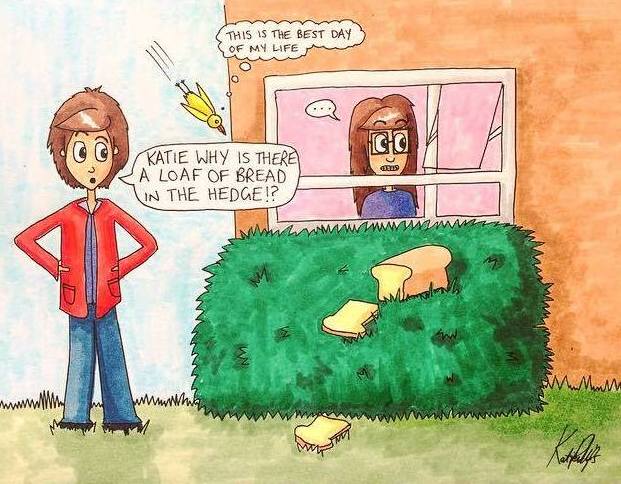
8. Know their meal plan – Again this one depends from sufferer to sufferer but personally I find it helpful when those around me know what is on and what is expected of me in my meal plan as it makes me accountable in some way. Obviously the goal is to get to a point where I don’t need people to know what I should be eating and am able to be responsible myself, but right now my mum having a copy of my meal plan supports me every day. That way, when I am struggling and want to miss things out, I know that it is not a case of “nobody will notice so just throw the bread out of the window” as my mum would immediately wonder where the soft wholemeal has gone (and why there is half a loaf of Hovis stuck in the garden hedge)…

9. Don’t treat them like a disorder – When people see or think of me, I always feel they think of me as “the one with the eating disorder” and that I have no other identifiers to me as a person. It is therefore helpful when living with someone with an ED, to treat them as a normal person with other interests and hobbies so as to remind them that they are more than their disorder and will ultimately still have an identity left, even when the disorder is gone.

10. Do not comment on their meal plan or their body weight – This last one is probably fairly obvious but nevertheless very important so I had to include it. Whatever you do and if you only follow one of these tips as to how to support a loved one, make it this one and for the love of all that is holy NEVER comment on how much weight someone has gained on their recovery meal plan and NEVER comment on how big someone’s meal is. Eating disorder recovery meal plans may look totally normal but there are some that may perhaps be bigger than normal. Whatever the meal plan though, the person will need all the food prescribed to treat their malnourished body and repair all of the damage that has been done internally. If someone is soldiering through their meal plan trying to reassure themselves of this, the last thing they need is a comment like “blimey that is a lot of food, I couldn’t eat that”. Hand on heart a bank HCA in hospital with no experience in eating disorders sat next to me one meal time and after I had finished my main/was picking a spoon up to dive into my rhubarb crumble with custard, they commented “I don’t know how you can eat that. My main course was half the size of yours and I am already too full to eat another bite”…THAT IS NOT HELPFUL INFORMATION.

So there you have it, ten ways in which family/friends can support people with eating disorders (at least in my experience), without actually having to do much at all. Being desperate to help a loved one and wanting to support them doesn’t have to be carried out in dramatic acts like white water rafting or playing Pictionary, Sometimes all you need do to be the most helpful and make the biggest difference, is the little things like asking them for help with a crossword over their cornflakes or giving an encouraging nod at lunchtime.

Take care everyone x

supportsomeonewithed

Why Living With A Mental Illness Is Like Having A Full Time Job

When I told my mum and my various therapists that I had got a job for Christmas, the general reaction was “Why on earth have you gone and done that”, and admittedly, upon accepting the job, I felt very much the same. Realistically, I knew that my mental illnesses are currently putting too much of a strain on me to manage a job on top of them, but nevertheless I felt I had to get a job and that there was no choice in the matter. Why? Because of a question I always get asked by people in day to day life: “What do you do?”.

Whenever you meet someone new or see a family member that you haven’t seen for a few years, people tend to ask questions along those lines to find out what you are doing with your life, this often meaning in terms of job or career. It is this question and the moment in which it is asked that I always dread.
You see, pretty much all of my friends have proper jobs and it is generally accepted in society that everyone has a job to show that they are a valuable member of the population, contributing to society and earning money to put into a bank account somewhere to save for a mortgage on a house (what the hell is a mortgage!? How do you make a bank account?! Where do banks keep all the money? Who is in charge of all of this? When did they teach this in school? Why are piggy banks no longer acceptable as a money holding receptacle? Have I been mis-sold PPI?!).

Unlike most of my friends and indeed most people my age however, I do not have a proper job nor have I taken my first step onto the career ladder (I haven’t even found the damn ladder).
The reason for this is because my mental health currently dictates my day to day life and arguably makes a regular job impossible (hence why I have not applied for a regular job in years). This means that every time someone asks me what I am doing with my life I feel incredibly embarrassed and inferior having to say that I am “just trying to work on my mental health”. In essence this is ridiculous as I am well aware that there is no shame in not having a job because you are too unwell and I would never judge anyone else for being in a similar situation. Being ill myself, I know how drastically it can impact one’s routine, but as much as I know that I worry that people who haven’t experienced such things will think I am someone who is lazy or sponging off their parents, someone who should be written about or filmed for a Channel 4 documentary so that the general public can watch and rave on twitter about what a terrible person I am. Luckily I have never had any bad comments myself, but I know for a fact that when people ask my mother what I do and she responds with “Katie can’t work because of mental illness right now”, she has received comments akin to “so what on earth does she DO all day?.
It is as if they think I just tick the box for having a mental disability on all the forms I get for the sake of not having to hold down a job and then lie at home complaining about how bored I am. This could not be further from the truth. I tick that I have a mental disability on all of these forms and then when I go home I am not being bored, I am wrestling with a mass of nastiness in my brain that is trying to kill me, and that in itself is pretty hard work. I always felt like it was equivalent to a job myself, but lately the number of “what do you do” questions has been putting such a pressure on me that I started to wonder whether or not I really was making excuses and was as lazy as I assume everyone thinks I am.

After a week of work though, I have fully learnt the lesson that I feel more people need to learn in society, that being mentally ill is very much like a full time job all in itself (a really rubbish job with no time for a tea break, no pay and no Christmas party. Yeah. You heard me. NO CHRISTMAS PARTY.)
Things that should take minutes just take hours when it comes to me and the time simply goes by without me realising it. Showering can take forever and meal times are at least three hours so some days I may only be able to say “I have eaten three meals and had a shower” in response to “what have you done today?”, which doesn’t sound like much.
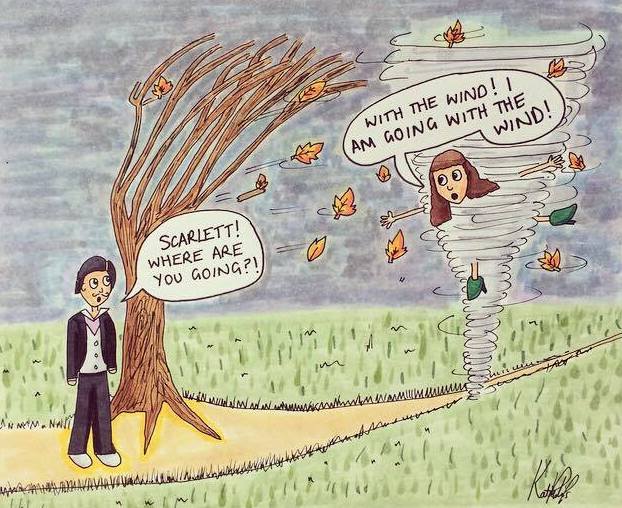
In the mind of a sane person that probably conjures up an image of two hours activity at the most with time in between to spare, without realising that really to achieve that is over ten hours work a day, and that doesn’t even include other things I may have to do like go to an appointment, go to the loo or get dressed (all of which are more things that go on for longer in duration than the film Gone with the Wind. God have you seen that movie? IT GOES ON FOR HOURS. I swear it never ends. It has been running in my living room since January 1989 and they are still waffling on. Also for a film with the word “wind” in the title I would like to complain that it is simply not blustery enough. I don’t even think we have had a light breeze yet let alone the gale force tornadoes I was expecting. FALSE ADVERTISING. MOVIE PEOPLE ARE EVIL.)
When viewed like this then, it is easy to see how mental illnesses demolish the time and effort people would usually put into a job, and it is the reason that I am struggling so much with my career as a Christmas temp for six weeks.

I only do five hour shifts five days a week which may not be as much as other people, but in carrying out that job the issue is that I haven’t simply been able to resign from my mental illness one to accept it. Having a real paid job doesn’t mean that I can just stop showering or eating for hours on end, so essentially I am now working two jobs. Considering I never really get free time you may be wondering how on earth I am able to do these two jobs as where can i fit these extra five hours in? As an answer to that I will simply say that rather than resigning from my mental illness job, I have had to resign from the position of “person who sleeps” instead.
Nowadays I work for five hours, then come home and work my usual eating and sleeping routine (I can’t bring myself to eat breakfast before work so I literally am having a working day then coming home and starting with the routine from the beginning with meals like breakfast as if I have just woken up).
If I am lucky and my “day” of trying to eat/stop washing/stop obsessively repeating things like brushing my hair finishes, it is then that I will go to bed. However, by this point it is practically time to start the next day in terms of official work, so after two to three hours I am up and have to get started all over again. I have also had to cancel every therapy appointment I had this week and I really am so exhausted that I have no idea what is going on. I am sort of in that drunken state that you find yourself in when you haven’t had enough sleep and end up staggering about, bumping into things and laughing at the pavement which in your deluded state suddenly seems to be a hilarious invention worthy of much mirth and merriment. It has got to the point where yesterday I genuinely felt a small hole when washing my stomach in the shower and panicked because I thought I had been mortally wounded somehow/was about to see my liver fly/spill onto the floor, before I realised that that “hole” is the belly button that has been chilling in the same place upon my abdomen for the past 24 years. As signs that you are pushing yourself too hard, I think “being scared of your own belly button” is a fairly big one.

I know that in writing this I am going to get comments telling me to quit this job before it gets too out of hand, and to be honest if it was anyone else in this situation I would be saying exactly the same thing. Carrying on with this job until the end of December goes directly against all the advice that I gave in my “tips for managing a job interview blog” (e.g. the whole “don’t push yourself past what is possible and take care of yourself first” idea), yet I am frustratingly one of those silly people who can give very good advice but very seldom follow it. That said, I still stand by all of that advice and can reassure you that there is no way I would be carrying on with this if it were a permanent position. I am not stupid, I KNOW that I could not keep up this level of hectic-ness forever. The way I am managing is by thinking I just have to keep my head down, get on with things for another 6 weeks or so and then I can get back to working only my mental health job. After that I think I will accept that I have thoroughly learnt my lesson and there is no way I will be applying for any more jobs until I am a lot less bonkers.

Nevertheless, as difficult as it is, I still really wanted to write this post as this experience is something that I am learning from, and hopefully they are lessons that, in writing them here will help us all out in the long run. If you can’t work because of your mental illness it doesn’t make you lazy, as you technically have a job getting through every day, it just isn’t one you handed in a CV for yet this doesn’t mean it is any less real. Also I really hope that this helps spread the message to people without experience of mental health problems as to what it means when someone is out of work because they are mentally unwell. It isn’t about laziness, it is simply about having the internal job of fighting your demons that nobody else can see, and if more people realise that then maybe the pressure to perform when you are not up to it will one day subside so other people don’t find themselves in my current pickle.

Now if you don’t mind, I will love you and leave you all with the illustration below, an image that depicts what the movie Gone With The Wind would have looked like had I been the writer/director.  As for me I think it is time to go to sleep. My next shift at work starts in a few hours. Oh good lord…

gonewiththewind


5 Tips For Managing A Job Interview When You Have Mental Health Problems

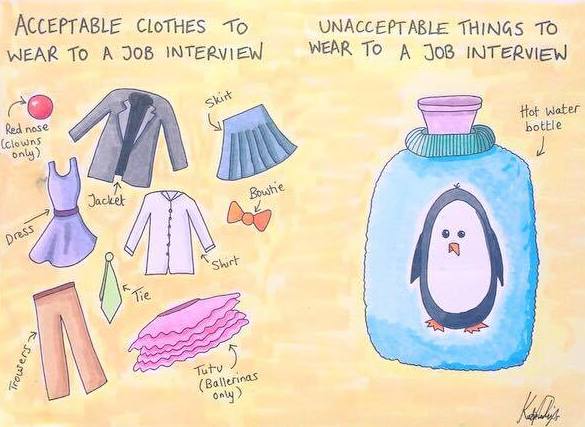
A couple of weeks ago, I had a job interview. Much like most people before an interview, I was terrified, but not exactly for any of the usual reasons for pre-interview nerves. Of course the normal worries like “Am I going to look like an idiot?” “What if I can’t remember my own name?” “What if I can’t answer any of the questions?” were there, yet the leading racers in the anxiety Olympics were all mental health related. My main concerns were things like “Are they going to want to shake hands?” “What if I have a panic attack?” “What if they offer me a biscuit?” and “Is it socially acceptable to go into this interview with a hot water bottle shoved down my trousers?” (admittedly that last one isn’t exactly mental health related but I think we can all agree it isn’t on the list of the most common interview worries…I was just very cold…still, my mother confiscated the hot water bottle because it would make me “look weird”…yeah…I am sure they saw the icicles forming on my chin as totally normal…I’m not bitter at all…)
Prior to the interview then, I had a lot on my mind, and in turn a lot of preparations to make to ensure that I was going to be able to actually get through the interview. This meant that over the course of the experience I learnt a few things, so I thought I would pass them onto you now in case anyone else out there is struggling with the “please hire me by the way I am insane” issue. I can’t say these tips are going to make your job interview a jolly occasion, but in the end, I got the job which the interview was for, so I guess these tips have their uses…

1. Anticipate parts of the interview that are going to cause particular problems: Prior to an interview, there are several things that everyone will think about in preparation. Maybe they will research the company in which they are seeking employment, think about potential questions, or have a google search of the latest updates in the business world so they are prepared for any topic up for discussion. In the same way then, it is important to think about and prepare for any potential events that could be difficult. For example, I was worried about hand shaking, so in preparation I spent the days before the interview anticipating the touching of palms and speaking to people about it to get through some of the anxiety. In practical terms I also found an anti bacterial foam that supposedly lasts for six hours, so I was sure to pack that in order for me to be able to use it before the interview as a sort of protection glove. I then made sure I knew where the nearest bathrooms were for post interview washing. I even prepared how to turn down a biscuit incase one was offered, so anticipate potential mental health hiccups and solve them before they arise. (Thankfully water was the only refreshment offered so I never had to turn down a biscuit…I accepted the water and really wanted to drink it, yet never got a chance because I was too scared of making a slurpy noise. Had it been a job interview for a position as professional slurper I would have drunk the water as fast as I could and been sure to demonstrate all the slurping noises possible but alas, my interviews was not located in an institution that advocated slurping…or hot water bottles stuffed down one’s trousers apparently…)

2. Be realistic: In job interviews, it is sort of an unwritten rule that you say “yes” to everything and worry about consequences later. Can you speak french? Of course you can! You have a french dictionary at home and 24 hours to learn it…what could go wrong? Can you fly? Of course you can! How hard can it be to sprout wings /morph into a sparrow overnight (from experience I can assure you that is VERY hard indeed). As great as it is to say whatever you can to get the job though, it is important to be realistic and not agree to things that your mental health is going to make impossible and that you are consequently going to go home fretting about. If you have social anxiety and can’t speak publicly to a crowd of thousands, do not agree to do so and then regret it later. If there are things you are not going to be able to do, let the people know right away to avoid getting into a difficult situation further down the line. Yes it will be awkward and maybe you won’t get the job if there is a key part of it that your mental health makes impossible, but then again if that is the case, maybe that job isn’t the one for you. In terms of being realistic about actions you can perform, it is also important to be realistic concerning what you can manage when it comes to hours. Accepting a job 24 hours a day 7 days a week when you know it will overwhelm you, interfere with medical appointments and leave you no time to take care of yourself, is never a good idea. Getting the job is important, but taking care of your needs is vital as without looking after yourself you wont be able to perform at work and getting the job will not be a success you can celebrate for long. I for example know that there are multiple aspects to this job that are going to be extremely challenging and on the surface, if I am honest with myself, the hours are more than I think I can realistically handle. However, I made sure only to apply for a Christmas job for 6 weeks so that if I get overwhelmed/it is detrimental, there is at least an end goal in sight.

3. Get there early: Everyone knows you should get to a job interview early purely because being late is not the best way to promote the “great time keeping skills” you bragged about in your CV. Nevertheless, with mental health problems I would always advise not just getting there early enough to ensure you are on time and make a good impression, but getting there super early to allow for potential disaster/to allow you to remove the hot water bottle shoved down your trousers. Obviously you can’t plan what your brain is going to do in advance and it would be unrealistic to decide that you are going to schedule a panic attack for 11:15 so you have time to calm down in time for the interview, but if there is a risk of that kind of thing happening, get there with the time such an event would take spare. If you often have panic attacks, get to the interview with enough time to have one. Even if you don’t have panic attacks but suffer with anxiety, still get there early just to allow yourself to gather your thoughts and carry out any coping mechanisms like listening to a certain song or practicing mindfulness if needed.

4. Do not take rejection personally: One thing I really struggle with when it comes to job interviews/anything in life, is the fact that I take rejection extremely personally. My main worries about not getting the job weren’t about not getting the job in itself, rather they were worries about the effect it would have on my self esteem. For example I know that getting rejected from roles in school plays/not performing as well as I wanted in a test, has always led to difficulties with self harm, self hatred and general feelings of “everyone hates me and this is a sign that they don’t want me to be alive anymore because I am so terrible”. Before you go for the job interview then, try not to build it up to be this majorly important thing on which your value as a person and entire future happiness depends. Don’t see it as something on which your life rests, as ultimately no job is worth that. Maybe even write out some bullet points in case rejection does come to remind you of the rational facts in the situation. When the rejection comes it is likely your thoughts will spiral into the irrational emotional side of the brain so get your pre-rejection rational thoughts in order first. If you don’t get a job it doesn’t mean you are a terrible person/rubbish at everything/doomed to fail in life. It likely means that there were a hell of a lot of applicants and even if you were more than skilled enough, perhaps you just weren’t right for the role or someone else was better suited. If you are a doughnut maker and don’t get a job as a doughnut advocacy speaker it doesn’t mean you don’t make good doughnuts. It might just mean that you were up against a talking doughnut, and lets be real, who is better to speak for doughnut advocacy than a talking doughnut? Nobody, thats who.

5. Be honest: This is the final tip I have to offer but it is also THE most important. When I used to be preparing for interviews I would debate whether or not to tell the potential employer about my mental health problems/how much to say. I always wanted to hide it incase my mental health would stand in my way, yet ultimately that just meant that by hiding my difficulties I made life more difficult for everyone involved. Eventually the truth would always come out, and it would have been a hell of a lot better simply to be honest in the first place. If your mental health affects your life in terms of abilities or availability, let the employer know. Otherwise you will find yourself lying about reasons you need a day off to go to an appointment and having to invent mythical physical diseases to request time off work when really you are having a mental health crisis. For the past few years I have even put my mental health problems somewhere on my CV or within any applications so that everyone is on the same page before I even get an interview. This then makes it easier to talk about in the interview and by being honest both I and the employer can see if the job will be possible/work out ways to make it possible. When I worked in a coffee shop I was open about my fear of touching the hoover and thus allowed to use it whilst wearing rubber gloves saving me a lot of anxiety and excuses to get out of having to use a hoover. Again, like the tip about being realistic, there is always a chance that being honest will affect your chances of getting the job, but if it affects your life so much that it will inevitably cause problems at work, again, maybe that is a job you shouldn’t be applying for.

So there you have it! My top tips for managing job interviews with mental health problems. Now of course I have the mission of managing the actual job itself… To be honest I haven’t figured out how to manage that bit yet, but I guess that is something I will learn along the way. If my experience over these next few weeks does teach me anything about mental health in the workplace though, I will be sure to pass on any helpful lessons to you later.

Take care everyone and good luck with any potential job opportunities. YOU CAN DO IT!

jobinterview


6 Tips For Managing Public Transport When You Have Mental Health Problems

As you read these words I will hopefully be hot footing my way to London. I say hopefully because, as the idea is so terrifying, I cannot be sure I will go through with the journey (I am writing this a week in advance. Call me Mr Organised. Actually don’t, make that Señor Organised…has a bit more of a flourish don’t you think?).
Going to London/leaving the house at all is scary for a multitude of reasons such as managing food, being in unfamiliar environments with uncontrolled levels of bacteria, generally being around people, but one of the top scary things on the list of ultimate London scariness (it is a very long list), is the fact I will have to use public transport, and I am pretty sure that will be on many peoples’ lists of scary things about leaving the house.
Therefore, today I thought I would write this blog post to help anyone out there who is overwhelmed with terror at the mere thought of bumbling along on a bus or trundling track via a train. I can’t say these are the best ways to manage public transport anxiety issues, but they are at least the tips I will be using to get me through…if I manage to leave the house to get to the public transport stage that is…All aboard the mental health travel tip train! Here we go!

1. Make alternative routes: If there is one thing you can rely on when it comes to public transport, it is the fact that it will be unreliable. Buses break down, flights have to stay grounded because it is cloudy and I am yet to have a train journey which hasn’t started with a good half hour wander up and down the platform listening to the woman on the tannoy tell me that my train is delayed in a frustratingly calm voice (she always says she is sorry to announce the delay but if you ask me she doesn’t sound sorry at all. HOW DOES SHE SLEEP AT NIGHT?). I once even had a train cancelled with the explanation that there were “slippery leaves”…That’s right, slippery leaves. Not even going to try and make a sarcastic joke about that. I think the phrase “slippery leaves” makes the point. Anyway, due to multiple reasons much like the aforementioned soggy foliage, it is likely that any route you plan to take will be interrupted. This is enough to make anyone frustrated, but when you are already anxious and stressed it can feel like the end of the world and make you run back to your home wondering why you ever bothered leaving the front door. For this reason it is always vital to have an alternative route to fall back on incase any slippery leaves rear their ugly heads to get in your way.

2. Customise your route: When trying to look up directions, pretty much all of us will turn to the internet (dear young readers, did you know that maps actually used to be things you could find on paper rather than apps on your phone with floating blue dots. They called these maps “The A-Z”. They were marvellous things, I really wish you could have seen them), and when you look up directions on the internet it will often tell you what it thinks is the easiest route. However, this “easiest” route is the route judged as easiest by a computer, it is a purely rational decision and unlikely to fit with what is “easiest” for the irrational fears in your head. Of course we must all push ourselves and challenge our mental illnesses lest they control every aspect of our lives and sometimes there is only one way to get from A to B. Nevertheless if there are options on a journey that may not be the quickest route on paper but that will help you manage anxiety better, go with them. Walking a few streets along may take longer than hopping on the London underground, but if the tube is likely to cause a paralysing panic attack in the end, walking may actually save time and a hell of a lot of stress.

3. Do not rely on the internet: Another thing in life that can be as unreliable as the number 44 bus is internet signal. It is all well and good to entrust your travel plans into the route calculating hands of an online computer but if you find yourself in the middle of nowhere with no internet, Siri is going to be of little use in helping you out of that predicament. Even if you do have signal, phones and other pieces of technology are always at risk of running out of battery (especially if you have spent too much time playing Pokemon go…ahem), so regardless as to whether you found your route online, make sure you take a paper copy. Paper doesn’t require signal and paper does not run out of battery leaving you in an anxious heap. In short paper is awesome, so don’t forget to use it.

4. Listen to audiobooks: When on a train or a bus I often find my anxious thoughts speeding around my mind faster than the mode of transport I am riding, so fast that they are little more than a blur that I cannot decipher. Every bump in the road is a potential earthquake to my terrified brain, every new passenger a potential murderer, and for this reason when anxious on public transport it is vital to have distractions. A lot of people listen to music in order to help soothe them and if you are one of those people then make sure any journey out of the house involves earphones to listen to your favourite tunes. Personally though I struggle with listening to music on public transport, as when you put music on shuffle it can be unhelpfully unpredictable. It is all well and good to be on the bus nodding your head to a relaxing ballad from Adele but seconds later you can find yourself being bashed about the ears with the drums of heavy rock which is not relaxing at all. For this reason then, I often listen to audiobooks which I find are a lot easier to get lost and calmed by, so I thoroughly recommend them as a distraction technique (especially Harry Potter books on trains. That way you get the dulcet tones of Stephen Fry and you can pretend you are on the Hogwarts express as you listen).

5. Buy tickets in advance and get money ready: To buy tickets you need to queue. Queuing is stressful. People with anxiety and mental health problems do not need added stress. The solution? AVOID QUEUING (by booking tickets in advance at quiet “non rush hour” times or online, not by whacking everyone else in the queue out of the way with your hand bag.) Personally when it comes to buying tickets I also find touching money to be a challenge, so if you also struggle with this may I suggest getting your fare ready prior to the moment some ticket officer asks for it so that you do not have to suffer the money touching stress with the “oh my goodness I cannot find the right change why is my purse full of pennies people are staring at me” stress. When I prepare a bus fare in advance I always like to antibacterialise it and then keep it in a separate pocket to lower anxiety further. It isn’t ideal in terms of trying to fight things like OCD, but if needs must, in my eyes it is better to do whatever you need to to get out of the house.

6. Give yourself time and plan every step that is difficult: The final thing that I would say makes travel difficult is the general panic and hysteria I find myself getting into when I am in a rush/under a strict time limit. For this reason to reduce anxiety I always leave a lot longer for my journey than might otherwise be necessary AND I plan in travel breaks whenever I need them. It makes more sense to hop from train to bus to train and on again until you reach your destination, but incase the anxiety gets too much it is important to plan pit stops to release some tension and take a break from all the mania. Personally, with planning breaks I also like to plan toilet breaks because the idea of an unplanned unexpected public toilet experience freaks me out, so if it scares you too, maybe find loos along your journey that would be easiest and fit them round your ticket times.

So there you have it! The six tips that I use to help me get through the fear of public transport and the six tips I will hopefully be carrying out right now on the way to London (like I said it is a week in advance but already I have planned every safe toilet along the journey. PREPARATION IS KEY.).
Of course they won’t take the fear of public transport away, but hopefully they will make it a little easier or at least doable.
I wish you all safety and relaxation during any upcoming travels and promise to keep my fingers crossed that you are never faced with the horror film inspiring added obstacle of “slippery leaves”.

Take care everyone x

transportanxiety

How To Fight Fear With Fear In Recovery From Mental Health Problems

When you are in treatment for a mental health problem, one of the questions that comes up a lot is the query of “What do you want?”. Many people find this helpful, and in thinking about what they want from life, they find motivation and strength to recover. For example, I know a lot of people with eating disorders who want to have children, are helped to eat by the thought that they need to be healthy to have a nice comfy womb (that is the scientific term for “be fertile” I believe).
When you know what you want from life, it doesn’t make recovery easy, but it gives you a purpose, something to fight that nagging voice in your head with, an argument as to why you are forcing yourself to do things like challenging pieces of therapy that make you feel uncomfortable. With an end goal, the stress and pain of recovery make sense, like running a race and focusing on the finish line with a giant gold trophy at the end of it, whether that trophy represents kids, a passion to travel the world or a desire to pursue a difficult career that wouldn’t be possible with insanity by your side.

To be fair I think “What do you want?” is a really important question for anyone to ask themselves in life, or indeed an important question for waiters to ask customers prior to bringing them food. Imagine if every time you went to a restaurant the chef just always assumed you wanted oranges and served everyone who ever sat at a table a bowl crammed with citrus wedges without finding out if the person liked such a thing first. WHAT A MAD WORLD THAT WOULD BE!
Clearly then, the aforementioned question is vital for sanity in the mental health world and the restaurant trade, but the problem with it is how you answer such an inquisition when you are unsure of exactly what you want, what your goal in life is, and it is an issue that can leave you feeling a bit stuck. That is how I feel, like I am running in a race where I can’t see a finish line or big shiny trophy to aim for, and considering that a loss of interest in things is a symptom of depression, I imagine it is a feeling that many are familiar with.

The only thing that I can hand on heart say that I actually have a desire to do, or a want to achieve, is to be a published author one day. That idea is the thing that gets me out of bed in the morning, but I am tentative to make that my overall focus for recovery. Becoming a professional author is a notoriously difficult thing to achieve and I am fearful of basing my entire recovery on such a risky goal that is really quite out of my control. Of course I realise no career or dream is straight forward and nothing anyone would ever really want is easy to reach. After all, if dreams weren’t a little fantastical and difficult, where would the appeal be? The point of dreams is that they have that element of the unattainable surrounding them to make them special. That said, wanting to be a writer is probably up there in the top ten dreams that are seldom realised.
When you want to be a writer, there are no directions, no post code to put into google maps and no yellow brick road giving you a little route to follow to your desired destination. You want to be published and can write all you want, but getting anywhere with it is a little out of your control and a lot of it is based on luck. It really is a case of writing and then keeping your fingers crossed, a particularly difficult combination of actions to do together as when one’s fingers are crossed, it makes it infinitely more difficult to hold a pen to write anything with.

In terms of concrete and definitely attainable things I want then, my pocket of ideas is empty. I suppose I should count myself lucky that I have the want to be a writer at all, as like I said, when you are depressed or caught up in a mental illness, you are so wrapped up in your mind that you can’t want anything other than for the pain to stop.
Coincidentally, when psychology professionals and therapists ask me what I want, that is pretty much my answer. I don’t know what I want, so personally I find focusing on what I don’t want is easier, as I know I don’t want to feel the way I do. I don’t want to feel the weight of sadness on my shoulders when there is nothing rational to be sad about, I don’t want to be anxious about touching doorhandles, I don’t want to shower for ages and I don’t want to care about what food I will be eating in the next few weeks. At the same time though, it has been such a long time since I lived in any other way that I don’t know what the alternatives to those things are. When you have been out of the real world for so long, how can you remember what it is like there, let alone what things you would want to get out of it?

It sounds pretty negative to focus on things you don’t want rather than the things you do, but recently I have to say that actually thinking that way has been a bigger help and more of a motivation than any potential desires on the horizon.
When in hospital and indeed now I am back home, at every meal time I am scared and I do not want to eat. It isn’t a case of not wanting whatever food has been place in front of me (please let it be known that my mother is a fabulous cook and all of her concoctions are a delicious treat for all the senses…if you don’t have an eating disorder screaming at every mouthful). No, rather than a case of unappetising culinary creations, when I do not want to eat, it is a case of feeling so sick with terror that I fear consuming the food as I know it will only make that anxiety worse which, clearly, I do not want. If anyone was placed in front of a plate of something that scares them, who on earth would dive in with joyous anticipation of the spine tingling sensations they knew would ensue?
Say someone was scared of spiders and they were presented with a plate of little arachnids performing a traditional waltz around a dinner plate (fun fact, 8 legged insects are fantastic at and passionate about ballroom dancing. You won’t find any evidence of it online or any book so you will have to trust me on that. Seriously though, they LOVE it.)
When presented with these graceful creatures using crockery as their own professional dance floor, who with a fear of spiders would offer a hand to one of the many limbs scurrying before them in the interests of dancing a jive or having a cheeky go at a tango? More importantly, who would want to? Probably no-one. The only way I can think of getting someone to want to do such a thing would be to make an alternative which they wanted less. For example, if it was a a case of dance with a spider for ten minutes or marry a spider for life, I imagine a lot of arachnophobes would want to give the insect tango a try.

That is in essence how I manage to eat at home and how I motivate myself to do a lot of challenging things treatment requires of me in terms of anorexia, OCD or indeed depression. I do not want to eat, I know that I will feel anxious and an agonising guilt just from picking up the fork, but I know that if I don’t there will be consequences I want even less and fear even more, such as my CTO having me hauled back into hospital before I can say “why are there nurses banging at the door?”.
I guess what I am trying to do is play fear at its own game. I know that I am going to be scared every day and I don’t have a positive idea of what I want in life to override that. Therefore instead of being cornered by the fear, I come back at it and use fear to make me do the things I am scared of by creating a far more horrifying alternative, by making whatever action scares me in recovery the “lesser of two evils” as it were. I am scared to eat dinner this evening, but I am more scared of being taken back into hospital and made to gain more weight, so I know I will get on and chow down no matter what.

I would love to write a Disneyfied post instead of this, one that reassures any readers out there that dreams can come true, can conquer any mental torment and that focusing on the positives like answering the question as to “what you want” in life is the key to recovery. I want to tell people who are struggling that all you have to do is find your passion as the way to overpower your demons once and for all, but answering that question as to what you want is a challenge in itself. Of course it would be infinitely better if I were able to eat a steaming bowl of spaghetti without any anxiety because I had goals and passions in life stronger than the fear flowing through my veins, but it is I suppose better to use fear to manage the scary things than to not do the scary things at all.

If you have a mental illness that is taking over your life and you don’t feel a burning desire to dance like Billy Elliot or paint like Van Gogh pushing you forward, don’t let that lack of knowing what you want hold you back and don’t let the fear of making changes bind you in chains. Play fear and lack of interest at their own game, take advantage of them. Rather than being dominated by an OCD or anorexic fear of touching a door handle/eating pasta, think of the alternative to challenging that behaviour and find a fear of living your whole life being controlled by your neuroses that inspires a greater terror than any door handle/Italian carbohydrate ever could. I can’t promise it will work and I can’t even be sure whether or not this will make sense to anyone out there, however this post is at least an attempt to explain how I am dealing with the fear and apathy involved in the struggle for sanity.
Nobody ever wants to feel fear, but often when it comes to mental illness, fear is all you have, so I for one am going to use what I have got until I can find something better.

spider1

Preparing For University With A Mental Health Problem

In a few short days it will be September, aka the month in which all of the leaves turn orange and everyone takes this as a sign that everyone should probably go back to school, or, potentially, to university. What with leaving home, meeting new people and learning to use a frying pan, going to university for the first time is stressful for anyone. With mental health problems however, the experience can be a whole new level of terrifying, and although your chosen institution may provide a handy welcome pack with maps and phone numbers of who to call when the oven explodes, they never seem to offer any advice on how to deal with the whole thing when you are a new student without marbles, a situation I found myself in several years ago.

I think part of the problem is that before people have even stepped onto campus, they have built up an image of what their first year at university is “supposed to be like” and anticipate having to be involved in various situations they may not be comfortable with.
People expect that they will have to drink copious amounts of alcohol, attend wild house parties where somehow everyone ends up naked, make best friends with everyone living in their accommodation, share a kitchen with people who never wash any dishes so that by month three the sink is covered in plates that have rapidly been growing some kind of blue fungus, carry out crazy pranks with their hilarious roommate Colin, get entangled in a passionate one night stand with a mysterious moustachioed stranger, live off kebabs/Pot Noodles/Pizza, experiment with drugs, and capture all hilarious moments on a polaroid camera to place carefully in a scrapbook which will then provide unforgettable memories of the university experience that will forever be heralded as the best three years of your life.
That university image, so often portrayed on social media, is understandably a nightmare concept for various mental health conditions. People with depression and social anxiety may fear attending all these wild parties when they are often unable to get out of bed, let alone party and interact with strangers. People with OCD may struggle with the wild unstructured “anything goes” attitude and questionable hygiene or lack of ritualistic order associated with student living, or people with eating disorders may fear having to drink alcohol and eat pizza to fit in at any social gathering.

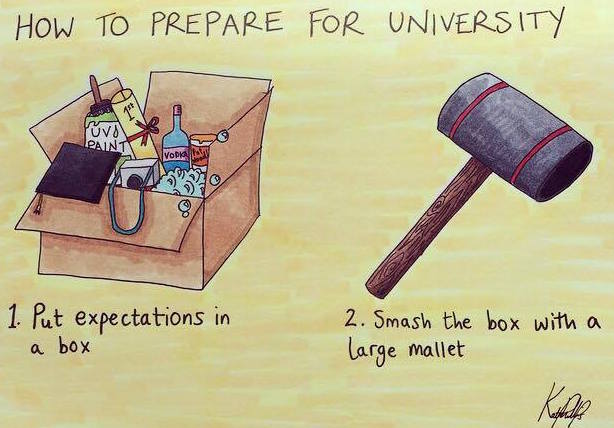
Well, if that wild carefree party life described above matches your expectations as to what you think university will be/require you to live up to, I would like to invite you to place those expectations or ideas of things that are “supposed to happen” in a box, and then smash that box with a fairly large mallet. Nay, lets go wild. With a flipping colossal mallet.

Admittedly, my description of what people envisage before they go to university, really is the experience had by some students (bar the bit about hilarious pranks with roommates called Colin…people called Colin don’t tend to like pranks), but it isn’t the experience that you have to have or feel pressure and stress to be involved with. I would love to say that going to university with a mental health problem is easy, and it is true that some people find the new environment beneficial to recovery, but that doesn’t happen for everyone and it is important to acknowledge that so we can deal with it.

Indeed, when you embark on your university journey whilst dealing with a mental health issues, it is likely that it is not going to be straight forward and you may not have the same experience as everyone else. It isn’t pessimistic to think this way, it is realistic, and being aware of potential difficulties from the outset is a far better way to go about things than charging forth unprepared with deluded optimism, pretending you don’t have mental health issues in hopes that they will just go away. Denying them will not make university any easier and not dealing with them could make difficulties you thought wouldn’t be an issue come as quite a shock. The key is to accept early on that you are going to university in perhaps a different situation to most people (after all it isn’t every student that goes to get a degree whilst fighting an unrelenting mental health gremlin), and that is ok, not something to feel ashamed or guilty about.
You don’t have to pressure yourself to live the “expected” university life of gay abandon if that is something you cannot manage right now…

…That said, I am not trying to tell you all to go to university and allow your mental health issues to take over entirely, as whilst you must acknowledge the issues are there, it is good to challenge yourself and try new things. TO AN EXTENT.
University can provide opportunities for millions of new experiences, and though you may not be able to join in with all the things that are on offer, if there is something you would like to try that challenges your mental health problem in a manageable way, (whether that be going to a society, or saying hello to someone in your accommodation), go for it. I know I avoided all challenges in the early weeks by totally isolating myself (aka I lived under my desk for a month covered in a blanket in fear another student might see me through the peephole in my door and want to say hello), and it made things a hell of a lot worse for me in the long run.
Eventually however, I came out from under my desk, and over the three years I managed to go clubbing/ to a party a few times and live with some lovely girls in a shared house. I didn’t want to do any of these things and was terrified for various OCD, anxiety, ED reasons, but on days where I felt a little stronger, I pushed myself to try and join in with others. Of course it was difficult and I can’t say it always went to plan, but by dipping my toe into the waters just outside of my comfort zone occasionally, I managed to have some fun that I would have missed out on had I kept myself locked away in my rituals and bubble of safety.
What I mean then by saying you should challenge yourself to an extent, is to be aware of your difficulties and know when a challenge is manageable and when one is not. It is great to give scary things a go, but do not blindly leap so far out into the waters of your comfort zone that you end up drowning if you are not ready, just because you feel you should/feel pressured to. It is not weak or boring to say no to things everyone else is doing, so don’t be too hard on yourself. Nobody “fails at life” just because they didn’t manage to go to that foam party with UV paint being splattered into the crowd and needed to spend the night curled up under a blanket for a good cry instead.

It really is key that people remember the fact that when going to university with a mental health issue, you are ill, and have to put as much time into prioritising care for your mental health as you do for prioritising attempts at socialising or writing essays.
For example, if you have an eating disorder, it is important to make time to eat, follow any prescribed meal plan you have and not let things slip just because you are away from people at home who “know”, so if you miss bits nobody will notice. If you have depression and can’t get out of bed for a few days, take care of yourself and keep yourself safe rather than beating yourself up or feeling guilty about it. Prioritise taking your medication, make time to go to the Doctor, seek out mental health services available to you and take up offers of appointments. Equally, inform lecturers of your issues so that they can support you if you miss a lecture or require essay extensions, as although scary, being honest with staff and the support I received in return was vital for my experience.

Most importantly and the most difficult thing to accept though, is to know when enough is enough. It would be great to go to university with mental health problems and for it all to go swimmingly, but if that doesn’t happen and if you going to university has such a dramatic impact on your mental health that you find yourself becoming increasingly unwell, accept that this might not be the right time for you to be there. Allow yourself to drop out or defer until another year. Maybe in a few years time when you are in a better place you can try again, or maybe university just isn’t right for you, but either way it is fine, not a sign of failure, and no degree is worth sacrificing your health for.

There are a million other things I could probably go into when it comes to university and mental health or more specifics in terms of how to deal with it with specific illnesses, but I have waffled on too long and as a basic overview, I guess this is my advice:
It will be hard, it will be scary (much like an old toffee wearing devil horns), but the most important thing is to just try your best, take care of yourself first and never give yourself a hard time for being unable to live the “typical student” lifestyle.

That said if anyone would like more specific information or tips on managing university with certain illnesses or situations, feel free to comment or message me privately and I will do my best to help. To all those going to university in a few short weeks, good luck, I will be thinking of and supporting all of you. Take care.

University