How Physical Health Problems Can Trigger Mental Health Problems

Last week I talked about a recent incident where my mental health, more specifically my eating disorder’s obsession with drinking a lot of water, had a detrimental affect on my physical health and in a hilarious twist of fate and example of bizarre symmetry (and by hilarious I mean literally the most unamusing thing to happen ever), this week I am talking about how the opposite can also be true, and how physical health conditions can end up triggering or making a pre existing mental health problem worse.

So when we last left off, I had explained how I had been admitted to hospital for water intoxication and was being treated for this problem via a strict fluid restriction plan to get all of my electrolytes back to acceptable levels (it is at times like this when I wish I had one of those “previously on” video clips that they show before episodes of various TV dramas…I should really look into that…ooh and a theme tune! I do love a good theme tune!)
Now, after a few days, the fluid restriction, whilst being incredibly annoying for me, seemed to be working, and my sodium levels kept improving until they were back to normal. Really, that should be the end of the story, the problem was solved so I should have been packing my bags and making my merry way home, but alas the story did not end there and developed into what I like to think of as an epic novel of utter ridiculousness.

You see whilst my sodium levels were improving, I wasn’t feeling any better which didn’t make much sense. I had been admitted for a problem that was being successfully treated yet bizarrely, as the days went on, I became more unwell with a pain in my stomach. The doctors couldn’t really make sense of this and before long I was in so much pain that I couldn’t stand or lift my head off the pillow and was in need of all the morphine I could get. A few tests were run but no answers were revealed so a surgeon was sent to have a look at me.

After thumping me in the abdomen with an iron mallet a few times (she said she was only going to “press gently” but trust me from the pain I am pretty sure that woman had a mallet and a vendetta against my stomach region), it was concluded that I might have a swollen appendix. I was told that normally the surgeons would book me in for an operation to whip it out just incase, however due to my already poor physical health from my eating disorder, they wanted to avoid taking me to theatre (alas the operating one and not the version where you get to watch The Sound of Music on stage whilst eating a little pot of ice cream with a spoon that is basically just a mini plank of wood with no resemblance to a spoon whatsoever), because they weren’t sure I would survive an anaesthetic.

Thus it was decided that they would only operate if they were absolutely certain that such a thing was necessary and therefore some more tests were scheduled to try and clear up what was going on. The problem with this was that by leaving time for tests, we were also leaving time for things to go downhill which they did fairly rapidly. Again the surgeon visited and again an operation was suggested but also feared so I was sent to yet another test in the form of a CT scan where I was basically shoved in and out of a tube a few times whilst doctors took photos of my insides (I really hope that my organs put on their best clothes and posed nicely for the occasion…it isn’t every day someone wants to photograph your intestines).

After the CT scan was complete it was around 1am and I was finally allowed to have some more morphine and attempt a snooze, whilst my sister, who had been sitting beside my bed for the past few days, went home. That was until 4am when another surgeon woke me up, to tell me that the scan had shown that things were rather serious and I was scheduled for emergency surgery immediately, my sister being called back in by the nurses having only just left. The next little bit of time is somewhat of a blur but from what I remember I was pumped with anaesthetic and taken to theatre (again, the operating one. I didn’t get so much as a lick of ice cream and I saw no children dancing in curtains. Livid.)
I was so knocked out that it was about 24 hours before I woke up from the procedure, dazed and confused with a tube coming out of my stomach and leading to a bag of some unidentified liquid.

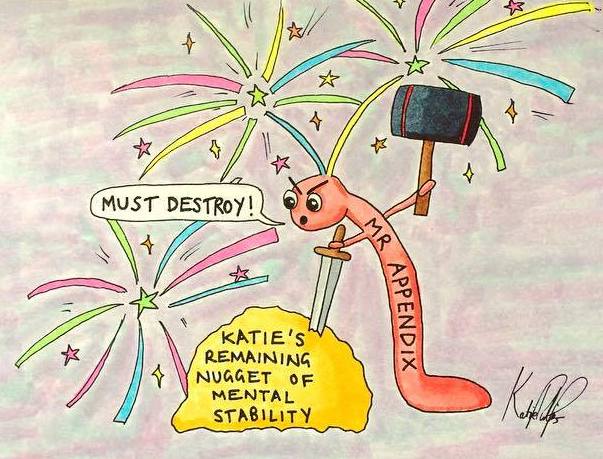
It was then that I was informed that my appendix, in being left for so long, had ended up exploding. (The surgeon told me that I shouldn’t say that it “exploded” because in technical terms you should say that it “ruptured” but damn it I went through a hell of a lot of pain and nonsense because of what happened so if I want to say that my appendix literally exploded like a firework on the 5th of November then I will jolly well do so!)
Consequently my body had been filled with poison, hence the tube and bag scenario coming out of my stomach after the appendix had been removed, to drain the poison out (the poison being the funny liquid in that bag.)

Since then the job has basically been to free my body of poison, recover from the surgery and try to build my body back up after its internal beating, a job that isn’t going too well at the moment because this whole physical health problem extravaganza has triggered the life out of my mental health problems, more specifically my eating disorder.

Admittedly I haven’t been doing particularly well for a while now, but I have been clinging on to some sense of stability by rigidly carrying out the same routine meal plan via some form of repetitive autopilot action. Unfortunately, this event has utterly destroyed my autopilot “just do what you did yesterday” routine.

I think when you have an eating disorder, eating your meals is kind of like a recovering alcoholic avoiding the pub.
If you force yourself to eat the same meal plan every day, you get into a sort of rhythm, a rather bumpy and unpleasant rhythm that you can’t lead a good conga to, but a rhythm all the same. Missing one meal however is like an alcoholic downing one mouthful of vodka after a few months sober and then suddenly finding it impossible to stop.

Knowing that missing one meal will always make the next one harder is the reason that I fight so hard to complete my meal plan even on the bad days because I know that not doing so will make it harder for me in the long run, but in this whole “my organs are exploding” situation, missing a meal wasn’t something I had any control over.
For the first day of the hospital admission, eating was mentally impossible because I was in a different place with different foods. This problem was somewhat solved when family and friends hauled bags upon bags of my safe foods to my bedside, but by that point I was physically in too much pain to lift my head let alone grab a spoon to chomp down on some cornflakes. During all of these pain days I was also constantly being wheeled in and out of various tests that doctors were telling me I wasn’t allowed to eat before, and incase I was going to need emergency surgery after some of these tests, my stomach also had to be kept empty on the off chance that people would be whipping the scalpels out (apparently it is significantly harder to operate when one has just demolished a peanut butter sandwich…or any kind of sandwich…not that there is any other sandwich worth mentioning).

Post surgery I was finally allowed and encouraged to eat to regain my strength and I genuinely tried, but again there were hurdles. Firstly the combination of anaesthetic/poison/million medications made me extremely nauseas, and I was being sick multiple times a day. My taste buds had also suddenly gone haywire and for some reason I could not tolerate sweet foods which for someone who always picks sweet over savoury and who lives off sweet things like porridge and cereal, this was somewhat of a problem. Even the flavour in toothpaste made me throw up (all over my toothbrush I might add…suffice it to say my breath was not minty fresh), and shock of all shocks, I started to be repulsed by peanut butter. Me. Repulsed by peanut butter aka the food that was previously the holiest substance on earth? Who am I? I think I am going through some kind of identity crisis. You might as well start calling me Malcolm.

Therefore I was trying to find new foods that I could both mentally and physically tolerate, family and friends bringing in new groceries every day (including my parents who had had to cut their holiday short and catch an emergency flight back to the UK with fears that they might not get “back in time”…safe to say their relaxing trip to Malaysia was somewhat of a disaster this year..).

Excitingly, a new safe food that I could physically and mentally tolerate was discovered in the form of mashed potato, but by this point it had been so long since I had eaten properly even that was a struggle. I felt sick at every meal time and I could never be sure why. On one hand it could have been the “genuinely physically ill with poison and anaesthetic” sick that I shouldn’t have forced myself to fight as nothing I ate would be kept down anyway, or it could have been the simply sick with anxiety and fear of food sick that I really should have been challenging to prevent it getting any worse. Sometimes food would arrive and I would feel so ill that I wouldn’t risk a mouthful only for the food to be taken away, the sickness to go and me to realise that all that nausea had been anxiety as apposed to anything related to physical complications.

After multiple meetings with my eating disorder services who visited me a lot on the medical ward, it was decided that I would be discharged home incase eating became easier there due to familiar surroundings. Armed with a ridiculous amount of mashed potato, I really tried but a few days in found that I was struggling to swallow. Again I assumed this must be that whole “throat closing up with anxiety” thing, so I persevered, but then after finding some weird white nonsense all over my tongue and throat and a trip to the doctor, it was discovered that life had thrown yet another curve ball and in my weakened post surgery state, had given me tonsillitis and oral thrush, conditions that make swallowing rather difficult and would therefore interfere with anyone’s ability to eat…Oral thrush? I didn’t even know that was a thing? WHAT THE HELL IS GOING ON WITH MY BODY.

Now I am three weeks post surgery (happy no appendix anniversary to me!) and in positive news, the nausea from anaesthetic and poison is practically gone. Having started another lot of antibiotics and some weird throat drops I have also regained the ability to swallow but after so many physical preventions to eating, I am now mentally more terrified than ever at the prospect. I have been to my eating disorder unit and the scales say that I have lost weight yet somehow I feel bigger.
Doctors are telling me that I have to get back to my old meal plan immediately so that we can add new things in to regain all that I have lost but it feels impossible. I cannot comprehend how the hell I was managing to eat before, despite the fact I was doing it only a few weeks ago, because now such an ability has become alien and frightening. I am tied up in a bundle of fear over food, throwing up, weight gain, trying to eat whilst being laid up in bed unable to carry out my usual exercise routines and consequently recovery from surgery isn’t going very well because I don’t have the energy to recover. Both the physical affects and mental health problems are feeding off each other like my body is an all you can eat buffet, and ironically the one person not getting fed in this situation is me. I have been on the edge of collapse for months now, clinging to the edge of stability with all the strength I can muster, but this has thrown me. I have fallen off the cliff. I am spiralling.

…And on that jolly note, that is pretty much my explanation of how a physical illness can go on to affect/cause/trigger a relapse in a pre existing mental illness. As with a lot of my blog posts, it hasn’t been a particular barrel of laughs as far as topics go, but it is the honest truth, and as always, that is what I am determined to put out there in terms of raising awareness of mental health problems.
Now after all this typing, I think I am very much in need of a nap and then maybe I will give some more mashed potato another go. Eating food is the last thing I want to do right now and my stomach is already full from terror, but I promise, I really am trying.

Take care everyone x
AppendixExplode

“I Wish I Had The Self Control To Be Anorexic”

Several times in my life I have heard the phrase “I wish I had the self control to be anorexic” and, considering I am now writing this blog post about this phrase, you can safely assume that I have a lot to say about it.
You may be thinking “Katie, you already wrote a post about people wanting anorexia and how silly that is, why are you repeating yourself?” (a post you can find at the link here: A Message To All The People Out There Who Are “Pro-Ana”), but please hold that thought as I actually think that the problem with this phrase is not about people wanting eating disorders.
Indeed, unlike people who are “pro-Ana”, in my experience, people who say this are not actually craving the bulging rib cage and hip bone images promoted on “pro-Ana” websites. The mistake these people make is not that of idolising a mental illness, rather it is of completely misunderstanding what an eating disorder actually is and what it is like to suffer from one.

I think when it comes to illnesses such as anorexia, there is a misconception that when people with the illness don’t eat, it is because of their will power or an extreme superhuman ability for self-control. They assume that sufferers feel hungry and want to eat but powerfully override the primal urge to seek food because they are strong, yet in my experience, it is the total opposite, and it is in the times that I am unable to follow this primal urge that I feel the weakest that I have ever felt in my entire life (even weaker than the time I was beaten in an arm wrestle by an rather arrogant and ambitious sloth I met drinking tequila in a bar a few years ago…that was a BAD evening.)

Whenever I miss a meal or don’t eat a free sample handed to me in a supermarket, it isn’t because I implement my ability to make decisions/affect my actions as the word “control” implies. Instead, it is because I am not in control at all, a point I think is easier to explain if we take a trip down memory lane and travel back in time to any birthday I have had over the course of the last decade.

Most years, when it gets near to my birthday, if I am out shopping in a supermarket with my mum, when we walk past the birthday cake section, she will look at the birthday cakes and sigh. Following this signal, we may have a wander over to look at all the intricately decorated creations topped with thick white icing and pictures of various Disney characters (I don’t look at the plain old boring cakes for “adults” that simply say “Happy Birthday”. Seriously who wants one of those when you can have an sponge shaped like a minion or a giant chocolate caterpillar with a cheeky grin?!), and then after five minutes of eye wandering my mum will turn to me and ask the question “can I get you a birthday cake this year?”.
Now, if I had any degree of “self-control” when it comes to food and my ability to nourish myself, I can honestly say I would turn to my mother in these moments and say something along the lines of:

“Can you buy me a birthday cake? Why of course! There is no question regarding such a matter! It is my birthday in two weeks and I simply cannot celebrate the occasion without a cake! Quick! Let’s go around all the supermarkets and bakeries in the area to try and find the biggest penguin shaped chocolate cake available. I want nothing more than to share such a delight with all of my nearest and dearest friends! Ooh can I please reserve the chocolate beak for me because it is my birthday? I do love a chocolate beak! Hurry mother, let us away to the automobile and get started on this quest immediately!”.
I would probably then insist we head to the candle area to pick the most garish, brightly coloured candles on offer to adorn my perfect penguin centrepiece, poised and ready for the moment when I am ready to blow out the flames and make a wish that Helena Bonham Carter hurries up and marries me already.

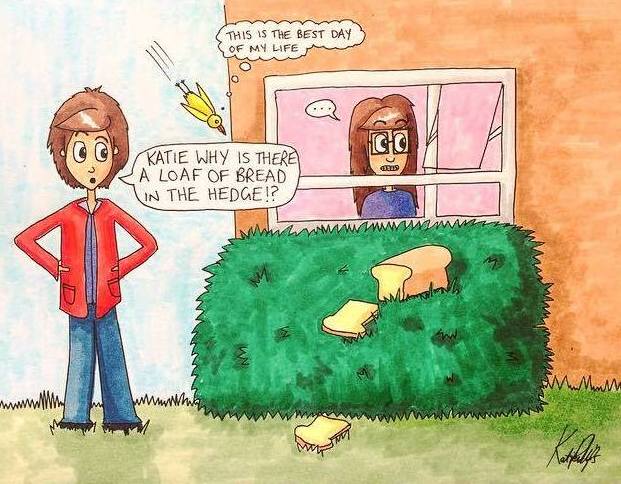
That is the response of a Katie who is in control. Unfortunately though, we haven’t seen “In Control Katie” around much lately. That Katie popped out for bread about ten years ago leaving an out of control mess in place, and since then we haven’t heard anything (better be picking up some damn good bread is all I can say…I’m talking a good quality ciabatta or we are going to have issues).
Therefore, with “In Control Katie” otherwise engaged on a mission to find a tasty source of carbohydrates, it is the “out of control” one that turns to Mum year on year with a dejected look and says: “I wish. Maybe next time”, at which point we agree to try again next year before repeating the annual routine in roughly 365 days time.
I know it would mean the world to my mum to buy me a giant penguin birthday cake to share with her/the family, and I desperately want to accept her offer each time mainly because I want to see her reaction. I want to see her face light up with the brightness of a birthday cake candle, filled with hope that for once she can do something that normal mothers do rather than having to come up with some kind of eating disorder friendly replacement for her neurotic offspring (e.g. the act of sticking a candle in a pink lady…the kind of apple I mean…not an unsuspecting blushing female who doesn’t know what’s coming).
When I do not accept the offer of a proper birthday cake then, it is not because I don’t want to, it is because my mind throws up barriers that make me feel that I physically can’t.
It is like a “normal” person standing in front of a bonfire and wanting to put their hand in it to retrieve a particularly nice log. They can look into those flames and want to put their hand in to get the log (this person really likes logs), but no matter what, they can’t. Of course they are physically capable of moving their arm into the vicinity of the fire, but the fear of pain stops them (no matter how much they like logs).
Saying “I wish I had the self-control to be anorexic” then, is basically like saying “I wish I had the self-control not to put my hand on a bonfire”. Of course eating and setting yourself aflame aren’t the same thing, one is vital for life whilst the other is downright ridiculous and not something I advise anyone to try at home or anywhere else for that matter, but the similarity exists in the sense that both the person who doesn’t put their hand in the fire and the person with the eating disorder do not carry out their actions because of self-control, rather it is because they are both scared and fear the pain that could result from their actions.

Whenever you hear yourself or anyone wishing they had the “self-control” and “will power” to eat like someone with an eating disorder then, please know that when it comes to eating disorders, self-control has absolutely nothing to do with any of it. When someone is unable to keep themselves healthy by eating enough, it is because they are not in control, and because the reins of decision are actually being held hostage by an evil dictator in their head who is trying to kill them.
If I had self-control and willpower over my life I could write a list of about a million things I would use it for. The ability to fill my mother’s eyes with disappointment, to refuse sharing a dessert with a friend or turn down the offer of a birthday cake would not be on there.

Take care everyone x

ControllingPea

How Summer Can Affect People With Eating Disorders

When you live with an eating disorder, there are a lot of things that can affect it. For example my eating disorder rules are often impacted by things like my location, what time it is, who I am with, what is going on for the rest of that day, and, as I have learnt very recently, what season it is.

I have always known that things like the season can affect my eating disorder, but never have I realised this more than this summer, especially the past few weeks of June. If you do not live in England you may not be aware of what has been going on, so to clue you in, you should know that for the majority of June, England has been doing its very best impersonation of a Sauna. IT WAS 34 DEGREES.
For those of you who are used to living in hot countries this may not sound particularly hot, but for people who have always lived in England, 34 degrees feels like you are wearing three hundred woollen jumpers and have been thrust into a furnace with a hot potato shoved down your trousers, a feeling that is not helped by our inability to go for more than 24 hours without a good cup of hot tea (seriously we can’t do it. This isn’t a joke. Tea withdrawal disease is a very serious problem in the UK and 90% of hospital admissions are poor folk who cannot find their favourite teapot).

Now when the weather is hot, people like to take off their clothes or at least wear as few clothes as possible. Gone are the winter coats and snow boots and out come the shorts and crop tops, items that I find rather terrifying due to my eating disorder and body confidence issues. Throughout the year I live in large baggy jumpers so as to cover my body up and out of sight, so that people cannot see all of the disgustingness I see when I look in the mirror, which is a slightly problematic practice when the weather is hot. In summer when you have an eating disorder or body dysmorphic issues, you basically have two choices, stick to your normal wardrobe and roast to death or wear sensible clothes that allow a little bit of breeze here and there but that simultaneously leave you incredibly uncomfortable/stuck in the high street rigid with anxiety because you are wearing a pair of shorts.

I don’t know about anyone else, but I also find summer and warm weather extremely triggering to my eating disorder because I am so used to being cold and being cold is a symptom of being “unwell”. Indeed being cold is a feeling so synonymous and such a documented symptom for people with eating disorders that thermometers were shoved in our ears multiple times a day in hospital to see if we were at risk of hypothermia (an unpleasant experience though I suppose better than that of having a thermometer shoved anywhere else…).
Every time I say or am told by someone that I feel cold, doctors will say things like “it is because you are underweight” or “it is because you don’t eat enough”, so when I am not cold, I panic.
Due to the association with being cold to not eating enough, if I feel warm or heaven forfend “hot” at any time, my head will immediately convince me that it is because I must have accidentally eaten ten buckets of lard and have gained one thousand kilograms. If I feel warm, my eating disorder states that I also must be fat.
It is completely nonsensical but I cannot help it. As much as I try to apply logic to the situation, my brain will always convince me that being warm has absolutely nothing to do with the giant ball of fire burning in the sky (aka the sun…calm down this is not the apocalypse), and has everything to do with what I have eaten and how much I weigh. For me then, eating becomes a lot harder in the summer time because it is easier for my eating disorder to convince me that I don’t really need the food seeing as I am already abundantly covered in enough flesh to keep me toasty warm.

Another problem I have faced this year more than ever, is that of the longer daylight hours we have in summer. I know a lot of people find that sunlight is beneficial to their mood and can actually help them with mental health problems like depression, but for me it is the opposite. I hate sunshine (which is why I live in the UK).
In the sunshine everything feels too bright, too loud, too intense, and I feel calmer in the quiet winter months when people are tucked up inside rather than running around out doors with no clothes on.
I have also always struggled to eat when the sun is up, a problem that has somehow got worse this year. You see, I am currently sectioned under a CTO, a part of the mental health act that means I am allowed to live at home as long as I adhere to certain conditions like staying above a certain weight and going to appointments. I want to say that my main motivation to eat is to be healthy but as true as that is, I am ashamed to say that if I am completely honest, the main push that gets me eating is the fear of going back into hospital and having to eat more food and gain more weight. In the day time however, that fear is not as strong. When the sun is up my brain thinks “hey it is fine, you will stay above your CTO weight, if you don’t need to eat now, you can do it later”.
When the sun is down, there is no later though, and I realise that if I want to maintain my weight and with it my freedom, I am going to need to get some munchies out. The problem is that I know my weight will be acceptable as long as I eat and does not depend on when that eating happens, so naturally as with most things you fear/dread in life, I avoid it as long as possible.
In the winter, this was not such a problem because it was dark by 4pm, but in the summer with all this daylight savings malarky, it isn’t dark until around 10pm and as the months have gone on I have found my eating getting later and later in the day until the point I am at as I write this, a point where I am basically carrying out a year long, eating disorder motivated version of Ramadan. This would make sense if I was a particularly devout follower of the Muslim faith, but my adherence to such rules is not driven by a special spiritual meaning or importance, it is is because I have an eating disorder in my ear who is a total idiot.

In summer as well as taking their clothes off, people tend to change their way of life in the sense of what food they eat and the roast dinners and steamed syrup puddings of the winter time are replaced by cold salads and ice cream.
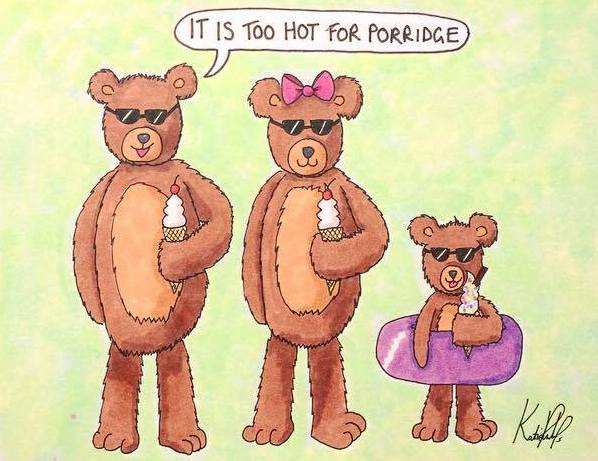
Again however, this is another seasonal transition that my eating disorder leaves me struggling with, because I eat exactly the same foods in the exact same proportions every day and one of these foods is porridge, aka that boiling hot bowl of oats that most people don’t whip a pan out for until there is a significant chill in the air.
When it is 34 degrees outside, nobody in their right mind would start getting oats out of the cupboard to perform their daily Goldilocks’ impression, but I am not in my right mind, so that is exactly what I do (the slight difference in my impersonation being that I am a brunette version of Goldilocks…Oh yeah and I don’t break into people’s houses to get my oats, especially if those people are bears).

In June then, during the hottest week England has seen in my lifetime, I was stuck in the predicament of being boiling hot and thus convinced that I didn’t need to eat because I was clearly obese. Then by 10pm when the CTO fear would hit me, I would force myself to eat despite being so warm, only I would trigger myself even more and make it even harder by making the food I was consuming a steaming bowl of porridge.
“Eat cold porridge” I hear you cry, “try overnight oats which is the exact same thing but you don’t cook it”, yet even that couldn’t solve my problem as OCD has rules about how porridge is prepared and naturally has me convinced that unless my porridge has been cooked for exactly 4 minutes and 40 seconds with stirring at the appropriate intervals, I will kill everyone on the planet. What logic!

As you can see then, summer/the season and weather in general is one of the many things that people may not think about affecting people with an eating disorder, another thing that complicates the simplified idea that people with eating disorders “just don’t eat”.
They are complex creatures, mysterious as the dark side of the moon (10 points to anyone who got that reference), and the control they hold over a person’s life creates anxieties and difficulties most people might not think about. I am of course happy for everyone out there who loves summer and if you are one of those people living in England, I really hope you are having a lovely time in the June sunshine and are feeling as sunny as…well…the sun…
In the meantime I guess I will just have to suck it up and count down until the winter months when jumpers, porridge and 24 hour darkness are socially acceptable again. My God I am a jolly soul!

Take care everyone x

SummerBear

Why Are Eating Disorders Competitive?

Many people are aware by now of the dangers of eating disorders, the emotional inner turmoil, the isolation, and the potentially fatal consequences. However, one of the biggest dangers that isn’t quite as discussed is the fact that eating disorders can be incredibly competitive. It sounds odd and it is quite hard to explain how an illness can be competitive, but basically if anorexia was ever personified, it would be the person who becomes dangerous when playing board games and is prone to breaking valuable ornaments in the home over an unlucky roll of the dice in a game of Monopoly.

I think most people, often and unknowingly, see other homo sapiens as threats for many different reasons in every day life. At work you may feel in competition with someone to get a promotion, in a supermarket you might choose the best looking bunch of bananas so that yours will be better than those of whatever potassium craving customer comes after you, or in a car park you might discreetly race another vehicle to get the last available space. Maybe your competitive streak involves competing with your gaming arch-nemesis to be captain of the tiddlywinks championship team, whatever it is, at some point in every day, whether we realise it or not, most of us enter into little competitions with our fellow humans and in turn those people become threats.

It is rare however, for people to compete with another person’s illness, and I have often wondered why eating disorders are so different in that respect. Possible reasons I have come up with are things like the tendency for people with eating disorders to naturally be high achieving perfectionistic people, or that eating disorders are an illness that usually involve a lot of numbers and in turn, ways the illness can be “measured”. Obviously, in reality the severity of someone’s eating disorder is impossible to measure no matter how many scales you weigh them on or how many calories you see them eat, but no matter how incorrect the idea, people who do not really understand eating disorders to be a mental illness rather than a physical one, tend to measure the severity of an eating disorder by the physical effects they can potentially lead to. If people see a thin person they will wrongly assume that person to be more “anorexic” than their equally troubled neighbour who just so happens to be a healthy weight. With other illnesses though, this ability to gauge how ill someone is just by looking at them, however inaccurate the final judgement may be, is far more difficult in comparison. For example two people can have a liver disease but when they are walking side by side in a park, you cannot guess as easily who you perceive to be the sickest unless you take a few blood tests and maybe open them up with a scalpel (which would probably lead to them asking why you were wandering around a park asking people for blood tests and performing major operations).

When an illness is seen as focused around numbers then, comparison and thus competition tends to breed. Over the past decade I have met people whose eating disorders have led them (for I highly doubt someone’s individual personality would compete about such things), to compete with regards to numbers as to how much someone weighs, what their BMI is, how many calories they consume, even obscure things like who takes the longest to eat a meal, who has been into hospital the most times or who has the lowest white blood cell count. It is a disgusting, sick and twisted side to the illness since you are basically competing to see who can kill themselves the best, but I cannot deny it happens.
For this reason I actually think the more distanced a sufferer attempting recovery is from the intense eating disorder community, the better. If you are living in the middle of nowhere with a family of healthy people, you simply have your eating disorder to wrestle with (and lord knows one is still far too many). In hospital settings like inpatient eating disorder units, therapy groups, or even social media recovery accounts online, you are surrounded with other sufferers and thus other eating disorders to battle with. Don’t get me wrong, it is lovely to have people you can relate to, but the ability to relate to other people who are unwell and spending large amounts of time with them can lead to a loss of perspective.

Gathering a group of people with eating disorders together, either physically or online, is sort of like gathering a group of wild gorillas in the middle of the rainforest (I would avoid both of these gathering activities if I were you as neither are particularly safe…if you are an avid collector or gatherer may I suggest gathering stamps or Pokemon cards instead).
There are probably a hundred reasons as to why gorillas sometimes stand on their haunches and beat their chests, but from my dedicated research and observation (I watched Tarzan), when a gorilla beats its chest in front of another gorilla, it can be interpreted as “look how big and mighty I am! Have you ever seen such a fine specimen of gorilla? Look at my hairy arms! They are fabulous! I am the best gorilla in all of the world and far superior to you! I am the best! Leave my forest or I will strike your hairy behind! Back off I say! Flee! Flee!”.
All the gorillas in the rainforest will naturally want to be best gorilla around to ensure their survival, establish their right to the most attractive mate or the biggest banana. They aren’t doing it for laughs (maybe the odd titter), but they are naturally born with that competitive instinct so that they can stay alive.
Similarly, when a group of people with eating disorders gather, their internal eating disorder gorillas perk up and start beating their chests to let everyone know that they are the best and strongest eating disorder around. Ironically though, unlike the real gorillas, the “winner” in terms of measuring who is the most physically ill from their eating disorder, the thinnest or the one who has gone the longest without eating, is the least likely to stay alive the longest.

If you are reading this as a healthy minded person you are probably thinking that competing as to who can lose the most weight is ridiculous and sick, and when it comes to that judgment, you would be right.
However I think people often forget how much competition there is with regard to weight loss even in “healthy” circles. On TV shows like The Biggest Loser, people compete to see who can lose the most weight with a cash prize for the winner, and though perhaps less extreme than competing with white blood cell counts, surely this is similar? What about in local weight loss clubs when people compete with their next-door neighbour to see who can lose more weight than anyone in their area in order to be awarded with the sash declaring them “Slimmer of the Year”. When you think about it, in our society, competing around food and weight is not as alien an idea as people with eating disorders can make it seem.

There is however one reason people often suggest as the answer to the “why are eating disorders competitive” question, that I strongly disagree with, and that is the idea that people compete purely because they want to be the “thinnest” and that the competitive drive is all about vanity and outer appearance. If anything, I think the drive is the total opposite to vanity, and more to do with insecurity and low self esteem regarding the internal self.
When you live with an eating disorder you basically live with a voice in your head telling you that everything you do is wrong and no matter how hard you try to please it, it will never be satisfied or see your “efforts” as enough. No matter what you eat, your eating disorder will tell you it was too much. Even if the portion was initially decided by your eating disorder, it will tell you that you could have left a bit or maybe it will tell you that you ate it wrong; too quickly, too slowly or with the wrong sized mouthfuls. Whatever you do, the voice will tell you you are not living up to the standards you should be, you are not good enough.
My drive to lose weight is not to see a nice patch of rib cage, it is to achieve something that my eating disorder tells me is “better” than my former self. Of course there is nothing “better” that can come from starving yourself and if I were talking to any other sufferer I would tell them that the “best” they can be is the healthy version of themselves who is able to nourish their bodies and enjoy a healthy relationship with food. Yet still when it comes to me, the eating disorder somehow manages to manipulate my thoughts in that direction that I am a “better” me, less repulsive, less annoying, less deserving of a punch in the face, if I stick by my eating disorder’s rules. I am constantly held up between my past self, current self and encouraged to compete against them to reach this “superior” future me. When you add another sufferer into the mix then, it is yet another person for my eating disorder to compare me to. No longer is it telling me to lose weight or starve because I am not good enough compared to the potential me I could become if I were to behave myself, now I am also not good enough compared to the person or group of people surrounding me. I don’t follow the rules to the standards my eating disorder would like in an ideal world, and when I am around other people it tells me that I am even more inferior because they are following these stupid rules better than me. I don’t feel competitive because I am vain and want people to admire my collarbones, I feel competitive because I despise myself, because behaving well and following all my rules gives me a sense of self worth, a sense that I am doing something right, so if I am not following the rules “the best”, then I am not good enough.

So why are eating disorders competitive? Well, there are many reasons from internal anorexia gorillas to self hatred, perfectionist personality traits or the ability to compare and misunderstand the importance that physical numbers have to play in a mental illness. Obviously this competitive undercurrent is wrong, needs to be tackled and is disgustingly disordered, but we are dealing with eating “disorders” so I suppose it makes sense. What I want more people to know though, is that of all the reasons, as sick and twisted and horrible as they are, they are not reasons that derive from vanity or any sense of bodily pride compared to the person in the next bed to you. If anything it is about desperation to be good enough in the eyes of a devil that is constantly telling you you are worthless, both in yourself, and in comparison to everybody else.

Take care everyone x

HairiestGorilla

Eating Disorders Away From The Table

If I were to hand you a pencil and ask you to draw a person who, in the moment depicted, was struggling wth their eating disorder, you would probably draw an image of a person sitting at a meal table with a plate of food in front of them (Unless you are anything like my mother who instead, when given a pencil and asked to create a picture, will throw that pencil back in your face and run for the hills screaming “I can’t draw – leave me alone!”)
On one hand, drawing someone at a table would be right as it is likely that if someone has an eating disorder, meal times are going to be difficult for them. However I think there is an idea that when you have an eating disorder your struggles come into action at the dinner table and depart once the meal is over, a nice idea, though one that is unfortunately far from the truth.

For me at least, my eating disordered thoughts are there from the second I wake up and my first thoughts of the day will be about food and how much/what I am planning on eating during that day. It is silly really, because everyday I eat the exact same foods in the exact same amounts, so there is no decision to be made and any dithering is futile. There is no point in wondering whether or not I want Coco Pops or toast, I can ponder and postulate pancakes and Pop Tarts all I like but no matter what, the first thing I will eat that day remains the same as every other, in the same amounts and even on the very same plate. It is also pointless to think about this from the second I wake up as currently I am struggling with this rule that I cannot eat when the sun is up so, being summer, the first meal is usually hours away and shouldn’t be an immediate concern.
Nevertheless, every morning the thoughts and worries about what I am going to eat are immediately there, thinking about infinite options, things that might be healthier, lower calories/lower fat, before inevitably settling with the usual. It is like this for every meal no matter how far away that meal is, be it hours, days, even years.
There are several reasons why I have the same foods every day. For one thing I know what my weight does/how my body reacts to this meal plan, but mainly I stick to the same thing because it removes the need to debate the decision for hours each day.
Everything is planned down to the smallest most specific detail, I don’t just eat an apple a day, I eat a Pink Lady apple specifically to avoid the chance of spending three hours debating between a Golden Delicious or a Granny Smith, yet even if I know the debate is heading nowhere, it still arrives before every meal. I will spend the hours leading up to it debating the options and calculating various calorie amounts without ever getting an acceptable result.

Then, even when the inevitable decision has been made, the eating disorder is still there for the food preparation extravaganza, controlling every movement and weighing out ingredients to the exact gram, no matter how long it takes. I often weigh things multiple times on different scales to check that one set isn’t lying to me (I once saw a set of kitchen scales on Jeremy Kyle who failed the lie detector test. Turned out he WAS the child’s father and I have never trusted a pair of scales since). As always, the weight will be the same on every set of scales, but still I will spend time worrying that the food I was weighing was “different to usual” and that I randomly managed to pick up an incredibly dense courgette with twice the calories of a normal one.
Food prepared, there is then the obvious struggle people know about, the bit we all picture when we imagine someone with an eating disorder, the eating that takes place at the dining table. However even when I leave that table, the battle is still going on, and rather than sitting at the table politely waiting for the next meal, anorexia follows me rabbiting on about what went on at the table and the meal that, for everyone else, was over hours ago.
Did I eat too quickly? Did I eat too much? Do I feel fuller than usual, aka a sign that the scales were lying earlier and I was dealing with a magically calorie dense genetically engineered superhuman courgette? Have I gained weight that I can see? All of these questions swirl around in my brain amidst the thick soup of guilt and I replay the meal in my head over and over again incase I missed some key piece of evidence of something that I should be worrying about. I said in the part about worrying about meals before they occur that the meal can be hours or weeks away, and similarly the worrying afterwards can carry on for years after I put my knife and fork down on a plate.

Eight or nine years ago, during one of my admissions to hospital, I had a meal involving mashed potato. I had been eating the hospital mash for months and months before so I knew exactly what to expect, yet there was one particular day that the mash tasted different. They say variety is the spice of life, but as I ate that mash the difference frightened me and as someone with an eating disorder I wished that variety would keep its peppery little paws off my food thank you very much.
At first I wasn’t sure what the difference in the meal was but then it hit me that the mash tasted sweeter than usual. Immediately I became convinced that someone had mashed a doughnut into it and hoped I wouldn’t notice. Other than the slightly sweeter taste I had no evidence to support this theory, hospitals were not struggling with an epidemic of caterers with an uncontrollable urge to shove an iced ring into every dish, but that sweet taste was enough to have me convinced. It has been 9 years and yet I still think and worry about the doughnut that I am convinced was in my mashed potato nearly a decade ago.

Every waking hour between meals is consumed with food fears and often every sleeping hour is too. Not only does anorexia not live at the dinner table, it doesn’t live in the land of conscious thought either, and is well known to infiltrate and get its claws into the snoozetastic unconscious place known as “The land of nod”.
I have nightmares most nights, all of them with varying storylines, characters and background music, yet a lot of them have similar themes, one of these themes being food. I will dream that I have been held up at gun point and forced to eat an entire chocolate cake, before waking up and fearing that I did it for real and that I therefore have to go for X amount of time without food to make up for my behaviour. On many occasions I have woken up so convinced that I have eaten something that was actually part of a dream, that I have had to search the kitchen for evidence to prove to myself it wasn’t real. One specifically memorable dream involved me cooking and eating a gigantic spaghetti bolognese and the fear upon waking made me feel so sick that I had to go downstairs and check cupboards to see that all the pans were clean, the pasta wasn’t open and the bin was bolognese free, so I couldn’t have cooked and made it for real (apparently my brain believes I might unconsciously cook and eat a meal but draws the line at the idea that I would have washed up afterwards.)
I also dream about exercise and whilst some people have unconscious thoughts that lead them to sleepwalk, mine sometimes drive me to do sleep sit ups on autopilot so that I will wake up halfway through a set, stomach muscles aching, out of breath, wondering what the hell is going on.

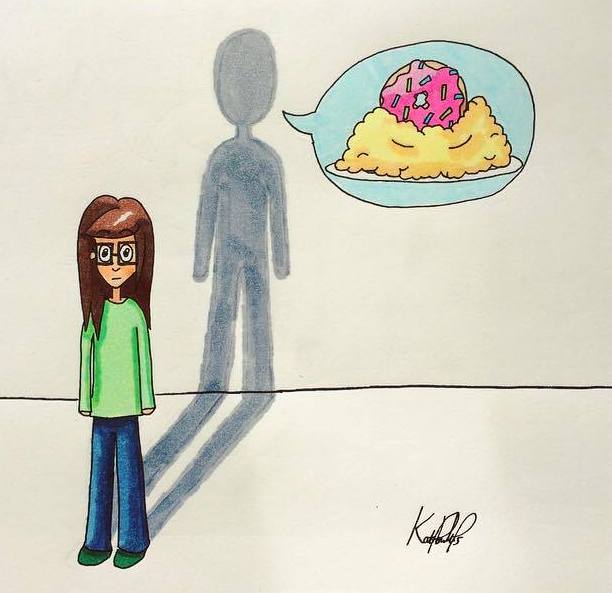
For me then, having an eating disorder isn’t just about struggling at meals, it is about being constantly controlled and dictated to 24 hours a day 7 days a week, a voice that follows me no matter where I go or how unconscious I am, interfering with thoughts and my ability to function even when food is nowhere nearby. It is a nice idea to assume that eating disorders do just live at the table and that meal times are the only difficult times for sufferers, but to tell you the truth, when you have an eating disorder, that devil will stick to you like an unrelenting shadow.

Take care everyone x

EatingDisorderTable

The Problem With Before And After Photos In Eating Disorder Recovery

A few months ago, towards the end of February, it was Eating Disorders awareness week, so naturally I did as I always do on this occasion and buried my head in the sand for the duration of the week (I also allowed children to use the remaining sand to build sand castles atop my hiding place because I am such a lovely person). This may sound like odd behaviour for someone who is constantly talking about mental health problems like eating disorders in order to raise awareness and for someone who has a strong disliking of sand, but then again odd behaviour is what I am known for. Literally.

The reason that I avoided the internet during that week, and indeed avoid it every year, is that it is a week in which social media is filled with “before and after” pictures, aka photos of someone taken during the depths of their illness, compared to a later photo taken post/during recovery. Don’t get me wrong, these photos certainly have their place and I would be lying if I were to say that I have never been inspired by any of them. Often these pictures will come with an empowering and motivating story of someone’s journey in recovery and triumph over anorexia, and that is brilliant. That is something that should be celebrated, and those stories  are shared throughout the Eating Disorder community to encourage others to fight their illnesses and to give hope to those who doubt recovery is truly possible. I love these stories but it is not the stories of recovery that I have a problem with, rather I have a problem with the “before and after” photos that are often involved in telling the triumphant tale.

Firstly, these images will usually show the person in the depths of their illness as an incredibly underweight individual, with ribs popping out so far all over the place that you could easily use them as a xylophone. Regardless of the inspirational intention with which they were posted, there is always the risk of these pictures going on to be triggers for other sufferers or, dare I say it, “thinspiration” for all those misguided souls who think that anorexia is something to aspire to. They can also make sufferers who are perhaps not as underweight (or who are unable to see themselves as that underweight) consequently see these images and feel that they cannot seek help because they aren’t “thin enough” or “bad enough”, when encouraging people to seek treatment is supposed to be the whole point of a week dedicated to educating and raising awareness of eating disorders. Similarly, in their representation of someone with an eating disorder and someone without, they encourage the myth that eating disorders are about being thin and that eating disorders can be seen, (a myth I have tried to tackle here: Why it is physically impossible to “look anorexic”.)
For people who do not know much about eating disorders and who do not have the time or interest in reading full accounts of recovery journeys, these snapshots may be the only experience they get of someone with an eating disorder, so the risk is that the stigma and lesson of “ill is underweight”, “well is a healthy weight” will be perpetuated without taking into account the far more complex and important internal and mental struggle that is having an eating disorder.

Similarly, as an image to summarise recovery, I feel it is problematic in that the main difference that is visible between the two pictures is weight, which implies that the main difference one goes through is the difference of the number on the scales. It suggests that in recovery, the biggest thing you “gain” is weight, when really weight is probably the smallest of all the things I have seen people gain in recovery. I may not be able to speak as a recovered person myself, but of all the friends I have watched beat their eating disorders into a soggy pulp on the ground that is no longer able to control their lives, the change in their weight has been the least significant change of all. Okay there is a change in weight and perhaps clothes size, but when I see my recovered friends, I do not see the change in their BMI, what strikes me most is the change in their lifestyle and their overall presentation as a person. To me they have not gained weight as much as they have gained themselves. When you are in the depths of your eating disorder, as much as you fool yourself, you cannot maintain a normal life. Your ability to have a job, have normal relationships with people, be happy or even function are seriously compromised, and these things are all aspects of life that can be improved on with recovery. I have seen friends go on to study medicine at university, have romantic relationships, give birth to children, climb mountains (I am talking proper big mountains like Kilimanjaro), and travel the world. They have regained their ability to properly smile, to laugh without having to fake it, and to me seeing all those photos of them skydiving in Australia or getting married and having babies have been far more significant and noticeable changes than what size jeans they wear. It is these aspects of recovery that are the really important reasons that people need to fight and it is these changes in lifestyle that are the really inspiring stories. Yes weight gain is a part of the journey, but what is more important is the places that weight can take you, for example to medical school or up a flipping huge mountain.

On a similar note, my other issue is that I feel before and after photos simplify the process of recovery. In one picture you probably have someone who is underweight and either looking miserable or faking a smile out of dead eyes, and in the other you have someone who has gained weight and perhaps, is beaming at you with genuine joy. This then makes recovery very straight forward, “Being underweight make you unhappy and thus gaining weight will make you happy”. It automatically assumes that the happiness comes as the weight increases, without highlighting the far more complicated journey in getting that weight to be there.

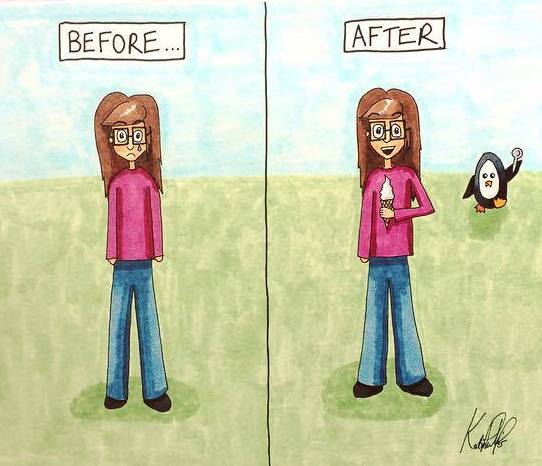
It is hard to explain exactly what I mean, but it is like looking at a picture of someone standing in a field looking miserable, and then another photo of them smiling in the same field but with the addition of an ice cream. At face value then, you can look at these pictures and think “well a person was sad because they didn’t have an ice cream but then they got an ice cream and they were happy” , simple. What the picture will not tell you however, is how that ice cream got there. Little would you know that the person had not simply walked up to the nearest ice cream van, asked for a 99p Mr Whippy and walked away smiling, just as the person in recovery had not simply gained some weight, and in turn, a smile (side note did you know that they don’t even do 99p Mr Whippys anymore? They are now at least £1.50! How do those ice cream men still have the nerve to play jolly tunes as they patrol the streets for customers now that they are basically performing daylight robbery rather than offering a merry treat. You can play Greensleeves all you want but that doesn’t change the fact you are making me re-mortgage the house to buy myself an ice cream. SHAME ON YOU ICE CREAM MEN. SHAME ON YOU.)

Anyway, what the picture doesn’t show is that to acquire their ice cream they were forced to go on a perilous test of their endurance, that pushed them to the limits of mental and physical strength. To get that ice cream in the picture, that person had in fact had to walk across continents and cross oceans to America, the largest producer of almonds in 2014 I will have you know, and then had to hand pick hundreds of almonds ready to blend into a creamy milk worthy of a tasty frozen dessert (this person was lactose intolerant so almond milk was the milk required for the job.)
Then, exhausted from months of trekking, nut picking and milk making, that person had to swim across even more oceans into the freezing cold pole of the Arctic where they stirred their almond milk with a wooden spoon atop a large glacier that acted as a natural freezer for their ice cream churning process. Even when the ice cream was made it didn’t get any easier as they had to then wrestle with a penguin who had cheekily tried to steal the ice cream (I don’t blame him to be honest. I would steal ice cream if all I had ever eaten was raw fish), and then they had to get the ice cream all the way back to that field in their country of origin, back through the hot climate of almond fields in America, without the creation melting. Clearly that is a far more character building excursion to get to that point of “person with ice cream in a field” than the picture initially suggests, and I didn’t even tell you the 5 month side trip it took to make the cone in which the ice cream was to rest (it would take too long to tell you fully but as a brief summary it involved a very angry rhino and a lot of waffles).
The person worked hard to get to the point where they were standing in that field with that ice cream, and all that hard work is eradicated, as it is in recovery journeys, when all you see is a simple before and after shot.

Obviously I am not saying we should stop people from sharing their recovery stories and indeed, if you have recovered from an eating disorder, then I am OVERWHELMINGLY proud and impressed by your determination and strength. If you were here with me now rather than wherever you are reading this, I would give you so many rounds of applause that my hands would fall off and I would be left clapping stumpy wrists to show appreciation of your achievement. What I am saying is that maybe, more often we should be celebrating and telling these stories without the underweight photos that go with them. A story is still a great story without pictures. Hell, look at Harry Potter, that story changed and continues to change generations of people, it has grown theme parks and movie franchises, careers and other astonishing things, all from a pile of words cobbled together with no images at all (For the purpose of this post can we please just pretend that the illustrated versions that are currently in production don’t exist.) Still, even when pictures are added to the Harry Potter books, it will still be the words that are doing all the talking.

So that is why I have a problem with before and after photos when it comes to eating disorder recovery, not because I don’t like inspirational stories or don’t want people to celebrate their achievements, but because those pictures don’t really do anything but diminish and reduce the value and greatness of what has been achieved. As a snapshot ok, a picture may say a thousand words, but a recovery journey is made up of millions of them.

Take care everyone x

BeforeAndAfter

41 Ways To Celebrate Easter When You Have An Eating Disorder

If I were to tell you that within the next seven days, a giant mole would appear in your garden and would hide chocolate potatoes amongst your shrubbery, you would probably look at me as if I were mentally ill (and you would have a point). If however we were to change that giant mole to a rabbit and the chocolate potatoes to chocolate eggs, I am sure your reaction would be a little different and more akin to “hooray, I love Easter!”.
Indeed, I would share in that hooray, as I have also always loved Easter and the whole  celebration of days that go alongside it. When I was younger, Shrove Tuesday or “pancake day” was the highlight of my year and I vividly remember having competitions with my grandparents as to who would be able to eat the most pancakes (spoiler alert, I won every year). I also loved making hot cross buns with my mother, mixing melted chocolate with shredded wheat to make “birds nest cakes”, and the annual tradition of putting Cadbury mini eggs into my plastic purple duck who would “lay” one of these eggs every time you pressed his head (please note this does NOT work with normal ducks no matter how hard you press them on the head. All you get in that situation is no chocolate egg and a very very angry duck).

Whenever I received an Easter egg as a child I remember being so excited that I couldn’t choose which one to eat first and from the age of five years old I would line them all up in order of expiration date just to make the decision for me. Even with this excitement I would make my eggs last for months and months, only having a little bit a day as a treat because I didn’t want them to disappear, so that it wasn’t unusual for me to still have an egg on the go at Christmas. In senior school they were so invested in festivities that there was even a giant egg hunt around the school grounds on the last day of term before we broke up for Easter and this was taken VERY seriously. People got into teams to compete, eggs were hidden with the utmost secrecy, and four or so teachers would even dress up as rabbits and hide in especially difficult to find spots, with bonus points going to any team who managed to find a bunny and drag them to the finish line. If you found a bunny, you were guaranteed a place in the top five teams and one of my fondest memories of my school days was watching as a hoard of screaming teenagers ran across a field in pursuit of the deputy head, who, after being found hiding in a tree, was sprinting for his life complete with bunny ears and a fluffy tail. It was truly a remarkable sight and Sir, if you are reading this, may I say you suited that fluffy tail perfectly and should seriously consider adding it to your daily wardrobe rather than saving it for special spring time occasions.

As I am sure you can see from all of those memories however, food is a key part of the Easter celebrations, so joining in with the festivities when you have an eating disorder can be quite difficult and lead to the Easter weekend being a stressful, as opposed to enjoyable time. Obviously, as I said when faced with this similar situation at Christmas, it would be great and ideal that for Easter we would all be able to set our eating disorders aside and join in. Eating disorders are horrible, potentially fatal illnesses that should not be allowed to dictate or ruin your Easter, and as my dad quite rightly says “eating a few chocolate eggs once a year isn’t going to do anything to you”. Alas eating disorders are not so easily persuaded by such demonstrations of logic and even with the best intentions and determination, they often interfere with one’s ability to join in with a lot of the “normal” Easter activities. Of course, if you are able to challenge yourself and join in with the more anxiety provoking aspects of Easter this year, then I would encourage you to go ahead and have a cracking time, but nevertheless, today as I did for Christmas, I thought I would offer you a blog post containing a few suggestions as to how to get involved and celebrate a holiday with your family in alternative ways that are not so focused on the food components of pancakes, buns and eggs…

41 Ways to celebrate Easter when you have an eating disorder

  1. Buy some of those little yellow chicks you can get to stick on cakes and instead of an Easter egg hunt, distribute the chicks around the house or garden and use them for your Easter themed hunt instead.
  2. Make an Easter decoration by doing some Papier-mâché on a balloon. Then when it is dry decorate it with as much paint and glitter as you can find to create the most fabulous egg you have ever seen.
  3. Email me a picture of your creation.
  4. Make an Easter wreath.
  5. Plant and decorate an Easter tree.
  6. Sit behind a bush with a leaf on your head and make noises like a lettuce in order to try and attract the Easter bunny.
  7. If the Easter bunny doesn’t show up, change tactics and try making noises like a cabbage instead (as we all know cabbages speak with a far lower pitch so maybe take someone with a deep voice for this one).
  8. If the Easter bunny still doesn’t show up, set off on an expedition around the world in search of your little rabbit friend.
  9. If yet again efforts fail, give up in your attempts to find the Easter bunny and simply become the Easter bunny yourself.
  10. Congratulate yourself on having become the Easter bunny and throw a party to celebrate your new job.
  11. Travel around the world as fast as possible and leave chocolate eggs for everyone who celebrates Easter (I know it is a big job but I think you will find you took it upon yourself).
  12. Rest after exhausting yourself doing number 11.
  13. Weave an Easter basket.
  14. Have an egg and spoon race (I know this technically involves an egg which can be considered as a food BUT the activity of an egg and spoon race doesn’t actually rely on consumption aka eating of the egg and is far more centred on putting the egg on a spoon and running as fast as humanly possible).
  15. Go to a pottery class and make an egg cup.
  16. Paint your egg cup.
  17. Play pin the beak on the chick (A PAPER CHICK).
  18. Buy a female chicken.
  19. Buy a male chicken.
  20. Leave both of your chickens in a barn.
  21. Add mood lighting to create a romantic atmosphere.
  22. Quietly play romantic songs into the barn (I recommend Dolly Parton. I am not sure why but I feel like chickens would like Dolly Parton.)
  23. Give your chickens some privacy.
  24. Wait until an egg has been laid.
  25. When an egg has been laid, ensure it is kept warm and is well cared for until it is ready to hatch.
  26. Watch as the egg hatches and congratulate yourself for creating a romantic partnership that has led to a new life in the form of a real life Easter chick.
  27. Realise that there is no way for you to achieve all of this in the next few days as Easter is only a week away and it takes considerably longer than that to progress from step 18-26
  28. Research how long steps 18-26 will take realistically.
  29. Check what date Easter is next year and put a date in your diary as many days/weeks before Easter Sunday needed to realistically carry out steps 18-26 in order to actually have an Easter chick born on Easter Sunday.
  30. Make pop up Easter cards to give to friends and family.
  31. Learn to knit and make some cuddly Easter bunnies.
  32. Turn those few bunnies into several hundred bunnies because as we all know, in nature these creatures tend to multiply rather rapidly.
  33. If you are religious, go to church.
  34. If you are not religious, maybe give someone without a car who is religious a lift to church.
  35. If you are not religious and don’t know anyone who is, simply kidnap a passer by and take them to church in the interests of traditionally celebrating Easter Sunday. I am sure the Pope would approve.
  36. Lie completely flat on the floor and impersonate a pancake.
  37. Plant daffodils.
  38. Water your daffodils with a watering can shaped like a bunny.
  39. Become a daffodil (please note you can only do this one if you didn’t do suggestion number 9 for as we all know it is far too much responsibility for one to be both the Easter bunny AND a daffodil.)
  40. Wear all of your winter clothes at once, get very angry and then play crazy golf. If anyone asks what you are doing answer that you are celebrating Easter by having some “hot cross fun”
  41. Roll your eyes at number 40 and wonder why on earth you are still reading the blog of someone who is clearly an idiot

So there you have it! 41 Non food related ways to celebrate Easter when you are suffering from an eating disorder! If you are a friend or family member of someone with an eating disorder, maybe suggest one of these activities to them in order to make them feel included in the festivities, or maybe ignore all of my suggestions and come up with a more sensible non food related way to celebrate to make sure that your friend/family member feels included with the holiday. Hopefully if you yourself reading this are a person with an eating disorder, one day you will feel able to participate in the more “traditional” chocolate egg/hot cross bun parts of Easter and maybe one day you will be fully recovered and able to enjoy Easter as much as you did before your eating disorder rudely entered your life. Either way, whatever stage you are at, I hope you all manage to have some fun this Easter weekend and that things aren’t too stressful. Stay calm, stay strong, and if in doubt, just become the Easter bunny.

Take care everyone x

EasterED

The Mystery Of Hunger When You Have An Eating Disorder

Whenever I play Cluedo, (or Clue to any American readers out there), I am confused as to why anyone would ever choose to commit a murder in a library with a candlestick. You are supposed to be quiet in a library, not create a racket bashing someone’s head in, and how are people expected to read if they are being plunged into darkness because someone was foolish enough to break all the candles?
Whenever I play Monopoly, I am also confused. I do not understand why I am repeatedly being thrown into jail when I have done NOTHING wrong, especially when, ten minutes prior to my unfortunate detainment, I was allowed to roam freely around the planet with no consequences, even after the discovery that I had beaten Professor Plum over the head with a piece of lead piping in the Billiard room (where I was courteous enough not to disturb anyone. Nobody was playing Billiards. They were all trying to read in the library and I allowed them to continue in peace because I am a good person).
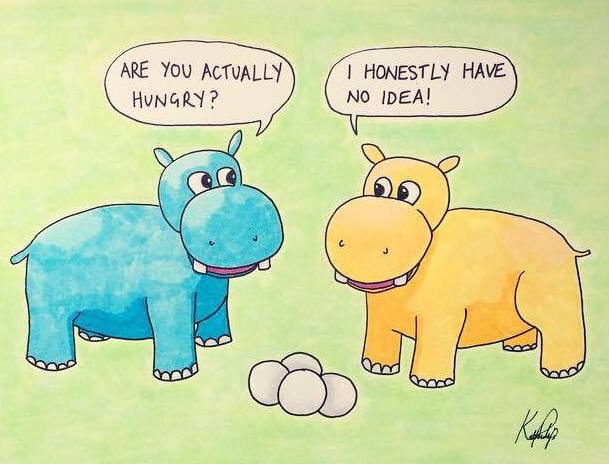
When it comes to games however, there are none I find more confusing than that classic joy of “Hungry hippos.” Are these hippos actually hungry, and if they are hungry, what exactly does that mean?

Multiple times during my life with an Eating Disorder, I have had people offer me bits of advice that they think will be the key to my recovery. One of the more common pieces of advice is that I should just “stop listening to the anorexia and eat when I am hungry”.
On paper, I suppose this is fairly sound advice. Eating disorders want to kill you whereas your natural body impulses are there to keep you alive, so it makes sense to listen to them. The problem is, when you have had an eating disorder you spend your life trying not to listen to them, and eventually the mutual understanding and connection you had with your body is diminished. Indeed, your disorder actually spends every day purposely trying to suppress all natural instincts that were built up during the cave man days so that it can be in charge of what food is consumed, how much and when. You don’t “eat when you’re hungry” as you are supposed to, rather you eat when, or if, you are allowed.

Obviously I know what it is like for the body to go without food. I am familiar with the light headed tingliness, head aches, dizziness, chills, fainting spells and the pains in ones’ abdomen that occur when your stomach hasn’t seen any tasty morsels for a while, but I am unsure as to at what point all of these feelings constitute “hunger”. Does hunger start from the moment your tummy utters its first inquisitive growl or is that just being “peckish?” Is hunger what you feel when you see a chocolate doughnut with rainbow sprinkles or is that just curiosity…or being peckish? What even is peckish? When does hunger become starving? Is ravenous worse than starving? WHAT DO ALL OF THESE WORDS MEAN?

I know some people will probably say that you can’t think of hunger in such rigid terms and it is more of a sliding scale, but I am just so confused as to how people know when to eat if it is a sliding scale and not a case of two opposites. If we all had little signs on our heads that flipped from “not hungry” to “hungry” when it was time to eat it wouldn’t be a problem, yet people seem to just understand their bodies in a way that is completely baffling to me. All of my meal times are rigidly planned out, I know it is time to eat by my eating disorder giving me a time and then I simply watch the clock. Is it time to eat? I don’t know, lets see if the little hand is on the right number and if it isn’t we will give it a few more hours.

My parents, aka people without eating disorders, do not have strict rules on dinner time and they are two of those mysterious people who I often observe knowing when to eat by knowing when they are hungry. It makes no sense. Sometimes my mum’s stomach will growl and she will say something like “I don’t know why it’s making that noise, I am not even hungry.” What? I thought a growling abdomen was the universal sign for hungry? Does it only mean that sometimes? At other times does it growl to test its abilities in lion impersonations? How do you know which is which? Some evenings my mum will ask my Dad if she should put on the dinner and he will say something like “in a bit, I’m not hungry yet”. I will then spend the next however many minutes watching him, and at some point, with no signal from any outside force and no noise from his stomach he will announce, “Ok, might as well put the tea on, I’m hungry now”. HOW DID HE KNOW THAT? When did the switch flip? When did “not quite hungry” become full on hungry in a way that needs to be satisfied? I was watching him closely the whole time and I saw nothing! Not a single rhino burst into the room wearing a sign declaring “Now is the time for food”, there were no fog horns, smoke signals and no morse code (I was watching him and listening very very closely).

Even in hospital settings, it is an alien concept to listen to your body and adhere to hunger cues. In every hospital I have ever been in, you know it is breakfast or lunch time because the clock tells you it is so. The nurses don’t rally up the patients, ask who is and who isn’t hungry and stagger the meal accordingly, it is just time to eat so you do. More than that, the clock tells you when to stop eating rather than you deciding that you are “no longer hungry”, and portions are equally dictated by how many ladles of pasta bake is on the nutrition guidelines rather than “how much you fancy”. You can’t even forget the “eat when you are hungry” bit and skip to the “stop when you are full”, because again in hospital, what your body feels has nothing to do with what you eat. When at home you may stop mid meal because you are no longer hungry, but in hospital your allocated portion has to be eaten, so you often have to keep eating rather than stop when you are full because the dietician and meal plan has stated that is so. Full of cottage pie and not “hungry” for apple crumble? Tough, nutritionists have stated that your body needs apple crumble for medical medicinal reasons so you are going to eat it anyway, and you simply listen to their hunger cues and portion sizes instead of your Eating Disorder’s or your body’s. Natural impulses and intuition have nothing to do with it.
I honestly cannot remember a time when I just ate a meal because I knew I was hungry or stopped because I was full, for years I have simply followed the instructions prescribed much as someone else might follow the instructions on the back of a packet of custard (sidenote: Isn’t custard awesome?!)

It is even the same for me when it comes to using the bathroom. Not to overwhelm you with “too much information”, but as much as I do not understand people knowing when to eat, I do not comprehend how they know when they need the bathroom. They say “when you need to go you go”, but when is need? Is it at the first sign that your bladder is a little on the full side or do you wait until you are so desperate that you are hopping from foot to foot like Michael Flatly performing the River Dance? Somewhere in between these two points? Cool…BUT WHERE? WHEN? Again my natural impulses haven’t been in control of that kind of thing for over a decade as it is my OCD/eating disorder that tells me when I am allowed to pee even if I may not feel the need. When it comes to following my body’s impulses then, I find it impossible not just because I have an eating disorder or OCD screaming in my head, but because I have lost sight of what those impulses are by forcing myself to ignore them for so long.

Perhaps I have just waffled on in an incomprehensible meandering mess in this blog and once again none of you have any idea what I am on about. In writing it I have definitely learnt how hard it is to explain something you cannot get your head round, much like it is trying to ask someone to explain something invisible like air or untouchable like a rainbow.
Still I hope I have at least explained in some sense yet another reason as to why recovery or living with an eating disorder is so hard, and not something you can get over by “just eating” like everyone else. Sometimes, even with the best of intentions you can want to “just eat” as other people do, deciding it is lunch time based on an intuitive flicker of the gut or portioning your roast potatoes out based on how many you think you can manage rather than how many are on your meal plan. Nevertheless, intentions or not, to me it still remains an unfathomable mystery of just how in the hell all these people do it.

Take care everyone x

Hippo

10 Ways To Support Someone With An Eating Disorder

Living with an eating disorder is hell, but I think it is underestimated just how horrendous it can be for the people living with people who have eating disorders. I know many parents, families, partners and friends tend to feel pretty hopeless when watching someone they love slowly drowning, without knowing how to stop it. Almost every day my mum will ask me what she can do to help, like there is some problem solving action she can perform as easily as changing a lightbulb.
I know for a fact that if there were an action she could carry out, my mum would do it in an instant no matter how inconvenient or unpleasant (I think she would even play Pictionary and she HATES Pictionary…weirdo). Unfortunately, eating disorders don’t have quick solutions and no matter how much a loved one wants to help, they cannot fix the problem. They can however support the person, and often these little offerings of support are nowhere near as dramatic as people seem to think. Supporting someone with an eating disorder doesn’t require grand complicated acts of kindness, often you can support someone with little things that don’t take much time or effort at all. So today, I am going to share with you a list of things that I find help me at home aka 10 simple ways you can help someone with an eating disorder.

1. Don’t get angry with the person, get angry with their disorder – When you have an eating disorder in the house/in any relationship, you can guarantee it is going to cause some conflict. I have lost count of the number of arguments I have had with my mum with regard to eating disorder issues like what I am eating for dinner. I honestly don’t think we have ever had an argument about anything that wasn’t mental health related (bar one argument we had in 2002 because she wanted Will Young to win Pop Idol when I was firmly on the side of Gareth Gates. I would like it noted that I can now lift my hands up and admit I was wrong on that one). Just yesterday I am ashamed to say I had an argument with my mother and yelled at her for about half an hour because she tried to help, and unknowingly put my kidney beans in the “wrong pan”.
Afterwards I felt incredibly guilty/like the worst person in the world. This guilt would have eaten me up and is the kind of thing that makes me feel that I don’t deserve food, but after we had all calmed down and I had apologised, what I found helpful is the fact that my mum made it clear that she understood that I hadn’t meant to yell about a bean pan. She knew it had just been the eating disorder taking control, and though I need to work on managing that myself, the acknowledgement that I wasn’t this terrible person who worried more about what pan my beans were in than my mother’s kind attempt at assistance, made me feel more able to continue with the meal.

2. If you are eating with someone with an eating disorder, keep them distracted and don’t make the food the sole focus of the experience – Meal times with someone with an eating disorder are not the most relaxing of situations and can be pretty intense (like one of those awkward dinner parties you see on Come Dine with me only less bitchy and without a voiceover man commenting on every little thing that occurs). For this reason, when I have to eat a meal with someone, I find it really helpful for them to help keep me distracted and not make it all about the food. Silence allows thoughts to creep in at the table, so I would recommend conversation if the person is able or, if they are unable (sometimes I cannot talk very much/think of words because I am so anxious), have the radio on in the background or play a game. Sometimes in hospital we would even do things like crosswords or little quizzes which really helped keep your mind occupied by working on something else (my favourite thing about this was that when there were bank staff they would go through the pile of quiz questions without realising which ones we had already done so we were all able to provide correct answers instantly and looked like geniuses.)

3. Allow them to take baby steps in their recovery rather than expecting miracles overnight – When people are in recovery from any mental health problem, there is often a lot of pressure for progress to be quick so that the problem can be solved and forgotten about as soon as possible. However, recovery is a very slow process and this pressure is often detrimental as it can make a sufferer more anxious and stressed. To help someone who is struggling, allow them to make progress at a steady pace they are comfortable with rather than forcing them to make dramatic changes which ultimately will not be sustainable.

4. Praise them…or don’t praise them at all – I have many friends who appreciate a little “well done” or similar nudge of encouragement after a meal to make them feel supported and like their hard work hasn’t gone unnoticed, so offering those words of praise can be a great way to support a loved one. That said, I know there are others, (me included) who actually find this more unhelpful, as they like to leave the table and forget everything rather than acknowledge the meal that has just been consumed. Denial may not be the best way to deal with mealtimes, but at the moment denial is how I cope, so I am helped by nobody commenting on how fantastic it is that I have cleared my plate. For this one then, maybe ask the person you are supporting to see whether praise would be helpful to them before whipping out the party poppers to celebrate an empty bowl of cereal.

5. Try to be as relaxed as possible at the dinner table – When I sit at the table, I am always anxious, and when I can see that other people are anxious, it makes me more anxious. This then makes them more anxious and before you know we are left with a table of people panicking about a meal that hasn’t even happened yet. For this reason when supporting someone at a meal time, if possible try to be calm and relaxed to show that the situation isn’t anything to be afraid of, rather than freaking  yourself out and condoning the “THE TABLE IS A SCARY PLACE” fear.

6. Seek support for yourself – People with eating disorders need support and so do the people around them. As important as it is for carers to have an outlet somewhere to discuss their concerns and worries though, it is helpful to make that outlet someone other than the person who is struggling. When you feel that you are a terrible person who is ruining everyone’s lives because you cant eat normally, emotional outpourings condoning that are only going to make things worse. Ultimately then for this one, support someone by finding support and seeking help for yourself too.

7. Keep diet talk to a minimum if you are on a diet – Obviously when you have an eating disorder, people being on diets can be rather triggering. That said you cannot dictate that nobody who lives with someone who is struggling is allowed to have any say in what they eat. Naturally we all have needs and some people may be prescribed special diets from a doctor which of course they should follow. If this is the case however, the best way to help the sufferer manage the situation is to not make a song and dance about it (aka no conga lines for the fact you have switched to low fat yoghurt and if possible none of those “I LOST THREE STONE” certificates which diet clubs award people plastered all over the fridge).

8. Know their meal plan – Again this one depends from sufferer to sufferer but personally I find it helpful when those around me know what is on and what is expected of me in my meal plan as it makes me accountable in some way. Obviously the goal is to get to a point where I don’t need people to know what I should be eating and am able to be responsible myself, but right now my mum having a copy of my meal plan supports me every day. That way, when I am struggling and want to miss things out, I know that it is not a case of “nobody will notice so just throw the bread out of the window” as my mum would immediately wonder where the soft wholemeal has gone (and why there is half a loaf of Hovis stuck in the garden hedge)…

9. Don’t treat them like a disorder – When people see or think of me, I always feel they think of me as “the one with the eating disorder” and that I have no other identifiers to me as a person. It is therefore helpful when living with someone with an ED, to treat them as a normal person with other interests and hobbies so as to remind them that they are more than their disorder and will ultimately still have an identity left, even when the disorder is gone.

10. Do not comment on their meal plan or their body weight – This last one is probably fairly obvious but nevertheless very important so I had to include it. Whatever you do and if you only follow one of these tips as to how to support a loved one, make it this one and for the love of all that is holy NEVER comment on how much weight someone has gained on their recovery meal plan and NEVER comment on how big someone’s meal is. Eating disorder recovery meal plans may look totally normal but there are some that may perhaps be bigger than normal. Whatever the meal plan though, the person will need all the food prescribed to treat their malnourished body and repair all of the damage that has been done internally. If someone is soldiering through their meal plan trying to reassure themselves of this, the last thing they need is a comment like “blimey that is a lot of food, I couldn’t eat that”. Hand on heart a bank HCA in hospital with no experience in eating disorders sat next to me one meal time and after I had finished my main/was picking a spoon up to dive into my rhubarb crumble with custard, they commented “I don’t know how you can eat that. My main course was half the size of yours and I am already too full to eat another bite”…THAT IS NOT HELPFUL INFORMATION.

So there you have it, ten ways in which family/friends can support people with eating disorders (at least in my experience), without actually having to do much at all. Being desperate to help a loved one and wanting to support them doesn’t have to be carried out in dramatic acts like white water rafting or playing Pictionary, Sometimes all you need do to be the most helpful and make the biggest difference, is the little things like asking them for help with a crossword over their cornflakes or giving an encouraging nod at lunchtime.

Take care everyone x

supportsomeonewithed

How To Deal With People On Diets When You Are In Recovery From An Eating Disorder

When it comes to treating an eating disorder, there are about a million ways out there that people go about it. It is like the overall goal of recovery is the Triwizard cup from the Triwizard tournament played out during Harry Potter and the Goblet of Fire, and all people with eating disorders are standing inside this perilous maze running down various paths to try and find their way to victory in recovery (and hopefully not a surprise encounter with Voldemort as happened to Harry. By God that was unfortunate). Some people take the path of medication, others attend groups, try various different kinds of therapies, visit hypnotists, but of all eating disorder recovery journeys you can guarantee they will all, at some point, share something in common: a meal plan. Sometimes people construct these meal plans themselves, others are prescribed them by therapists or dieticians, and some have their meal plans dictated by doctors and nurses in a hospital setting.
Obviously eating the meal plan is hard enough in terms of having an eating disorder and the thoughts that go alongside that, but one thing that can make following your meal plan a hell of a lot harder than just carrying out the basic set of instructions, is the almighty trigger of people on diets.

Picture the scene. You are sitting there at home, ready to eat your healthy balanced lunch prescribed by your dietician. All your basic food groups are present (protein was a little late to the table as he got held up by a tractor on the motorway but everyone is there now). You are anxious but determined to soldier through the meal in your journey to recovery. Then a member of your family comes to join you. You smile and wave, grateful for the company, anticipating a nice bit of conversation to distract you from the eating disorder screaming at you not to pick up the fork, but then the family member sits down. Glancing at their plate, your face falls. All they have is lettuce. THE NERVE OF IT.
If you are anything like me it is around this point that you will start to feel very angry and indignant, and your already difficult task of eating lunch becomes a hell of a lot harder. Suddenly your recovery meal plan lunch looks like it has doubled in size like some unwelcome food multiplication miracle in the style of Jesus and all those loaves and fishes. The already intimidating quantity feels even more excessive and unnecessary than it felt before and the thoughts are churning. “If I eat this when they are just sitting there with a salad I will be greedy”, “clearly I don’t need this much for lunch if that is all they are having for the equivalent meal”, “why should I eat this food when they are allowed to eat lettuce” etc etc. Then things escalate, and before you know it you have hit your lunch time companion over the head with the left over half lettuce in the kitchen, torn up their copy of Slimming World magazine and crumbled any diet pills they were taking to dust, dust which you then sculpt into a giant sand castle prison to lock them in until they agree to eat normally again (not that I have ever thought this through in detail prior to writing this post you understand). Basically, it sucks, but for all you people out there who struggle with this trigger, never fear, for I have words of potential wisdom that I hope will help, as there is a key thing to remember in all of this.

The most important thing to remind yourself when you are at that table, eating your recovery meal plan around potentially salad chomping dieters, is that you are in a completely different situation to that person, so different and far apart in fact that you are actually not even on the same table.
If you are in recovery for an eating disorder and have been prescribed a meal plan to follow, that meal plan is your medicine, and the nonsense in your head trying to tell you not to eat it because someone else is eating less than you, is a voice that makes as much sense as someone with an ear infection refusing to take antibiotics because nobody else in their household is.
Who knows? Maybe that person on a diet has been prescribed their low calorie meal plan by a doctor because their previous diet was giving them health problems, or maybe they are just doing one of those silly fad diets for a few days after an advert they saw in a magazine. Either way, that does not mean that automatically you should not follow the meal plan that is prescribed/necessary for your body, and following it does not make you greedy simply because you are eating “more” than someone else.

When you are at the table trying to eat your meal plan and you are with someone who you know is having less than you, the most helpful thing to focus on for me is imagining the distance in your situations (aka a person with an eating disorder and a body damaged by the effects of starvation and malnutrition vs a person without an eating disorder who is not malnourished), as a genuine distance in physical location.

For example, imagine an explorer standing in the Arctic as representing a person with an eating disorder (for the purpose of this example we will call him Eggbert because I would imagine that people called Eggbert are rather adventurous/like the cold). Eggbert is surrounded by a blizzard, a glacier is rapidly approaching from the North and a polar bear to his left is giving him very funny looks (even the polar bear looks a little on the chilly side despite being designed as fluffy enough for these conditions).
Now picture a holiday maker on a beach in Barbados as representative of people without eating disorders. Doreen, for that is the name of our sand loving pal (actually that’s a lie…her real name is Doris but she had to change her name because she is on the run from the law…SHHHH!), is on a beach in Barbados with temperatures so hot that the local chicken eggs are laid hard boiled.
Now imagine the food aspect of things as a giant pile of coats and blankets.
Eating disorders aside, I think we can all agree that in these circumstances, Eggbert who is shivering with the polar bear in the Arctic, is definitely in need of all the coats and blankets and hot water bottles available to him. Indeed it is vital for Eggbert’s survival for him to take those things on board and snuggle up regardless of what Doreen is wearing on her beach in Barbados. By keeping all of the blankets to himself and not sharing some with Doreen somehow, Eggbert is not greedy, he just is at a place in life where he has different needs to Doreen to keep him alive. It is a situation in which Eggbert is using necessary resources to keep himself safe, and he still needs all those blankets and hot water bottles even if Doreen is lying elsewhere on a beach towel fully nude (AVERT YOUR EYES CHILDREN).

That may sound a bit of a drastic difference in situation to illustrate the point, but it is vital to acknowledge the difference in situation between you and the person you are eating lunch with if they are eating less than you. You are not on a weight loss diet because you do not need to lose weight, their diet magazines do not apply to you, and if you tried to attend their weekly weight loss sessions for more weight loss tips you would be turned away. As hard as it is, you really do just have to cut that person’s weight loss mission, diet and exercise out of your life and not allow the voice to trigger you to use someone else’s behaviour as a reason to avoid doing what you need to do. As with needing jackets in the Arctic, you need the food, even if the person sitting next to you is as naked as the day they were born and munching on lettuce. What a lovely image to end a post on. I really hope you enjoy it.

Take care everyone x

newyeardiets