The Importance Of Seeing Food As Fuel When You Are In Recovery From An Eating Disorder

When I first thought about writing this post, as you can see from the title, I was intending to talk about why people with eating disorders need to see food as something to fuel them and keep them alive, yet now I have changed my mind (not that I am indecisive or anything…or am I…I’ll have to get back to you on that…). Ok this post is still going to be about the importance of seeing food as fuel, but actually I feel I should address why EVERYONE needs to start doing this, as it seems that in our society, whether you are mentally ill or not, food is primarily thought of in terms of what it will do to your weight.

For example, a few years ago during an inpatient admission, I was on bed rest which meant that, as you have probably guessed, I “rested” in a garage (only joking, it was in a bed. Just keeping you on your toes). Anyway, I was lying there and I was confused as to why I had to eat my meal plan when I wasn’t “doing anything” to burn it off. In my eyes, if I ate even a pea whilst lying down all day, I would gain weight because I wouldn’t have exercised enough to burn it off. I talked to one of the therapists about this and I remember her telling me that even if I wasn’t “doing anything”, I still needed to eat and still needed to have energy just for my body to work. Ok I may not be running around anywhere, but my body still needed the food so that all the bits inside could do their jobs and she drew out this chart as to how much food is actually needed just to sustain life without all the wandering in-between. I, by jumping from “eat X” to “gain weight from X”, had skipped a massive step and had imagined that whatever I ate would make me gain weight. Nevertheless, every time I was given a meal plan increase, my first thought was “that is going to make me gain weight”, without thinking of all the reasons and uses for food that come before the body even gets around to considering weight gain. Hearing that from someone with an eating disorder probably isn’t surprising, but at the same time the idea of food as a dictator of weight and nothing more is something that I see throughout society.

These days what you eat seems to be less about giving you energy to actually help keep your liver livering so that you can live your life and more about making choices based on what size jeans you want to fit into.
It is like those articles online or segments on daytime television, where they tell you what exercises you would have to do to burn off a certain food. I am pretty sure that a few years ago they were even considering adding that information to the wealth of nutritional guidelines scrawled across any packet of Hobnobs just so that people would know that if they ate one of the biscuits, they could easily burn it off with fourteen and a half press ups and a quick run through of the Macarena.
It just makes me wonder what on earth we think food is for if all we are doing is thinking about how it needs to be “burnt off”, skipping the state where we allow the body to actually use it, like I did all those years ago. Why do we need to be so obsessed with burning our food off? Know what happens if you “burn off” and “use up” every calorie by running on a treadmill? You win a prize? No. YOU DIE.

Think about the times when there is a cake in an office or people order desserts at a meal. Usually if someone turns down a piece, you can bet a good chunk of cheddar that their refusal will be something along the lines of “Oh no I can’t join in with that because it will go straight to my love handles”. It is rarely, if ever, someone will turn down food because they “don’t want it”, and is unfortunately usually down to this idea that whatever they eat will affect their weight which of course it won’t and that immediate connection is incredibly disordered.
The truth is, the primary purpose of food and indeed the necessity of food is to keep you alive and any other consequence is only a secondary consideration, yet it is the secondary consideration that people focus on all too much. Like I said when I began this post I intended to encourage people in recovery from their eating disorders to see meal plans as things that are there to keep them alive rather than seeing them as things that are going to cause them to gain weight. Ok weight gain may result if enough calories are consumed to allow that (weight gain that if you are on a re-feeding diet I highly expect is necessary), but that is not the first thing to happen. Indeed people with eating disorders, myself included, seem to focus so much on the effect of food on weight that they forget that it has any other purpose.
Years ago during another admission, I remember following my meal plan for months and eventually I did manage to gain enough weight to get me back in the healthy range and my first thought was “oh well I clearly don’t need to eat anymore because I don’t need to gain any more weight”. When the doctor told me to keep my meal plan the same I was confused as I had imagined he would say that I could stop eating now I had gained to the point where my body was healthy, what use did I have for food? What use did you have for food past Katie? Hmm let me think…TO KEEP YOU ALIVE BECAUSE THAT IS PRIMARILY WHAT FOOD IS FOR.

Food did not originate with the sole purpose of changing our bodies like those “eat me” cakes in Alice in Wonderland or that mushroom where if she eats from one side she gets tall and from the other side she gets small (I actually have a theory that all mushrooms have that power but because we tend to eat mushrooms whole aka we eat both sides, the magic of each side cancels the other out, thus we remain the same size…maybe don’t shout about that in public though…in my experience whenever I talk about magic mushrooms someone tends to call the police and I end up with a lot of explaining to do.)
No, unlike Alice’s wonderful mushrooms (or, if I am right, normal mushrooms), food is primarily there to keep the heart beating and that is it, yet like past Katie this seems to be something we have all forgotten.

Take the hellish old saying of “a moment on the lips, forever on the hips”. This makes it sound like the second you take a bite of a tasty salted french fry (after it has been dipped in ketchup of course), that french fry immediately sets off through your digestive system until it reaches the hip, at which point it will decide to set up camp and stay there as an extra piece of flesh. No. In reality, the first thing that french fry will do is go down your digestive system and start looking for things to do. Looks like the heart could use a little energy? Awesome, then the fry will head over there and give a few beats to keep the old ticker going. Kidney need a bit of help (or kidneys if you are one of those lucky devils who still has two), fine, that fry will head off to those kidneys and do a bit of filtering or whatever kidneys do. Without food those things don’t just keep happening! What do people think is keeping us alive if food is only there to dictate the width of our thighs? Do we think livers and kidneys run on fairy dust and pixie magic? HAS THE WORLD GONE MAD?

I just think that we all need to back up out of this disordered attitude of “things you would have to do to burn off a carrot stick” thing and be reminded that food is actually fuel that keeps you alive. If you are in recovery from an eating disorder, don’t get me wrong, I understand, and with every bite my head is focusing not on what that piece of food is going to do for my kidneys but what it is going to do to the number on the scales, but when those thoughts crop up remember that the whole weight gain aspect is a secondary thing and not the primary purpose of food as is made out in society. You do not need to be underweight to earn the right to eat cake on your birthday and you don’t suddenly stop requiring food the moment you are weight restored. No matter who you are or what your weight, you NEED fuel to survive like a car needs petrol. It doesn’t matter what colour the car is or what size the wheels, no matter what the physical composition of that car, it needs petrol to move just as you need food to breathe. YOU ARE THAT CAR. It doesn’t matter if you have small tyres, a huge engine, dodgy limp wing mirrors or a sizeable windscreen wiper, you need fuel to go, end of discussion.

Whether people have eating disorders or not though, collectively if I could do anything in this post it would be to urge people to see food less in the disordered “a moment on the lips forever on the hips” sense and in a way more akin to “a moment on the lips and then down to the aortic pump for a good few beats to keep me alive so that I can actually get on with my day and have a life”. Admittedly it isn’t as catchy, but trust me, it is far more scientifically accurate.

FoodIsFuel

41 Ways To Celebrate Easter When You Have An Eating Disorder

If I were to tell you that within the next seven days, a giant mole would appear in your garden and would hide chocolate potatoes amongst your shrubbery, you would probably look at me as if I were mentally ill (and you would have a point). If however we were to change that giant mole to a rabbit and the chocolate potatoes to chocolate eggs, I am sure your reaction would be a little different and more akin to “hooray, I love Easter!”.
Indeed, I would share in that hooray, as I have also always loved Easter and the whole  celebration of days that go alongside it. When I was younger, Shrove Tuesday or “pancake day” was the highlight of my year and I vividly remember having competitions with my grandparents as to who would be able to eat the most pancakes (spoiler alert, I won every year). I also loved making hot cross buns with my mother, mixing melted chocolate with shredded wheat to make “birds nest cakes”, and the annual tradition of putting Cadbury mini eggs into my plastic purple duck who would “lay” one of these eggs every time you pressed his head (please note this does NOT work with normal ducks no matter how hard you press them on the head. All you get in that situation is no chocolate egg and a very very angry duck).

Whenever I received an Easter egg as a child I remember being so excited that I couldn’t choose which one to eat first and from the age of five years old I would line them all up in order of expiration date just to make the decision for me. Even with this excitement I would make my eggs last for months and months, only having a little bit a day as a treat because I didn’t want them to disappear, so that it wasn’t unusual for me to still have an egg on the go at Christmas. In senior school they were so invested in festivities that there was even a giant egg hunt around the school grounds on the last day of term before we broke up for Easter and this was taken VERY seriously. People got into teams to compete, eggs were hidden with the utmost secrecy, and four or so teachers would even dress up as rabbits and hide in especially difficult to find spots, with bonus points going to any team who managed to find a bunny and drag them to the finish line. If you found a bunny, you were guaranteed a place in the top five teams and one of my fondest memories of my school days was watching as a hoard of screaming teenagers ran across a field in pursuit of the deputy head, who, after being found hiding in a tree, was sprinting for his life complete with bunny ears and a fluffy tail. It was truly a remarkable sight and Sir, if you are reading this, may I say you suited that fluffy tail perfectly and should seriously consider adding it to your daily wardrobe rather than saving it for special spring time occasions.

As I am sure you can see from all of those memories however, food is a key part of the Easter celebrations, so joining in with the festivities when you have an eating disorder can be quite difficult and lead to the Easter weekend being a stressful, as opposed to enjoyable time. Obviously, as I said when faced with this similar situation at Christmas, it would be great and ideal that for Easter we would all be able to set our eating disorders aside and join in. Eating disorders are horrible, potentially fatal illnesses that should not be allowed to dictate or ruin your Easter, and as my dad quite rightly says “eating a few chocolate eggs once a year isn’t going to do anything to you”. Alas eating disorders are not so easily persuaded by such demonstrations of logic and even with the best intentions and determination, they often interfere with one’s ability to join in with a lot of the “normal” Easter activities. Of course, if you are able to challenge yourself and join in with the more anxiety provoking aspects of Easter this year, then I would encourage you to go ahead and have a cracking time, but nevertheless, today as I did for Christmas, I thought I would offer you a blog post containing a few suggestions as to how to get involved and celebrate a holiday with your family in alternative ways that are not so focused on the food components of pancakes, buns and eggs…

41 Ways to celebrate Easter when you have an eating disorder

  1. Buy some of those little yellow chicks you can get to stick on cakes and instead of an Easter egg hunt, distribute the chicks around the house or garden and use them for your Easter themed hunt instead.
  2. Make an Easter decoration by doing some Papier-mâché on a balloon. Then when it is dry decorate it with as much paint and glitter as you can find to create the most fabulous egg you have ever seen.
  3. Email me a picture of your creation.
  4. Make an Easter wreath.
  5. Plant and decorate an Easter tree.
  6. Sit behind a bush with a leaf on your head and make noises like a lettuce in order to try and attract the Easter bunny.
  7. If the Easter bunny doesn’t show up, change tactics and try making noises like a cabbage instead (as we all know cabbages speak with a far lower pitch so maybe take someone with a deep voice for this one).
  8. If the Easter bunny still doesn’t show up, set off on an expedition around the world in search of your little rabbit friend.
  9. If yet again efforts fail, give up in your attempts to find the Easter bunny and simply become the Easter bunny yourself.
  10. Congratulate yourself on having become the Easter bunny and throw a party to celebrate your new job.
  11. Travel around the world as fast as possible and leave chocolate eggs for everyone who celebrates Easter (I know it is a big job but I think you will find you took it upon yourself).
  12. Rest after exhausting yourself doing number 11.
  13. Weave an Easter basket.
  14. Have an egg and spoon race (I know this technically involves an egg which can be considered as a food BUT the activity of an egg and spoon race doesn’t actually rely on consumption aka eating of the egg and is far more centred on putting the egg on a spoon and running as fast as humanly possible).
  15. Go to a pottery class and make an egg cup.
  16. Paint your egg cup.
  17. Play pin the beak on the chick (A PAPER CHICK).
  18. Buy a female chicken.
  19. Buy a male chicken.
  20. Leave both of your chickens in a barn.
  21. Add mood lighting to create a romantic atmosphere.
  22. Quietly play romantic songs into the barn (I recommend Dolly Parton. I am not sure why but I feel like chickens would like Dolly Parton.)
  23. Give your chickens some privacy.
  24. Wait until an egg has been laid.
  25. When an egg has been laid, ensure it is kept warm and is well cared for until it is ready to hatch.
  26. Watch as the egg hatches and congratulate yourself for creating a romantic partnership that has led to a new life in the form of a real life Easter chick.
  27. Realise that there is no way for you to achieve all of this in the next few days as Easter is only a week away and it takes considerably longer than that to progress from step 18-26
  28. Research how long steps 18-26 will take realistically.
  29. Check what date Easter is next year and put a date in your diary as many days/weeks before Easter Sunday needed to realistically carry out steps 18-26 in order to actually have an Easter chick born on Easter Sunday.
  30. Make pop up Easter cards to give to friends and family.
  31. Learn to knit and make some cuddly Easter bunnies.
  32. Turn those few bunnies into several hundred bunnies because as we all know, in nature these creatures tend to multiply rather rapidly.
  33. If you are religious, go to church.
  34. If you are not religious, maybe give someone without a car who is religious a lift to church.
  35. If you are not religious and don’t know anyone who is, simply kidnap a passer by and take them to church in the interests of traditionally celebrating Easter Sunday. I am sure the Pope would approve.
  36. Lie completely flat on the floor and impersonate a pancake.
  37. Plant daffodils.
  38. Water your daffodils with a watering can shaped like a bunny.
  39. Become a daffodil (please note you can only do this one if you didn’t do suggestion number 9 for as we all know it is far too much responsibility for one to be both the Easter bunny AND a daffodil.)
  40. Wear all of your winter clothes at once, get very angry and then play crazy golf. If anyone asks what you are doing answer that you are celebrating Easter by having some “hot cross fun”
  41. Roll your eyes at number 40 and wonder why on earth you are still reading the blog of someone who is clearly an idiot

So there you have it! 41 Non food related ways to celebrate Easter when you are suffering from an eating disorder! If you are a friend or family member of someone with an eating disorder, maybe suggest one of these activities to them in order to make them feel included in the festivities, or maybe ignore all of my suggestions and come up with a more sensible non food related way to celebrate to make sure that your friend/family member feels included with the holiday. Hopefully if you yourself reading this are a person with an eating disorder, one day you will feel able to participate in the more “traditional” chocolate egg/hot cross bun parts of Easter and maybe one day you will be fully recovered and able to enjoy Easter as much as you did before your eating disorder rudely entered your life. Either way, whatever stage you are at, I hope you all manage to have some fun this Easter weekend and that things aren’t too stressful. Stay calm, stay strong, and if in doubt, just become the Easter bunny.

Take care everyone x

EasterED

The Mystery Of Hunger When You Have An Eating Disorder

Whenever I play Cluedo, (or Clue to any American readers out there), I am confused as to why anyone would ever choose to commit a murder in a library with a candlestick. You are supposed to be quiet in a library, not create a racket bashing someone’s head in, and how are people expected to read if they are being plunged into darkness because someone was foolish enough to break all the candles?
Whenever I play Monopoly, I am also confused. I do not understand why I am repeatedly being thrown into jail when I have done NOTHING wrong, especially when, ten minutes prior to my unfortunate detainment, I was allowed to roam freely around the planet with no consequences, even after the discovery that I had beaten Professor Plum over the head with a piece of lead piping in the Billiard room (where I was courteous enough not to disturb anyone. Nobody was playing Billiards. They were all trying to read in the library and I allowed them to continue in peace because I am a good person).
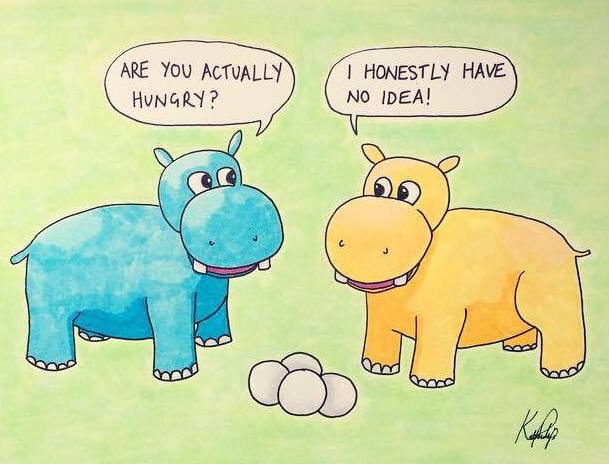
When it comes to games however, there are none I find more confusing than that classic joy of “Hungry hippos.” Are these hippos actually hungry, and if they are hungry, what exactly does that mean?

Multiple times during my life with an Eating Disorder, I have had people offer me bits of advice that they think will be the key to my recovery. One of the more common pieces of advice is that I should just “stop listening to the anorexia and eat when I am hungry”.
On paper, I suppose this is fairly sound advice. Eating disorders want to kill you whereas your natural body impulses are there to keep you alive, so it makes sense to listen to them. The problem is, when you have had an eating disorder you spend your life trying not to listen to them, and eventually the mutual understanding and connection you had with your body is diminished. Indeed, your disorder actually spends every day purposely trying to suppress all natural instincts that were built up during the cave man days so that it can be in charge of what food is consumed, how much and when. You don’t “eat when you’re hungry” as you are supposed to, rather you eat when, or if, you are allowed.

Obviously I know what it is like for the body to go without food. I am familiar with the light headed tingliness, head aches, dizziness, chills, fainting spells and the pains in ones’ abdomen that occur when your stomach hasn’t seen any tasty morsels for a while, but I am unsure as to at what point all of these feelings constitute “hunger”. Does hunger start from the moment your tummy utters its first inquisitive growl or is that just being “peckish?” Is hunger what you feel when you see a chocolate doughnut with rainbow sprinkles or is that just curiosity…or being peckish? What even is peckish? When does hunger become starving? Is ravenous worse than starving? WHAT DO ALL OF THESE WORDS MEAN?

I know some people will probably say that you can’t think of hunger in such rigid terms and it is more of a sliding scale, but I am just so confused as to how people know when to eat if it is a sliding scale and not a case of two opposites. If we all had little signs on our heads that flipped from “not hungry” to “hungry” when it was time to eat it wouldn’t be a problem, yet people seem to just understand their bodies in a way that is completely baffling to me. All of my meal times are rigidly planned out, I know it is time to eat by my eating disorder giving me a time and then I simply watch the clock. Is it time to eat? I don’t know, lets see if the little hand is on the right number and if it isn’t we will give it a few more hours.

My parents, aka people without eating disorders, do not have strict rules on dinner time and they are two of those mysterious people who I often observe knowing when to eat by knowing when they are hungry. It makes no sense. Sometimes my mum’s stomach will growl and she will say something like “I don’t know why it’s making that noise, I am not even hungry.” What? I thought a growling abdomen was the universal sign for hungry? Does it only mean that sometimes? At other times does it growl to test its abilities in lion impersonations? How do you know which is which? Some evenings my mum will ask my Dad if she should put on the dinner and he will say something like “in a bit, I’m not hungry yet”. I will then spend the next however many minutes watching him, and at some point, with no signal from any outside force and no noise from his stomach he will announce, “Ok, might as well put the tea on, I’m hungry now”. HOW DID HE KNOW THAT? When did the switch flip? When did “not quite hungry” become full on hungry in a way that needs to be satisfied? I was watching him closely the whole time and I saw nothing! Not a single rhino burst into the room wearing a sign declaring “Now is the time for food”, there were no fog horns, smoke signals and no morse code (I was watching him and listening very very closely).

Even in hospital settings, it is an alien concept to listen to your body and adhere to hunger cues. In every hospital I have ever been in, you know it is breakfast or lunch time because the clock tells you it is so. The nurses don’t rally up the patients, ask who is and who isn’t hungry and stagger the meal accordingly, it is just time to eat so you do. More than that, the clock tells you when to stop eating rather than you deciding that you are “no longer hungry”, and portions are equally dictated by how many ladles of pasta bake is on the nutrition guidelines rather than “how much you fancy”. You can’t even forget the “eat when you are hungry” bit and skip to the “stop when you are full”, because again in hospital, what your body feels has nothing to do with what you eat. When at home you may stop mid meal because you are no longer hungry, but in hospital your allocated portion has to be eaten, so you often have to keep eating rather than stop when you are full because the dietician and meal plan has stated that is so. Full of cottage pie and not “hungry” for apple crumble? Tough, nutritionists have stated that your body needs apple crumble for medical medicinal reasons so you are going to eat it anyway, and you simply listen to their hunger cues and portion sizes instead of your Eating Disorder’s or your body’s. Natural impulses and intuition have nothing to do with it.
I honestly cannot remember a time when I just ate a meal because I knew I was hungry or stopped because I was full, for years I have simply followed the instructions prescribed much as someone else might follow the instructions on the back of a packet of custard (sidenote: Isn’t custard awesome?!)

It is even the same for me when it comes to using the bathroom. Not to overwhelm you with “too much information”, but as much as I do not understand people knowing when to eat, I do not comprehend how they know when they need the bathroom. They say “when you need to go you go”, but when is need? Is it at the first sign that your bladder is a little on the full side or do you wait until you are so desperate that you are hopping from foot to foot like Michael Flatly performing the River Dance? Somewhere in between these two points? Cool…BUT WHERE? WHEN? Again my natural impulses haven’t been in control of that kind of thing for over a decade as it is my OCD/eating disorder that tells me when I am allowed to pee even if I may not feel the need. When it comes to following my body’s impulses then, I find it impossible not just because I have an eating disorder or OCD screaming in my head, but because I have lost sight of what those impulses are by forcing myself to ignore them for so long.

Perhaps I have just waffled on in an incomprehensible meandering mess in this blog and once again none of you have any idea what I am on about. In writing it I have definitely learnt how hard it is to explain something you cannot get your head round, much like it is trying to ask someone to explain something invisible like air or untouchable like a rainbow.
Still I hope I have at least explained in some sense yet another reason as to why recovery or living with an eating disorder is so hard, and not something you can get over by “just eating” like everyone else. Sometimes, even with the best of intentions you can want to “just eat” as other people do, deciding it is lunch time based on an intuitive flicker of the gut or portioning your roast potatoes out based on how many you think you can manage rather than how many are on your meal plan. Nevertheless, intentions or not, to me it still remains an unfathomable mystery of just how in the hell all these people do it.

Take care everyone x

Hippo

Why We Need To Keep Talking About Mental Health

Tomorrow is a very special day for this blog that you are oh so kindly reading in this moment (cheers for that), for tomorrow will mark the one year anniversary of Born Without Marbles being “a thing” on the internet as opposed to an idea in my head that I was too scared to carry out.
That means that I have been harping on about mental health, whether you have liked it or not, for an entire year, and I wouldn’t be surprised if there were people out there wondering why on earth I am still waffling on about illnesses that the majority of the population are well aware of by now.
Ok the general public may have misconceived ideas and perceptions as to what an illness may really be like, but everyone has a rough idea these days as to what things like OCD and Anorexia actually are, so why am I still talking about these things and why do I plan on continuing to talk about these things for the foreseeable future? Newton isn’t still harping on about the time that apple fell on his head (partly because Gravity is old news that doesn’t own the headlines these days and partly because he died in 1726 which somewhat limits his abilities to “harp on”), so why do I keep talking about what it is like to be mentally ill when the existence of mental illnesses is no longer breaking news. Well friends, whether you have been here from the beginning or whether this is your first experience of Born Without Marbles (Welcome. Please excuse the penguins I have left lying around in each post. They are kind of important), today I am going to answer that question and tell you why, even after a year of weekly waffling, I still feel that we all need to keep talking about mental health.

Of course there are all the obvious things like the fact that the more we talk about mental illness, the more research there will be and in turn the more likely we are to find a cure. To explain why I personally have such a passion for the subject however, I need to take you back to 2003, and, more specifically, eleven year old Katie (to set the scene I looked exactly the same as I do now only shorter).
As the name of this blog suggests, I can see that I have shown signs of mental illness from the moment I was born, but it was in 2003 that things really began to become a problem, that I became afraid and ashamed for the first time of the thoughts going on in my head. It was the first time that I didn’t feel normal, and feared that I was different from everyone else.

Every day at school I would watch other pupils in awe. I would see them eating school dinners, opening doors and shaking hands with each other as if it was the easiest thing in the world, and I would wonder how on earth they did it all. For some reason when I tried to open a door, I would find myself frozen in fear, unable to touch the handle as if someone was holding my arms behind my back. When I was in the queue for school dinners, my head was screaming at me to run away because I wasn’t allowed to eat, and no matter how hard I tried to concentrate in lessons about ox bow lakes, all I could see in my mind were images of terrible things happening to all the people I loved, and hear threats that the only way to stop those things happening was to repeat some kind of ritual. This would have been rubbish enough, but the worst bit was that I had no idea what this meant or why this was happening. I thought long and hard, trying to come up with an explanation but the whole thing made very little sense to me. What was so scary about the germs on a door handle when I had evidence all around me showing that nothing bad was happening to people “contaminated” with them? Why couldn’t I go to lunch, even on pasta days? Logically I knew that I loved pasta (pasta is flipping awesome), so why did the idea of eating a steaming bowlful topped with as much cheese as I could get away with before a disapproving dinner lady grasped my cheddar filled palm, scare me so much?
These things went on for months, and I said nothing to anyone because I was too afraid. Maybe mental health wasn’t as widely discussed in 2003 or maybe I was just unaware of what mental illnesses were, but I had never heard of anyone experiencing these things so I kept silent and hoped they would go away. Spoiler alert: they didn’t. Of all the awkward situations I found myself in however, there is one in particular that sticks in my mind and one that continues to motivate me and my dedication to this blog today.

“It” happened at the end of a music lesson. Now, in my school, music was taught in a separate building to all others, ditto art, drama, and DT who all had their own individual buildings (something tells me the staff members of the more creative subjects did not get on well…this explanation of the separate buildings certainly correlates with the time I saw the head of drama pelting the art teacher’s studio with water balloons anyway…)

On the day in which our story occurred, our class had been taken to a room on the top floor of the music building where there were a lot of computers and keyboards set up for us to spend a few hours learning how to play the theme tune from Titanic (a vital part to any eleven year old’s education). Then, the lesson ended and we were dismissed, a fact that meant we were going to have to leave the room and therefore, someone was going to have to open the door. Usually I was very good at avoiding such a responsibility, and at the end of every lesson I would fumble around with my bag until someone else had done the job so that I could scoot on after them without touching anything. This technique worked perfectly for every lesson, but today, for some reason, the teacher wanted us to lead out in single file from the nearest computer to the door. I think maybe someone had been messing about with a keyboard, playing Celine Dion’s soundtrack with a little too much gusto, so in the exit of the classroom, the teacher wanted to establish some serious authority. I felt sick. I was at the computer nearest the door. I was to be the first to leave, I was to lead my fellow students to freedom. I was to open the door. When I saw that it was a push door then, I was thrilled. Happily I nudged the door with my foot and led my classmates out, but the relief was short lived as I realised we were headed for another door, a pull one with a handle…AND AN EXIT CODE KEYPAD.
I thought about pausing in the corridor to let someone overtake but the corridor was too narrow, it was single file, there was no escape, and as I walked down the stair case to the door I genuinely felt like I was walking to the gallows. This was it. I was going to have to touch a door handle, and it was going to be the end of the world. When I reached the door I stopped. The time had come to raise my hand, but I couldn’t move. Instead, I just found myself stuck, panic building as the queue of students eager to go home started forming behind me. Luckily everyone was talking about the day too much to notice my embarrassing situation at first, but after a few minutes of standing in a line waiting, understandably, people started wondering what the hell was going on, and from the back of the line I heard a voice ask perfectly reasonably “is there something wrong with the door?” From then it went silent and all I could hear was the response in my head of “no actually, there is nothing wrong with the door, there is something wrong with me and I have no idea what it is”.

Eventually, after what felt like 34 years, the person behind me became impatient, reached around and opened the door, and from there I ran sobbing to the medical centre with shame, fear and embarrassment. I didn’t want to see anyone ever again, I had to hide, so I decided to take refuge in the sanitarium. When the nurse asked me what was wrong, I lied and told her that I had a tummy ache. I spent the rest of the day curled up on the sofa with a hot wheat bag watching episodes of the Simpsons, feeling more alone than I knew it was possible to feel. There were hundreds of other pupils in the school, but for some reason I was different, I couldn’t open doors or eat meals like they appeared to, and there was nobody, least of all me, who understood why.

It is for that Katie sitting on that sofa with that smelly hot wheat bag that I started this blog, and it is for all the smelly hot wheat bag holding people out there pretending to be fine, pretending to have tummy aches to cover up the fact they are terrified of their own minds and too scared to speak out for fear that other people won’t believe them, that I write this blog. Had I heard about mental health problems sooner, maybe I would have asked for support sooner, but what I would have found more helpful than any of the symptoms listed in the millions of health care packs, would have been the knowledge that there was at least someone out there who struggled with the same things, who let me know I wasn’t crazy, that I wasn’t alone. It is for that reason that, no matter how much awareness there is about the existence of mental illnesses, I will keep talking about my experiences with mental health problems in public spaces. This isn’t a blog to just give information, in my eyes, this blog is a friend, both to me, to the readers and to anyone out there who comments to say that they can relate to my problems and thus remind me once again that none of us are alone.

So happy birthday Born Without Marbles, and thank you from the bottom of my heart for all the support anyone reading this has ever provided. Here’s to another year, another 52 weeks of my ramblings, another 365 days of friendship.

Take care everyone x

MarblesBirthday

Are People With Mental Health Problems “Really Disabled”?

If you live in the UK and follow the news when it comes to anything mental health related, you will probably be aware of a certain Tory MP named George Freeman (not the guy who made grills. That was George Forman. He was so proud of his grills that he put his name on them don’t you know). Anyway, this Freeman bloke has been in the news a lot this past week, due to his recent comments regarding the rights of people with mental health problems claiming benefits.

Initially I wasn’t going to make a post about this, as thankfully a lot of people were angered by what he said on the issue, and therefore there have been many posts on the internet addressing why his opinions are so misguided. Having read a few of these posts I couldn’t help but think “well I don’t need to say anything about it because at least one other person has said it for me”, but then I realised that when a crowd of voices chant the same thing, it is a hell of a lot louder than any noise made by a single individual (unless that individual is armed with a giant and extremely powerful microphone…Alas, such things are often reserved for people with power who have no idea what they are talking about…ahem…)
I also wasn’t going to post about it because since his damaging comment, our old buddy George (again, not the one with the grills), has retracted all of the nonsense he has been spouting. Maybe then I should forgive the poor chap, as clearly he regrets his statements (or just realised that everybody hated him for being such an idiot and thus backed down on opinions he was so passionate about, to avoid being glared at in the streets…I guess we will never know…).
However the damaging comments made by Mr Freeman are unfortunately not anything new, nor any revelatory belief shared by nobody else before him. They are comments that a lot of the public have probably felt and said in private themselves, it’s just those people  didn’t have the microphones allowing everyone to hear. So I am writing this as much for them as it is for my buddy George (starting to wish I was referring to the other George as my buddy now…I could use a free grill.)

So what are these comments that have outraged so many and that are damaging to society’s view of those who suffer from mental health problems? Well, they are about people who are unable to work due to mental health problems claiming benefits, and how their payments should be stopped in order to save the money for the “really disabled”.
It is funny actually that this has come up at this time as it was just last week before this controversy started, that I filled out a form applying for benefits myself. For years therapists have encouraged me to fill out these forms and claim what they thought I was entitled to, yet I have always refused because even though I knew they were right, the thought of officially asking for support for being disabled made me feel incredibly guilty. I think over the years you cannot help but internalise some of the stigma lying around these days, just as if you tell someone enough times that they have a big nose they will eventually start to believe you even if their nose is the tiniest nose of all time.

Though I have always been aware of my inability to work, I have still felt an internal judgement and feel that maybe I am just being silly and that I am not “really disabled”.
A wheelchair user may not be able to open a door that is at the top of a flight of stairs because they are physically unable to walk. I however am physically able to walk up those stairs, yet still I am also unable to open that door. Physically I could, yet still, mentally, the fear is so strong that I can’t. Really the brain shouldn’t be viewed as any less “real” than your average limb as technically the organ of the brain is a physical part of the body as much as a leg is. Still I suppose it is a lot harder to remember that when it is hidden behind a thick skull and an “I am OK” mask, unlike a broken leg which is far more visible. If you can see a giant green face claiming to be the Wizard of Oz, it is infinitely easier to believe in that reality over the invisible little man controlling the illusion behind it (if your name is Dorothy at least. I saw through that Wizard all along. Dorothy was silly…and her little dog was too!).

This being the case then, my brain often being the cause of my inability to perform basic actions like feeding myself or opening doors, how is that not disabled? I don’t claim to be an expert in the English Language (although I did study english literature and I read Moby Dick which is a HUGE book with a lot of long words), but when you look at the definition of the term “disabled”, I think that it makes clear that George and those agreeing with his views do not really understand what the word means, hence their belief that someone with mental health problems is not “really disabled”. When you look it up, the dictionary states that to be disabled means to be a person who has a “physical or mental condition that limits their movements, senses or activities. So lets examine this:

1. Do I have a mental condition – Yes

2. Do these conditions limit my movements – Yes. I cannot open doors or move around in public without an aid supporting me through the anxiety, much like a wheelchair user may struggle to be mobile without their aid, aka the chair.

3. Do these conditions limit my activities – Considering I am often able to leave the house/partake in normal life, yes.

Yet according to certain MPs, I am not “really disabled”? I am sorry George, are you arguing with the dictionary? I totally support your right to free speech but are you sure you want to do that? It is a really big book (even bigger than Moby Dick), and if you start arguing with a dictionary then all the words in your argument technically lose all meaning and thus you will be making no sense…are you sure you want to do that George? Gibbering nonsense to a book would look awfully weird…people may start to think you were mentally ill!
If people without mental health problems are not “really disabled” then what are we? Just playing some sick game of dress up like I pretended to be a vet with my very own stethoscope when I was younger and made it my business to treat all of my teddy bears (rest assured, I may have been pretending then but I was very skilled and all my patients made full recoveries).

Tell me then, if I am unable to leave the house or touch things in public and spend most of my time fighting demons, a pastime that leaves me utterly exhausted and often a bit soggy with tears, what job would you recommend I try? What job would I be able to do effectively on the days that I am so depressed and suicidal that I cannot leave my house let alone contribute to society? Any ideas? The only job I could think of would be that of performer in a freak show, where people could come to my house and pay to see the hysterical sobbing mess in the corner who is so deluded they fear eating with a knife or fork. Is that what you want? (Even if that is the plan I would still need benefits anyway…If I have to be in a freak show I at least need a sequinned leotard. THOSE THINGS DON’T COME CHEAP FREEMAN.)

In a way, I suppose George being so vocal with his misguided opinions could turn out to be a good thing. Like I said, I am sure that he is by no means the only person who feels this way about people with mental health problems receiving benefits, and by speaking out about it, it has given us crazy folk an opportunity to respond publicly and tackle the stigma that before now has existed only in people’s homes behind closed doors. People make these statements all the time and are never challenged, yet now the words are out in the open, we have a public platform on which we can talk back and educate those who may not understand how debilitating mental health problems can be. Maybe we can use this as an opportunity to do good.

So here I am, standing on my public internet platform speaking into my megaphone as someone with mental health problems and for others with mental health problems. To Mr Freeman and all of his supporters, I have one thing to say.

*STEPS UP TO MEGAPHONE*

“As sufferers of mental health problems, I will admit that our disabilities may be invisible, but our struggles are real. The pain in our heads is real. Nobody is pretending, nobody is playing games and we honestly are, “really disabled”.

*DROPS MEGAPHONE AND STORMS OFF PUBLIC PLATFORM LIKE A BOSS*

Take care everyone x

georgefreeman

The Difficulty Of Dating When You Have A Mental Health Problem

If you have walked into any shops or restaurants in the past few weeks, you may have noticed a lot of brightly coloured hearts in various shades of fuchsia splashed about all over the place. Cards with hearts on, posters with hearts on, even giant teddy bears holding hearts (which is biologically confusing as without the heart how is the bear able to breathe and thus hold the heart at all…unless he is holding someone else’s heart in which case that is pretty damn sinister if you ask me). Funnily enough this is not because February is a month in which humans feel the need to celebrate the life giving aortic pump caged within our ribs (or in the hands of a rather terrifying and possibly murderous teddy bear), all this heart shaped nonsense is because tomorrow is Valentine’s day. Personally I have never understood why you should need a holiday to remind you to let your partner know that you love them, but I suppose it is better to have a day dedicated to love than something horrible like punching puppies in the face. Nevertheless, I still find it quite a difficult holiday as it is one that reminds me all too loudly of the detrimental effect my mental health has on my love life.

To sum up my current “love life” I guess you could simply say that it is non existent and has been this way for several years. During my life, in times in which my mental health has been better, I have somehow managed to have two “proper” relationships thus far, both of which it can be argued ended either because my mental health problems were actively getting worse or because they simply became too overwhelming for my partner (which was totally understandable in both situations.)
I guess in a way it is good that the main reason for both of my relationships collapsing is centred around an illness because at least an illness can be cured and could potentially disappear one day. Had the problem been a weird habit of belting out ABBA’s greatest hits in my sleep, that would perhaps be more frustrating, as to my knowledge there is no cure for that kind of thing. When it comes to OCD, depression and anorexia however, I know there are people who have got better and hopefully one day I will be able to count myself among them.
Truthfully though, I cannot see that happening. I would love it if it did and I will never stop working towards that goal, but realistically the chances are pretty slim, and even professionals have admitted that I am going to struggle with my illnesses for the rest of my life, maybe not to the same extent as I do now, yet chances are they will always be there. Assuming these predictions are right then, any relationship I ever have is going to involve my mental health problems having some kind of an impact, and that is the kind of thing that inspires the classic “I am going to die alone” worry considering my mental health problems have been the destruction of all former attempts at having a partner. I can’t even do what most people who fear this do and resign myself to the identity of being a “crazy cat person” because I don’t think I could handle four little paws spreading potential bacteria around my house let alone a whole litter’s worth… What back up is there to the “crazy cat person” back up plan? The only option is to be simply “the crazy” person…That doesn’t sound fun…

I think relationships are actually one of the biggest struggles faced by people with mental health problems but it is a struggle people rarely talk about because admittedly it feels a little embarrassing. Nevertheless, it is because nobody really talks about it that I think it is so important to talk about it. If I struggle with and worry about this kind of thing whilst feeling totally alone in it, amongst other people my age who are doing things like getting married and giving birth, then there is a high chance that there are other crazy people out there who feel the same and need to know that it isn’t abnormal. Indeed, I think the impact mental health can have on relationships is seriously under reported. The instability of my mood, the inability to touch most things, the compulsion to clean obsessively, body image issues blocking the way to physical intimacy, trust me, the list of obstacles in my way is endless, and those are the problems you face when you have actually managed to get into a relationship in the first place.

Nowadays before you can even get to that stage you have to go through the terrifying minefield that is otherwise known as “dating”. I know that a lot of my friends have been on these “dates”, but mental health wise I cannot get my head around the idea. For one thing, where are they meeting all these people with whom they go on dates?
Usually people come into contact with potential romantic entanglements during social events or hobbies, but because of my mental health I am rarely at social events and my only hobbies are things like repeatedly tapping doorhandles which is a relatively solitary pass time. The only places I tend to go regularly when I leave the house are therapy appointments, so the only people I meet are mental health professionals, and I think it is pretty frowned upon to start dating your psychologist.

Considering we are currently in the age of internet dating you may think that my lack of social skills in real life are no longer an issue as I could easily meet someone on one of these websites like match.com or an app like “Tinder” (WHAT THE HELL IS TINDER. Everyone has it and from what I gather it is just a lot of swiping…what are we swiping…where are things going when we swipe them out of view…should I want to be swiped? WHAT IS GOING ON).
Thing is, though I have never been on any of these websites myself, from what I gather they involve putting pictures of yourself online as well as a brief description of your personality. A brief description of my personality? What the hell can I write there? “Totally bonkers”? Who would look at that and think “well I want to spend the rest of my life with that insane creature”. Of course I could easily lie and write something like “I am a totally sane and calm human who is not crazy at all and likes long walks on the beach” (massive lie. I HATE the beach), but that seems far too much like false advertising. Ok, people false advertise in adverts all the time (like with that mermaid Barbie I wanted when I was 7…she wasn’t a real mermaid! I threw her in the bath and she didn’t even float let alone swim. What kind of mermaid sinks? LIES I SAY), yet despite its acceptability in general life the idea of putting myself online without mentioning my mental health issues isn’t just false advertising, rather it is dishonest. The truth is that at the moment there is no aspect of me that does not involve some kind of mental health complication, and were I to ever get into a relationship again, that would be something that I would have to be open about from the start.

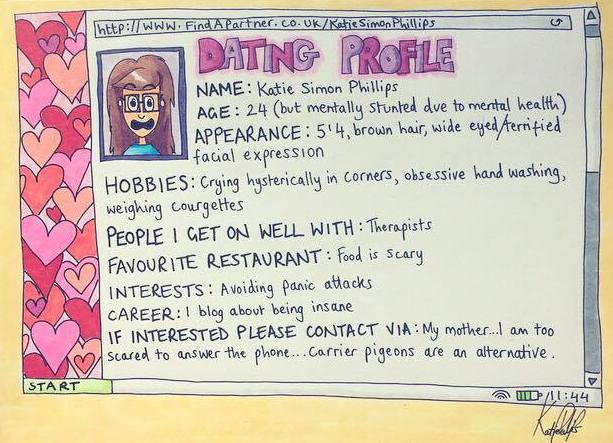
Then even if you have mental health problems and manage to somehow get a date with your restricted daily schedule and unattractively marble free online profile, how the hell do you actually go on the date you somehow acquired? Usually a date will include something like a meal, but with my eating disorder a meal out is basically impossible and in terms of OCD any other activity like bowling is ruled out too. YOU CAN’T BOWL IF YOU ARE UNABLE TO TOUCH THE BALLS. Then there are the obvious issues caused by general anxiety, social anxiety and depression making everything more complicated, as well as OCD worries like the fact I wouldn’t be able to hold open a door for anyone which would look very rude, and that isn’t getting into the inability to hold someone’s hand or touch their skin without panicking. How can you advertise all that on an online dating profile or ask someone on a date in that situation? “Hi, my name is Katie, I would love to go on a date with you…but there can be no food involved or if there is food I will just have to watch you eat…also we can’t do any activity that involves touching objects in public or each other…and I need you to be aware that I might cry at random moments without warning…yeah…thats about it…CALL ME!..but not on my phone…phones are scary…CONTACT MY MOTHER.”

Maybe I am panicking a little too much about all this as I know everyone worries about the whole “dying alone” thing, but I have to say that with mental health problems the whole dating world and romantic stuff does get a lot more complicated. If I put on my optimist’s hat (it is purple with a penguin on), I like to think that in the end I will read this post back one day with my future wife and laugh at what a fuss I made worrying about something that really will be ok in the end.
Reading this back I now realise that I haven’t actually given helpful or constructive advice on how to date or manage a relationship with mental health problems. Instead I have simply splurged my anxieties all over you (apologies for splurging), but I hope that I have started some kind of discussion or raised some awareness as to the impact mental health problems can have on one’s love life. Right now I don’t think I am qualified to give any romance advice anyway, yet if ever I find myself able to manage the dating world rather than panic at the thought, any tips I do learn will be passed on to you. For now at least I have helped my fellow relationship worriers out there know that they are not alone and not a freak for being unable to go on Tinder or go on dates and have fun like everyone else this Valentine’s day.
Even though none of you are my other halves I still send each and every one of you a lot of love this Valentine’s day and every day of the year…You can thank me by getting me a date with Helena Bonham Carter, or at least getting her to call me (and by me, I mean my mother).

Take care everyone x

datingmhproblems

10 Ways To Support Someone With An Eating Disorder

Living with an eating disorder is hell, but I think it is underestimated just how horrendous it can be for the people living with people who have eating disorders. I know many parents, families, partners and friends tend to feel pretty hopeless when watching someone they love slowly drowning, without knowing how to stop it. Almost every day my mum will ask me what she can do to help, like there is some problem solving action she can perform as easily as changing a lightbulb.
I know for a fact that if there were an action she could carry out, my mum would do it in an instant no matter how inconvenient or unpleasant (I think she would even play Pictionary and she HATES Pictionary…weirdo). Unfortunately, eating disorders don’t have quick solutions and no matter how much a loved one wants to help, they cannot fix the problem. They can however support the person, and often these little offerings of support are nowhere near as dramatic as people seem to think. Supporting someone with an eating disorder doesn’t require grand complicated acts of kindness, often you can support someone with little things that don’t take much time or effort at all. So today, I am going to share with you a list of things that I find help me at home aka 10 simple ways you can help someone with an eating disorder.

1. Don’t get angry with the person, get angry with their disorder – When you have an eating disorder in the house/in any relationship, you can guarantee it is going to cause some conflict. I have lost count of the number of arguments I have had with my mum with regard to eating disorder issues like what I am eating for dinner. I honestly don’t think we have ever had an argument about anything that wasn’t mental health related (bar one argument we had in 2002 because she wanted Will Young to win Pop Idol when I was firmly on the side of Gareth Gates. I would like it noted that I can now lift my hands up and admit I was wrong on that one). Just yesterday I am ashamed to say I had an argument with my mother and yelled at her for about half an hour because she tried to help, and unknowingly put my kidney beans in the “wrong pan”.
Afterwards I felt incredibly guilty/like the worst person in the world. This guilt would have eaten me up and is the kind of thing that makes me feel that I don’t deserve food, but after we had all calmed down and I had apologised, what I found helpful is the fact that my mum made it clear that she understood that I hadn’t meant to yell about a bean pan. She knew it had just been the eating disorder taking control, and though I need to work on managing that myself, the acknowledgement that I wasn’t this terrible person who worried more about what pan my beans were in than my mother’s kind attempt at assistance, made me feel more able to continue with the meal.

2. If you are eating with someone with an eating disorder, keep them distracted and don’t make the food the sole focus of the experience – Meal times with someone with an eating disorder are not the most relaxing of situations and can be pretty intense (like one of those awkward dinner parties you see on Come Dine with me only less bitchy and without a voiceover man commenting on every little thing that occurs). For this reason, when I have to eat a meal with someone, I find it really helpful for them to help keep me distracted and not make it all about the food. Silence allows thoughts to creep in at the table, so I would recommend conversation if the person is able or, if they are unable (sometimes I cannot talk very much/think of words because I am so anxious), have the radio on in the background or play a game. Sometimes in hospital we would even do things like crosswords or little quizzes which really helped keep your mind occupied by working on something else (my favourite thing about this was that when there were bank staff they would go through the pile of quiz questions without realising which ones we had already done so we were all able to provide correct answers instantly and looked like geniuses.)

3. Allow them to take baby steps in their recovery rather than expecting miracles overnight – When people are in recovery from any mental health problem, there is often a lot of pressure for progress to be quick so that the problem can be solved and forgotten about as soon as possible. However, recovery is a very slow process and this pressure is often detrimental as it can make a sufferer more anxious and stressed. To help someone who is struggling, allow them to make progress at a steady pace they are comfortable with rather than forcing them to make dramatic changes which ultimately will not be sustainable.

4. Praise them…or don’t praise them at all – I have many friends who appreciate a little “well done” or similar nudge of encouragement after a meal to make them feel supported and like their hard work hasn’t gone unnoticed, so offering those words of praise can be a great way to support a loved one. That said, I know there are others, (me included) who actually find this more unhelpful, as they like to leave the table and forget everything rather than acknowledge the meal that has just been consumed. Denial may not be the best way to deal with mealtimes, but at the moment denial is how I cope, so I am helped by nobody commenting on how fantastic it is that I have cleared my plate. For this one then, maybe ask the person you are supporting to see whether praise would be helpful to them before whipping out the party poppers to celebrate an empty bowl of cereal.

5. Try to be as relaxed as possible at the dinner table – When I sit at the table, I am always anxious, and when I can see that other people are anxious, it makes me more anxious. This then makes them more anxious and before you know we are left with a table of people panicking about a meal that hasn’t even happened yet. For this reason when supporting someone at a meal time, if possible try to be calm and relaxed to show that the situation isn’t anything to be afraid of, rather than freaking  yourself out and condoning the “THE TABLE IS A SCARY PLACE” fear.

6. Seek support for yourself – People with eating disorders need support and so do the people around them. As important as it is for carers to have an outlet somewhere to discuss their concerns and worries though, it is helpful to make that outlet someone other than the person who is struggling. When you feel that you are a terrible person who is ruining everyone’s lives because you cant eat normally, emotional outpourings condoning that are only going to make things worse. Ultimately then for this one, support someone by finding support and seeking help for yourself too.

7. Keep diet talk to a minimum if you are on a diet – Obviously when you have an eating disorder, people being on diets can be rather triggering. That said you cannot dictate that nobody who lives with someone who is struggling is allowed to have any say in what they eat. Naturally we all have needs and some people may be prescribed special diets from a doctor which of course they should follow. If this is the case however, the best way to help the sufferer manage the situation is to not make a song and dance about it (aka no conga lines for the fact you have switched to low fat yoghurt and if possible none of those “I LOST THREE STONE” certificates which diet clubs award people plastered all over the fridge).

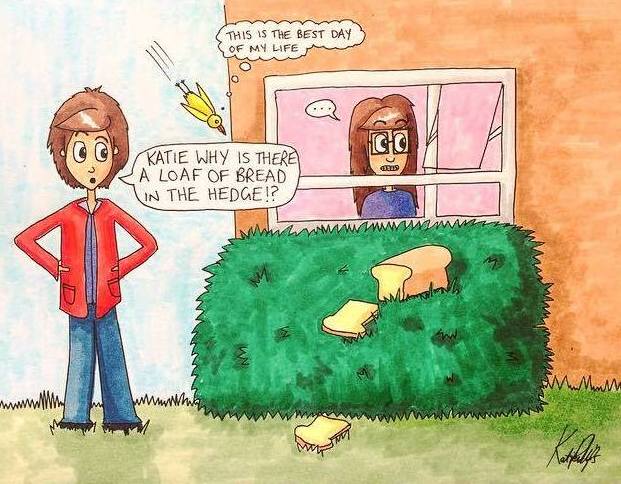
8. Know their meal plan – Again this one depends from sufferer to sufferer but personally I find it helpful when those around me know what is on and what is expected of me in my meal plan as it makes me accountable in some way. Obviously the goal is to get to a point where I don’t need people to know what I should be eating and am able to be responsible myself, but right now my mum having a copy of my meal plan supports me every day. That way, when I am struggling and want to miss things out, I know that it is not a case of “nobody will notice so just throw the bread out of the window” as my mum would immediately wonder where the soft wholemeal has gone (and why there is half a loaf of Hovis stuck in the garden hedge)…

9. Don’t treat them like a disorder – When people see or think of me, I always feel they think of me as “the one with the eating disorder” and that I have no other identifiers to me as a person. It is therefore helpful when living with someone with an ED, to treat them as a normal person with other interests and hobbies so as to remind them that they are more than their disorder and will ultimately still have an identity left, even when the disorder is gone.

10. Do not comment on their meal plan or their body weight – This last one is probably fairly obvious but nevertheless very important so I had to include it. Whatever you do and if you only follow one of these tips as to how to support a loved one, make it this one and for the love of all that is holy NEVER comment on how much weight someone has gained on their recovery meal plan and NEVER comment on how big someone’s meal is. Eating disorder recovery meal plans may look totally normal but there are some that may perhaps be bigger than normal. Whatever the meal plan though, the person will need all the food prescribed to treat their malnourished body and repair all of the damage that has been done internally. If someone is soldiering through their meal plan trying to reassure themselves of this, the last thing they need is a comment like “blimey that is a lot of food, I couldn’t eat that”. Hand on heart a bank HCA in hospital with no experience in eating disorders sat next to me one meal time and after I had finished my main/was picking a spoon up to dive into my rhubarb crumble with custard, they commented “I don’t know how you can eat that. My main course was half the size of yours and I am already too full to eat another bite”…THAT IS NOT HELPFUL INFORMATION.

So there you have it, ten ways in which family/friends can support people with eating disorders (at least in my experience), without actually having to do much at all. Being desperate to help a loved one and wanting to support them doesn’t have to be carried out in dramatic acts like white water rafting or playing Pictionary, Sometimes all you need do to be the most helpful and make the biggest difference, is the little things like asking them for help with a crossword over their cornflakes or giving an encouraging nod at lunchtime.

Take care everyone x

supportsomeonewithed